
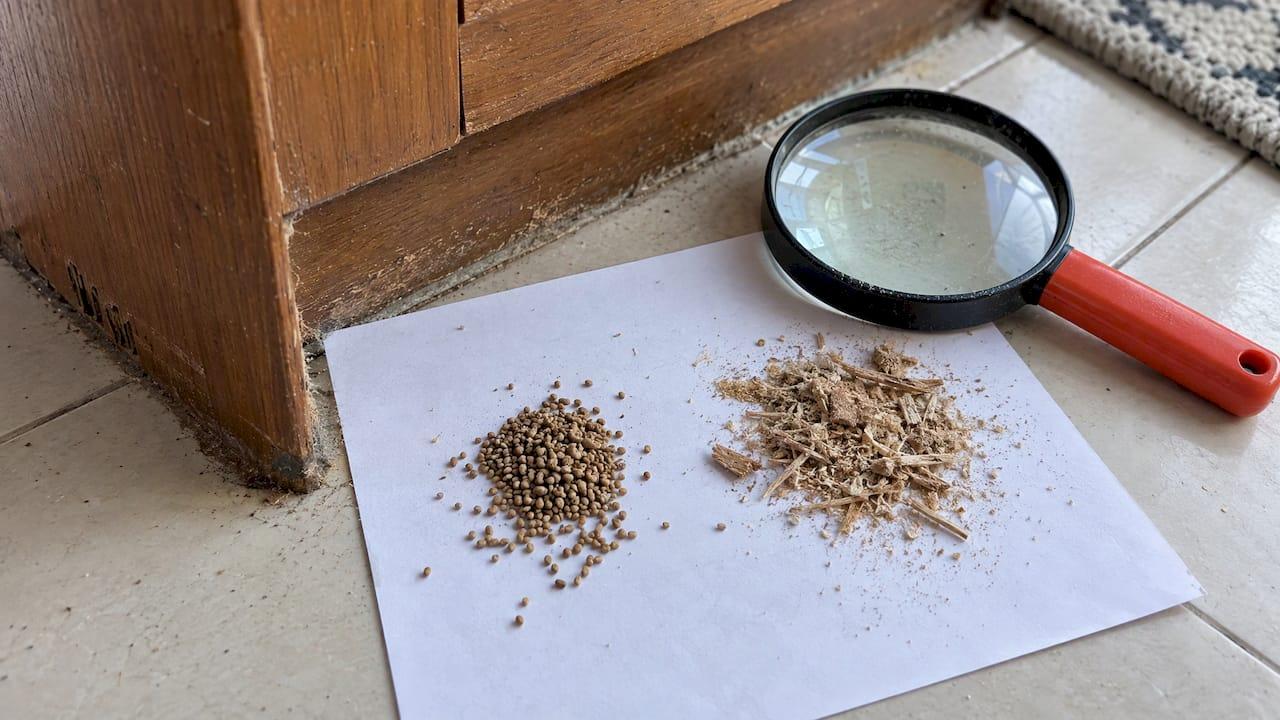
Termite droppings, called frass, are tiny, hard, uniform pellets. Sawdust is soft, fluffy and irregular. If you find a small pile of grainy, sand-like material beneath a piece of wood, look at it closely. Pellets with a consistent shape that keep reappearing in the same spot point to drywood termites. Loose dust with no pattern usually has another cause, such as carpentry work, a wood-boring beetle or ordinary wear.
This guide explains how to tell the two apart, what the wood dust from termites usually looks like in Singapore homes, and what to do once you have a pile in front of you.
TL;DR
- Termite frass is made of tiny, dry pellets of fairly uniform size. Sawdust is fluffy, uneven and often contains splinters.
- Drywood termites push frass out of small holes in the timber, so it collects in neat mounds below furniture, frames and fittings.
- Subterranean termites rarely leave pellet piles. Their main signs are mud tubes, hollow-sounding timber and swarmers.
- Fine, powdery dust from a wood-boring beetle can look like termite frass. A professional inspection settles the question.
- Do not sweep the pile away. Photograph it, collect a sample, and call a licensed pest control company.
Table of Contents
- What termite droppings are
- Termite droppings vs sawdust: the key differences
- What wood dust from termites looks like in practice
- Drywood and subterranean termites leave different signs
- Does sawdust attract termites?
- What to do if you find a suspicious pile
- What treatment involves
- Our perspective
- Get the pile identified by a licensed team
- Prevention: make your home less inviting
- FAQ
- Sources
What termite droppings are
Termites eat cellulose, the main structural material in wood. What passes through them is a dry waste, and drywood termites keep their galleries tidy by pushing it out through tiny openings. That waste is frass.
The droppings are the clue homeowners most often find first. In Singapore, a July 2026 AsiaOne report on a condo with a drywood termite problem explained why. Drywood colonies live deep inside wooden furniture and fittings, can grow for years without detection, and are often noticed only when sand-like droppings or flying termites appear.
That is also why the question "is this sawdust?" matters. The pile on the floor may be the only visible sign of a colony that has been active inside the timber for a long time.

Termite droppings vs sawdust: the key differences
Sawdust is what a saw, drill or sander leaves behind. Frass is a waste product. That difference in origin shows up in five features you can check without any tools.
| Feature | Termite frass (drywood) | Sawdust or ordinary wood dust |
|---|---|---|
| Shape | Small, hard, uniform pellets, often with ridged sides | Irregular fragments, fibres and fine powder |
| Size | Very consistent, about the size of a grain of sand or a poppy seed | Varies from powder to visible splinters |
| Texture | Dry, hard, granular. It runs like coarse sand when tipped | Soft, fluffy, clings together and smears on your fingers |
| Colour | Tan to dark brown, usually close to the colour of the wood being eaten, and uniform in one pile | Matches the wood, but with mixed shades and pale flecks |
| Pattern | Small mounds under tiny holes, recurring after you clean | Scattered or in a layer, with no source hole, and does not return |
No single row proves the diagnosis. Take them together. A pile that is uniform in shape, hard, granular and reappearing under a pin-sized hole is far more likely to be frass.
Shape and size
Place a pinch on white paper and look at it with a magnifying glass or your phone's camera zoomed in. Frass pellets are tiny and nearly identical to each other. Many are slightly elongated with rounded ends and shallow ridges along the sides. Sawdust shows no such repeating unit. You will see fibres, shards and powder in many sizes.
Texture
Rub a little between your fingers. Frass feels gritty, like fine sand, and does not smear. Sawdust feels soft and often forms small clumps. If the material breaks into a fine powder under pressure, it is more likely sawdust or beetle dust than pellets.
Colour
Frass takes its colour from the wood the colony is eating. It can range from pale tan to dark brown, and a single pile tends to be one consistent shade. Over time, old frass can darken. Sawdust is a mixture of heartwood, sapwood and bark, so shades often vary within one pile.
Where it lands
This is the clue that settles most cases. Drywood termites keep a tidy gallery by expelling waste through small kick-out holes. The frass falls in neat cones or mounds directly below. You will often find them under:
- wardrobes, kitchen cabinets and built-in joinery
- door frames, window frames and skirting
- timber furniture legs and the underside of tables
- roof timbers and the edge of false ceilings
- picture frames and wooden decor
Sawdust from carpentry or renovation is spread across a work area. If nobody has cut, drilled or sanded anything nearby, the case for termites grows stronger.
What wood dust from termites looks like in practice
People search for "wood dust from termites" because the pile does not always look like the textbook photograph. Three things can change its look.

Old or crushed frass. Pellets that have sat for weeks, been walked on or been wiped away can break down into a fine, gritty dust. Look at the edges of the pile, where intact pellets usually remain.
Mixed debris. Frass can mingle with ordinary household dust, shed wings or wood fragments. Sort a sample on white paper and look for the repeating pellet shape.
Different kinds of wood. Dense timbers and soft timbers give different colours and sizes. Do not rule out termites because the colour does not match a photo you saw online.
Not every dust pile is termites. Powderpost beetles also eat timber and leave very fine powder. We cover the difference in our guide on powderpost beetle vs termite. In short, beetle dust is a flour-like powder that often packs into the tunnels, while termite frass is made of distinct pellets. If beetles turn out to be the cause, the treatment is different, and our page on powderpost beetle treatment explains why borates feature heavily.
Drywood and subterranean termites leave different signs
A large part of the confusion comes from assuming all termites behave alike. In Singapore, two groups matter most for homeowners, and they leave very different traces.
Drywood termites: pellets and kick-out holes
Drywood termites live entirely in the timber they eat and do not need contact with soil. That is why they turn up in furniture, door frames and cabinets, including in high-rise homes. Their characteristic signs are:
- piles of frass below small holes
- hollow or papery sounds when you tap the wood
- blistered or rippled surfaces on veneers and laminates
- swarmers or discarded wings near windows and lights
Subterranean termites: mud tubes, not pellets
Subterranean termites nest in soil and travel to the wood they feed on. They protect themselves by building mud tubes along walls, slabs and pipes. They generally do not expel pellet piles in the open, so a pile of pellets is less likely to be from them. The signs to look for are:
- thin mud tubes running up walls, around door frames or along skirting
- timber that sounds hollow and crumbles to reveal soil-streaked galleries
- flying termites after rain
- damaged paper, books or cardboard stored near the ground
The seasonal pattern matters here. Our article on termite swarm season in Singapore explains why swarms often follow storms and what to do when they appear. Finding subterranean activity can also be slow. A Singapore study on detection of subterranean termites with in-ground stations found that stations took anywhere from 1 to 24 weeks to register activity. That is a reminder that a quiet garden does not mean a clear one, and that structured inspection beats guessing.
For a full rundown of the species, photos and how thermal checks fit in, read our guide to the six termite species in Singapore.
Does sawdust attract termites?
No, not in the way people usually fear. Termites are drawn to sound or damp timber, moisture and a protected route to it. A small pile of sawdust is not a lure. What matters is what is around it:
- If there is no source for the dust, and it keeps returning, treat it as a possible frass pile, not as something that attracted termites.
- If the dust comes from your own woodwork, keep offcuts, sawdust and timber scraps away from the ground floor and from wall edges. Damp debris holds moisture, shelters other pests and can help hide early signs.
- If you are storing firewood, cardboard or timber offcuts near the house, move them away from walls. Subterranean termites can use stored wood as a feeding point close to the building.
In short, sawdust does not cause an infestation, but a pile you cannot explain deserves a closer look.
What to do if you find a suspicious pile
Work through these steps in order. They take about ten minutes and give an inspector what they need.
- Do not vacuum or sweep it away yet. Photograph the pile from above and from the side, with a coin or ruler for scale.
- Collect a small sample in a clean zip bag or a small container. Keep it dry.
- Look up. Check the timber above for pin-sized holes, blistering or cracks. Mark the spot with a sticky note.
- Clean the area and watch it. Wipe the surface, then check it every few days. Fresh pellets that reappear point to an active colony.
- Tap nearby timber with a screwdriver handle. A hollow or papery sound suggests galleries inside.
- Check the neighbouring units of furniture. Drywood colonies can occupy several pieces at once, especially built-in joinery that shares panels.
- Book a licensed inspection. Send your photos in advance. This speeds up the first visit.
Spraying a household insecticide at the holes is not a fix. It can scatter the colony into other timber and removes the evidence an inspector needs. If you want to understand when a self-managed approach has limits, our comparison of DIY vs professional pest control in Singapore walks through the decision.
What treatment involves
The right treatment depends on the species, where the colony sits and how far the damage has spread. Drywood infestations are contained in the timber, so treatment is aimed at the affected pieces. Subterranean colonies need the nest, or the foraging network, addressed, along with barriers and monitoring.
In practice, we see three common routes:
- Targeted treatment of infested timber, for example injection or localised treatment where the galleries are reachable.
- Whole-structure or whole-room approaches, such as fumigation, when infestations are widespread or spread across inaccessible joinery. See our fumigation services in Singapore.
- Soil and perimeter measures with monitoring, which suit subterranean termites. Our overview of NEA-registered subterranean termite control explains this process.
Some cases are harder. The AsiaOne report mentioned above describes homeowners in new condominiums who were told that heat treatment and pesticides did not fully solve drywood infestations, and that removing affected cabinets was the best solution. Where cabinetry is heavily damaged, replacing it can be the sensible outcome, and the choice of replacement timber matters. Some furniture makers explain why they use kiln-dried wood at 6–8% moisture, which is useful background when you are choosing new pieces. After replacement, ask your pest control provider to inspect adjacent timber so the new pieces do not sit beside an active colony.
Our perspective
Most homeowners who call us about "sawdust" are right to worry. Many piles turn out to be frass, and the colony behind them has usually been active for a long time before anyone sees a trace.
We start every inspection by identifying the pest, not by choosing a product. Frass, mud tubes, beetle dust and renovation debris each point to a different cause and a different plan. Our technicians are NEA-licensed, and we use thermal imaging to look inside timber and walls without cutting into them, so we can locate the activity and decide where to treat.
Our approach rests on integrated pest management. We use non-toxic, environmentally safe methods that prioritize the safety of people and pets, and we combine treatment with advice on moisture, storage and proofing so the problem does not return. Termites are one of the pests we have handled for more than 30 years, along with rodents, bedbugs, cockroaches, mosquitoes and birds.
If you have a pile you cannot explain, send us a photo. We would rather identify it early than treat it late.
Bespoke-Enviro Services
Get the pile identified by a licensed team
If you have found pellets, dust or kick-out holes, our team can inspect the area, identify the pest and recommend a treatment plan for your home, office or site. We are available 24/7 and work with homeowners, business owners, property managers and construction sites across Singapore. Our termite control and treatment service covers inspection, identification and treatment, and we do not publish a fixed price because each case depends on the species and the extent of the infestation.

If you want an overview of everything we handle, visit Bespoke Enviro Services or read the general pest control services page.
Prevention: make your home less inviting
You cannot make timber termite-proof, but you can reduce the chances and make early detection easier.
- Fix leaks and damp spots. Moisture around bathrooms, kitchens and window frames helps termites and wood-boring beetles.
- Keep timber off the ground. Do not stack wood, cardboard or paper against walls.
- Ventilate storage areas. Cabinets under sinks and wardrobes against exterior walls are common trouble spots.
- Inspect when you clean. Look under and behind wooden furniture, and at the lower edges of doors and skirting, every few months.
- Check new furniture and fittings. Look for pin-sized holes or fine dust before you accept delivery, and again during the first months.
- Book periodic inspections. Homes with a history of termites, older timber or built-in joinery benefit from regular checks.
For wood-boring beetles that leave similar dust, see wood borer treatment in Singapore.
FAQ
What does termite frass look like?
Termite frass looks like a small heap of tiny, hard, granular pellets, similar in size to sand or poppy seeds. The pellets are uniform in shape and one colour, from pale tan to dark brown. They collect in cones under small holes in infested timber.
Can I tell termite droppings from sawdust without a microscope?
Yes, in most cases. Tip a pinch onto white paper and use your phone's zoom. Frass shows repeating, identical pellets and feels gritty. Sawdust shows irregular fibres and feels soft. Where the pile sits, and whether it returns after cleaning, adds strong evidence.
Do subterranean termites leave droppings?
Not in the open as a rule. Subterranean termites are better known for mud tubes on walls and slabs, hollowed timber and flying swarms. A pellet pile under a hole in furniture points more often to drywood termites.
Is termite frass harmful to people or pets?
Frass is not a poison, but dust can irritate some people, especially those with allergies or asthma. Avoid sweeping it dry into the air. Use a damp cloth, and ask a doctor for advice if someone in your home develops breathing problems or skin irritation.
Will sawdust attract termites to my home?
A small pile of sawdust does not attract termites on its own. The real risks are damp timber, stored wood or cardboard near walls, and gaps that give termites access. If you see dust with no clear source, have it checked.
Sources
- Tre Ver condo grapples with termite trouble; property giant UOL helping residents (AsiaOne, 27 July 2026)
- Detection and control of subterranean termites using in-ground stations in Singapore
- Protect your furniture: buy kiln-dried wood at 6–8% moisture