
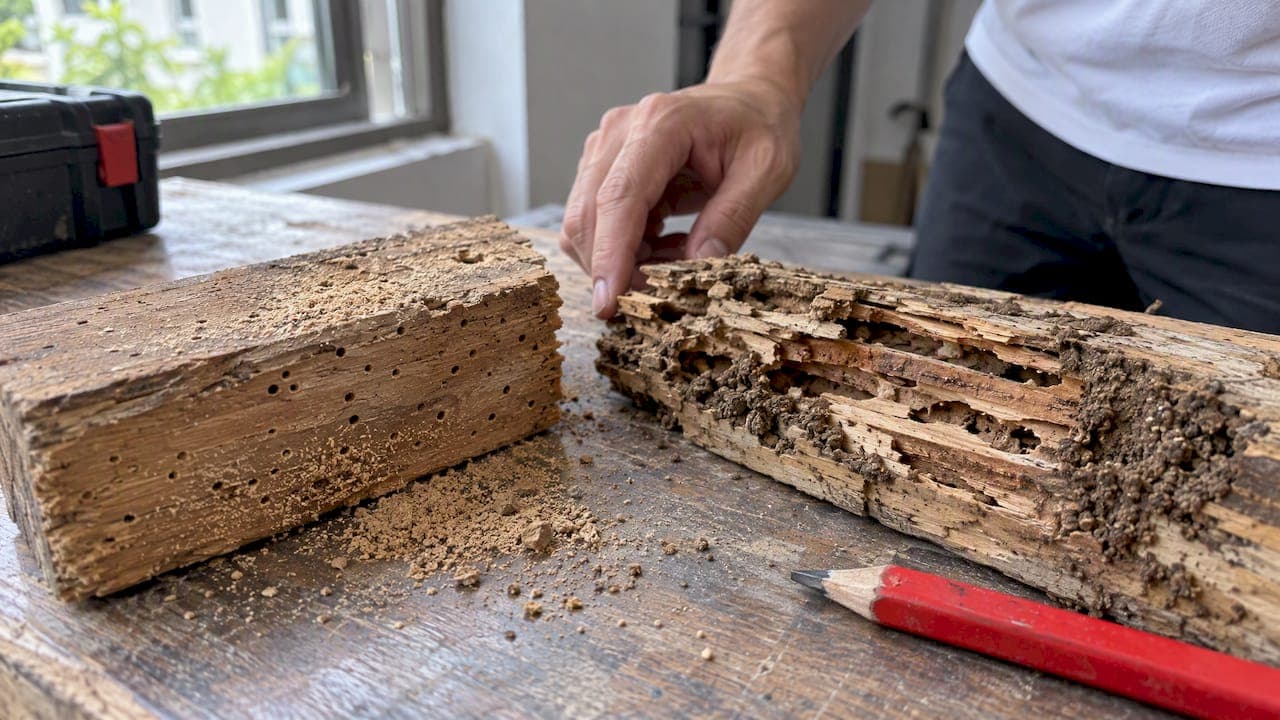
Powderpost beetles and termites both destroy wood, but they leave different evidence. Powderpost beetles leave small, round exit holes and fine, flour-like powder. Termites leave mud tubes, blistered or hollowed timber, and, in the case of drywood termites, small hard pellets. Telling them apart matters because the treatment for each is different, and treating the wrong pest lets the real one keep feeding.
This guide shows you what to look for in a Singapore home, how to check whether an infestation is still active, and when to call a licensed professional.
TL;DR
- Powderpost beetle: tiny round holes and fine powder that feels like flour or talc. The pest is usually in furniture, flooring, panelling or bamboo.
- Termite: mud tubes, hollow-sounding or papery timber, and (for drywood termites) larger granular pellets with ridged sides.
- Active or old: clear the powder, mark or seal the holes, and check again. Fresh powder or new holes means the infestation is active.
- Treatment differs: beetles and termites need different methods, so a wrong identification can leave the colony alive.
- Next step: photograph the signs and book an inspection by an NEA-licensed operator.
Table of Contents
- Powderpost beetle vs termite at a glance
- What powderpost beetles are
- What termites are
- Signs side by side
- Is the infestation still active?
- How the damage compares
- Why the difference changes the treatment
- Our perspective
- Preventing both pests in a Singapore home
- When to call a professional
- How we can help
- FAQ
- Sources
Powderpost beetle vs termite at a glance
The table below summarizes the signs most homeowners notice first.
| Feature | Powderpost beetle | Termite |
|---|---|---|
| Type of insect | Small wood-boring beetle; the larvae do the damage | Social insect living in colonies |
| Exit holes | Small, round "shot holes" in the surface | Usually none; damage often hidden |
| Debris | Very fine, flour-like powder (frass) | Mud tubes (subterranean); hard pellets (drywood) |
| Wood affected | Seasoned or newly processed hardwood and bamboo, rich in starch | Structural timber, furniture, paper, books, even non-wood materials |
| Typical clue | Powder under furniture, holes in timber | Mud tubes, swarming winged adults, hollow-sounding wood |
| Adults seen | Small beetles, sometimes on windowsills | Winged swarmers near lights after rain |
These are general patterns. Some signs overlap, which is why a physical inspection is worth more than a photo comparison.
What powderpost beetles are
"Powderpost beetle" covers several species of small beetles, roughly 1/8 to 3/4 inch long, that reduce wood to a flour-like powder. The adults lay eggs in cracks and pores of the wood. The grub-like larvae then tunnel inside, and the tunneling and development take place entirely below the surface. That is why the first sign is often not an insect at all, but powder and small holes.
True powderpost beetles (the Lyctinae) produce a fine, dust-like frass that feels like baking flour or talcum powder. Related bostrichid beetles can also turn bamboo and sapwood timber into powder, as research on household insect pests notes.
What attracts powderpost beetles to wood
The main attractant is the wood itself. Powderpost beetles usually attack newly processed hardwoods with high starch and moisture content, and tropical hardwoods and bamboo are especially vulnerable. The same source notes that attack often happens before the timber is imported. That is relevant in Singapore, where much furniture, flooring and joinery is made from imported tropical hardwood.
For a homeowner, this means:
- New or recently refurbished timber can arrive already infested, with no sign for months.
- Bamboo items, rattan-like products and plywood-backed furniture deserve a close look.
- Humid rooms and poorly ventilated storage spaces do not help, because moisture favors both beetles and termites.
We would add one practical point from our own inspections: a beetle problem often starts with a single piece of furniture or a section of flooring. Checking the items around it early limits the spread.
What termites are
Termites live in colonies and feed on cellulose. The two groups most relevant for property owners are subterranean termites, which nest in soil and travel through mud tubes, and drywood termites, which live inside the wood they eat. Subterranean damage is usually noticed as blisters, dark stains or crushed, paper-thin surface wood, without exit holes nearby. If you want to match what you see to the species found locally, our guide to six termite species in Singapore with photo IDs is a good companion.
Termites are far more discreet than beetles. In a humid, high-density city like Singapore, damage can stay invisible behind walls, ceilings and cabinets until it is advanced.
Signs side by side
Exit holes
Powderpost beetle adults chew out of the wood, leaving round holes. University of Maryland Extension puts typical emergence holes at about 1/32 to 1/8 inch across, roughly the size of a pinhead to a pencil lead. Termites do not make neat exit holes in the same way. If you see a scatter of clean, round holes in a table leg or door frame, think beetles first.
Frass and debris
This is the most reliable clue to read:
- Powderpost beetles: fine, flour-like frass that feels smooth between the fingers.
- Drywood termites: larger, granular, pepper-like pellets with ridges on their sides.
- Subterranean termites: little visible debris. Instead, look for mud tubes on walls, foundations and beams.
Rub a pinch between your fingers. Flour or talc suggests beetles. Hard, tiny pellets suggest drywood termites. Soil-like mud suggests subterranean termites.
Wood condition
Beetle galleries are packed with frass and the surface often stays intact except for the holes. Termite-damaged wood may sound hollow when tapped, feel papery, or collapse under a screwdriver, and galleries may contain soil or mud. Subterranean termites also leave mud-lined galleries that run with the grain.
The insects you see
Adult powderpost beetles may turn up on windowsills. Termite swarmers, the winged reproductives, tend to appear in numbers near light sources, often after rain, and shed their wings. A pile of discarded wings is a strong termite sign.
Is the infestation still active?
Many homeowners find old holes and wonder whether they have a live problem. Active infestations usually have powder the color of freshly sawn wood sifting from the holes, while yellowed, caked or dusty powder probably points to old damage.
A simple test:
- Vacuum or brush away all powder from the area.
- Mark the holes with tape or a pencil, or seal them with wax or putty.
- Check again after a few weeks. Fresh powder or new holes means the beetles are active.
University of Maryland Extension says activity is supported when fine frass reappears within a few weeks after it has been cleared. Timing matters: the Kentucky entomologists note that adult emergence is often seasonal in their region, so a quiet month does not always prove the wood is clear. In Singapore's year-round warm climate, we advise rechecking over a longer period rather than a single week, and photographing the area each time.
This test works for beetles. For termites, there is no equivalent do-it-yourself check. If you find mud tubes, the colony is almost certainly active and you should not disturb the tubes before an inspection, as breaking them can prompt the colony to rebuild elsewhere.
How the damage compares
Both pests can ruin timber, but they do it differently.
Powderpost beetles work on the wood itself. Larvae feed for months, sometimes longer, converting the interior to powder. The result is weakened furniture, flooring, picture frames, bamboo items or joinery. Structural failure is less common than with termites but possible in heavily infested beams. Because adults emerge and lay eggs in the same timber, a piece can be reinfested for as long as it stays susceptible.
Termites can spread through a whole building. A subterranean colony can reach roof timbers, door frames, built-in cabinets and even books and stored paper. Drywood termites stay within a single piece of timber but can establish in several places. In both cases, damage may be extensive before anything is visible. We cover how treatment costs scale with the extent of damage in our termite treatment cost guide for Singapore.
Why the difference changes the treatment
Treatment follows biology. Beetle larvae sit deep inside the timber and need treatment that penetrates it, or removal of the infested item. Termites need colony-level control: eliminating the nest, cutting off soil access, or treating the infested timber, depending on species.
Getting this wrong is expensive. The Singapore code of practice for vector control operators says that licensed professionals should be consulted for structural infestations, because misidentification or improper application can leave the colony alive and the damage continuing. The same document describes a professional process that starts with site assessment and pest identification, then monitoring and assessment of control measures.
For beetles, the approach we favor starts with borate-based treatment of the timber. Our article on powderpost beetle treatment with borates first explains why. For termites, the right method depends on the species and the extent of activity. See our pieces on localized termite treatment and eco-friendly termite treatment.

What about fumigation?
Fumigation is sometimes raised for heavily infested timber or large items. In Singapore it is regulated: fumigation falls under the Hydrogen Cyanide (Fumigation) Act 1947 and its regulations, and a licence is required to carry out or oversee it. Do not allow anyone without that licence to fumigate. We treat fumigation as one option within a wider plan, not a first reflex, and only where inspection shows it is justified.
Pesticides and safety
Only NEA-registered pesticides, which carry a registration number and logo, should be used, and they must be applied according to their label instructions. Spraying household insecticide into holes yourself rarely reaches the larvae and exposes your family to chemicals for little gain. If you have children, pets, or anyone with respiratory conditions at home, mention this when you book so the treatment plan can account for it.
Our perspective
In our experience across more than 30 years in Singapore, the most common mistake is not choosing the wrong product. It is naming the wrong pest. A homeowner sees powder under a cabinet and assumes termites, or sees a neat hole and assumes beetles, and acts before anyone has opened the timber.
We approach it the way the national standard asks. Singapore Standard SS 721:2025 provides a national framework for professional pest management and promotes integrated pest management, which means prevention and risk-based assessment first, and less reliance on chemicals. In practice that means:
- We identify before we treat, using physical inspection and, where useful, thermal imaging to find hidden activity behind surfaces.
- We choose non-toxic, eco-friendly methods wherever they can do the job, with the safety of people and pets as a condition, not an afterthought.
- We tell you plainly when an old hole is just an old hole and no treatment is needed.
- We recommend prevention: dry storage, ventilation, and inspection of new timber before it goes into your home.
Our technicians are NEA-licensed, and we are available around the clock for urgent cases such as a swarm in the middle of the night.
— Bespoke-Enviro Services
Preventing both pests in a Singapore home
Prevention for the two pests overlaps, but not entirely.
Against powderpost beetles
- Inspect new furniture, flooring and bamboo products before they enter the home. Look for holes and powder, and ask the seller about the timber's origin and drying.
- Keep unfinished timber off damp floors and away from humid storage.
- Finish and seal exposed wood surfaces, since beetles lay eggs in bare pores and cracks.
- Isolate any item showing fresh powder until it has been inspected.
Against termites
- Fix leaks, damp walls and standing water near foundations.
- Keep timber and cardboard away from direct contact with soil and walls.
- Schedule regular inspections, especially for older homes and landed properties.
- Consider preventive barrier treatment during renovation, when walls and floors are open.
A regular schedule suits many properties. Our guide to pest control frequency in Singapore explains how inspections are usually paced for homes and commercial sites.
When to call a professional
Call an NEA-licensed operator if you see any of the following:
- Mud tubes on walls, beams or foundations.
- Discarded wings near windows or lights.
- Fresh powder returning after you cleared it.
- Round holes appearing in new timber or in structural wood.
- Floors, skirting or door frames that sound hollow or give under pressure.
Before the visit, photograph the signs, note where and when you saw them, and keep a sample of the powder or pellets in a sealed bag. That helps the inspector identify the pest quickly.
How we can help
We inspect, identify and treat both pests for homes, commercial sites and construction projects. If you suspect termites, see our termite control and treatment service. For wood-boring beetles, rodents, cockroaches and other pests in the same property, our general pest control service covers a full IPM plan. Where fumigation is the right answer, we explain why on our fumigation page. You can also start from our main site and request an inspection.
FAQ
Are powderpost beetles hard to get rid of?
They can be, because the larvae live deep inside the wood where surface sprays do not reach. Success depends on correct identification and on using a treatment that penetrates the timber, or on removing the infested item. A licensed operator can assess how far the damage extends.
What are the signs that my home has powderpost beetles?
Look for small round holes in wood and fine, flour-like powder below them. Fresh powder the color of newly cut wood suggests activity. Adult beetles may also appear on windowsills.
Are powderpost beetles worse than termites?
Not usually in Singapore homes. Beetles mostly damage individual pieces of timber, while termites can spread through a building and cause hidden structural damage. Both need prompt attention, and which is worse depends on what is infested.
Can I treat powderpost beetles myself?
You can isolate the item, clear the powder and run the activity test. Treatment itself is better left to a licensed professional, because misapplied products can leave larvae alive and expose your household to unnecessary chemicals.
Sources
- Powderpost Beetles, University of Kentucky Entomology
- Wood-Boring Beetles in Homes, UC IPM
- Urban Entomology Chapter 5, UC Riverside
- Powderpost Beetles, University of Maryland Extension
- Common insect pests in homes and cultural heritage sites
- Code of Practice for Vector Control Operator, Technician and Worker, NEA
- Fumigation, NEA
- Singapore Standard SS 721:2025 background, NEA