
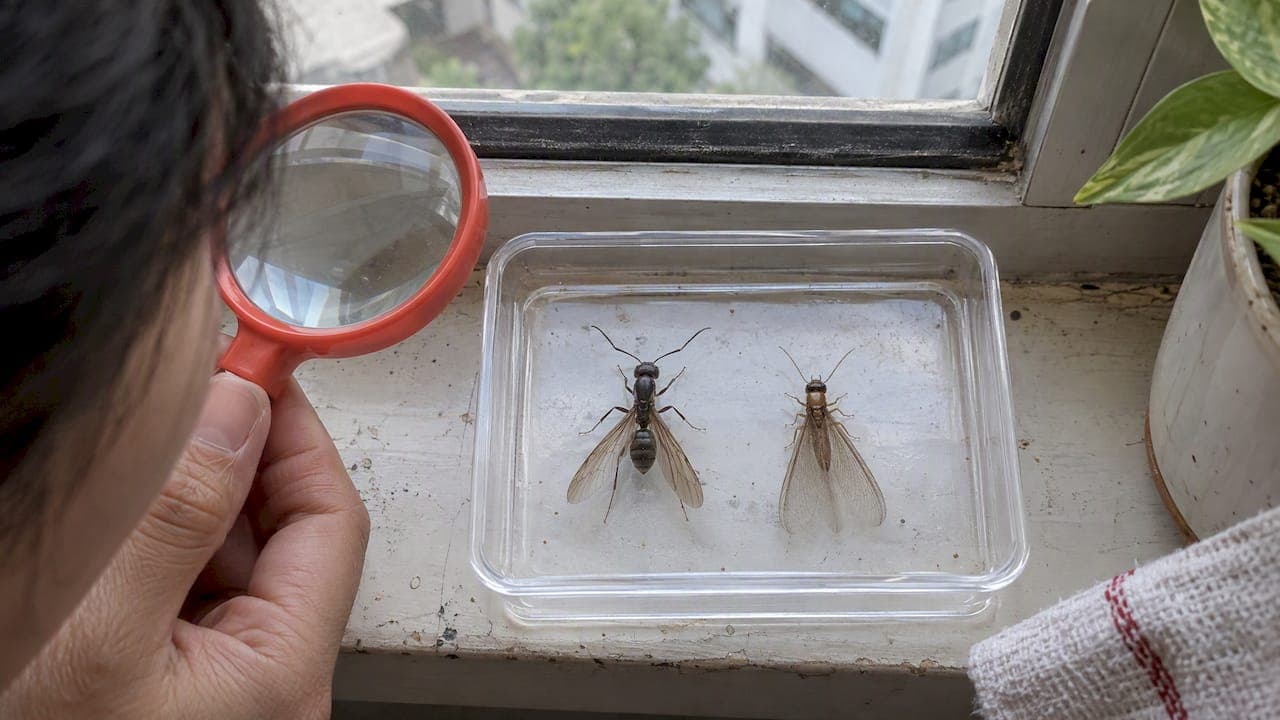
Check three body cues first: elbowed antennae, a pinched waist and unequal wing pairs point to carpenter ants, while straight antennae, a broad waist and four equal wings point to termites. Carpenter ants excavate damp wood and leave coarse shavings, while termites eat wood and leave mud tubes and packed galleries. If you see either sign in structural timber, photograph or collect evidence and arrange a professional inspection.
TL;DR:
- Because swarmers shed their wings and both groups swarm in warm, wet conditions, identify a specimen using multiple features rather than the swarm alone.
- Carpenter ants often nest in decayed wood before extending into sound timber, while termite galleries may stay hidden inside structural members.
- Keep loose wings and frass in a labeled container, photograph nearby damage, and do not pry or drill into structural timber before inspection.
- Call a professional for mud tubes, hollow wood, frass from structural timber, or an indoor swarm; treatment depends on species, colony location, and moisture.
- Repair leaks and drainage problems, remove damp wood conditions, and check places where wood touches soil to reduce the risk of infestation.
Table of Contents
- How can you tell carpenter ants from termites at a glance?
- What do the physical differences look like up close?
- Where do the signs show up, and how does the damage differ?
- How do you collect evidence safely before an inspection?
- When should you call a professional, and how do treatments differ?
- What can you do now to lower the risk of both pests?
- Why does moisture repair matter as much as pest removal?
- FAQ
- Sources
How can you tell carpenter ants from termites at a glance?
Most identification comes down to a handful of features you can see without a magnifying glass. The features below can help you decide what evidence is worth gathering for a technician.
- Antennae: elbowed (bent) on ants, straight and beaded on termites.
- Waist: narrow and pinched on carpenter ants, broad with no constriction on termites.
- Wings: an ant's front wings are longer than its hind wings, while a termite's four wings are equal in size and often longer than its body.
- Debris: carpenter ants push out sawdust-like frass from smooth galleries, while termites leave mud-lined tunnels, packed galleries and discarded wings.
- Visibility: carpenter ants often forage in the open, but termite workers usually stay hidden inside wood and soil.
Three features separate winged ants from termite swarmers: antennae, waist and wing length. Because wings are often shed, use all three cues together rather than trusting any single one.
What do the physical differences look like up close?
Start with the antennae, because they are the easiest feature to photograph. A carpenter ant's antenna bends sharply, like an elbow, partway along its length. A termite's antenna runs straight and looks like a string of tiny beads. A close-up photo of a captured insect may help show the difference.
The waist is the next check. Carpenter ants have a clearly narrowed, pinched connection between the thorax and abdomen. Termites have a thick, cigar-shaped body with no visible constriction. Kansas State University entomologists describe termite swarmers as dark brown to black with wings of equal size and no constricted waist, while ant swarmers have unequal wing pairs and elbowed antennae. University of California identification keys also treat wing size and antennae shape as diagnostic.
Wings deserve extra care because swarmers shed them quickly. A loose wing on a sill can still tell you something: if the front and hind wings differ in size, an ant may have dropped it. If you find wings of identical size, consider termites, but use other identification cues too.
Color helps less than most people expect. Color can be a useful clue, but identify the insect using its antennae, waist and wings rather than color alone. Swarmers of both groups can look dark, and lighting distorts color in photos, so treat it as a hint, never a verdict.
- Check antennae, waist and wings on the same specimen.
- Compare what you see with the debris near the insects.
- Note the time of year and weather, since both groups swarm in warm, wet conditions.
- Never decide from swarming alone.
Pro Tip: A swarm tells you very little by itself. Both ants and termites produce winged swarmers and both shed wings, so identify by body plan and by the evidence around your building.
Where do the signs show up, and how does the damage differ?
The two pests damage wood in different ways. Carpenter ants do not eat wood. They excavate it to make nests, and their galleries stay smooth and clean while excavated material is pushed out of entrances. Termites consume the cellulose, so their galleries are often packed with soil, mud or fecal material. University of Georgia specialists note that carpenter-ant nests can begin in decayed wood and extend into sound wood, while termite damage can stay hidden inside structural members.
Work through these signs in order:
- Frass piles: coarse, sawdust-like shavings beneath a baseboard, sill or small opening suggest carpenter ants.
- Wall evidence: visible insects or debris near an opening may be worth documenting for an inspection.
- Mud or soil: mud or soil associated with galleries can be a clue to termites.
- Suspect wood: termite damage can remain hidden inside structural members, so arrange a professional inspection if you suspect damage.
- Discarded wings: discarded wings near windows or doors can be a reason to investigate, but use body features and other evidence to identify the insect.
Carpenter ants excavate galleries, while termites consume cellulose and can leave galleries packed with soil, mud or other debris. Because termites can work behind intact surfaces, the damage may stay invisible until a board gives way.
Speed also differs. One homeowner-focused guide notes that termites can cause significant damage in two to four years, while carpenter-ant damage usually develops more slowly and is easier to spot because the ants are visible. Carpenter ants also favor wood already softened by moisture, so their presence often points to a leak.

Check the attic, crawl space, eaves, door sills, wooden posts and any spot where wood touches soil. For further photo comparisons, see our guide to warning signs of termites.
How do you collect evidence safely before an inspection?
Good evidence shortens an inspection and removes guesswork. University of Maryland Extension makes the same point: a photograph or specimen is more useful than guessing from a swarm alone.
- Preserve a specimen if you can do so safely. A photograph or specimen can help with identification.
- Keep loose wings and frass. Place wings, shavings and small wood fragments in a sealed bag or container and label it with the location and date.
- Shoot useful photos. Take a close-up of the antennae and waist, a full-body side view, wide shots of frass piles and any mud tubes.
- Leave structural timber alone. Do not pry or drill into beams or joists. Arrange a professional inspection if structural wood is involved.
- Write a short report. Note where you found each sign, what debris was present and when any swarm occurred.
Our termite inspection checklist offers further information. For additional guidance after a swarm, see this guide to preserving swarmer evidence.
Pro Tip: Photograph the insect clearly, including its antennae, waist and wings, to help with identification.
When should you call a professional, and how do treatments differ?
Call a professional as soon as the evidence points to structural wood: mud tubes, hollow timbers, frass from a framing member or a swarm inside the building. Penn State Extension explains that carpenter-ant and termite control require different investigations and treatments. Carpenter-ant work locates parent and satellite nests and addresses damp wood. Termite work identifies the termite type, the colony route and the extent of hidden damage before a treatment is chosen.
A generic spray or DIY identification is not a reliable substitute for an inspection, because treatment depends on species, colony location, moisture, construction and whether damage is active.
For carpenter ants, the aim is to locate nests and address damp wood and moisture sources. Killing the workers you can see rarely solves the problem, since they may be foragers from an outdoor parent colony or a satellite nest indoors. Termite treatment should be selected after identifying the termite type, colony route and extent of hidden damage.
An inspection typically covers:
- Mud tubes and internal galleries
- Moisture pathways and leak points
- Parent and satellite nests
- The extent of timber damage
- Where wood meets soil
Cost and timeline depend on species, colony size and how far the damage has spread, so a firm estimate comes only after the inspection. Read more about thermal imaging in our thermal imaging homeowner's guide. Our technicians handle structural concerns through our termite control and treatment service. Photographs or a specimen may help with the inspection.
What can you do now to lower the risk of both pests?
Prevention starts with water, because moisture-softened wood draws carpenter ants and rots on its own. University of Maryland Extension advises treating a carpenter-ant find as a moisture investigation: check window and door sills, flashing, gutters, plumbing and crawl spaces and dry or repair every water source.
- Find and repair leaks, condensation and other sources of damp wood.
- Check roof and gutter drainage for water problems.
- Look for wood touching soil.
- Check areas where dampness or decay may be present.
- Inspect for access points and signs of activity.
- Check attics, crawl spaces and eaves for signs of moisture or pests.
These steps lower the odds of colonization but do not replace an inspection. If you spot frass, mud tubes or hollow-sounding wood, move to the evidence steps above rather than waiting.
Why does moisture repair matter as much as pest removal?
Most people ask us how to kill the ants they can see. We think the better question is why the colony settled there. Wood that stays damp invites ants and fungi, and an ant treatment without a leak repair tends to bring the problem back.
Persistent leaks can support carpenter ants and wood-rotting fungi, and the fungal decay can threaten a timber as seriously as the ants do. That is why our integrated pest management approach pairs nest removal with moisture correction and keeps safety for people and pets first. If you suspect structural damage, preserve the evidence and book a licensed inspection before anything is opened or replaced.
— Bespoke-Enviro Services
FAQ
Which is worse, carpenter ants or termites?
Termites are usually the bigger structural threat because they consume wood and can damage timber out of sight. Carpenter-ant damage is often slower and tied to moisture problems, but it can still compromise a key timber, so neither should be ignored.
What does carpenter ant damage look like?
Look for smooth, clean galleries inside the wood and coarse, sawdust-like frass pushed out of small openings. The wood often feels softened because it was already damp.
What is the fastest way to get rid of carpenter ants?
Locating and addressing parent and satellite nests is central to control, because killing foraging workers without finding the nests often fails to solve the problem. Pair nest removal with repair of the moisture source so the colony has no reason to return.
How do I know it's termites and not ants?
Check the antennae, waist and wings together. Straight antennae, a broad waist and four equal wings indicate termites, and mud tubes or packed galleries support that call.
Sources
- Biology and Management of Carpenter Ants | CAES Field Report
- Ants and Termites: How to Tell the Difference | University of Maryland Extension