
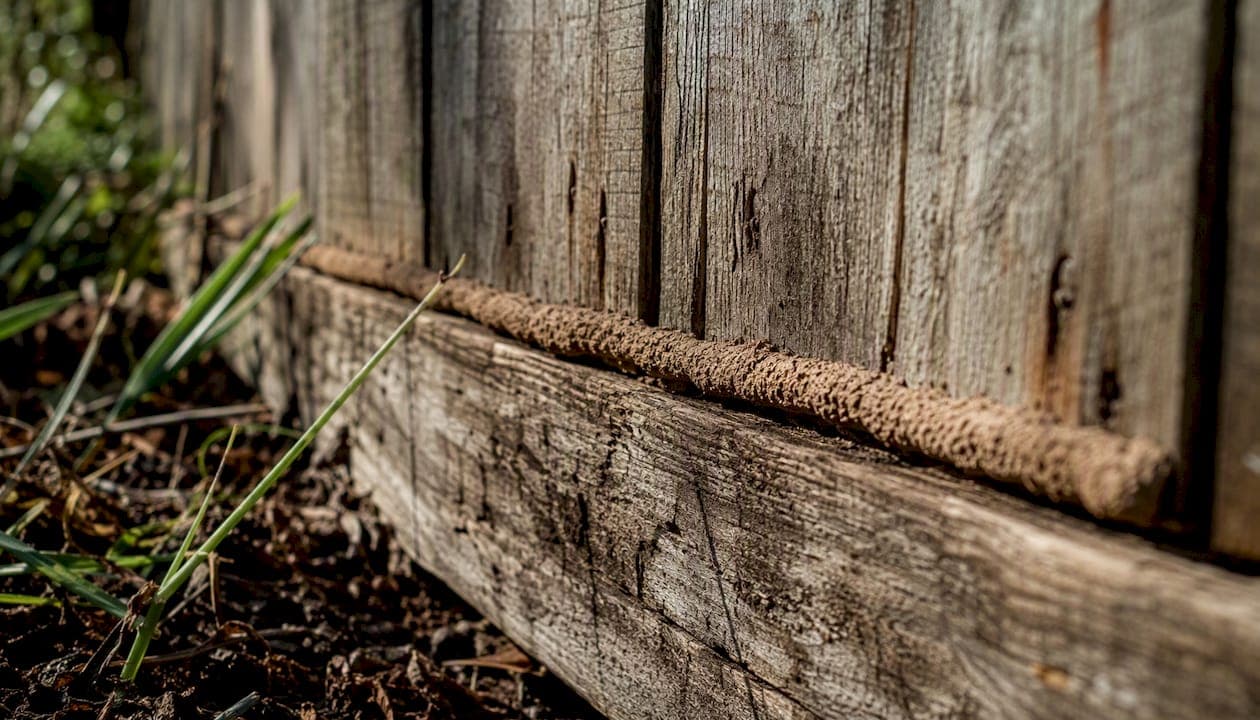
The most reliable signs of termites are mud tubes on your foundation, swarmers or piles of discarded wings near windows, frass (tiny wood-colored pellets) near baseboards, and wood that sounds hollow when tapped. If you spot any of these, your first move is to mark the spot, photograph it, and call a licensed termite inspector rather than disturb the evidence.
The six most reliable visible signs:
- Mud tubes running up foundation walls or crawl space piers
- Swarmers (winged termites) indoors, or piles of shed wings near light sources
- Frass: tiny, six-sided pellets that look like sawdust or coffee grounds
- Wood that sounds hollow when you knock on it, or crumbles under light pressure
- Bubbling or peeling paint on wood surfaces with no moisture source
- Stuck windows or doors that weren't sticking before
Pro Tip: Never rip out a mud tube or tear open a wall the moment you find it. Mark the tube's edges with a pencil, take a date-stamped photo, and leave it intact. Professionals use the tube's path to trace the colony back to its entry point. Destroying it first makes their job significantly harder.
Key Takeaways
Early detection is the single most effective way to limit termite damage, and the signs are visible long before structural harm occurs.
| Point | Details |
|---|---|
| Top visible signs | Mud tubes, discarded wings, frass, and hollow-sounding wood are the most reliable indicators. |
| Break-and-watch test | Break a one-inch mud tube section and check for repair within 48 hours to confirm active termites. |
| Inspect every 1–3 years | NPMA recommends professional inspections regularly; WDO reports are often required for home purchases. |
| Structural damage takes years | Termite colonies usually take several years to produce visible structural damage, so early inspection matters. |
| Preserve evidence first | Mark and photograph signs before disturbing them so inspectors can trace the colony's path. |
Table of Contents
- What do the signs of termites actually look like?
- Where should you inspect for termite activity?
- Quick homeowner tests to confirm active termite activity
- When should you stop DIY and call a licensed inspector?
- Practical prevention and IPM steps you can take right now
- How do termite species differ in the signs they leave?
- How do you tell termite damage apart from rot or carpenter ants?
- Common termite myths and mistakes that make infestations worse
- What most termite advice gets wrong
- Ready to get a professional termite assessment?
- Sources
What do the signs of termites actually look like?
Mud tubes
Mud tubes are pencil-width tunnels made from soil, saliva, and wood particles. Subterranean termites build them to travel between the soil and the wood they're eating, keeping themselves protected from open air. You'll usually find them running vertically up concrete foundations, crawl space walls, or piers. According to Virginia Cooperative Extension, these flattened tubes at soil contact points are among the most diagnostic signs of subterranean termite activity.
The break-and-watch rebuild test is the most useful homeowner check: break a one-inch section of the tube and check back in 24–48 hours. If termites have repaired it, the colony is active. If it stays broken for a week, the tube may be old, but that still warrants a professional opinion since colonies can be active elsewhere in the same structure.
Swarmers and discarded wings
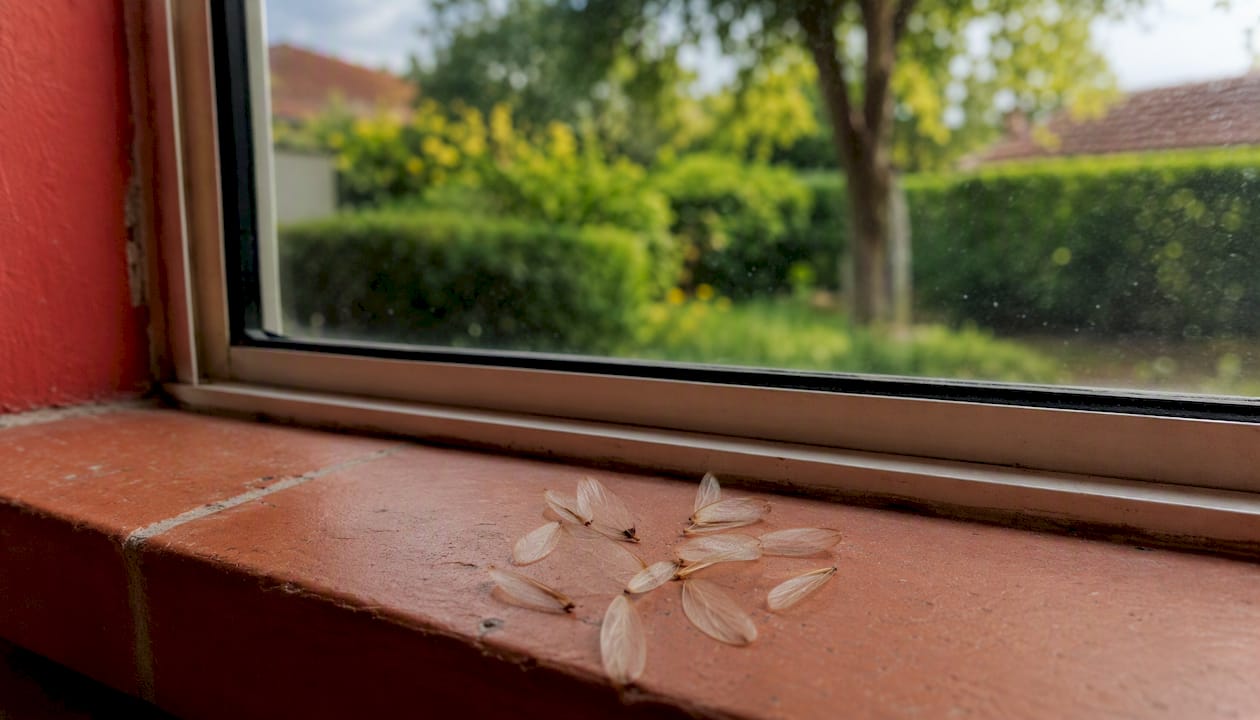
Swarmers are winged reproductive termites that leave the colony to start new ones. Finding them indoors almost always means a colony is already established nearby. They're attracted to light, so check windowsills, door frames, and light fixtures. More often than the insects themselves, you'll find their shed wings in small piles. Termite swarmers shed wings shortly after landing, leaving uniform, translucent pairs that are roughly equal in length.
Frass
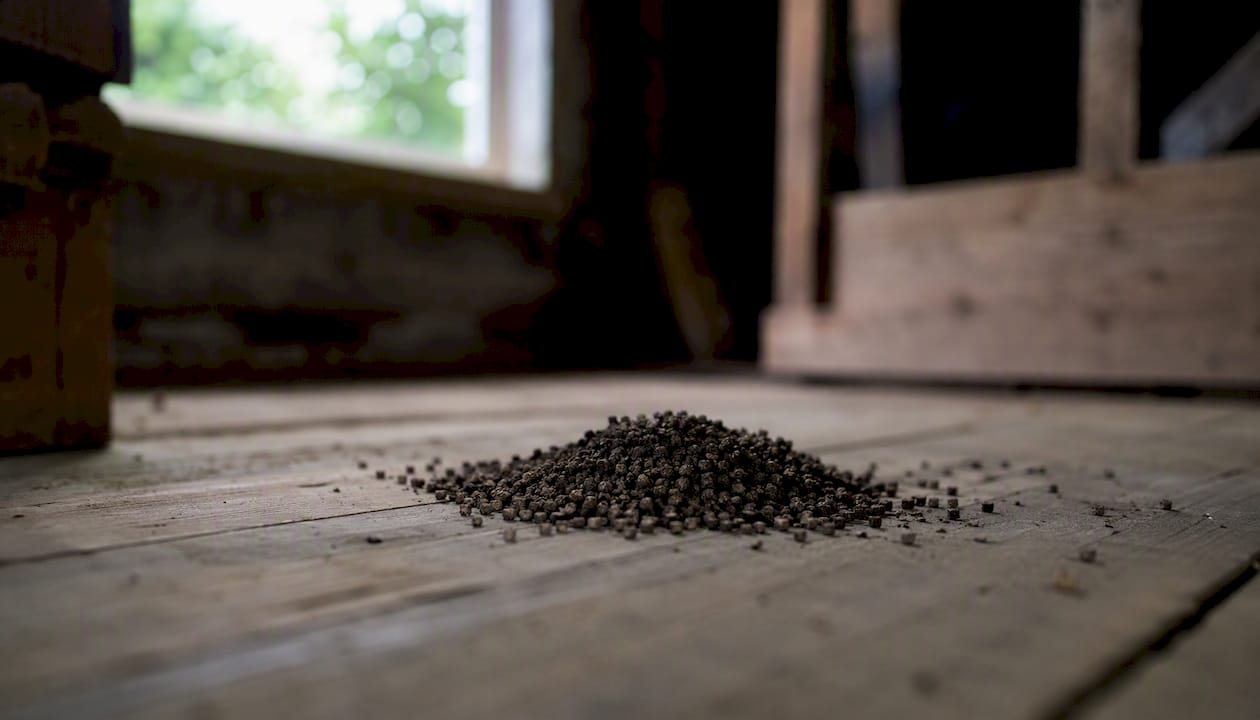
Frass is the fecal matter of drywood termites, pushed out through tiny kick-out holes in the wood. It looks like fine sawdust or coffee grounds but has a distinctive shape: uniform, six-sided pellets about 1mm long. Construction sawdust is irregular and fibrous. Frass is smooth, consistent, and tends to pile up in small mounds directly below the exit hole.
Hollow or blistered wood
Termites eat wood from the inside out, leaving a thin shell of paint or surface grain intact while hollowing the interior. Tap along baseboards, door frames, and structural beams with your knuckle. A dull, papery thud instead of a solid knock signals internal galleries. Blistering or bubbling paint on wood with no nearby plumbing leak is another clue.
| Sign | What it looks like | Diagnostic confidence |
|---|---|---|
| Mud tubes | Pencil-width dirt tunnels on foundation | High (subterranean) |
| Discarded wings | Uniform translucent pairs near windows | High (active swarming) |
| Frass | Six-sided wood-colored pellets | High (drywood) |
| Hollow wood | Dull thud when tapped | Moderate (confirm with probe) |
| Bubbling paint | Raised, blistered surface on wood | Moderate (rule out moisture) |
| Stuck doors/windows | Sudden warping with no weather change | Low to moderate (confirm with probe) |
Pro Tip: Dried mud inside a gallery doesn't automatically mean active termites. Mississippi State University Extension notes that old galleries can look identical to active ones. Mark the area and let a professional determine whether the colony is still present before you repair anything.
Where should you inspect for termite activity?
Termites follow moisture and wood. That combination narrows down where to look.
High-risk locations to check:
- Foundation perimeter, especially where soil meets concrete or wood siding
- Crawl spaces: piers, beams, and any wood within 6 inches of soil
- Attic rafters and eaves, particularly near roof leaks or condensation
- Windowsills and door frames, especially on the ground floor
- Porches, decks, and attached wood structures
- Fence posts, firewood stacks, and wood debris near the house
- Utility penetrations through the foundation (pipes, conduit)
Walk the full perimeter of your home with a flashlight and a flathead screwdriver. Look for mud tubes, discolored wood, and any point where wood contacts soil. In the crawl space, check every pier and beam. In the attic, focus on rafters near the eaves and any area with visible moisture staining.
Subterranean termites are cryptobiotic by nature, spending most of their time hidden in soil or inside mud tubes. That's exactly why a slow, methodical perimeter walk catches what a quick glance misses.
Safety note: Don't pull back insulation, open walls, or disturb structural framing during your check. Photograph what you find, mark its location, and stop there. Probing too aggressively can weaken already-damaged wood and make it harder for an inspector to assess the full scope.
Quick homeowner tests to confirm active termite activity
These four tests take less than ten minutes and give you real information before you call a professional.
-
Break-and-watch mud tube test. Break a one-inch section of any mud tube you find. Mark the break with tape or a pencil line. Return in 24–48 hours. Repaired tube means active termites. No repair after 5–7 days suggests the tube may be dormant, but still report it to an inspector.
-
Screwdriver probe test. Press the tip of a flathead screwdriver firmly against suspect wood. Sound, healthy wood resists. If the tip sinks in with little pressure, or if the surface crumbles, internal galleries are likely. Don't stab repeatedly; one or two careful probes at the most suspicious spot is enough.
-
Wing and antenna check. Termite swarmers have two pairs of wings that are equal in length and straight antennae. Flying ants have wings of unequal length (front pair longer) and elbowed antennae. This distinction matters because ant swarms are common in spring and get misidentified constantly.
-
Tap test for hollow wood. Run your knuckle along baseboards, door frames, and exposed beams. Solid wood returns a sharp knock. Termite-damaged wood returns a dull, papery sound. Work systematically across a 12-inch section rather than tapping randomly.
Pro Tip: Before calling an inspector, take date-stamped photos from multiple angles: a wide shot showing location, a close-up of the sign itself, and one with a coin or ruler for scale. Inspectors can often narrow down species and severity from good photos before they even arrive.
What not to do:
- Don't rip open walls to look for galleries
- Don't apply over-the-counter termiticide sprays near suspected activity; they can scatter the colony and mask evidence
- Don't attempt DIY tenting or soil injection
- Don't assume a single negative probe means the area is clear
When should you stop DIY and call a licensed inspector?
Call a licensed pest control professional when you find any of the following:
- A mud tube that rebuilds within 48 hours of being broken
- Swarmers emerging from inside the house, or a pile of wings indoors
- Frass piles near baseboards or below ceiling fixtures
- Wood that fails the screwdriver probe test
- Any sign of structural sagging, loose tiles over a concrete slab, or floors that feel soft underfoot
A professional inspection covers the full foundation perimeter, crawl space, attic, and any accessible structural wood. The inspector identifies the species, maps entry points, assesses moisture conditions, and can issue a Wood Destroying Organism (WDO) report when requested. WDO reports are commonly required for mortgage-related home purchases and real estate transactions. The NPMA recommends scheduling a professional termite inspection every 1–3 years, even when no signs are visible.
| Inspection type | When needed | Typical deliverable |
|---|---|---|
| Visual inspection | Every 1–3 years (routine) | Verbal or written findings report |
| WDO inspection | Home purchase or refinance | Formal WDO report for lender/buyer |
| Monitoring service | Active or high-risk properties | Ongoing station checks and reports |
Questions to ask your inspector:
- Which species did you identify, and where is the likely entry point?
- Is the activity active or historic?
- What treatment options do you recommend, and why?
- What does the treatment warranty cover, and for how long?
- Do you offer a monitoring plan after treatment?
Serious structural damage from termites typically takes 3–8 years to develop because colonies eat from the inside out. Visible surface damage often signals an infestation that has been active for years, not weeks.
Practical prevention and IPM steps you can take right now
Integrated Pest Management (IPM) for termites starts with removing the conditions they need: moisture, wood-to-soil contact, and undisturbed harborage.
Immediate actions:
- Pull firewood, lumber, and wood debris at least 20 feet from the foundation
- Eliminate any point where wood siding or framing contacts soil directly
- Fix leaking pipes, gutters, and downspouts; standing water near the foundation is a major risk factor
- Clear mulch away from the foundation; keep a 6–12 inch gap between mulch or soil and wood siding
- Repair or replace decayed wood on porches, eaves, and window frames
Longer-term IPM measures:
- Install and check termite monitoring stations around the perimeter every 3–6 months.
- Improve crawl space ventilation to reduce moisture below 50% relative humidity.
- Seal foundation cracks and utility penetrations with appropriate caulk or foam.
- Schedule a professional inspection every 1–3 years, or annually in high-risk regions.
- Use targeted soil treatments only when monitoring stations confirm activity, not as a blanket preventive.
Pro Tip: Eco-friendly borate-based wood treatments applied to exposed framing in crawl spaces and attics can deter termites without broad chemical application. They work best as a preventive measure on untreated wood, not as a cure for an active infestation. When chemical soil barriers become necessary, a licensed professional can apply them with precision that DIY products can't match. For a broader look at how building defects connect to pest risk, the pest control SWOT framework offers useful context on structural vulnerabilities.
How do termite species differ in the signs they leave?
The three termite types most relevant to U.S. homeowners leave different evidence, which affects where you look and how urgently you act.
Subterranean termites are the most widespread and destructive. They live in the soil and must maintain contact with it, which is why mud tubes are their signature sign. Entry points are typically foundation cracks, utility penetrations, and any wood touching soil. They're responsible for the majority of structural termite damage in the U.S. University of Maryland Extension confirms that mud tubes, soil contact, and hollow-sounding wood are the primary diagnostic signs for this species.
Drywood termites nest inside the wood itself and need no soil contact. Their calling card is frass: those uniform six-sided pellets pushed out through tiny kick-out holes. You'll find them in attic framing, furniture, door frames, and hardwood floors. They're most common in coastal and southern states.
Formosan termites are an invasive subterranean species with larger colonies and faster damage rates. They build mud tubes higher on walls, sometimes over foam insulation or inside wall voids, and produce notably large swarm events, often in late spring evenings.
| Species | Habitat | Primary visible sign | Typical entry | Regional prevalence |
|---|---|---|---|---|
| Subterranean | Soil-based | Mud tubes, hollow wood | Foundation cracks, soil contact | Nationwide |
| Drywood | Inside wood | Frass pellets, pinhole exits | Exposed wood, attic vents | South, Southwest, coastal |
| Formosan | Soil-based (invasive) | Large mud tubes, massive swarms | Foundation, wall voids | Southeast, Gulf Coast, Hawaii |
Key insight: Finding no live termites in damaged wood doesn't mean the infestation is over. Dried mud in galleries can be old damage, or the colony may have moved deeper into the structure. Only a professional inspection can determine whether activity is ongoing. Mark the area and monitor it rather than assuming the problem resolved itself.
How do you tell termite damage apart from rot or carpenter ants?
This is where homeowners waste the most time and money: treating for termites when the culprit is water rot, or ignoring termite damage because it looks like a carpenter ant problem.
| Damage type | Tunnel pattern | Surface clue | Key test |
|---|---|---|---|
| Termite damage | Smooth, parallel to grain, mud-lined | Hollow tap, thin paint veneer | Break open: mud lining inside |
| Water rot | Cubical cracking, spongy texture | Soft, discolored, damp feel | Moisture meter reads high |
| Carpenter ants | Rough, sawdust-filled galleries | Coarse frass with insect parts | No mud lining; frass is fibrous |
Breaking open a piece of damaged wood and finding mud-lined tunnels running parallel to the grain is the clearest confirmation of termites over rot or ants. Water rot produces a spongy, cubical breakdown with no tunneling. Carpenter ant galleries are rough-edged and packed with fibrous sawdust mixed with insect parts, never mud.
Quick diagnostic checks:
- Press a pin into the surface: termite-damaged wood offers almost no resistance; rot feels spongy but may still resist a pin at the surface
- Check for moisture with a meter: rot almost always reads above 20% moisture content; termite damage can occur in relatively dry wood
- Look for mud lining inside any gallery you can access without tearing open a wall
Pro Tip: Bubbling paint is often misread as a moisture problem. If there's no plumbing nearby and the paint is bubbling on a wood surface, probe the area gently. Termites can create enough internal humidity from their activity to blister paint from the inside, with no external water source involved.
Common termite myths and mistakes that make infestations worse
Myths worth dropping:
- "If I don't see termites, I don't have them." Subterranean termites spend almost their entire lives hidden in soil or inside wood. Most homeowners never see a live termite until swarmers emerge.
- "A can of spray fixes it." Over-the-counter sprays kill surface insects but don't reach the colony. Worse, they can scatter foragers, making the infestation harder to locate and treat.
- "Termite wings mean ants." This is the most common misidentification. Check wing length and antenna shape before dismissing a swarmer pile as an ant problem.
Mistakes that make infestations harder to treat:
- Ripping open walls immediately after finding hollow wood, destroying the evidence trail professionals need.
- Applying surface pesticides near mud tubes, which can cause the colony to reroute deeper into the structure.
- Waiting weeks after seeing swarmers indoors before calling an inspector. Swarmers indoors are a strong signal of an established colony, not a future risk.
- Repairing damaged wood before an inspector has assessed the full scope.
- Skipping routine inspections because no signs are visible.
Do not do list:
- Don't disturb mud tubes before photographing and marking them
- Don't apply DIY termiticide without a professional assessment
- Don't assume old damage is inactive without confirmation
Pro Tip: When you call an inspector, bring your date-stamped photos and describe exactly where you found each sign. Note whether stuck doors or windows appeared suddenly or gradually. That timeline helps inspectors distinguish a fast-moving infestation from a slow, long-established one.
What most termite advice gets wrong
Most termite content online treats the problem as a binary: either you have termites or you don't, and the answer is always "call a professional immediately." That framing skips the most useful middle ground.
The reality is that a homeowner who knows how to run the break-and-watch test, distinguish frass from sawdust, and tell a termite swarmer from a flying ant is far better positioned than one who either panics at every crack or ignores every sign. The goal of a first inspection isn't to diagnose the infestation yourself. It's to gather enough evidence that when you do call a professional, you can describe what you found, where you found it, and when it appeared. That information changes the quality of the inspection you get.
The other thing most guides understate: visible damage is almost never a new problem. Termite colonies take years to produce the kind of structural evidence most homeowners notice. By the time a floor sags or a door frame crumbles, the colony has likely been active for three years or more. That's not a reason to panic; it's a reason to inspect on a schedule rather than waiting for symptoms.
The 1–3 year inspection interval recommended by the NPMA isn't conservative caution. It's the window within which a professional can catch an infestation before it reaches the structural damage threshold. Skipping inspections because nothing looks wrong is exactly how a minor problem becomes a major repair bill.
Ready to get a professional termite assessment?

If you've spotted any of the signs covered here, or if it's been more than a year since your last inspection, the next step is a professional assessment by a licensed pest control specialist. Bespoke-enviro uses eco-friendly, IPM-based termite management to identify species, map entry points, and recommend targeted treatments that protect your property without unnecessary chemical exposure. Book an inspection before visible damage becomes structural damage.
Sources
- Top 5 Signs of a Termite Infestation in Your Home
- Signs of Termite Infestation | Mississippi State University Extension Service
- Subterranean Termites (Virginia Cooperative Extension publication)
- Termites: Types, Warning Signs, Health Risk and Treatment