
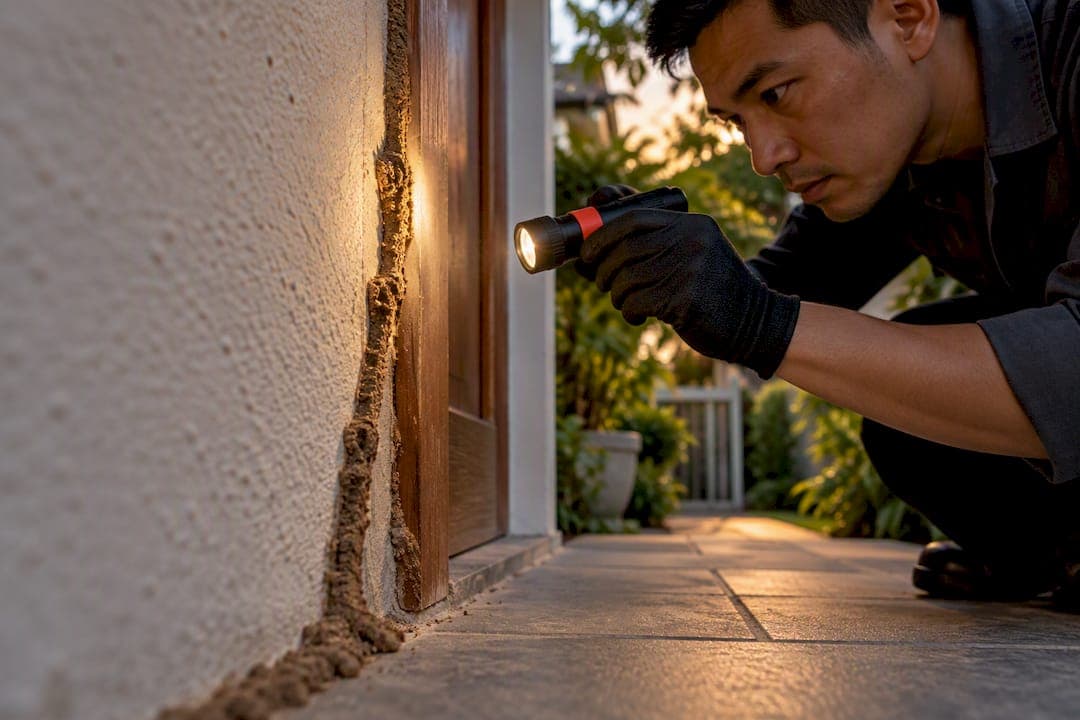
Singapore homes face three termite groups: subterranean, drywood, and dampwood. Subterranean termites, especially Coptotermes gestroi and Coptotermes curvignathus, cause the most structural damage in the country. If you spot mud tubes, discarded wings, or hollow-sounding timber, photograph the evidence, leave it undisturbed, and book a professional inspection right away.
TL;DR:
- Most damage in Singapore homes is caused by Coptotermes gestroi and Coptotermes curvignathus due to their large colonies and extensive underground foraging ranges.
- Identifying termite signs such as mud tubes, frass, wings, and hollow wood can help narrow down the species and assess the immediate risk to structures.
- Treatment with baiting usually takes from 3 to 24 weeks to eliminate subterranean colonies, requiring ongoing monitoring for confirmation of full eradication.
- Preventative measures include eliminating wood-to-soil contact, managing moisture, and regularly inspecting for early signs of activity, especially near trees and garden timber.
- Professional inspection combining visual checks, thermal imaging, and in-ground monitoring offers the most reliable detection and targeted treatment options.
Table of Contents
- Termite Species Singapore Homeowners Actually Encounter
- How to Identify Termite Infestations and Tell Species Apart
- Which Termite Species Cause the Most Damage in Singapore
- Where Termites Occur Across Singapore Properties
- How Professionals Detect and Monitor Termite Activity
- Termite Treatment Options Available in Singapore
- What to Do the Moment You Spot Termite Signs
- Preventing Termite Problems Before They Start
- A Local Perspective on Early Detection
- Get a Professional Termite Inspection From Bespoke-Enviro
- Sources
- FAQ
Termite Species Singapore Homeowners Actually Encounter
Not every termite in Singapore threatens your house. Understanding which group you're dealing with narrows down the risk fast, and it starts with three broad categories that behave very differently.
Subterranean termites nest in soil and build mud tubes to travel between the ground and their food source, which is usually the timber in your home. Colonies can number in the hundreds of thousands, and because the nest sits underground or in a tree root system, you rarely see the termites themselves until damage is advanced. Drywood termites skip the soil connection entirely. They live inside dry timber, furniture, or structural wood, forming smaller colonies that produce distinctive pellet-like droppings called frass. Dampwood termites favor moisture-damaged or decaying wood and are less commonly reported as structural pests in Singapore homes, though they still show up in rotting fence posts, old fixtures, and waterlogged garden timber.
Within those groups, six species come up again and again in Singapore records and pest surveys. A Singapore field study using in-ground monitoring stations detected all six in urban tree environments, which gives a useful local snapshot of who's actually out there.
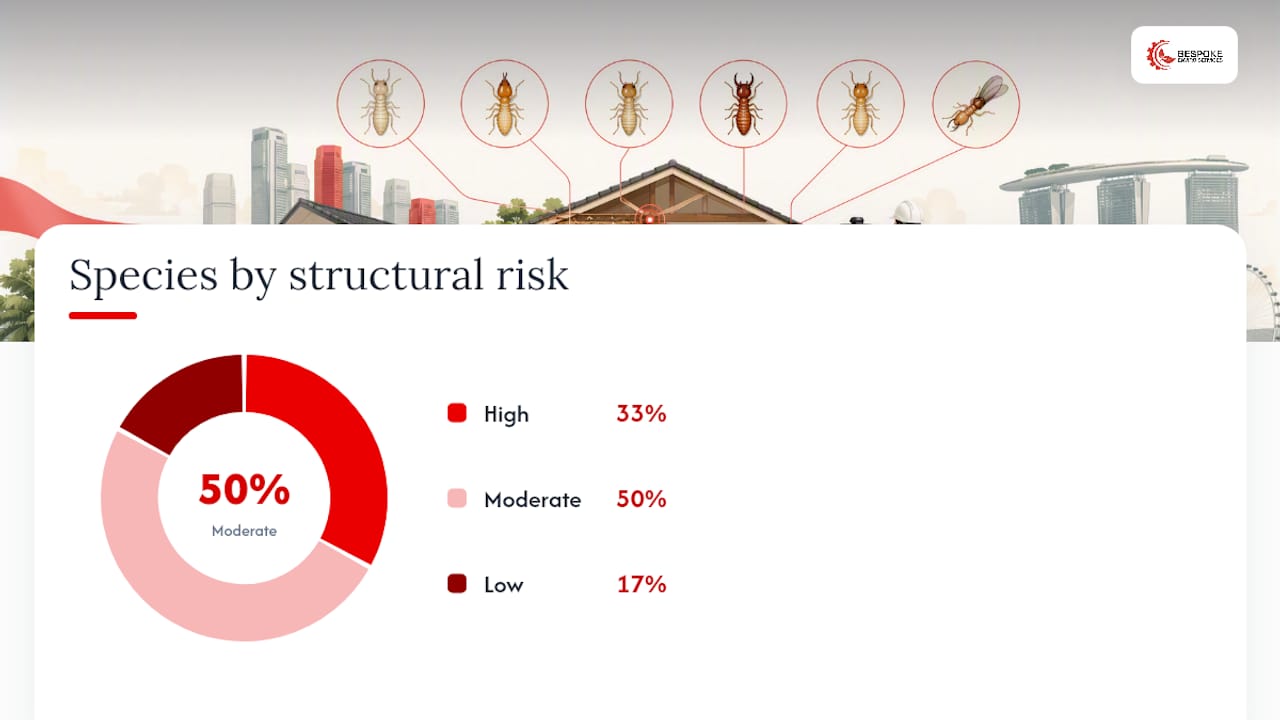
| Species | Group | Typical encounter | Structural risk |
|---|---|---|---|
| Coptotermes gestroi | Subterranean | Homes, gardens, urban trees | High |
| Coptotermes curvignathus | Subterranean | Trees, landscaped areas, occasionally structures | High |
| Macrotermes gilvus | Subterranean (mound-building) | Gardens, parks, dead wood | Moderate |
| Macrotermes carbonarius | Subterranean (mound-building) | Coastal forest, nature reserves | Low (localized) |
| Microcerotermes crassus | Subterranean | Dead wood, tree stumps, urban greenery | Moderate |
| Schedorhinotermes medioobscurus | Subterranean | Soil, decaying wood, garden structures | Moderate |
Coptotermes gestroi is the species most homeowners in Singapore should worry about. It's classified within the family Rhinotermitidae and is widely documented as a common structural pest here, building extensive underground galleries that reach timber framing, skirting boards, and door frames.
Coptotermes curvignathus behaves similarly but has a stronger association with living and dead trees, including landscaped species in parks and private gardens. It can move into structures when tree roots run close to foundations.
Macrotermes gilvus and Macrotermes carbonarius are mound-builders, more visible in open ground than the Coptotermes species, but the two differ sharply in how often you'll actually meet them. Macrotermes gilvus turns up in parks, gardens, and areas with dead wood on the ground. Macrotermes carbonarius, by contrast, is documented by NParks as a coastal and forest species with a Vulnerable conservation status in Singapore, restricted to specific pockets rather than spread across residential neighborhoods. Treat any Macrotermes carbonarius sighting as ecologically notable, not as a typical pest call.
Microcerotermes crassus and Schedorhinotermes medioobscurus round out the list. Both feed primarily on dead wood, stumps, and decaying garden timber, and both showed up in the same Singapore monitoring study alongside the more destructive Coptotermes species. Neither is considered a major structural threat on its own, but a heavy presence near your property signals conditions that could eventually attract more damaging species too.
If you're trying to answer "which termite species Singapore properties actually deal with day to day," the honest answer is: mostly Coptotermes gestroi, with curvignathus a close second wherever mature trees sit near buildings.
How to Identify Termite Infestations and Tell Species Apart
Termite identification in Singapore comes down to reading physical evidence, since the insects themselves stay hidden inside wood or soil for most of their lives. Five signs cover almost every case a homeowner will find.
- Mud tubes: pencil-width trails of soil running up foundations, walls, or posts. Almost always subterranean termites, most likely Coptotermes gestroi.
- Frass pellets: tiny, gritty, sand-like droppings collecting below timber or furniture. A strong indicator of drywood termites working inside the wood itself.
- Discarded wings: papery, translucent wings scattered near windowsills or light fixtures after a swarm. Points to a mature colony nearby, subterranean or drywood.
- Hollow or papery-sounding wood: tap suspect timber with a screwdriver handle. A hollow, drum-like sound means galleries have already eaten through the interior.
- Kick-out holes: tiny, pinhead-sized openings in wood surfaces where drywood termites push frass out of the colony.
Matching the sign to the species narrows things down quickly. Mud tubes climbing a wall or fence post almost always mean Coptotermes gestroi or curvignathus at work, since both need constant soil contact to survive. Frass without any mud tubes nearby usually points to a drywood infestation, often introduced through infested furniture rather than from the garden. Large, obvious galleries chewed into a tree trunk or exposed root, especially paired with a soil mound at the base, often trace back to Macrotermes gilvus or carbonarius rather than a Coptotermes species.
According to extension pest guidance widely used for identification, these four signs (mud tubes, frass, wings, and hollow wood) form the backbone of nearly every termite inspection checklist worldwide, and Singapore's climate makes them appear faster than in temperate regions because colonies here stay active year round.
Pro Tip: When you photograph a sign for a pest technician, include a wide shot showing the location on the structure, plus a close-up with something for scale (a coin or a pen). It helps a technician judge species and severity before ever stepping on site.
Telling termites from flying ants trips up a lot of homeowners, and the confusion is understandable since both swarm in similar weather. Look at three features: termite wings are equal in length front and back, while ant wings are noticeably uneven. Termite antennae run straight, while ant antennae bend at an angle. Termite bodies show no narrow waist between thorax and abdomen, while ants have a distinctly pinched waist. If you're still not sure, a photo showing the insect from the side, next to a ruler or coin, is enough for most technicians to make the call remotely.
One more field note worth knowing: not every swarm means a new infestation. Termites swarm to establish new colonies, often triggered by rain and humidity shifts, so a single evening of winged insects near your porch light doesn't automatically mean your home is compromised. Recurring swarms in the same spot, or wings appearing indoors rather than outside, deserve a closer look.
Which Termite Species Cause the Most Damage in Singapore
Coptotermes gestroi and Coptotermes curvignathus account for the overwhelming majority of serious structural termite cases in Singapore, and the reason comes down to colony size and foraging range. A mature Coptotermes colony can number in the hundreds of thousands, with worker termites ranging dozens of meters underground from the nest to find food. That range means a colony living under a neighbor's garden can still reach your skirting boards, door frames, and roof timbers without ever surfacing where you'd notice it.
Damage from these two species tends to follow a pattern:
- Hidden galleries first: workers tunnel through the interior of structural timber, leaving the painted or varnished surface intact while hollowing out the core.
- Surface changes second: paint starts to bubble or ripple slightly as moisture from the colony's activity affects the wood surface.
- Structural signs third: doors and windows stick or warp as frames weaken, and skirting boards sound hollow when tapped.
- Visible collapse last: by the time timber actually crumbles or gives way underfoot, the infestation has usually been active for a year or more.
Left unaddressed, a Coptotermes infestation in a timber-framed structure can cause meaningful damage within 12 to 24 months, though the exact timeline depends heavily on colony size, moisture conditions, and how much untreated timber sits within foraging range.
Macrotermes gilvus and Macrotermes carbonarius behave differently. Both species build visible mounds and mostly target dead wood, fallen branches, and tree stumps rather than seasoned structural lumber. That makes them a real concern for garden structures, wooden fencing, and landscaping timber, but a lower risk to a concrete or brick home's core structure. Macrotermes carbonarius in particular is restricted enough in Singapore, largely to coastal forest pockets, that most residential properties will never encounter it at all.
Microcerotermes crassus and Schedorhinotermes medioobscurus sit in a middle tier. Both feed on decaying wood and can slowly compromise garden timber, old fence posts, or untreated outdoor structures, but neither has the aggressive foraging range or colony size that makes Coptotermes species so destructive to occupied buildings.
A 2025 field study using in-ground monitoring stations tracked colony elimination timelines after chitin synthesis inhibitor baiting was introduced, finding that subterranean colonies took anywhere from 3 to 24 weeks to eliminate, depending on species and site conditions. That range matters for homeowners: it shows that even with effective treatment, patience and follow-up monitoring are part of the process, not a sign that the first round of bait failed.
Where Termites Occur Across Singapore Properties
Termite risk in Singapore tracks closely with landscape features, not just building age. Properties bordering parks, mature trees, or unmanaged garden beds face measurably higher exposure than those on cleared, paved lots.
A few conditions raise risk on almost any property:
- Wood-to-soil contact: fence posts, decking, and garden structures touching bare earth give subterranean termites a direct path indoors.
- Mulch and dense ground cover: organic mulch retains moisture and can mask early mud tube activity near foundations.
- Tree root systems near foundations: roots from mature trees, especially those hosting Coptotermes curvignathus, can carry colonies within reach of a house slab.
- Standing dead wood: old stumps, fallen branches, or untreated timber piles left in a garden are common starting points for Macrotermes and Microcerotermes activity.
NParks records place Macrotermes carbonarius specifically in coastal and forest reserve pockets, which explains why homeowners near Singapore's nature reserves occasionally report mound sightings that neighbors elsewhere never see. It's a locally restricted, ecologically notable species rather than a widespread suburban pest.
Environmental shifts also change where and when termites turn up. The same Singapore monitoring research found that flooding, high soil salinity, and the removal of infested trees can alter termite foraging patterns, sometimes delaying activity at monitoring stations for weeks. That's a useful thing to know before assuming a quiet monitoring station means a property is clear. A colony can simply be foraging elsewhere for a season, particularly after heavy rain or nearby construction disturbs the soil.
For property managers overseeing multiple units or a mixed landscape, this means treating termite risk as a moving target tied to seasonal rainfall and any recent landscaping changes, not a one-time assessment.
How Professionals Detect and Monitor Termite Activity
Visual inspection remains the starting point for every termite survey, but it has a hard limit: it only finds what's already visible. Mud tubes on an exterior wall, frass on a windowsill, or hollow-sounding skirting all show up during a walk-through. A colony working through a wall cavity, under a slab, or inside a load-bearing beam often stays completely hidden until damage is already significant.
That gap is why professional detection in Singapore typically combines several methods:
- Visual inspection: a technician checks foundations, timber framing, garden structures, and known termite entry points for the standard signs.
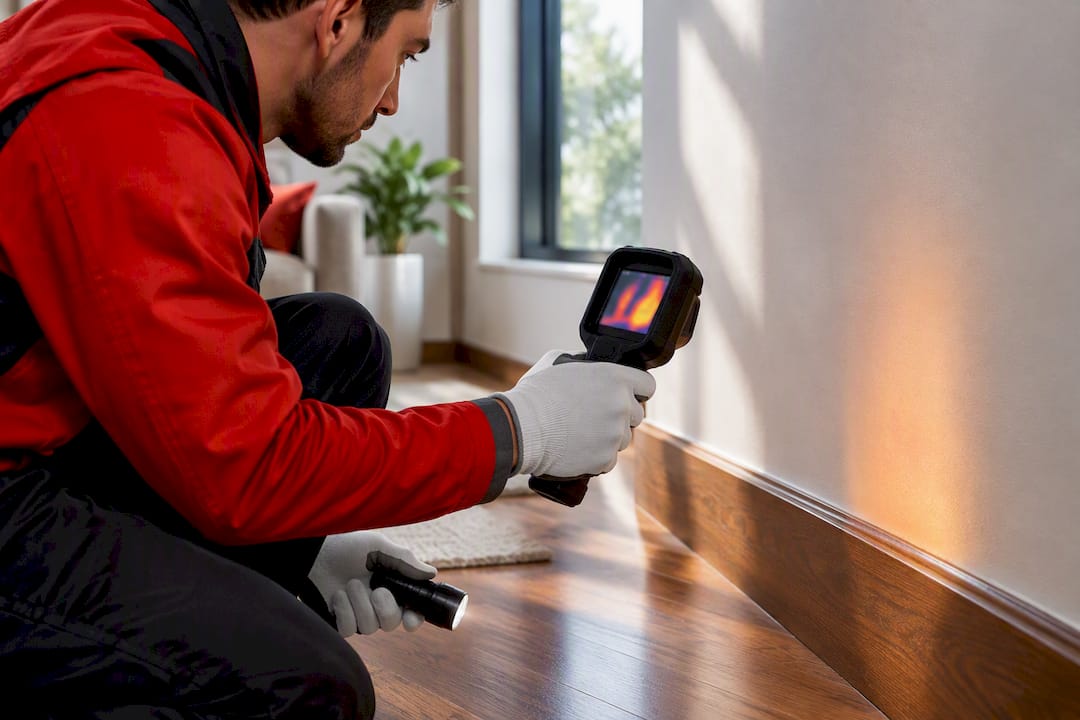
- Thermal imaging: infrared cameras detect subtle temperature and moisture differences behind walls and in voids, often flagging termite activity long before it's visible on the surface. Thermal imaging is widely supported in arboriculture and pest detection research as an effective supplementary tool when paired with a physical inspection.
- In-ground monitoring stations: stakes placed around a property's perimeter attract foraging termites, giving technicians an early warning system without waiting for visible damage indoors.
- CSI baiting: once a station shows activity, bait containing a chitin synthesis inhibitor is introduced, which foraging termites carry back to the colony and share through social grooming, gradually eliminating the entire nest.
Each method covers a blind spot the others miss. Visual inspection is fast and cheap but shallow. Thermal imaging sees through walls but needs the right temperature differential to register clearly. In-ground stations catch activity before it reaches your home but can take time to activate, particularly if soil conditions or recent tree removal have shifted a colony's foraging route.
Pro Tip: If a technician recommends a follow-up visit rather than declaring your property clear after one inspection, that's usually a sign of thoroughness rather than uncertainty. Subterranean colonies can take weeks to trigger a monitoring station, and a single dry inspection day tells you far less than repeat visits across different conditions.
Homeowners considering thermal imaging as part of an inspection should know it works best on active infestations with a moisture or temperature signature, not old, dried-out damage from a colony that's already been eliminated. That's one reason combined approaches, rather than any single tool, tend to give the most reliable read on a property.
Termite Treatment Options Available in Singapore
Treatment choice depends almost entirely on which termite group you're dealing with, since subterranean and drywood infestations respond to very different approaches.
- CSI baiting: the standard for subterranean colonies, particularly Coptotermes gestroi and curvignathus. Bait stations placed around the property deliver a chitin synthesis inhibitor that spreads through the colony via social grooming and feeding. Local field data shows elimination can take anywhere from 3 to 24 weeks depending on species and site conditions, so patience and scheduled follow-ups matter more than speed here.
- Localized injection or spot treatment: often used for drywood termites confined to a specific piece of furniture, a door frame, or a small section of timber, where treating the entire structure isn't necessary.
- Fumigation: reserved for severe or widespread drywood infestations that have spread through multiple pieces of furniture or large sections of a structure, requiring whole-space treatment to reach every hidden colony.
- Heat treatment: another option for isolated drywood infestations, particularly in furniture, using controlled temperature increases to eliminate termites without chemical exposure.
CSI baiting works especially well against subterranean species because it relies on the colony's own social behavior. Worker termites feed the bait to nest mates, larvae, and eventually the reproductive termites, so the treatment reaches individuals a spray or injection never could. Drywood infestations don't offer that same colony-wide transfer opportunity, since colonies are smaller and more self-contained, which is why localized treatment or fumigation tends to be more commonly used.
Follow-up monitoring after any treatment isn't optional if you want confidence the colony is actually gone. In-ground stations left in place after baiting let a technician confirm activity has stopped rather than just assuming it based on symptom improvement. This lines up with an integrated pest management approach: combine detection, targeted treatment, and ongoing monitoring rather than relying on a single spray-and-hope application.
For homeowners weighing cost against severity, it's worth reviewing a termite treatment cost guide for Singapore before committing to a specific method, since price ranges shift significantly between spot treatments and full-structure fumigation.
What to Do the Moment You Spot Termite Signs
Finding termite evidence in your home doesn't call for panic, but it does call for a specific sequence of actions.
- Photograph everything first: document mud tubes, frass piles, discarded wings, or damaged wood before touching anything. Wide shots and close-ups both help a technician assess severity remotely.
- Avoid disturbing the evidence: don't break open mud tubes or pull apart suspect timber. Disturbing a colony can scatter termites and make an inspection harder to interpret.
- Isolate affected items when safe: if the infestation is confined to a piece of furniture, moving it away from other wood (without breaking it apart) can limit spread while you wait for an inspection.
- Call a licensed pest-control service: this is the right move when you see mud tubes, more than one swarm of wings, structural symptoms like sticking doors, or frass appearing repeatedly in the same spot.
A professional inspection typically starts with the same visual checks you'd do yourself, followed by sampling of any suspect material, thermal imaging where wall cavities or hidden voids are a concern, and a check of any existing in-ground monitoring stations on the property. From there, the technician will outline which treatment fits the species and severity found, along with a realistic timeline for results.
Working through a termite inspection checklist beforehand helps you flag problem areas the technician might otherwise need extra time to locate, and it gives you a clearer picture of what "normal" looks like on your own property going forward.
Preventing Termite Problems Before They Start
Most termite prevention in Singapore comes down to removing the conditions colonies need, rather than any single product or treatment.
- Eliminate wood-to-soil contact: raise fence posts, decking, and garden structures off bare earth using concrete footings or metal brackets.
- Store timber away from the building: firewood, construction offcuts, and spare lumber left against an exterior wall give subterranean termites a direct bridge indoors.
- Fix leaks and manage drainage: moisture around foundations attracts termites and softens wood, making it easier to tunnel through.
- Inspect regularly: check skirting boards, door frames, window sills, and any trees or stumps on the property every few months, particularly after heavy rain.
- Manage landscaping: remove old stumps, keep mulch away from foundation walls, and avoid planting large trees, especially species known to host Coptotermes curvignathus, too close to the house.
Pro Tip: Keep a simple photo log of your foundation and garden timber every few months. Comparing photos over time makes it far easier to spot a new mud tube or a fresh patch of frass than relying on memory alone.
For properties with a known history of termite activity, or those bordering parks and mature tree cover, an ongoing monitoring contract with scheduled inspections offers more consistent protection than a single one-time treatment. Regular checks catch early activity before it reaches the point of visible structural damage, which is almost always cheaper and less disruptive to address.
A Local Perspective on Early Detection
Across the termite cases we've seen throughout Singapore, the pattern is consistent: homeowners usually notice a sign weeks or months after a colony first became active, not at the start. That delay is the single biggest factor separating a quick, low-cost treatment from a full structural remediation.
We've also noticed a common misstep: homeowners spray visible termites or wipe away mud tubes, feeling like the problem is solved, when the colony underground remains completely untouched. That's why an integrated pest management approach, pairing thermal imaging with in-ground monitoring and targeted baiting, matters more than any single quick fix. It treats the colony, not just the symptom you happened to see.
Document what you find, resist the urge to disturb it, and get a proper inspection scheduled. Early action is consistently the difference between a contained treatment and a much larger repair bill.
— Bespoke-Enviro Services
Get a Professional Termite Inspection From Bespoke-Enviro
Professional pest control companies offer Singapore homeowners a faster, more precise alternative to guessing at termite signs alone by using NEA-licensed technicians who combine thermal imaging with in-ground monitoring and CSI baiting to find and treat colonies most visual-only inspections miss entirely.

Our approach starts with a proper inspection, not a sales pitch. A technician walks your property checking for mud tubes, frass, and structural symptoms, uses thermal imaging to check wall cavities and voids for hidden activity, and reviews any existing monitoring stations before recommending treatment. Every method we use follows integrated pest management principles, prioritizing non-toxic, targeted solutions that keep your family and pets safe while still eliminating the colony at its source. For severe or widespread infestations, we also offer full fumigation services when whole-structure treatment is the right call.
If you've spotted mud tubes, frass, or discarded wings anywhere on your property, don't wait for the damage to become visible from the outside. Visit our termite control and treatment page to request an inspection and get a clear treatment plan for your specific situation.
Sources
The species and treatment details in this guide draw on NParks' official species records, peer-reviewed local field research, and established pest identification standards. NParks' Macrotermes carbonarius species page documents habitat and conservation status for one of Singapore's more ecologically notable termites. The 2025 IG-CSI monitoring study provides the field data behind detection timelines and CSI baiting effectiveness referenced throughout this guide. General identification cues rely on established extension pest guidance, and species classification details come from Singapore biodiversity records on Coptotermes gestroi.
- Detection and Control of Subterranean Termites Using In-Ground Termite Monitoring Stations and Chitin Synthesis Inhibitor Baiting for Singapore Urban Trees (2025)
- Macrotermes carbonarius (NParks species page)
- Extension
- The Biodiversity of Singapore — Coptotermes gestroi
FAQ
How Can I Tell What Kind of Termites I Have?
Look at the physical evidence first: mud tubes on walls or foundations point to subterranean termites like Coptotermes gestroi, while frass pellets and kick-out holes in wood indicate drywood termites. If you're unsure, photograph the signs with something for scale and send them to a licensed technician for a clearer read.
What Type of Termites Are Worse?
Subterranean termites, particularly Coptotermes gestroi and Coptotermes curvignathus, cause the most serious structural damage in Singapore because their colonies are large and forage widely underground. Macrotermes and Microcerotermes species mostly target dead wood and garden timber, making them a lower risk to occupied structures.
What Smell Do Termites Hate the Most?
There's no reliable scent-based repellent that eliminates an established termite colony, and relying on smells alone can delay proper treatment while damage continues. Some natural oils are anecdotally reported to deter foraging termites temporarily, but professional inspection and treatment remain the only dependable way to address an active infestation.
Should I Be Worried If I See Termites?
Seeing termites, especially swarmers or mud tubes, is worth taking seriously, but it doesn't always mean severe damage has already occurred. A prompt inspection lets a technician assess the species and extent early, when treatment options like CSI baiting are typically faster and less costly than addressing advanced structural damage.