
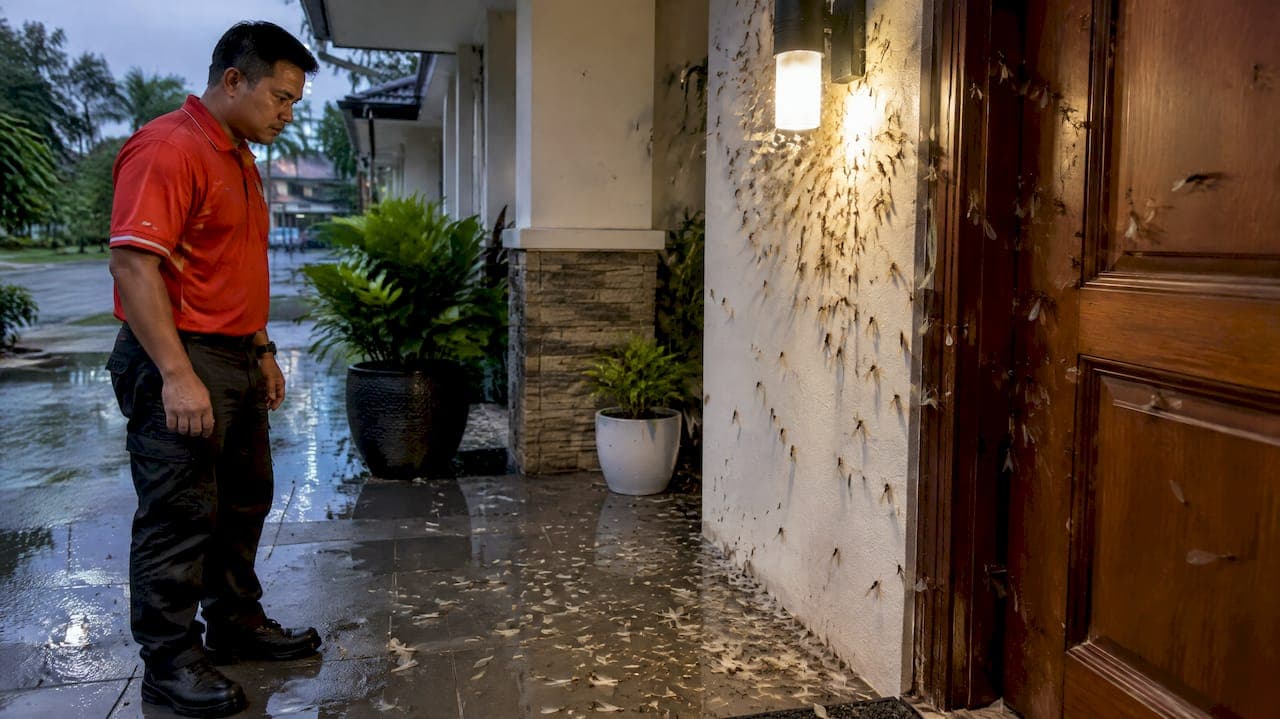
Termites swarm in Singapore throughout the year, but activity peaks on warm, humid nights after heavy rain, especially around the inter-monsoon months and during sudden thunderstorms. If you spot discarded wings near windows or lights after a storm, that is your cue to inspect the property and line up an NEA-licensed Vector Control Operator. Below, we cover the signs, the seasonal patterns, and the compliant treatment steps that follow.
TL;DR:
- Swarming usually occurs after heavy rain or during inter-monsoon months when humidity and still evenings are ideal conditions for termites to emerge.
- Not all swarms indicate immediate structural risk; identifying termite type through inspection is necessary, as subterranean and drywood termites behave differently.
- Post-swarming inspections should focus on mud tubes, hollow timber, frass, and moisture, with quick action recommended within the first few hours.
- Professional treatment with licensed vector control operators involves targeted chemical barriers, bait stations, and ongoing monitoring, but always requires scheduled follow-ups.
- Preventive measures like reducing moisture, removing wood contact, and regular inspections are essential for long-term termite risk management.
Table of Contents
- When and why termites swarm during Singapore's monsoon cycle
- What a termite swarm actually tells you about the colony
- Signs to check for after a swarm event
- Prevention and treatment options for homes in Singapore
- What to do right after you spot a swarm or wings
- Why an NEA-licensed VCO matters for termite treatment
- Our take on managing termite risk year-round
- How we can help if you've spotted a swarm
- FAQ
- Sources
When and why termites swarm during Singapore's monsoon cycle
Singapore does not have a true termite "off-season." Reproductive termites, known as alates, leave the colony to start new nests whenever conditions turn warm, still, and humid, and those conditions show up somewhere in the calendar almost every month. What changes through the year is how often the right trigger lines up with a swarm.
Our climate runs on two monsoon seasons separated by inter-monsoon periods: the Northeast Monsoon from December to early March and the Southwest Monsoon from June to September. The inter-monsoon months, typically April, May, October, and November, bring lighter winds, higher humidity, and frequent afternoon thunderstorms, including the sudden Sumatra squalls that roll in from the west. These are the stretches when swarming tends to become most visible, since the pairing of a downpour followed by a warm, still evening is close to ideal for a mass emergence of winged termites.
Homeowners do not need to track every meteorological detail, but a simple seasonal checklist helps:
- After any heavy storm followed by a calm, humid evening, check porch lights and window sills for discarded wings.
- During the inter-monsoon months, step up visual checks around skirting boards and timber fixtures.
- Through both monsoon seasons, watch for swarms shortly after rain lets up, since termites often time their flight to that window.
- Treat any swarm sighting as a reason to inspect, regardless of the month.
What a termite swarm actually tells you about the colony
The winged insects you see swarming are reproductives, not worker termites. Their job is to pair off, mate, and found new colonies, which means a swarm at your property usually signals that a colony nearby, or inside a structure, has matured enough to produce them. Subterranean termite colonies, the type most often responsible for structural damage in Singapore, can grow into large, long-established networks that spread through soil contact and timber, which is why DIY sprays rarely solve the underlying problem.
Not every swarm points to the same risk. Subterranean termites build mud tubes and need soil or moisture contact to survive, while drywood termites can nest directly inside dry timber with no soil link at all. Dampwood termites favor consistently wet, decaying wood. Knowing which type you are dealing with changes where an inspection should focus and what treatment makes sense.

Signs to check for after a swarm event
A swarm sighting is only the starting point. What you find during a follow-up inspection tells you how serious the situation is and gives a technician something concrete to work from.
- Photograph any discarded wings near windows, doors, or light fixtures, and collect a small sample in a sealed bag if it is safe to do so.
- Look along skirting boards, door frames, and foundation walls for pencil-width mud tubes, which subterranean termites build to travel between soil and timber.
- Tap on wooden fixtures and listen for a hollow sound, a common indicator that termites have hollowed out the interior.
- Check for small, pellet-like frass near wood surfaces, a sign more typical of drywood termite activity.
- Note any bubbling paint or warped flooring, which often points to moisture buildup linked to termite or fungal activity.
- Walk the perimeter where landscaping, mulch, or soil touches the structure directly, since that contact point is a common entry route.
Pro Tip: When photographing suspected termite damage, take one wide shot showing the location on the structure and one close-up in good light. Technicians can narrow down the likely species and entry point faster with both angles.
Prevention and treatment options for homes in Singapore
Day-to-day prevention starts with removing what termites need most: moisture and direct wood-to-soil contact. A few habits make a real difference:
- Keep firewood, timber offcuts, and garden stakes off the ground and away from exterior walls.
- Fix leaking pipes, gutters, and air-conditioning condensation lines promptly, since damp timber attracts termites.
- Improve ventilation in crawl spaces and under-floor areas to reduce the humidity termites rely on.
- Trim vegetation and mulch back from the foundation so soil does not sit directly against timber or masonry.
Professional treatment goes further than household habits can. Pre-construction soil treatment creates a chemical barrier before a building's foundation is laid, while post-construction soil treatment injects termiticide around an existing structure's perimeter. Baiting systems place slow-acting bait stations in the ground to intercept foraging termites and reduce colony numbers over time, and reticulation systems embed piping during construction for future re-treatment without digging up the soil again. Physical barriers, such as stainless steel mesh or graded particle barriers, block entry points without chemicals but work best when installed during construction.
Every one of these methods comes with regulatory strings attached. NEA guidance on termiticide use specifies that soil treatment should not go ahead when the ground is excessively wet or rain is likely, since that raises the risk of termiticide washout into drains and waterways. Only companies registered as Vector Control Operators are permitted to carry out this kind of work, which protects both residents and the environment from improper handling.
A soil chemical barrier or baiting system only works with scheduled follow-up, since treatment effectiveness depends on ongoing monitoring rather than a single application. Many local guides recommend quarterly or annual inspections, with extra attention before the wetter inter-monsoon stretches.
What to do right after you spot a swarm or wings
Acting quickly in the first hour or two after a sighting makes the eventual inspection faster and more accurate.
- Photograph the wings, any live insects, and the surrounding area, then bag a small sample if you can do so safely.
- Leave mud tubes undisturbed. Breaking them open scatters the colony and makes it harder to trace.
- Dry out any damp patches nearby and clear loose wood debris or stored timber from the area.
- Hold off on watering plants close to the foundation until the situation is assessed.
- Call an NEA-licensed VCO rather than reaching for an over-the-counter pesticide, and mention the timing of the sighting, recent rain, and any photos you have ready to send.
Why an NEA-licensed VCO matters for termite treatment
Termiticide application is regulated for good reason. Vector Control Operators must be registered with NEA, and the code of practice for licensed technicians sets out how chemicals are stored, applied, and disposed of to avoid harming people, pets, or the surrounding soil and waterways.
A typical professional visit follows a clear sequence:
- An inspection of affected and at-risk areas, sometimes supported by thermal imaging to spot hidden activity behind walls or under flooring.
- A recommendation matched to the termite type found, whether that means a soil barrier, baiting system, or targeted spot treatment.
- Installation of reticulation or bait stations where ongoing access for monitoring makes sense.
- A monitoring schedule, often quarterly for higher-risk properties near greenery or waterlogged ground, and annually for lower-risk homes.
Pro Tip: Ask whichever technician you book whether thermal imaging is part of the inspection. It can reveal termite galleries behind drywall long before visible damage appears.
We built our termite service around integrated pest management, pairing non-toxic treatment options with inspection technology like thermal imaging so the diagnosis guides the treatment, not the other way around.
Our take on managing termite risk year-round

Treating swarm season as a single window misses the point. We see the real risk as constant, with visible spikes after rain that simply make it easier to notice what has likely been building for a while. Prevention around moisture and wood contact matters every month, not just before a storm.
The properties that fare best are the ones with a routine: inspect after any swarm sighting, keep a professional involved for anything beyond basic housekeeping, and treat soil barriers or bait stations as ongoing commitments rather than a single fix. A treatment lowers risk. It does not remove the need to keep checking.
— Bespoke-Enviro Services
How we can help if you've spotted a swarm
If you have found discarded wings, mud tubes, or any of the signs covered above, we offer termite control and treatment services in Singapore built around licensed inspection, targeted treatment, and the ongoing monitoring that soil barriers and baiting systems need to stay effective.

Before you book, a few quick things speed up the first visit:
- Have photos of wings, mud tubes, or damaged timber ready to share.
- Note the date of the sighting and recent weather, since that helps narrow down likely activity.
- Mention any areas of the property with past moisture issues or wood-to-soil contact.
Beyond termites, our general pest control services cover other common household concerns if you notice more than one issue during your inspection. Reach out through our termite control and treatment page to arrange an NEA-compliant inspection.
FAQ
Should I worry about swarming termites?
A swarm is worth taking seriously, since it usually means a colony nearby has matured enough to reproduce. It does not always mean your specific structure is infested, but it is a solid reason to inspect skirting boards, door frames, and timber fixtures for mud tubes or hollow wood.
What time does termite stop swarming?
Swarming activity tends to taper off after dusk settles into a calm, dry stretch, since termites are drawn out by warm, humid, still air right after rain. There is no fixed clock time; it depends more on weather conditions than the hour.
Which smell do termites hate?
Homeowners often mention cedar oil, vetiver, or clove-based scents as mild deterrents, but none of these replace professional treatment for an active infestation. A mature colony needs a licensed inspection and a proper treatment plan, not a scent-based fix.
What kills termite swarms?
Swarmers themselves are short-lived and die off quickly if they fail to pair and burrow, but the swarm is a symptom of a larger colony that needs addressing. Licensed soil treatments, baiting systems, or physical barriers applied by an NEA-registered operator target the colony itself, not just the visible swarm.
How often should I inspect my home for termites?
Many local guides recommend quarterly checks for properties near greenery or damp ground, and at least annual checks for lower-risk homes. Stepping up inspections ahead of the wetter inter-monsoon months is a sensible habit given how closely swarming tracks rainfall and humidity.