
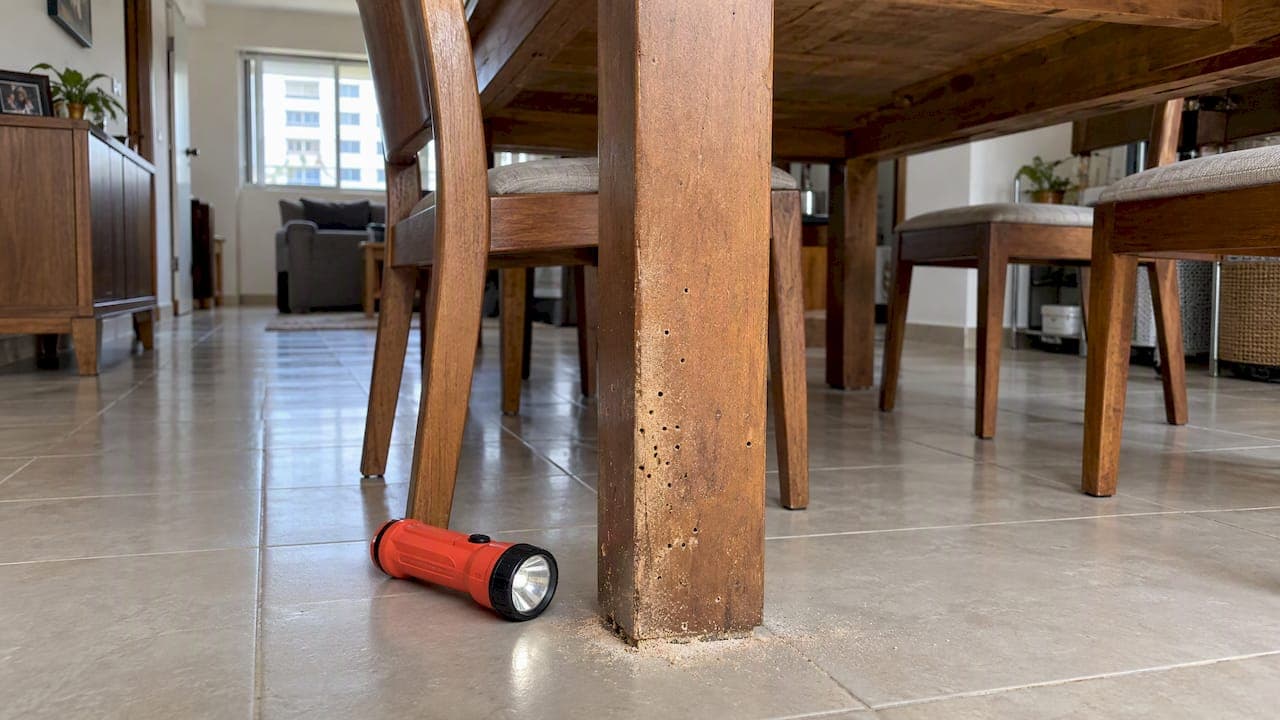
Wood borer treatment starts with one question: is the infestation active? If it is, the right treatment depends on what the wood is. Furniture can often be treated with borate products, heat or freezing. Structural timber in a home or building needs a licensed professional to inspect it, confirm activity and choose between surface treatment, replacement or fumigation. Holes alone do not prove a problem, and acting on old damage wastes money.
This guide explains how to tell active borers from old damage, how to separate them from termites, what each treatment does, what affects cost in Singapore and how to keep them from coming back.
TL;DR
- Fresh, powdery frass that reappears a few weeks after you clear it means the infestation is active. Old holes with no new dust usually do not need treatment.
- Wood borers leave fine, flour-like dust. Subterranean termites build mud tubes. If you see mud tubes, treat it as a termite problem.
- One or two infested pieces can often be replaced. Furniture can be treated with borates, heat or freezing. Widespread or hidden infestations need a licensed professional.
- In Singapore, pest control work should be done by a registered vector control operator with licensed technicians, using NEA-registered pesticides.
- Dry wood is the best prevention. Control humidity, fix leaks and inspect timber before it enters your home.
Table of Contents
- What wood borers are and why Singapore homes are exposed
- How to tell if the infestation is active
- Wood borer or termite?
- Treatment options by situation
- When to call a licensed professional
- Our perspective: inspect first, treat the cause
- What affects the cost of wood borer treatment
- Get an inspection from us
- How to stop wood borers coming back
- FAQ
- Sources
What wood borers are and why Singapore homes are exposed
"Wood borer" is a catch-all name for beetles whose larvae tunnel through timber. The adult lays eggs in cracks and crevices, the larvae feed inside the wood for months or longer, and the adult chews its way out, leaving a small round exit hole. Powderpost beetles are the group most homeowners meet. We cover them in more detail in our guide to powderpost beetle treatment with borates first.
Singapore is a demanding place for timber. A 2025 article on the local built environment notes that the country consistently records some of the highest humidity levels in the world, and that wood absorbing this moisture becomes softer and more vulnerable. Wood borers are attracted to timber with higher moisture content, which is why damp, dark areas are the first places to check.
The things most often affected in homes are:
- Solid wood furniture, including upcycled or reclaimed pieces
- Timber flooring and skirting
- Door frames, window frames and wooden cabinetry
- Roof timbers in landed properties and older shophouses
- Rattan, bamboo and plywood items
- Stored timber and packing crates in commercial and industrial sites
How to tell if the infestation is active
This is the decision that matters most. Visible holes tell you borers were there at some point. They do not tell you borers are there now.
Signs of current activity
University of Maryland Extension advises looking for fresh-looking frass outside or near exit holes. Frass is the powdery or gritty dust the larvae push out. If piles reappear a few weeks after you clear them, the infestation is active.
Cornell's integrated pest management guidance adds that new damage generally shows frass or sawdust and a lighter-coloured interior inside the hole. Old holes may have been present before the wood was even cut and milled. In other words, a hole in a bought piece of furniture may predate you by years.
Sound is another clue. The same Maryland guidance says large larvae can sometimes produce rasping or clicking sounds, especially in spring and summer, and that stethoscopes are sometimes used in diagnosis. In Singapore's year-round warmth you should not rely on a season, but a quiet room and a careful ear can still help.
A simple check you can do at home
- Vacuum or brush away all dust from the suspect area and the floor beneath it.
- Put a sheet of dark paper or a strip of tape under the holes so new dust shows clearly.
- Check weekly for three to four weeks and photograph what you find.
- Compare: if fresh, fine powder keeps appearing, the infestation is active. If nothing appears, the damage is probably old.
The British Pest Control Association makes the same point from a professional standpoint: the key question is whether the evidence proves current activity, and all timber showing possible signs should be assessed by a suitably qualified professional to establish whether activity is current or historical before treatment begins.
Why hidden larvae are hard to confirm
Larvae live inside the timber, so you often cannot see them. Researchers have shown that acoustic-emission sensors can detect larval activity without opening the wood. A 2026 peer-reviewed study found that reliable detection extended to roughly 30 cm under its tested conditions, that sensitivity drops with distance and that expert interpretation is still needed. The practical lesson for homeowners: a single quick look is rarely enough for large structural members, and interpretation is a skill.
Wood borer or termite?
The two are often confused, and the treatments are different. Using a borer treatment on a termite problem leaves the colony alive.
| Sign | Wood borer (beetle larvae) | Subterranean termites |
|---|---|---|
| Dust or debris | Fine, flour-like frass pushed out of small round holes | Mud tubes on walls and timber, soil-like material |
| Wood when tapped | May sound hollow | Often sounds hollow |
| Holes | Small round exit holes | Usually few visible holes; damage is often hidden |
| Typical response | Targeted wood treatment, replacement or fumigation | Baiting, soil or wall treatment, colony elimination |
A Singapore flooring guide describes the same split: wood borers leave fine, flour-like frass, while subterranean termites build mud tubes. Cornell's guidance also stresses that diagnosis should combine hole appearance, frass texture, timber type and whether the damage is new or old.
If you see mud tubes, winged insects near lights or soft, papery timber, read our guide to six termite species in Singapore and get a termite inspection. Our termite control and treatment service covers that case.
Treatment options by situation
There is no single wood borer treatment. The right method depends on what is infested, how deep the larvae are and whether the item can be moved.
Replace a few infested pieces
If only one piece or a few pieces are affected, Maryland Extension says removal and replacement is recommended, and that there is no need for immediate action. It advises consulting a licensed pest control company when the infestation is widespread, hard to reach or the wood cannot be replaced. This is the cleanest fix for a skirting board, a single shelf or a small timber offcut.
Bag removed wood before carrying it through the house so that larvae and dust do not spread. When you dispose of replaced timber, a guide to timber waste disposal shows how bulk timber is separated and handled as its own waste stream.
Treat infested furniture
For active furniture infestations, a Singapore timber retailer's guide suggests spraying an insecticide and brushing on a borate-based product before sealing crevices, with fumigation considered if the damage is extensive. Borates soak into the wood and make it unattractive to feeding larvae. They are a sensible first step because they are low in odor and suit indoor use.

For small wooden items, temperature can work without chemicals. Texas A&M's extension publication says small items can be frozen at about 0°F (around -18°C) for at least 7 days or heated internally to 140 to 150°F (60 to 66°C) for 2 to 4 hours. Most household freezers will not hold a large piece, and heating at home risks cracking veneers and glue joints, so reserve this for small carved items, picture frames and similar pieces.

Once a piece is clear, fill the holes with wood putty, sand and refinish. Finishing also seals the cracks where new eggs would be laid.
Treat structural timber
The same Texas A&M publication says structural infestations may be managed by replacing infested wood, applying residual insecticides to the wood surface or fumigating the structure. Which one applies depends on how much timber is involved and whether it can be reached.
| Situation | Usual approach |
|---|---|
| One or two accessible pieces | Remove and replace |
| Surface-level activity on accessible timber | Borate or residual surface treatment |
| Small movable items | Freezing or controlled heating |
| Widespread, hidden or inaccessible infestation | Professional assessment, possibly fumigation |
| Mud tubes or soft, papery timber | Treat as termites, not borers |
Over-the-counter products
Singapore hardware stores sell woodworm eliminator products you can brush or spray on. For a single wardrobe or table, these can be a reasonable first step if you follow the label and ventilate the room. They are not a diagnosis. They will not tell you whether the infestation is active, and they will not reach larvae deep inside a roof beam or a built-in cabinet.
When to call a licensed professional
Call for an inspection when any of these apply:
- Frass keeps appearing after you have treated and cleaned the area
- The infested timber is a roof member, floor joist, door frame or built-in cabinet you cannot remove
- Holes appear in several rooms or on several pieces at once
- You are not sure whether the problem is borers or termites
- You are buying, renting out or renovating a property and need a clear record of condition
- The site is a commercial or industrial space with stored timber, pallets or packaging
A professional inspection answers the first question, active or historical, before any chemical goes on the wood. That protects you from paying for treatment you do not need and from skipping treatment you do.
What a licensed operator should show you
Singapore regulates pest control work. NEA's code of practice states that companies undertaking vector control work must register as vector control operators, and that their employees must be licensed or provisionally licensed technicians, or certified or provisionally certified workers, and follow Workplace Safety and Health Act requirements. The same code calls for pesticides registered with NEA and labeled for the target pest, and for protective equipment as specified in the product's safety data sheet and label.
In practice, ask any provider:
- Are you a registered vector control operator, and are the technicians on my job licensed?
- What evidence of current activity did you find, and can I see it?
- Which product will you use, and is it registered with NEA for this purpose?
- How long should people and pets stay out of the treated area?
- What follow-up inspection is included?
Our perspective: inspect first, treat the cause
We have worked on Singapore homes, commercial sites and construction sites for more than 30 years, and the most common mistake we see is treating before confirming. A hole in a table is not an emergency. An active infestation in roof timber is. Telling the two apart is what an inspection is for.
Our approach follows integrated pest management. We confirm what the pest is and whether it is active, find the moisture or access problem that let it in, choose the least disruptive effective treatment and then check the result. Our technicians are NEA-licensed, and we use non-toxic, environmentally safe methods that put the safety of people and pets first. For inspections where the damage is hidden, we use advanced tools such as thermal imaging to find moisture and activity that the eye cannot see.
We also advise against fumigation as a first reaction. It has its place when infestation is extensive or the timber cannot be reached, and we offer it, but a borate treatment or a targeted replacement is often enough. If the evidence points to termites rather than borers, we say so and treat accordingly.
— Bespoke-Enviro Services
What affects the cost of wood borer treatment
Singapore pest control companies rarely publish a flat rate for wood borer work, and we do not publish one either. The reason is that the scope varies widely from one job to the next. These are the factors that move the price:
- Size of the affected area. One cabinet is a different job from a whole roof frame.
- Accessibility. Treating exposed timber is simpler than opening ceilings, lifting flooring or working at height.
- Method. Surface borate treatment, injection, heat or freezing and fumigation each carry different labor and equipment costs.
- Property type. Landed homes, shophouses, offices and industrial sites have different access and safety requirements.
- Whether termites are also present. A combined problem needs a combined plan.
- Follow-up. A re-inspection or a maintenance contract adds to the scope but lowers the risk of repeat infestation.
The fair way to compare quotes is to ask each provider what they found, which method they propose, what area it covers and what follow-up is included. Our guide to termite treatment costs in Singapore shows how scope drives price for a closely related problem.
Get an inspection from us
If you have found holes and dust and want to know where you stand, our pest control team can inspect the timber, confirm whether the infestation is active and recommend the least invasive treatment that will work. For extensive infestations, we also provide fumigation services in Singapore. We are available 24/7 for urgent cases. Contact us through our website to arrange a visit.
How to stop wood borers coming back
Treatment removes the larvae that are there now. Prevention keeps new ones from settling in. Maryland Extension recommends inspecting timber and wood products before bringing them into the home, using properly kiln-dried or air-dried wood, improving ventilation and drainage, and finishing wood to fill cracks where eggs may be laid.
For Singapore homes and buildings, that translates into these habits:
- Control moisture. Repair leaking pipes, aircon drip lines and roof leaks quickly. Wet timber invites borers.
- Run dehumidification or airflow in closed storerooms, wardrobes and bookcases.
- Inspect before you buy. Check second-hand and reclaimed furniture for exit holes and fresh dust, and keep new pieces apart for a few weeks if you are unsure.
- Seal and finish timber. Varnish, lacquer or paint closes the cracks where females lay eggs.
- Keep timber off the floor and away from dark, damp corners. Do not store offcuts, crates or pallets indoors.
- Inspect on a schedule. Property managers and MCSTs should fold timber checks into routine inspections, as we explain in our guide to NEA-aligned pest control schedules.
Construction and fit-out sites have a particular exposure, because large volumes of timber arrive, are stored and are installed in short order. Checking deliveries and keeping stock dry reduces the chance of carrying an infestation into a finished unit.
FAQ
How do you eliminate wood borers?
Confirm first that the infestation is active by checking for fresh frass that returns after cleaning. Then match the method to the item: replace a few infested pieces, brush borate on furniture, or freeze or heat small items. Widespread or hidden infestations in structural timber need a licensed professional, who may recommend surface treatment or fumigation.
Can I treat wood borers myself?
For a single piece of furniture, yes, using a borate or woodworm product according to its label and with good ventilation. For roof timber, built-ins or infestations in several places, you should get an inspection. Without a professional assessment you cannot be sure the infestation is active or fully treated.
Is wood borer damage the same as termite damage?
No. Wood borers leave fine, flour-like frass and small round exit holes. Subterranean termites build mud tubes and often hollow out timber with little visible sign on the surface. The two need different treatments, so identify the pest before you spend money.
How much does wood borer treatment cost in Singapore?
There is no standard price, because the cost depends on the area affected, how accessible the timber is, the method used and whether termites are also present. Ask for an inspection and a written scope from a registered operator so you can compare quotes on the same basis.
Is wood borer treatment safe for pets and children?
It can be, when a licensed technician uses NEA-registered products according to the label and safety data sheet. Ask how long people and pets should stay out of the treated area. We use non-toxic methods and put the safety of people and pets first.
Sources
- Old House Borer, University of Maryland Extension
- Wood destroying insects, Cornell IPM
- Detection of Active Wood-Boring Insect Larvae, PMC
- PestWatch: Insects that destroy wood in buildings, British Pest Control Association
- Wood-boring Beetles of Structures, Texas A&M
- Tackling Wood Borers: Identification, Treatment and Prevention
- A Guide to Identifying Wood Bugs in Your Singapore Home
- Code of Practice for Vector Control Operator, Technician and Worker, NEA
- Timber waste disposal