
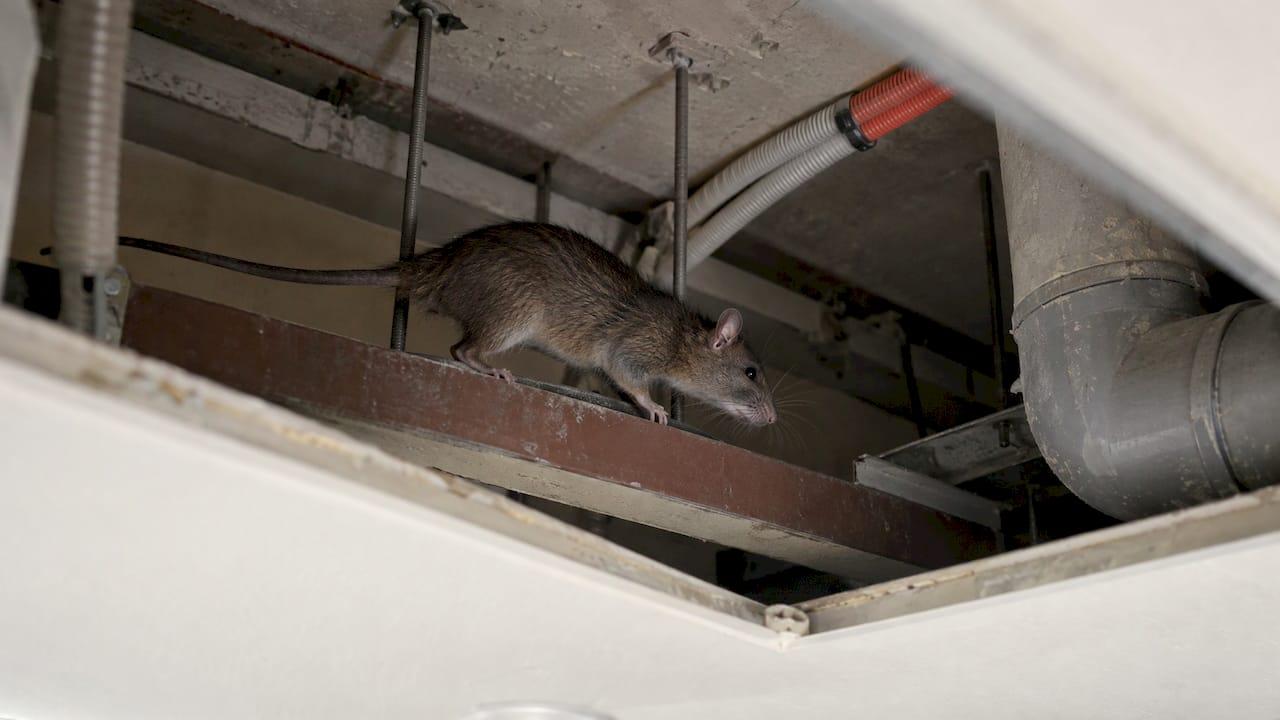
If you hear scratching, running or gnawing above your false ceiling, treat it as an active rodent problem. The void is dark, warm and full of cables, so rats settle there quickly and stay unseen while they damage wiring and contaminate surfaces. The safest way to deal with rats in a ceiling is to confirm the signs from below, stay out of the void, and have an NEA-licensed operator find the entry point, remove the rats and seal the route. Our rodent and rat control service is built around exactly that sequence, using non-toxic, integrated pest management (IPM) methods that put people and pets first.
TL;DR
- Scratching, droppings, grease marks and gnawed ceiling boards are the main signs of rats above a false ceiling.
- Rats in a ceiling are a health and fire risk: NEA warns they spread disease and that gnawed wiring can cause a short circuit and fire.
- Removing the rats is only half the job. The entry point must be found and sealed, or new rats move in.
- Do not climb into the void yourself. A licensed technician inspects it with the right equipment and a documented plan.
- Businesses and property managers should keep records of inspections and treatments for audits.
Table of Contents
- Why rats end up in false ceilings
- Signs of rats in a false ceiling
- What rats in your ceiling put at risk
- Why you should not tackle the void yourself
- How rats in a ceiling are dealt with, step by step
- Sealing the ceiling and keeping rats out
- Homes, businesses and managed buildings
- Rodent control from Bespoke Enviro
- Our perspective
- FAQ
- Sources
Why rats end up in false ceilings
Rats need three things: food, water and shelter. Singapore's Minister for Sustainability and the Environment has described rat problems as driven mainly by easy access to food, water and shelter, with poor waste management and feeding of strays as common causes. A false ceiling gives them the shelter. It is quiet, it is warm, and it connects to walls, risers and neighboring units.
Roof rats are the usual suspects overhead. Research from a US wildlife damage program notes that roof rats may live between floors or above false ceilings and come down to feed. They are agile climbers, so a gap well above ground level is as useful to them as one at floor level. If you want to know how to tell them apart from other rodents, our guide to roof rat identification in Singapore explains what to look for.
In practice, the rats in your ceiling usually came from somewhere specific: a gap around a pipe or conduit, an open vent, a damaged board edge, a shared void with the next unit, or a food source nearby such as an unsecured bin area. Finding that source is the real task.
Signs of rats in a false ceiling
You rarely see the rats themselves. You see what they leave behind. Singapore's food regulator lists the official signs of infestation in its guidelines on preventing rat and cockroach infestations: droppings, smear marks on walls and ceilings, gnaw marks on doors, false ceiling bitten through by rats, burrows, and sightings of live rats.
From below the ceiling, check for these:
- Noises at night. Scratching, scurrying or thumping above you, usually after dark when rats are active.
- Droppings. Dark, pellet-like droppings on ceiling boards, near light fittings, in cupboards below the ceiling or on top of wardrobes.
- Stains and grease marks. Rats carry oil and dirt on their fur. Academic extension guidance from North Carolina State University explains that oily rub marks along familiar paths show where rats travel and can indicate how long an infestation has lasted.
- Gnawed or sagging boards. Rats gnaw constantly because their teeth keep growing. Chewed edges around vents, light fittings and access panels are a clear sign.
- Smell. A musty, ammonia-like odor, or the smell of a dead rat in the void, which tells you the problem has been there for some time.
- Stains that spread. Brown, damp patches on boards can mean urine soaking through.
- Electrical faults. Flickering lights, tripping circuits or dead sockets can point to chewed cabling.
Note where and when you hear or see each sign. A short written log with the time, the location and what you noticed helps a technician target the inspection.
What rats in your ceiling put at risk
Three things are at stake: health, property and electrical safety.
Health. According to NEA's rat prevention and control page, rats can carry and spread Leptospirosis, Murine Typhus and Hantavirus by contaminating the environment, food and water. Their excretion and urine can contaminate food, and they can transmit diseases such as Salmonellosis. Droppings and urine in a ceiling void do not stay there: dust and droplets can reach the rooms below, especially around vents and light fittings.
Property. NEA states that gnawing on wires, insulation and building materials can lead to costly repairs. Insulation soiled with urine and droppings often needs replacing, and stained boards need repair.
Fire. The same NEA page warns that damaged electrical wiring can cause a short circuit and, in severe cases, start a fire. University of California IPM guidance also notes that roof rats in attics can cause electrical sparks and fires through gnawing and nest-building. A ceiling void is full of wiring, so this risk is real in Singapore homes and offices alike.
For a business, add the regulatory and reputation costs. A food establishment with rat activity in a ceiling faces inspection findings, not just a nuisance.
Why you should not tackle the void yourself
It is tempting to lift a panel, look and set something down. We advise against it for four reasons.
- Contact with contamination. Disturbing droppings, nests and urine-soaked insulation puts dust and pathogens into the air you breathe.
- Electrical hazards. Chewed cables may be live. Stepping or leaning on boards that are not designed to carry weight also risks a fall.
- Rats avoid new objects. The NC State guidance points out that rats show neophobia, meaning they often avoid unfamiliar objects. A trap or bait placed without knowing their routes is often ignored.
- Toxic baits in the void are restricted. NEA's Code of Practice for Vector Control Operators states that tamper-proof bait stations containing toxic baits are not allowed in the false ceiling of food establishments. Poison can also lead to dead rats in places you cannot reach, with odor and fly problems that follow.
The point is that a ceiling void is a controlled working environment. Leave the entry to someone licensed, trained and equipped.
How rats in a ceiling are dealt with, step by step
Here is the routine that a competent, licensed operator follows, and what each step takes.
1. Inspect and record
The inspection identifies and records all signs: droppings, rub marks, gnaw marks and live rodents. NEA's sample rodent contract specifications describe using special equipment such as night-vision infrared cameras and borescopes to verify infestation in inaccessible areas like confined ceiling space. This is where an operator's tools matter. Our technicians are NEA-licensed, and we use advanced technology such as thermal imaging for inspections, so we can look into places that are hard to reach.

Where it goes wrong: a quick glance through one access panel misses nests several meters away. A proper inspection covers the whole void and the routes in and out.
2. Identify the source
The NEA Code of Practice requires a detailed client proposal that identifies the likely origin of the rodents within the premises, for example the false ceiling or a hole or gap providing an entry point, assesses the infestation level, and describes a preventive strategy. In other words, the proposal should answer where they came from and how bad it is before any treatment begins.
3. Treat with a plan that suits the space
Treatment depends on the findings, the type of premises and who occupies it. For homes with children and pets, and for eco-conscious clients, we use non-toxic, environmentally safe methods grounded in IPM. IPM means combining inspection, sanitation, proofing and targeted control rather than relying on a single product. Where rodenticides are part of a plan elsewhere on a site, NEA's code sets the standard: tamper-proof bait stations around building perimeters, baits secured in the feeding chamber of burrows, and a recommendation for baits with a safety ingredient such as Bitrex (denatonium benzoate) to protect children, pets and wildlife.
4. Remove carcasses and clean up
Dead rats, droppings and soiled insulation must be removed and the area disinfected. NEA's sample specifications include carcass removal and disinfection as part of the work. Skipping this step leaves odor, flies and a disease risk behind.
5. Seal the entry points
This is the step that decides whether the problem returns. See the next section.
6. Follow up and monitor
Rats can return, especially in a building with shared voids. A follow-up visit confirms that activity has stopped and that the proofing holds. For commercial sites, NEA's sample specifications describe checking false ceilings at least monthly for entry gaps, nests, fresh droppings, grease marks and gnaw marks.
We are available 24/7, which matters when you hear rats overhead at midnight and want the problem assessed quickly.
Sealing the ceiling and keeping rats out
The longest-lasting rat control strategy is exclusion: building them out. UC IPM calls it the most successful and longest-lasting approach, and advises sealing all holes larger than 1/4 inch (about 6 mm) and plugging openings above ground level, since roof rats are excellent climbers. NC State Extension adds that gaps of 1/4 inch or larger let juvenile rats in, and gaps of 1/2 inch (about 13 mm) or larger let adults in. It recommends sealing holes, gaps and cracks in walls, floors and ceilings, and around conduits, electrical wires, water pipes, exhaust vents and ducts.
Singapore's food regulator gives similar direction to food operators: seal holes or crevices in ceilings, walls or floors, cover floor traps and downpipes with grating, fit strong wire mesh at doors and windows, and store food at least 15 cm above the ground in tightly covered containers, metal cabinets or screened rat-proof rooms.
A practical sealing checklist for a ceiling:
- Pipe and cable penetrations, where services run through walls into the void.
- Gaps around air-conditioning trunking and exhaust vents.
- Edges where the ceiling meets a wall or a bulkhead.
- Gaps at roof or external wall junctions, and unscreened vents.
- Shared voids between adjacent units, which let rats move from neighbor to neighbor.
Remove the attractants too. Close bin areas, store food in sealed containers, and fix leaks. Without food and water, a ceiling stops being worth the trip.
Homes, businesses and managed buildings
Homeowners. Your priorities are family health, pets and quiet nights. Choose a treatment that avoids loose poison and gives you a clear explanation of where the rats entered. If you have recently bought or moved into a unit, a move-in pest inspection can catch activity in the ceiling before it spreads.
Food businesses. Rat signs in a ceiling are an inspection finding. Documented, scheduled control matters. Our guides on pest control requirements for restaurants and a kitchen pest checklist show what auditors expect to see.
Property managers and MCSTs. Rats move through connected spaces. The Straits Times has reported that pest control firms advise owners of new buildings to run a thorough pest check before handover, including false ceilings, electrical risers and piping, which rodents use to move between points. A regular schedule keeps this under control; see our notes on pest control frequency and MCST pest check obligations. Facilities teams who want to build in-house understanding of inspection and records can also look at pest control management training for facilities.
Construction sites. New buildings with open voids and unfinished services are easy targets. Inspect before ceilings are closed and before handover, and keep records.

Rodent control from Bespoke Enviro
We provide rodent and rat control for homes, businesses, industrial sites and construction projects across Singapore. Our NEA-licensed technicians inspect with advanced technology, including thermal imaging, and use non-toxic, environmentally safe methods grounded in integrated pest management, with the safety of people and pets as the priority. We are available 24/7.

If you hear rats above your ceiling, book rodent and rat control, or contact us through our main site to arrange an inspection.
Our perspective
Rats in a false ceiling are a building problem, not just a rat problem. Rats are the symptom. The cause is a gap, a food source or a shared void, and a treatment that ignores the cause gives you a few quiet weeks.
With over 30 years in pest management in Singapore, we approach every job with integrated pest management. That means a thorough inspection first, then control and proofing that fit the premises, then follow-up. We prefer non-toxic, environmentally safe methods because ceilings sit above bedrooms, kitchens and offices where people and pets spend their time.
Our technicians are NEA-licensed, and we use thermal imaging in our inspections so that the work starts from what is actually in the void, not from guesswork. If you hear rats tonight, call us rather than open the ceiling. A planned, documented job protects your wiring, your health and your records.
Bespoke-Enviro Services
FAQ
How do I know if the noise above my ceiling is rats?
Rats are usually heard at night as scratching, scurrying or gnawing. Look for droppings, grease marks, gnawed ceiling boards and stains below the ceiling. A licensed technician can confirm activity by inspecting the void with the right equipment, so you do not need to enter it yourself.
Is it dangerous to have rats in the ceiling?
Yes. NEA states that rats can spread diseases such as Leptospirosis, Murine Typhus and Hantavirus, and that gnawed wiring can cause a short circuit and, in severe cases, a fire. If you notice flickering lights or tripping circuits along with ceiling noises, arrange an inspection promptly and consult a licensed electrician about the wiring.
How long does it take to get rid of rats in a ceiling?
It depends on the size of the infestation, the size of the void and how many entry points there are. The job covers inspection, treatment, clean-up, sealing and a follow-up check, so it is not a one-visit fix in every case. We assess your premises and set out a plan.
How do I stop rats coming back?
Seal every gap larger than about 6 mm, especially around pipes, cables and vents, secure food and waste, and fix leaks. For businesses and managed buildings, scheduled inspections of the false ceiling catch new activity early.
Sources
- SFA Guidelines on Prevention of Rat and Cockroach Infestations at Food Establishments
- NEA Rat Prevention and Control
- NEA Sample Rodent Contract Specifications for Food Establishments and Supermarkets
- NEA Code of Practice for Vector Control Operator, Technician and Worker
- Roof Rat Damage Identification, Internet Center for Wildlife Damage Management
- Surveillance and Management of Common Structure-Invading Rats, NC State Extension
- Rats, UC Statewide IPM Program
- A trap for a rat? That's the catch, The Straits Times