
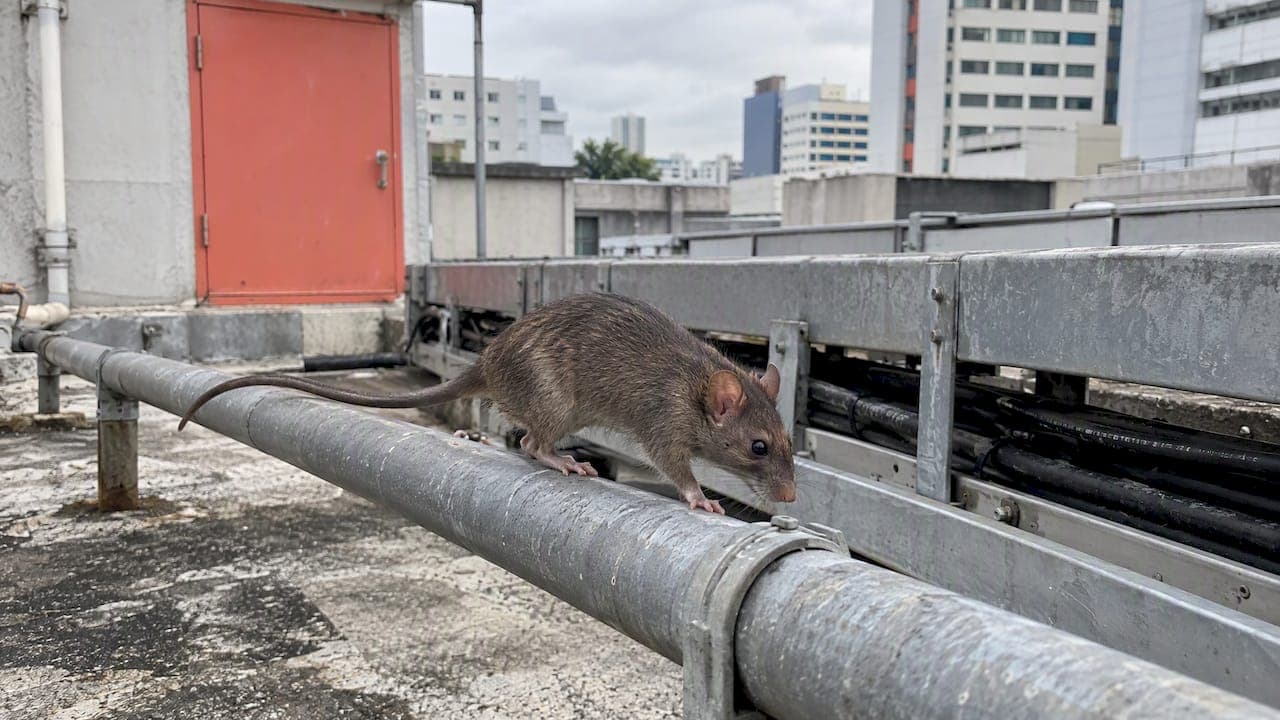
A roof rat is a slim, big-eared rat with a pointed nose and a tail longer than its head and body combined. It climbs well and lives above floor level, in false ceilings, roof voids, trees and cable runs. If you hear scratching overhead at night, find banana-shaped droppings, or see dark smear marks along beams and pipes, you are most likely dealing with this species. This guide shows you how to confirm it, how it differs from the Norway rat, and why the answer decides which treatment works.
TL;DR
- Roof rats have a slim body, pointed nose, large ears and a tail longer than head and body together. Norway rats are thick-bodied with a blunt nose, small ears and a shorter tail.
- Look up, not down. Noises in false ceilings, droppings on beams and gnawed cables point to a roof rat. Burrows and ground-level damage point to a Norway rat.
- Droppings are banana-shaped with pointed ends, about 1/4 to 1/2 inch (6 to 12 mm) long. Use them as a clue, never as the only proof.
- The species decides where bait stations and traps go, and what proofing is needed. A wrong call means weeks of failed control.
- Rodents carry disease, so a confirmed sign calls for a licensed professional inspection, not a wait-and-see approach.
Table of Contents
- Which rats live in Singapore
- How to recognize a roof rat by sight
- Roof rat vs Norway rat: a side-by-side comparison
- Signs that point to a roof rat
- Where to look: think high
- Why the species matters for control
- Our perspective: identify first, treat second
- What to do if you think you have roof rats
- Roof rat control with Bespoke Enviro
- FAQ
- Sources
Which rats live in Singapore
The National Environment Agency (NEA) names three common rodent species in Singapore: the Norway rat (Rattus norvegicus), the roof rat (Rattus rattus) and the house mouse (Mus musculus). The roof rat is also called the black rat, ship rat or, in some places, the sewer rat. The name "roof rat" is a habit, not a colour: it describes where the animal likes to travel and nest.
In Singapore the roof rat matters in a particular way. Homes, shophouses, restaurants and industrial buildings often have false ceilings, trunking, rooftop services and tall vegetation next door. That is the kind of elevated, hidden space this species favors. NEA notes that roof rats are agile climbers that can reach rooftops and false ceilings more easily than other rats.
How to recognize a roof rat by sight
Most people never get a clear look. If you do, check these features in order.
Body shape and size
Roof rats are slender. An adult measures about 5 to 7 inches (roughly 13 to 18 cm) in body length and around 12 inches (about 30 cm) with the tail, according to the University of Arizona Cooperative Extension. The body looks lean and the animal looks agile, not heavy.
Tail
This is the most reliable single feature. The roof rat's tail is longer than its head and body combined, and it is long enough to curl back and touch the tip of the nose when bent around. A Norway rat's tail is shorter than its head and body.
Face and ears
NEA describes the roof rat as having a sharp nose, big ears that reach the eyes when folded forward, and big eyes. The Norway rat has a blunt nose, small ears that do not cover the eyes when folded forward, and small eyes. The ear test is quick and easy to remember.
Color
Color is the weakest clue. Roof rats can be black, gray or brown, usually with a lighter gray, white or black underside. Norway rats can also be brown or gray, so do not name the species by fur alone.
Roof rat vs Norway rat: a side-by-side comparison
The two species look alike in a poor light. This table pulls together the differences that matter, based on NEA's species guidance and the University of Arizona publication.
| Feature | Roof rat | Norway rat |
|---|---|---|
| Body | Slim, lean | Thick, heavy |
| Nose | Pointed | Blunt |
| Ears | Large, reach the eyes when folded forward | Small, do not cover the eyes |
| Tail | Longer than head and body combined | Shorter than head and body combined |
| Droppings | Banana-shaped, pointed ends | Capsule-shaped, blunt ends |
| Typical location | Roof voids, false ceilings, trees, cable runs | Ground level, drains, burrows |
| Movement | Climbs, travels along wires, pipes and fences | Digs, stays low |
The house mouse is a different animal. It is much smaller than either rat, with large rounded ears and a pointed nose. A small rodent is not a young rat: juvenile rats have large feet and heads relative to the body, while mice are small at every stage.
Signs that point to a roof rat
You will usually find evidence long before you see the animal. Rats are cautious and mainly active at night, so they are rarely seen in daylight until a population is large. The Singapore Food Agency (SFA) guidelines list the standard signs: droppings, smear marks on walls and ceilings, gnaw marks on doors and false ceilings, burrows and live sightings.
Noises overhead
Scratching, scampering or rustling in a ceiling void after dark is the classic roof rat sign. It often starts an hour or two after sunset. Heavy thumping at floor level is more typical of larger animals or other causes, so note where and when you hear it.
Droppings
Roof rat droppings are black or dark, banana-shaped with pointed ends, and about 1/4 to 1/2 inch (6 to 12 mm) long. Norway rat droppings are capsule-shaped with blunt ends. Fresh droppings are soft and dark. Old ones are dry and crumbly. Look along beams, on top of ceiling boards, on ledges and near rooftop equipment.

Do not rely on droppings alone. Both species can share a building, and the Arizona extension guide warns that droppings by themselves are not a reliable way to separate species.
Smear and grease marks
Rats follow the same routes every night. Oils and dirt from their fur leave dark smears along walls, pipes, beams and the edges of openings. In Singapore buildings, check the points where trunking, pipes or cables pass through a wall or ceiling.
Gnaw marks
Fresh gnawing looks pale and clean. Check electrical cables, plastic pipes, timber, door edges and false ceiling boards. Gnawed wiring is also a fire risk, which is one more reason to act early.
Nests and food damage
Roof rats nest in roof voids, in insulation and stored materials, and in dense vegetation. Look for shredded paper, fabric or foam. Outdoors, check palms, climbers and thick shrubs against the building. Partly eaten fruit from garden trees, with gnaw marks on the rind, is another sign.
Where to look: think high
A common mistake is checking only near the ground. Roof rats prefer elevated routes: utility lines, fences, pipes, rafters and the branches of trees touching the building. An inspection should cover:
- False ceilings and roof voids, ideally at night or with a strong torch.
- Cable trays, ducting and pipe risers.
- Rooftop plant rooms and water tanks.
- Trees, palms and climbers touching or close to the building.
- Bin areas and food storage, which draw them in.
The SFA guidance and professional practice both use high-intensity torches at night, and thermal imaging can show heat from rodents hidden behind boards without opening up the ceiling. We use thermal imaging in our own inspections for that reason.
Why the species matters for control
Identification is not an academic exercise. NC State Extension stresses that rats are neophobic, meaning wary of new objects, and that correct species identification is critical because control methods differ. In practice:
- Bait station and trap placement. A roof rat moves along elevated routes, so stations at floor level may never be visited. A Norway rat needs ground-level stations near burrows and drains.
- Proofing. Roof rats can enter gaps as small as 1/4 inch and chew through plastic, foam and wood. The UC IPM rat guide recommends sealing with steel wool, wire mesh or sheet metal, and trimming tree limbs back so there is a gap of 3 feet from the roof.
- Follow-up. A roof rat population in a roof void will keep returning until the access routes are closed, even after the visible rats are gone.
This is why integrated pest management (IPM) is the standard approach. NEA's pest control overview describes IPM as a combination of mechanical, environmental and chemical controls, and encourages engaging NEA-licensed pest control companies.
Our perspective: identify first, treat second
We have worked in Singapore pest control for more than 30 years, and the most common reason a rat job fails is a wrong first assumption. A customer sets glue boards or bait on the floor because droppings were found in the kitchen, while the rats are living in the ceiling and coming down only to feed. Weeks pass, the noise continues and the customer concludes that nothing works.

Our approach follows a fixed order. We confirm the species through physical traits and behavioral evidence together, not droppings alone. We inspect high as well as low, using thermal imaging where it helps. We then trace entry points and travel routes, seal what can be sealed, and place stations and traps where that species actually moves. Chemical use is the last layer, not the first, which suits households with children and pets and clients who want non-toxic, eco-friendly methods wherever they are effective.
Our technicians are NEA-licensed, and we are available 24/7 because rat activity does not keep office hours. If you are not sure what you have, send us photographs of the droppings, the damage and the location. That is often enough for a first assessment.
— Bespoke-Enviro Services
What to do if you think you have roof rats
- Record what you see. Note the time of noises, the location of droppings and smears, and take clear photos with a coin or ruler for scale.
- Remove food and water. Store food in sealed containers, bin waste daily, clear pet food at night and fix leaking pipes.
- Cut the bridges. Trim branches and climbers that touch the roof or walls, following the 3 foot guideline above.
- Do not seal the gaps yet. Closing entry points with rats still inside can trap them in the building, where they gnaw to get out or die in the walls. Seal after a professional has cleared the activity.
- Avoid handling droppings or nests bare-handed. NEA lists rat-borne diseases including leptospirosis and rat bite fever. Wear gloves and a mask, and wash your hands well.
- Call a licensed company. Ask for an inspection that covers the roof void and exterior, a written findings report and a plan that includes proofing.
For food businesses, the stakes are higher because of licensing and audit requirements. See our guides to restaurant pest control requirements and pest control frequency for NEA-aligned schedules.
Roof rat control with Bespoke Enviro
If you have confirmed signs of roof rats, or you are unsure which species you have, our rodent and rat control service covers inspection, species identification, treatment and proofing for homes, businesses, industrial sites and construction sites. If rodents are one of several issues, our general pest control service puts them under a single IPM plan with regular visits.
FAQ
How do I know if I have roof rats?
Listen for scratching or running in the ceiling at night, and look for banana-shaped droppings, dark smear marks on beams and pipes, and gnawed cables. If you see the animal, check the tail: on a roof rat it is longer than the head and body combined. A professional inspection confirms the species.
What is the difference between a rat and a roof rat?
A roof rat is one species of rat, Rattus rattus. The other common one in Singapore is the Norway rat. The roof rat is slimmer, with a pointed nose, big ears and a longer tail, and it lives higher up in buildings. The Norway rat is heavier, with a blunt nose and small ears, and tends to stay at ground level.
Are roof rats aggressive?
They avoid people and are cautious by nature, so they rarely attack. A cornered or trapped rat can bite, though, and rat bites carry the risk of rat bite fever. Do not try to corner or handle one. The bigger danger is indirect: disease spread through droppings and urine, and damage to wiring.
How do I permanently get rid of roof rats?
No single treatment is permanent. Lasting results come from removing food and water, closing entry points of 1/4 inch or larger, trimming overhanging vegetation, and trapping or baiting at the right height. Regular monitoring afterward catches any return early.
Can I identify a roof rat from droppings alone?
Not reliably. Banana-shaped droppings with pointed ends suggest a roof rat, but both species can live in the same building. Combine droppings with the location of the signs, noises, smear marks and, where possible, a look at the animal.
Sources
- NEA: Rat Prevention and Control
- NEA: Pest Control Overview
- NEA: Pest Control (disease table)
- SFA: Guidelines on Prevention of Rat and Cockroach Infestations at Food Establishments
- University of Arizona Cooperative Extension: Roof Rats, Identification, Ecology, and Signs
- University of Arizona Cooperative Extension: How to Identify and Discourage Roof Rats
- UC IPM: Quick Tips, Rats
- NC State Extension: Surveillance and Management of Common Structure-Invading Rats