
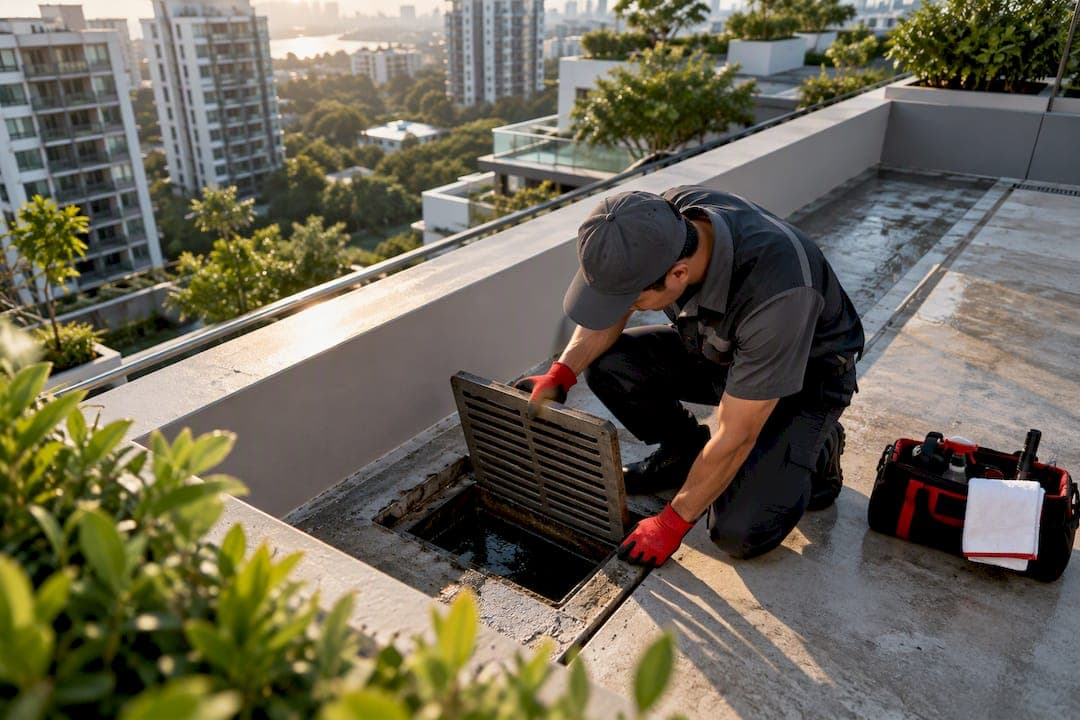
Under the BMSMA, an MCST must maintain common property and that statutory duty covers reasonable pest prevention and continuous monitoring. Failing to meet it risks fines or compensation claims. The standard is reasonableness, not perfection, so councils should review contractor scopes of work, confirm every contractor uses NEA-licensed vector-control staff, and start documenting inspections immediately.
TL;DR:
- The standard for pest prevention is reasonableness, requiring documented inspections and licensed vector-control staff, not perfection, to avoid liability.
- Weekly and fortnightly inspection routines, with photographic proof, are essential for effective compliance under NEA guidelines.
- Soil treatment and scanner-assisted inspections are necessary for termite management, especially with known infestation history, to prevent liability.
- Vague contracts increase liability risk; scope of work, inspection protocols, and evidence requirements must be explicitly detailed and regularly reviewed.
- A structured, documented integrated pest management program provides legal protection and better outcomes compared to reactive treatments alone.
Table of Contents
- MCST statutory duty and legal exposure under the BMSMA
- NEA rules, vector control operator licensing, and operational expectations for condos
- Termite risk, monitoring, and lessons from recent Singapore cases
- Contracts, supervision, and evidence to require from contractors
- Operational checklist and sample annual schedule MCSTs can adopt
- What a documented IPM programme actually changes for MCSTs
- How Bespoke Enviro Services supports MCST compliance
- Sources
- FAQ
MCST statutory duty and legal exposure under the BMSMA
Section 29(1)(b) of the BMSMA requires an MCST to maintain common property in a state of good and serviceable repair. According to BCA's strata management guidance, that duty extends to pest management measures affecting shared soil, drains, and common facilities. Courts do not apply strict liability here. They ask whether the council acted reasonably given what it knew.
Prior knowledge matters a great deal. An MCST aware of past infestations that continues with reactive treatment alone faces a harder case than one with no history and a documented preventive programme. Evidence that convinces a court an MCST acted reasonably typically includes inspection logs, contractor reports, and proof that treatment recommendations were followed rather than deferred.
Remedies differ by forum. The Strata Titles Boards handle disputes between owners and the MCST over maintenance and repair obligations, while civil courts can award compensation for property damage traced to a breach of the maintenance duty. Both routes reward councils that can show ongoing, not occasional, pest management.
NEA rules, vector control operator licensing, and operational expectations for condos
NEA's guidance for condominium estates sets out concrete inspection frequencies: weekly checks of gully traps, bin centres, and planters, with fortnightly reviews of roof drainage and other water-retaining structures. These are the minimums councils should see written into any contractor's scope of work, not vague promises of "regular visits."
Licensing is non-negotiable. Under NEA's Code of Practice for Vector Control Operators, every technician deployed must hold current VCT or VCW certification, pesticides used must carry NEA registration, and proper PPE is mandatory during operations. A contractor that cannot produce these credentials on request should not be on an MCST's shortlist.
Enforcement has teeth: NEA can fine premises significant amounts per mosquito breeding site found on common property. When drafting tender specifications, councils should quote NEA's stated frequencies directly and require photographic proof of habitat removal, since underbidding contractors often cut inspection rounds first.
Termite risk, monitoring, and lessons from recent Singapore cases
Subterranean termites do not respond to spot treatment. They travel through soil galleries invisible from the surface, which is why an effective programme combines in-ground soil treatment or bait stations with scanner-assisted inspections using thermal or microwave detection. A "search-and-destroy" approach that only reacts to visible damage misses the colony entirely.

A defensible three-element termite programme looks like this: continuous soil treatment or bait station coverage around the building perimeter, routine scanner-assisted inspections on a fixed schedule, and targeted colony elimination once activity is confirmed rather than broad spraying. Background industry guidance and the Singapore Standard SS 721:2025 both point to proactive soil treatment and ongoing monitoring as the expected professional standard, even where risk appears low at the time.

The reported Magistrate's Court decision summarized by LeenLee, commonly referenced as SGMC 88 or the Freesia Woods case, found that an MCST with prior knowledge of termite history can be held liable when it fails to carry out reasonable preventive measures. The judgment specifically criticized reactive-only treatment and the absence of soil treatment and monitoring records. Any council managing an estate with known termite history should treat this ruling as the new baseline, not an outlier.
Contracts, supervision, and evidence to require from contractors
A vague contract is the single biggest liability gap we see. The scope of works should name every common area covered, the inspection frequency per area, the treatment methods and materials approved, and the equipment required, including scanners or thermal imagers for termite checks. It should also reference NEA compliance explicitly.
- Assign a named managing agent or council supervisor with audit rights over the contractor.
- Require photographic evidence with timestamps for every service visit.
- Ask for chemical batch numbers and NEA registration marks on materials used.
- Build in scheduled spot-checks and quarterly review meetings with the contractor.
- Set clear termination triggers for missed visits or unresolved recurring issues.
Service reports without dates, photos, or follow-up notes carry little weight if a dispute reaches the Strata Titles Boards or a court. Contracts should also spell out service-level agreements, a warning process for underperformance, and a dispute procedure that does not leave the MCST stuck with an underperforming vendor for years.
Pro Tip: Ask any prospective contractor for a sample service report before signing. If it lacks photos, timestamps, and a follow-up section, it will not hold up as evidence later.
Operational checklist and sample annual schedule MCSTs can adopt
A written calendar turns obligations into habits. Councils can adopt a simple structure and adjust it at annual general meetings.
- Weekly: inspect gully traps, bin centres, and planter boxes for standing water and breeding sites.
- Fortnightly: check roof drainage, air-conditioner trays, and other water-retaining structures.
- Monthly: conduct a site-wide walkthrough covering car parks, ground soil, and common corridors.
- Quarterly: run a termite scanner sweep and check bait stations for activity.
- Annually: review the soil-treatment programme and renew contractor licensing checks.
Retain service reports, invoices, and pesticide use logs for at least the length of the maintenance contract, longer where a known infestation history exists. If an infestation is discovered, the response should follow a fixed order: notify the managing agent, isolate the affected area, apply targeted treatment, complete remediation, then communicate findings to residents. A sample maintenance schedule template can help councils calibrate visit counts against building size and risk.
What a documented IPM programme actually changes for MCSTs
We have watched councils move from reactive call-outs to structured integrated pest management, and the difference in both outcomes and paperwork is stark. Non-toxic treatments and inspection technology like thermal scanning catch problems before they become disputes, and a paper trail of dated reports gives a council something concrete to point to if a claim ever surfaces.
A documented programme does more than satisfy a contractor's obligations. It gives the council its own defense. Ask your managing agent or contractor for a sample scope of works and reporting template before your next renewal cycle.
— Bespoke-Enviro Services
How Bespoke Enviro Services supports MCST compliance
Bespoke Enviro Services works with MCSTs and managing agents to build NEA-compliant, court-defensible pest programmes, using NEA-licensed technicians and documented inspection routines rather than one-off call-outs. We tailor scopes of work to a building's own history and risk profile.

- General pest control services for maintenance contracts covering common property.
- Termite control and treatment with soil treatment, bait stations, and scanner-assisted inspections.
- Fumigation services for severe or persistent infestations requiring deep treatment.
Contact us to request a sample scope of works and an inspection schedule suitable for your estate.
This article is general information, not a substitute for advice from a qualified lawyer. Consult a qualified legal professional about your own circumstances before acting on anything here.
Sources
- BCA — Strata management guides / MCST duties
- NEA — Mosquito control in condominium estates
- LeenLee — Magistrate’s Court decision on MCST duty re termite infestation (SGMC 88 summary)
FAQ
What are the responsibilities of an MCST?
An MCST must maintain common property in good repair under BMSMA section 29(1)(b), which includes reasonable pest prevention across shared drains, soil, and facilities. This covers overseeing contractors, keeping maintenance records, and managing the sinking fund used for repairs and preventive works.
What are the three rules for pest control?
There is no single fixed "three rules" standard, but MCSTs are generally expected to follow prevention, monitoring, and documented treatment as the core pillars. This mirrors NEA's guidance on habitat removal, scheduled inspections, and licensed treatment application.
Can MCST be sued?
Yes, an MCST can face claims from unit owners or third parties if it fails its maintenance duty and damage results. The reported SGMC 88 judgment confirms that MCSTs with prior knowledge of an infestation risk liability if they skip reasonable preventive measures.
Can I cancel my pest control contract?
Cancellation rights depend on the contract terms the MCST signed, including notice periods and termination clauses tied to performance. Councils should check for service-level agreements and warning procedures before ending a contract, and document the reasons in case the decision is later questioned.
Who handles pest control inside individual units versus common property?
The MCST is responsible for common property such as drains, gully traps, and shared soil, while pest issues confined strictly inside a unit typically fall to the owner. Where an infestation originates in common property and spreads inward, the MCST's maintenance duty under BMSMA section 29(1)(b) still applies.