
Eco-friendly termite treatment in Singapore means finding out why termites are in your home, fixing those conditions, and using targeted tools such as in-ground monitoring and bait instead of blanket spraying. It can be effective, but it is not a do-it-yourself job. Termite work in Singapore needs a licensed operator, a proper inspection and a plan matched to the species you have.
This guide explains what "green" and "non-toxic" can honestly mean for termites, which methods fit which situations, what to ask about pets and children, and how to judge a quote.
TL;DR
- An eco-friendly termite plan starts with inspection and moisture or access fixes, then uses targeted baiting or localized treatment only where needed.
- Baiting with chitin synthesis inhibitors can eliminate Coptotermes colonies in weeks, but it needs monitoring and is not set-and-forget.
- "Non-toxic" is a claim to test: ask which active ingredient is used, where it goes, and how pets and children are kept away from it.
- Check that the company holds a valid NEA Vector Control Operator licence and gives an itemized written report and warranty terms.
- Home remedies such as salt water or sunlight rarely reach a hidden colony. Do not rely on them for structural termites.
Table of Contents
- What "eco-friendly" means for termites
- Start with the building, not the product
- The main eco-friendly methods compared
- Is it safe for pets and children?
- What about home remedies?
- How to check a provider before you book
- Our perspective: what we have learned from 30 years of termite work
- Planning for cost
- Book a termite inspection with us
- FAQ
- Sources
What "eco-friendly" means for termites
No one definition covers the phrase, so it helps to break it into what a provider actually does.
Singapore now has a national benchmark. The NEA's background on Singapore Standard SS 721:2025 describes a code of practice for pest management services built on integrated pest management (IPM). In plain terms, IPM puts proactive, science-based prevention ahead of reactive spraying. It uses biological, physical and targeted chemical controls only when necessary, to limit environmental and health risks.
For termites, an eco-friendly approach usually has four parts:
- Identification. You cannot pick a method without knowing the species. Different termites behave differently and respond to different treatments.
- Root-cause correction. Moisture, cracks, wood touching soil and poor drainage all invite termites.
- Targeted treatment. Bait or a localized treatment goes where the activity is, not on every surface.
- Monitoring. Activity is checked over time so the treatment can be adjusted or ended with evidence.
If a company proposes to spray the whole house on the first visit without inspecting, that is not IPM, whatever the brochure calls it.
Start with the building, not the product
Industry professionals in Singapore commonly point out that the best "treatment" is often habitat modification. Termites need moisture, food and a way in. Remove one of those and many problems shrink before any product is used.
The US EPA's termite guidance lists the same logic for construction and upkeep: keep a ventilation gap between soil and wood, seal exposed wood, and keep the structure less attractive to termites. In a Singapore home, this translates into practical checks:
- Fix leaking pipes, air-conditioning drip lines and damp bathroom walls.
- Keep timber, cardboard and stored paper off bare ground and away from damp walls.
- Remove old tree stumps, buried wood and rotting planters close to the building.
- Keep drainage clear so water does not pool against the foundation or in planter boxes.
- Look for mud tubes, discarded wings after a swarm, hollow-sounding timber and bubbling paint.
These fixes reduce the pressure, but they do not remove a colony that is already established. If you see live termites or mud tubes, a licensed inspection is the next step. Our guide to termite species in Singapore helps you recognize what you may be looking at before the technician arrives.
The main eco-friendly methods compared
Each method suits a different situation. The table summarizes how they differ.
| Method | How it works | Best suited to | Main limitation |
|---|---|---|---|
| In-ground monitoring and baiting | Stations detect activity; termites carry a slow-acting bait back to the colony | Subterranean termites, especially Coptotermes, around the building perimeter | Needs regular checks and patience |
| Localized (spot) treatment | Treatment applied only to the infested point, such as a single mud tube or timber section | Small, well-defined infestations | Works best when the source is clearly located |
| Borate wood treatment | Borates applied to timber to make it unattractive or toxic to wood-feeding insects | Exposed or new timber, furniture, some wood-boring beetles | Does not remove a soil-based colony by itself |
| Moisture and structural correction | Repairs, drainage, removing wood-to-ground contact | Prevention and the basis of every plan | Does not eliminate an active colony |
| Soil barrier treatment | A treated zone in the soil around the structure | Cases where baiting is unsuitable, such as some non-Coptotermes species | Uses more product, so it sits at the less targeted end |
Baiting: targeted and effective, with caveats
Baiting is the method most often meant when people ask for green termite control. Foraging termites feed on the bait and carry it back, so the colony is affected rather than only the termites you can see.

A study in Arboriculture & Urban Forestry tested in-ground monitoring stations with chitin synthesis inhibitor (CSI) baiting on Singapore urban trees. The research found colony elimination within about 3 to 6 weeks for Coptotermes gestroi and Coptotermes curvignathus, while more complex species could take up to 24 weeks. Those were tree termites in a research setting, so treat the timings as an indication, not a promise for your home.
Be honest about what baiting is. The active ingredient is a pesticide, used in very small quantities and placed in a targeted way. That is why it fits an IPM framework, but it is not "chemical-free". A good provider will tell you that plainly.
Professional pest managers also caution that baiting is not a universal solution. It works well on Coptotermes, the main structural pest, but it needs continuous monitoring and expert interpretation, and the method should be adapted to the species present. Baiting, barrier treatment or a combination may each be right in different cases. Research on Southeast Asian termite faunas notes that operators in the region typically sell baiting contracts only for Coptotermes and switch to chemical soil treatment when other termite groups turn up.
Localized treatment for small, defined problems
Not every sighting means a house-wide program. When activity is limited to one point, treating that point can resolve it with minimal product. We explain when this applies in our article on localized termite treatment and when one mud tube is enough. The key is a proper inspection to confirm the problem really is contained.
Borates for timber
Borates, a family that includes boric acid and borax, are often described as a least-toxic option for wood. The Northwest Center for Alternatives to Pesticides suggests choosing borates if you decide to use treated wood. They protect the timber they are applied to. They do not by themselves remove a colony living in the soil. For beetle problems in timber, see our note on powderpost beetle treatment with borates first.
Is it safe for pets and children?
This is the question behind searches for pet-friendly, non-toxic and safe termite treatment. No credible provider can say that any pesticide-based treatment carries zero risk, so ask specific questions instead of accepting a label.
Before you sign, ask the provider:
- Which product and active ingredient will be used, and can I see the product information?
- Where exactly will it be placed: inside the home, in the soil, or in sealed stations?
- Are bait stations tamper-resistant, and where will they sit relative to where pets and children play?
- Do pets, children or anyone in the home need to stay out of any area, and for how long?
- How will aquariums, pet food bowls and bird cages be protected?
- Who do I call if a pet shows unusual symptoms? If it happens, contact your veterinarian straight away and give them the product name from the report.
If anyone in the household is pregnant, has asthma or is immunocompromised, tell the company when you book, and ask your doctor if you have a specific concern.
The answers also help you compare companies. A provider who can explain product, placement and precautions clearly is applying IPM. One who only repeats "non-toxic" is not.
What about home remedies?
Search results are full of suggestions: cardboard traps, diatomaceous earth, salt water, sunlight, dry ice and even dish soap. Some of these may kill a few termites you can reach. The problem is that a subterranean colony lives in soil or inside walls and can contain very large numbers of termites, and surface treatments seldom touch it.
There is also a regulatory point. In Singapore, termite treatment by a business must be carried out by a licensed operator, so a service you hire should not be improvised. If you have a single visible mud tube or a swarm in your home, the safe step is to photograph it, avoid disturbing it, and arrange an inspection. Our guide to termite swarms after storms explains what to do and which NEA steps to follow.
How to check a provider before you book
Licence and credentials
The Avalon Services guide to choosing a pest management service notes that in Singapore a firm treating termites must hold a valid Vector Control Operator (VCO) licence, and technicians should ideally hold valid Vector Control Technician or Worker cards. Ask to see them. Licences are also category-specific, so a technician certified for general pest work may not be authorized for termite treatment, as this overview of VCO licence tracking points out.
Inspection before quotation
For a simple ant job, a fixed quote can be normal. For termites, recurring infestations or commercial premises, insist on a site survey and an itemized written quote covering scope, visits, warranty and products. A quote given sight unseen over the phone for a termite problem should make you cautious.
Documentation and warranty
The value of a professional service lies as much in records as in application. A reputable company gives a detailed report after each inspection or treatment, which becomes a useful record for property audits or a sale. Warranties in Singapore are said to run from one to ten years, and they are only worth what the contract says about when free re-treatment applies. Read those triggers before you compare warranty lengths.
Monitoring plan
Ask how often stations or treated areas will be checked, who interprets the findings, and what happens if activity continues. Because baiting depends on follow-up, this schedule matters more than the product name.
Our perspective: what we have learned from 30 years of termite work
We have worked in Singapore pest control for more than 30 years, and the most common mistake we see is treating the symptom. A homeowner finds termites, someone sprays, and the moisture source that attracted them stays exactly where it was.
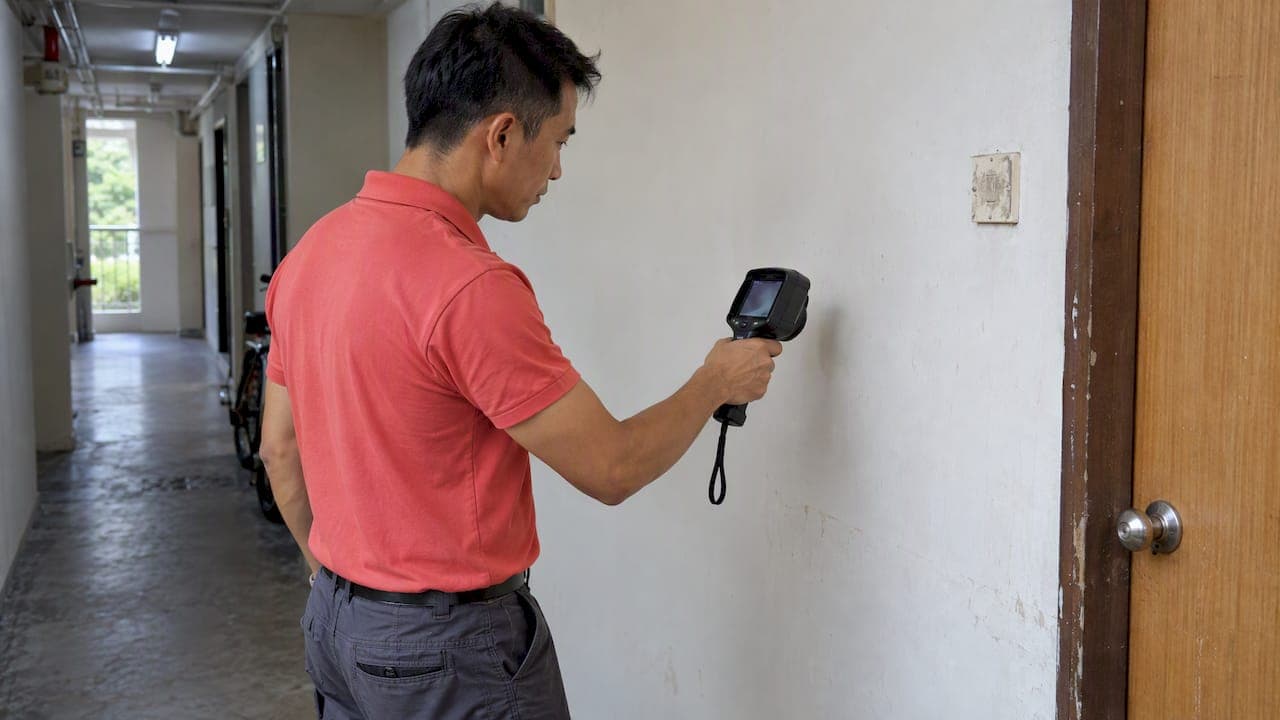
Our approach follows IPM. We identify the species first, because the right method depends on it. We look for the conditions behind the problem: leaks, wood-to-ground contact, gaps and damp. Where treatment is needed, we use non-toxic, environmentally safe methods that put the safety of people and pets first, and we place them where the termites are active. For inspections we use advanced tools including thermal imaging, which helps us see temperature differences that can point to hidden activity without opening walls unnecessarily.

We also tell clients what no one likes to hear: baiting needs monitoring, results take weeks, and some cases call for a combined approach. A fast promise is usually a sign that the method has not been matched to the problem. Our technicians are NEA-licensed, and we are available 24/7 for urgent cases such as a swarm inside the home.
If you want to know more about how we think about the species and methods, our article on subterranean termite control in Singapore goes into more detail.
— Bespoke-Enviro Services
Planning for cost
Prices vary by species, size of the property, severity and the method. We do not publish fixed prices for termite work because a responsible quote follows an inspection. For the factors that move the price, see our termite treatment cost guide for Singapore. When comparing quotes, line them up on the same points: inspection, number of visits, monitoring, products, warranty terms and reporting.
Book a termite inspection with us
If you suspect termites, or you want a plan that avoids unnecessary spraying, we can inspect your home, office or construction site and explain which method fits. See our termite control and treatment service in Singapore to arrange an inspection. If you have several pest problems at once, our general pest control service covers the wider picture under the same IPM approach.
FAQ
Is there a truly non-toxic termite treatment?
Prevention measures such as fixing leaks, improving drainage and removing wood-to-ground contact involve no pesticide at all. Treatments that eliminate a colony generally involve some active ingredient, though baiting and localized methods use far less than blanket spraying. Ask any provider to name the product and explain where it will be placed.
How long does eco-friendly termite baiting take?
It depends on the species and the colony. A study on Singapore urban trees reported colony elimination of two Coptotermes species in roughly 3 to 6 weeks, with more complex species taking up to 24 weeks. Your inspector should give you a realistic estimate after identifying the termites on your premises.
Is termite treatment safe for pets?
Safety depends on the product, the placement and the precautions taken. Ask which areas pets must avoid, how bait stations are secured and how long any restriction lasts. If a pet shows unusual symptoms after any treatment, call your veterinarian and share the product details from your service report.
Can I treat termites myself?
Home remedies may affect a few visible termites but rarely reach the colony. A business treating termites in Singapore needs a valid VCO licence, and a proper inspection is the only reliable way to know what you are dealing with. If you see mud tubes, swarms or damaged timber, arrange a professional assessment.
What should a termite report include?
It should record the species found, where activity was located, what was applied and where, and any follow-up visits. A detailed, itemized report also serves as a record for future property audits or a sale.
Sources
- Singapore Standard SS 721:2025 background, National Environment Agency
- Detection and control of subterranean termites using in-ground monitoring stations and CSI baiting, Arboriculture & Urban Forestry
- Research updates in subterranean termite management, Professional Pest Manager
- Challenges to subterranean termite management in Southeast Asia and Australia
- Termites: How to identify and control them, US EPA
- Managing subterranean termites, Northwest Center for Alternatives to Pesticides
- How to choose the best pest management service in Singapore, Avalon Services
- Best pest control software in Singapore 2026, FieldCamp