
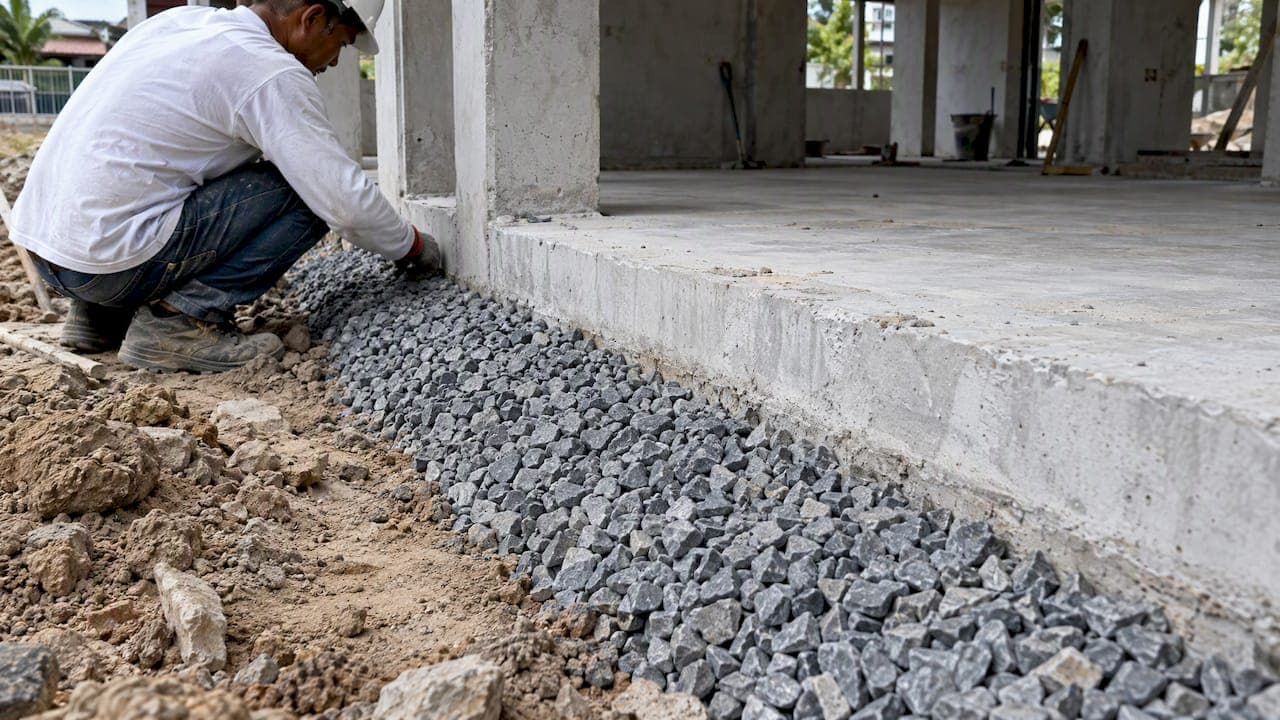
A physical termite barrier is a non-chemical, mechanical exclusion system installed during construction that blocks concealed termite access points such as the slab edge, under-slab area, and service penetrations. It reduces the risk of hidden entry but is not fail-proof: standards like AS 3660.1 require inspection access because no barrier guarantees zero termite attack.
TL;DR:
- For new builds, specify mesh grade, particle gradation, and sealed pipe and joint details before the concrete pour; under slab work cannot be added later.
- Graded sand or basalt barriers rely on particle size and compaction; tested aggregate near ASTM sieve numbers 8 to 12 stopped tunneling when properly installed.
- For an existing building, full under slab replacement is rarely practical, so inspections and localized chemical or bait treatments may address breaches more realistically.
- Schedule a professional inspection annually, and check again after landscaping, trenching, or storms; look for mud tubes, loose mesh, damaged seals, and soil bridging.
- Before hiring an installer, request recognized standards compliance, field test reports, written warranty terms, and specific details for sealing penetrations and mesh flanges.
Table of Contents
- Types of Physical Termite Barriers and What Each Material Does
- Where Barriers Go In: Slab, Edge, Penetrations, and Retrofit Limits
- Lifespan, Durability, and Common Failure Modes
- Inspections and Maintenance: What to Check and When
- Physical vs. Chemical Termite Barriers: Strengths and How They Work Together
- How to Choose the Right Barrier Spec or Contractor
- Why Trust This Guidance
- Our Practical Recommendation for Homeowners
- Get Professional Help Specifying or Inspecting Your Barrier
- FAQ
- Sources
Types of Physical Termite Barriers and What Each Material Does
Barrier systems rely on different mechanisms to stop termites from tunneling through undetected, and recognizing each type helps you read a construction plan or evaluate what a contractor proposes.
- Stainless steel mesh physically blocks termite passage through fine apertures; grade 304 or 316 steel resists corrosion, and flanges are parged or grouted into concrete to seal the connection, a detail confirmed in installation guidance from the Building America Solution Center.
- Sheet membranes and geotextile systems run continuously under a slab or along a foundation perimeter, often doing double duty as a vapor barrier while denying termites a path through seams, a combined function described in guidance on vapor and termite barrier membranes.
- Graded particle barriers, made of sand, basalt, or engineered aggregates, work through particle size and angularity rather than a solid shield. Laboratory research on aggregate barriers found that particle sizes near ASTM sieve numbers 8 to 12, with correct angularity and compaction, prevented subterranean termites from tunneling through in testing.
- Metal termite shields and flashing deflect termites outward along an exposed edge, making shelter tubes visible during an inspection rather than sealing access outright.
Where Barriers Go In: Slab, Edge, Penetrations, and Retrofit Limits
Most physical barriers are built into a structure before the concrete is poured, which shapes both what is possible and what a specification needs to cover.
- Under-slab and slab-edge work happens before the pour: mesh or graded aggregate is laid across the full slab footprint or along the perimeter trench, and this stage cannot be added back once concrete is in place.
- Penetrations and joints, where pipes, conduits, and expansion joints break the slab, need mesh collars, sand-retainer castings, or sealed flange details, since these gaps are a common place for termites to find an opening.
- Retrofitting an existing building has real limits. Full under-slab replacement is rarely practical, so retrofit work typically leans on inspection-led chemical treatments around the perimeter instead of a complete physical rebuild, an approach our post-construction termite treatment guide walks through in more detail.
Builders planning new construction get the most value from specifying barrier type and installation detail early, which our pre-construction termite treatment guide covers for anyone reviewing plans before the foundation stage.
Lifespan, Durability, and Common Failure Modes
How long a barrier performs depends on the material, the quality of the original installation, and what happens to the site afterward. Stainless steel mesh resists corrosion well over time, and particle barriers can remain effective if the graded layer stays undisturbed, but neither is immune to site changes.
- Landscaping or excavation work near the foundation can shift or breach a particle layer without anyone noticing until termites exploit the gap.
- Poor compaction during installation leaves voids in a sand or basalt barrier, undermining the particle-size protection the material depends on.
- Incorrect parging or loose mesh flanges create small seams that termites can work through over years of minor ground movement.
- Corrosion from mismatched metals at a junction point can degrade a mesh barrier faster than the base material would suggest.
Pro Tip: Ask any supplier for field-test reports covering performance under real termite pressure rather than relying on a marketing claim of being "termite-proof."
Inspections and Maintenance: What to Check and When
No physical barrier removes the need for ongoing checks. AS 3660.1 builds inspection access into its design requirements precisely because concealed entry remains possible even with a correctly installed system, and industry guidance on termite barrier systems notes that barriers can be bridged or breached by later site changes, construction defects, or everyday landscaping work.
- Look for mud tubes along the foundation, in crawl spaces, or on exterior walls, since these shelter tubes are the clearest visible sign of termite activity.
- Check joints and penetrations for gaps, deteriorated parging, or exposed mesh that has come loose from the slab edge.
- Inspect landscaping near the foundation, since soil, mulch, or garden beds piled against the wall can bridge a barrier, a risk our guide on mulch and foundation contact explains in practical terms.
- Watch for corrosion or damage on any exposed metal shield or flashing after years of weather exposure.
Pro Tip: Schedule a professional inspection annually, and add an extra check right after any landscaping, utility trenching, or severe storm that disturbs the soil near your foundation. Our termite inspection checklist lays out the full walkthrough homeowners can use between professional visits.
Physical vs. Chemical Termite Barriers: Strengths and How They Work Together
Physical and chemical barriers solve different parts of the same problem, and choosing between them usually comes down to whether you are building new or protecting an existing structure.
- Physical barriers last a long time when undisturbed, involve no toxins, and work best at preventing concealed entry when installed correctly during construction, but retrofit options for existing buildings are limited.
- Chemical barriers, including soil termiticides and bait systems, adapt readily to structures already standing and can address an active infestation by targeting foraging termites directly, though results depend on correct application and the use of registered products.
- A hybrid approach pairs a pre-construction physical barrier with scheduled inspections and, where needed, localized chemical or baiting treatment at a specific breach point rather than full chemical saturation. Our localized IPM treatment approach applies this logic when a single mud tube or isolated entry point turns up during an inspection.
How to Choose the Right Barrier Spec or Contractor
Turning the technical details into a decision comes down to a short list of questions before you sign off on a specification or a contractor.
- Material and grade: confirm mesh type and aperture size, or the particle gradation used for a sand or basalt barrier.
- Installation detail at penetrations: ask how pipes, conduits, and joints are sealed, and whether parging or grout will be applied to mesh flanges.
- Test reports and standards compliance: request documentation tied to recognized standards rather than accepting a verbal assurance.
- Contractor experience: look for a track record specifically with under-slab and foundation work, not general pest control alone.
- Warranties and references: ask for written terms and examples of past installations you can verify.
A contractor who cannot produce test documentation or hesitates on installation specifics is worth a second opinion, including an independent inspection before work proceeds.
Why Trust This Guidance
We bring extensive pest management experience to termite control, with treatment work grounded in the same standards referenced throughout this guide, including AS 3660.1 and published research on particle-size barrier performance. We recommend asking any installer for test reports and checking local building code requirements before work begins.

Our Practical Recommendation for Homeowners
Physical barriers earn their keep in new construction, but they work best as one layer in a broader plan rather than a standalone fix. Pair a correctly installed barrier with scheduled inspections and an integrated pest management approach, and bring a licensed termite specialist into the conversation during planning, not after a breach appears.
— Bespoke-Enviro Services
Get Professional Help Specifying or Inspecting Your Barrier
We offer termite inspections and ongoing termite management built around the same standards covered in this guide.

A typical next step starts with an inspection, followed by a report outlining what we find and which monitoring or treatment options fit your property. Reach out through our termite control and treatment services page to get a plan started before or after your barrier goes in.
FAQ
Can you physically see termites?
Termites themselves are rarely visible since they travel through concealed mud tubes and avoid open air and light. The clearest visible signs are mud tubes along foundations or walls, discarded wings near windows, or damaged wood that sounds hollow when tapped.
How do you make a termite barrier?
A physical termite barrier is built during construction using stainless steel mesh, graded sand or basalt, or sheet membranes installed under the slab, along the slab edge, and around penetrations, then sealed with parging or grout at every joint. Because most of this work happens before the concrete pour, it is not something a homeowner can add to a finished structure without professional retrofit planning.
Is particle board termite proof?
Particle board is not termite proof, so protecting it relies on exclusion methods like physical barriers and regular inspections. Protecting any wood product relies on exclusion methods like physical barriers and regular inspections rather than the material itself resisting attack.
What smell do termites avoid?
Essential oils are sometimes suggested as termite deterrents, but they are not a substitute for a tested barrier or professional treatment. Reliable termite prevention depends on mechanical exclusion, registered chemical treatments, and routine inspections rather than scent-based deterrents.
Sources
- AS 3660.1:2014 Termite management - New building work
- Evaluation of Aggregate Particles as a Physical Barrier to Prevent Subterranean Termite Incursion into Structures
- Polyguard