
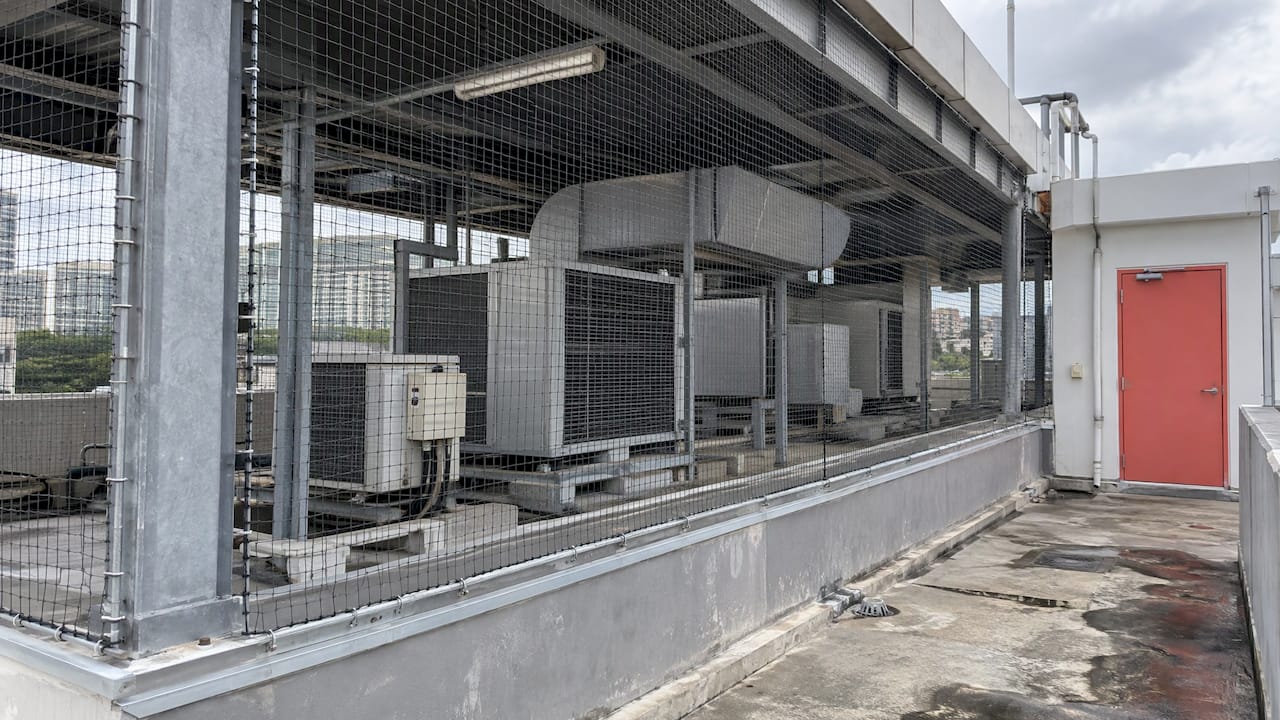
A roof is bird-proofed when pigeons, mynahs and crows have no ledge to land on, no gap to nest in and no food nearby to come back for. In Singapore that means physical exclusion (spikes, bird wire, netting) fitted to the exact spots the birds use, paired with cutting off the food. Single gadgets rarely last. A licensed technician who surveys the roof, fits the right barrier and keeps it maintained gets you a result that holds. That is the work our bird control and proofing service does.
TL;DR
- Physical barriers (spikes, wire, netting) are the most reliable roof deterrents. Sounds, smells and gels wear off or have limited effect.
- Birds return to food. Fix food waste and feeding nearby, or the barrier is fighting a losing battle.
- Netting and wire must be fitted correctly and inspected regularly, or birds get trapped or find the gaps.
- Around solar panels, vents and skylights, clearances and fire-safety materials rules apply.
- Feeding pigeons in Singapore is illegal, with fines of up to S$10,000 under the Wildlife Act.
Table of Contents
- Why birds choose your roof
- The main roof bird deterrents compared
- Smells, sounds and gels: what the evidence says
- Fix the food, or the barrier will not hold
- Installing bird proofing: rules and clearances to follow
- What a roof bird-proofing job involves
- How much does roof bird proofing cost in Singapore?
- Who needs this most
- Bird control that fits the roof
- Our view on roof bird proofing
- FAQ
- Sources
Why birds choose your roof
Pigeons look for three things: a flat, sheltered perch, a safe place to nest and a reliable meal within a short flight. Roof edges, parapets, water tanks, ledges under eaves, air-con ledges and gaps beneath roof sheets all tick the first two boxes. Food is usually a neighbor's feeding habit, an open bin or a hawker area nearby.
The damage is cumulative. Droppings stain finishes and block gutters. Nesting material clogs downpipes and vents. Nests can also carry mites that move indoors when the birds leave; we cover that in our guide to bird mite treatment in Singapore.
Singapore's own agencies treat this as a source problem. NParks describes a multi-pronged approach: cutting food sources, trapping and humane population control, and habitat modification such as sloped ledges that pigeons cannot roost on. Your roof plan should follow the same logic: remove the perch, remove the nest site, reduce the food.
The main roof bird deterrents compared
| Method | Best for | How it works | Watch points |
|---|---|---|---|
| Bird spikes | Ledges, parapets, gutter edges, beams | Stops birds from landing on a narrow surface | Must cover the full width of the perch; debris can build up between spikes |
| Bird wire (tensioned wire) | Long edges, ridge lines, rails | Makes landing unstable | Needs correct tension and secure posts |
| Netting | Open voids, under-roof gaps, plant decks, areas between beams | Seals the space so birds cannot enter | Correct mesh gauge, tight fixing, inspection access |
| Visual deterrents (reflectors, decoys) | Short-term support | Startles birds | Birds get used to them |
| Sound deterrents | Not suited to homes | Noise | Temporary effect, too loud for dense housing |
| Gels and repellents | Support only | Irritant or sticky surface | Limited, short-lived effect |
Spikes and bird wire
Spikes and wire work on narrow landing strips. Guidance from Natural Resources Wales notes that spikes on roofs and ledges should be blunt so they do not injure birds. That fits our approach: bird management that is humane and prioritizes safety for people and pets.
The common mistake is a partial run. If a ledge is 30 cm deep and the spike strip covers 10 cm, the pigeon simply lands beside it. Coverage matters more than the product.

Netting
Netting is the answer when birds are getting into a space, not just landing on it: gaps under roof sheets, voids between beams, open-sided plant areas and the edges of rooftop equipment. Done well, it is the most definitive barrier. The same Natural Resources Wales guidance says exclusion techniques such as netting, ropes and wires can be among the most effective deterrents but depend on the correct gauge, proper installation and regular inspection to avoid entanglement.
That inspection point matters for large buildings. Netting that cannot be reached cannot be checked, and a torn corner becomes a doorway. Our article on warehouse bird control and netting access panels explains how to plan for maintenance from the start.
Visual deterrents
Reflective tape, pinwheels and decoys are cheap and easy to hang, which is why they dominate search results. Their weakness is habituation. Natural Resources Wales advises that combining methods is likely to work better than relying on one, because birds quickly get used to scaring techniques. Treat visual items as a supplement to a physical barrier, never the barrier itself.
Smells, sounds and gels: what the evidence says
Searchers often ask what smell birds hate. The reliable answer is that scent is a weak tool for roofs. A 2013 study of two gel repellents found only a restricted, transient effect on feral pigeons. It also reported that chili-based capsaicin does not work on pigeons because they lack the receptors for it, and that exclusion and mechanical barriers remain the most reliable option. Sticky products also carry welfare risks, including fouled plumage and harm to non-target birds, which is why we do not rely on them.
Sound is no better. In Parliament in 2018, Singapore's AVA said sonic deterrents have only temporary effects as birds acclimatize and are too loud for dense residential areas. It added that no scientific method stops birds returning to a food source: the durable fix is removing the attraction.
Fix the food, or the barrier will not hold
A netted roof beside a daily feeding spot still has a pigeon problem on the next block, and the birds will test every edge of yours. Two points apply to every property:
- Feeding is an offense. NEA and NParks state that feeding pigeons is illegal, with fines of up to S$10,000 under the Wildlife Act. Our guide to Singapore pigeon laws sets out what residents should know.
- Food waste is the other lever. Covered bins, clean refuse areas and no food left on window sills or ledges all cut the pull. Property managers can include this in cleaning contracts and tenant notices.
Crows behave differently from pigeons and nest in trees and on structures. If crows are the issue, see crow control in Singapore. For mynahs, see keeping mynahs away without poisons.
Installing bird proofing: rules and clearances to follow
Roof work has safety and compliance sides that a quick online purchase ignores.
Fire safety and netting materials
The Ministry of Home Affairs stated on 14 October 2025 that anti-bird netting on building facades does not need SCDF approval or a Qualified Person submission, but it must use materials of limited combustibility and be installed without breaching Fire Code requirements. That answer concerns facade netting, so for any roof or complex structure confirm the position with your building's Qualified Person or management office. A Qualified Person is the registered architect or engineer responsible for a building's regulatory submissions.
Solar panels, vents and skylights
Rooftop solar attracts pigeons because the gap beneath the panels is a sheltered nesting space. The fix is a proofing system around the array's edge, not blocking the panels or airflow. SCDF's Fire Code amendments say PV modules, wiring and switchboards must not cover roof ventilation systems and need at least 500 mm horizontal clearance from ventilation systems and skylights. Any bird-proofing design must respect those clearances. Read more in pigeon proofing solar panels.

Working at height
Roof access, fragile sheets and edge protection are the reasons most owners should not climb up themselves. Our technicians are NEA-licensed, and we inspect roofs before we quote, using thermal imaging where it helps locate activity.
What a roof bird-proofing job involves
- Inspect. Identify where birds land, roost and nest, where droppings concentrate, and which entry points they use.
- Clear. Remove nests, droppings and debris safely, where permitted. Nests are removed first so that mites and residue do not carry on after the birds leave.
- Choose the barrier. Spikes or wire for edges, netting for voids, matched to the roof material and layout.
- Install. Full coverage, tight fixings, and access panels where inspection is needed.
- Maintain. Regular checks for sagging, tears and new gaps, because birds probe weak points.
Where the situation requires it, trapping is used as permitted. Our approach to humane control is described in MA Vapor and Nicarbazin: humane bird control.
How much does roof bird proofing cost in Singapore?
There is no single price, because the cost follows the work: how many meters of ledge need spikes or wire, how many square meters of netting, how high and accessible the roof is, and whether nest and dropping clearance is needed first. A quote based on a site inspection is the only honest figure, and it also shows which method suits which spot. We do not publish fixed prices for bird control, so request an inspection and quote with your roof type and the areas where birds gather.
Who needs this most
- Homeowners with pigeons nesting under roof tiles or on the air-con ledge.
- Property managers with several roofs and a need for scheduled checks and records.
- Business owners whose warehouse, shopfront or food area cannot tolerate droppings.
- Construction sites where half-built structures offer instant nesting sites.
- Eco-conscious clients who want non-toxic, humane methods rather than poisons or sticky gels.
Bird control that fits the roof
We provide bird control and proofing for residential, commercial and industrial properties in Singapore, including humane management with spikes, netting, repellents and trapping as permitted. Our technicians are NEA-licensed, our methods are non-toxic and built on integrated pest management, and we are available 24/7.

To have your roof assessed, see our Bird Control & Proofing Services or start from our main site.
Our view on roof bird proofing
Most failed roof jobs we are asked to look at have the same cause: one product used where a system was needed. A strip of spikes on one ledge pushes pigeons to the next. A net without access cannot be checked. A repellent hung up once is ignored in a week.
Our view is simple. Survey first, then fit physical barriers to the places birds actually use, and keep the food supply under control. That is integrated pest management applied to birds: inspect, exclude, remove the attraction and maintain.
We use non-toxic, environmentally safe methods that prioritize the safety of people and pets, and our NEA-licensed technicians work with thermal imaging for inspections. For you, that means a roof plan built around your building, not around a catalog.
Bespoke-Enviro Services
FAQ
How do I keep birds off my roof?
Start by removing the places they can land and nest: fit spikes or wire to ledges and netting to open voids. Then reduce food nearby by securing bins and not leaving food outside. Using more than one method is more reliable than any single deterrent.
What is the best deterrent to stop pigeons on a roof?
Physical exclusion is the most dependable: spikes, bird wire and netting. A 2013 study found exclusion and mechanical barriers to be the most reliable repellents, while gels had only a transient effect. The right choice depends on whether pigeons are landing on an edge or entering a space.
Is roof netting for birds safe for the birds?
It is when the mesh gauge is right, the net is fitted tight and it is inspected regularly. Loose or damaged netting is what causes entanglement. That is why we plan access for checks and maintain installations.
Do homemade remedies or smells work?
Not dependably. Pigeons are not bothered by capsaicin, and gels showed only a short-lived effect in research. Barriers combined with food control give lasting results.
Can I feed the birds if I also install proofing?
No. Feeding pigeons is illegal in Singapore, with fines of up to S$10,000, and it undermines any proofing by drawing birds back to your area.
Sources
- NParks, Urban Birds podcast transcript
- Natural Resources Wales, managing problems caused by wild birds
- Effectiveness of gel repellents on feral pigeons (2013)
- Measures to control wild bird populations in HDB estates (Parliament, 2018)
- NEA and NParks, managing pest birds
- MHA, anti-bird netting and SCDF approval (14 October 2025)
- SCDF, Fire Code 2023 third batch of amendments