
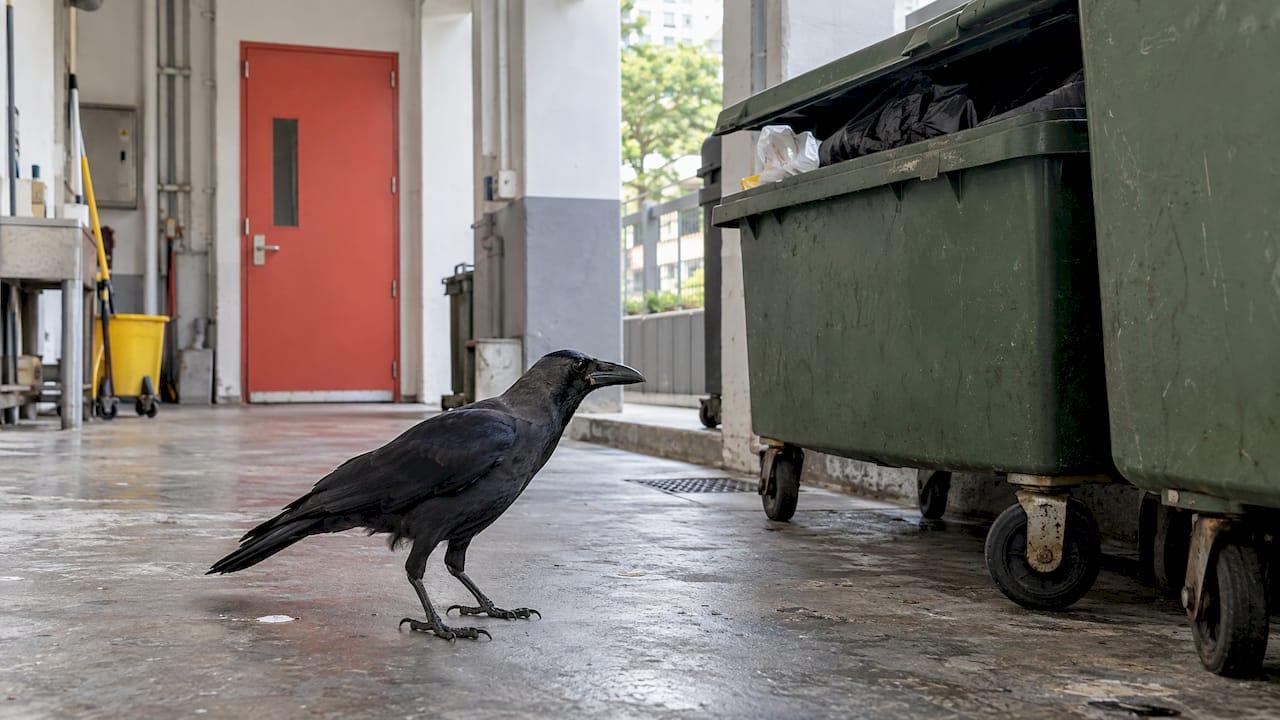
Crow control in Singapore has two parts. NParks manages the island-wide population through nest removal, trapping and, since March 2026, shooting. You manage your own premises: the food, the perching spots and the nesting access that draw crows to your building in the first place. We handle that second part with humane bird management, which means inspection, proofing, deterrents and, where permitted, trapping, carried out by NEA-licensed technicians.
This guide explains why crows have become a bigger problem, what the authorities do, what you can safely do yourself, and where a professional bird control service makes the difference for a home, a business or a managed property.
TL;DR
- House crows are a non-native species in Singapore. They thrive on food waste and urban nesting sites, and they become most aggressive when defending nests and fledglings.
- NParks runs the population measures: nest surveys, nest removal, trapping and shooting. Attacks and injured crows are reported to the Animal Response Centre at 1800-476-1600.
- On your own premises, crows follow food, water and safe perches. Covering bins, securing food and blocking perching and roosting spots cuts the pull.
- Feeding wildlife is illegal, and the fines announced in 2026 double the earlier ones.
- For buildings, rooftops, ledges and commercial sites, we use spikes, netting, repellents and permitted trapping within an integrated pest management (IPM) plan.
Table of Contents
- Why crows have become a bigger issue in Singapore
- Why crows attack, and when
- What the authorities do, and what that means for you
- Why crows choose your property
- What you can do yourself, safely
- The law on feeding wildlife
- Where a professional bird control service helps
- A practical plan by property type
- Promo: bird control for your property
- Our perspective
- FAQ
- Sources
Why crows have become a bigger issue in Singapore
The house crow is not a native bird. NParks' Animal and Veterinary Service describes it as native to the Indian subcontinent, omnivorous and well suited to Singapore's urban environment, where food waste and nesting sites are easy to find. Crows gather in large communal roosts, and the noise from those roosts is a common complaint in residential estates.
The numbers show the scale. According to an NParks survey cited by The Straits Times, the house crow population was about 160,000 in 2024, up from about 7,200 in a 2016 population study of mainland Singapore. Public feedback has followed. Mothership, citing NParks, reports that crow-related feedback to the Municipal Services Office tripled from close to 5,000 cases in 2020 to about 15,000 in 2025. Feedback about crow aggression rose from over 460 cases to more than 2,000 over the same period.

NParks' director of wildlife management has explained that house crows have no natural population controls here. As an invasive species, they can spiral out of control and damage the environment. NParks has also said crows mob, harass and displace native wildlife and prey on their young.
Why crows attack, and when
Most attacks come from breeding birds. Crows that feel threatened or are protecting young will swoop or peck, as CNA's explainer notes. A Senior Parliamentary Secretary told the press that adult crows are most protective during the May to June fledgling season. He added that crows can recognize faces and may target a specific person.
That matters for how you plan. A crow that attacks near a block is usually guarding a nest or a fledgling close by. It is not hunting you. The practical response is to understand where the nest is, avoid that path while the young are fledging, and remove what keeps the birds near your property.
If you are being attacked, here is what NParks asks of you. Call the Animal Response Centre at 1800-476-1600 if you meet an injured or distressed crow or are continuously attacked. Do not handle the crow yourself, and do not touch, chase or corner it, talk loudly or use flash photography. Those instructions come from NParks' house crow guidance. Trained wildlife professionals take it from there.
A single young bird on the ground may look abandoned, but its parents are usually watching. Keep your distance and report it rather than moving it. Picking it up is the fastest way to trigger an attack.
What the authorities do, and what that means for you
Crow management in public spaces is NParks' job. Its approach rests on three strategies: managing food availability, disrupting nesting opportunities and reducing the population.
The scale has grown quickly:
| Measure | 2021 | 2025 |
|---|---|---|
| Crow nests removed islandwide | Over 600 | Close to 9,000 |
| Crows trapped and removed | More than 1,800 | Over 13,000 |
These figures are from NParks as reported by The Straits Times. The same report says NParks found the population had still increased, so shooting resumed from the second half of March 2026 to complement existing efforts. The 2020 stop followed incidents in which homes near operations were struck by shotgun pellets, and the new operations are carried out by licensed wildlife management contractors certified in firearms handling.
Shooting began in Yishun and has been extended to other estates. CNA reported in July 2026 that more than 500 crows had been culled since 24 March, with Bukit Panjang, Marine Parade and Tanah Merah next. Shooters must keep the pellet trajectory directed upwards under strict safety protocols. The Minister told Parliament that site selection is guided by human traffic, proximity to buildings and public safety.
Trapping uses Larson cage traps, which are designed to be humane. In Punggol, an MP said birds are contained with food and water inside and handled according to established guidelines.
What does this mean for a homeowner or building manager? These programs reduce numbers in public areas and around estates. They do not stop crows from using the ledge outside your office, the open bins behind your restaurant or the rooftop of your warehouse. That part sits with the person who controls the premises, and it is where most complaints can actually be solved.
Why crows choose your property
Crows come for three things: food, water and a safe place to perch or nest. Look for these at a site:
- Open or lightly covered bins, overflowing refuse areas, and food courts or hawker centres with uncleared tables.
- Fruit trees in landed compounds, with ripe fruit left uncovered.
- Pet food left outdoors and water sources in yards.
- Ledges, signage, rooftop equipment and unprotected structures that offer a stable perch with a view.
- Dense trees close to buildings, which crows use for nests and roosts.
- People feeding birds, deliberately or not.
This is why a trapping-only approach tends to disappoint on a single site. If the food and the perch stay, new birds take the place of any removed.
What you can do yourself, safely
Some steps are simple, legal and recommended by NParks. Start here before any professional visit.
- Remove leftover food promptly. NParks advises clearing food from sinks and storing food, fruit included, in fridges or cupboards.
- Cover bins. Keep them covered, preferably with heavy lids.
- Never feed crows. Feeding wildlife is prohibited under the Wildlife Act.
- Use bird spikes where crows perch.
These four come from NParks' house crow page. For landed homes, The Straits Times adds practical tips: harvest fruit or cover fruit trees with opaque material, remove yard water sources near roost hotspots and clean up pet food spills. It also mentions distress-call recordings and shiny hanging pieces such as old CDs. It notes that these may lose effect, because crows are intelligent.
That last point is worth taking seriously. Residents in Yishun tried umbrellas, CDs and pinwheels when a resident's wife was pecked more than 10 times in three weeks. Quick fixes can give short relief, but a bird that learns a device is harmless will ignore it. Lasting results come from changing the site so it stops rewarding crows.
One more point on timing: if there is an active nest with young on your property, do not climb up or try to remove it yourself. Report persistent attacks to NParks on 1800-476-1600 and keep people away from the area.
The law on feeding wildlife
Feeding crows, pigeons and other wildlife is an offense. On 7 May 2026, amendments to the Wildlife Act were announced that double the fines to up to S$10,000 for a first offense and S$20,000 for repeat offenses, with up to 12 months' jail for repeat offenders. The higher penalties apply once the Bill is gazetted, which was expected in the second half of 2026, so check the NParks site for the current position.
For property managers, this is a useful point to put in tenant notices. A resident who scatters rice for pigeons also feeds crows, and the offense can attach to them personally. Enforcement is rising: NParks reported action in over 380 cases in 2025, up from nearly 150 in 2021, mostly for pigeon feeding.
Where a professional bird control service helps
DIY steps cover the basics. A professional visit matters when the site is large, the structure complex, the bird pressure high or a business cannot afford repeat complaints. Property managers, food businesses, warehouses and construction sites typically fall into that group.
Here is how we approach a crow or similar bird problem, using what our bird control service includes:
- Inspection. Our NEA-licensed technicians look at how birds use the site: perching points, roost areas, food sources and entry routes. We use advanced technology, including thermal imaging, in our inspections.
- Integrated pest management (IPM). IPM means combining prevention, proofing and targeted treatment rather than relying on one tool. It is the basis of our work.
- Proofing and deterrents. Our humane bird management includes spikes, netting and repellents, chosen for the structure and the species.
- Trapping as permitted. Where trapping is allowed, we include it in the plan.
- Non-toxic methods. Our treatments prioritize the safety of people and pets, which matters in homes, restaurants and shared spaces.
- 24/7 availability. When birds are an urgent problem, we can respond.
Different sites need different answers. A ledge above a restaurant entrance needs a different solution from a warehouse roof. Our article on warehouse bird control and access panels explains why netting on large buildings needs to be designed for maintenance access, and our piece on humane bird control methods covers the approaches we use. If mynahs are your main issue, read how to keep mynahs away without poisons.
Bird nests bring mites
Old nests on balconies, air-con ledges and roof spaces can carry bird mites that bite people once the birds leave. We cover that in our guide to bird mite treatment in Singapore, which explains why the nest is removed first. If you find mites after birds have nested near your home, it is a sign that the site needs a proper inspection.
A practical plan by property type
Landed homes. Cover or harvest fruit, clear pet food, keep bins lidded and check for perching points on roofs and fences. If crows are nesting in a tree close to the house, avoid that area during the fledgling season and report repeated attacks to NParks.
HDB flats and condominiums. Keep windows and balcony areas free of food and fruit. Management offices can tighten bin-centre routines, add heavy lids and communicate the feeding ban to residents. Proofing ledges and parapets on the building is a job for a professional.
Food and beverage outlets. Clear tables quickly, manage waste so that bins are closed and collected on time, and keep outdoor seating free of scraps. Birds on tables are a hygiene complaint waiting to happen, and an inspection can identify where they come from.
Warehouses, factories and construction sites. Large roof spans, open loading bays and site canteens attract birds. Proofing needs to be planned with access, safety and operations in mind. Construction sites also benefit from a pest inspection early, before temporary canteens and waste areas become a draw.
Managed estates. Consistency matters more than any single measure. A regular maintenance contract lets a property manager track bird activity, adjust the proofing and keep records for residents and management councils.

Promo: bird control for your property
If crows or other birds are using your roof, ledges, bins or compound, our bird control and proofing service in Singapore starts with an inspection by NEA-licensed technicians. We then plan humane deterrents, netting, spikes, repellents and permitted trapping around how birds actually use your site. For wider problems, our general pest control service covers the other pests that tend to come with the same food and waste.
We offer one-time treatments and ongoing maintenance contracts, for homes, businesses, property managers and construction sites.
Our perspective
Crows are an urban food problem as much as a bird problem. NParks is working to reduce the population across the island, and that effort matters. But on a single property, the birds stay where there is food, water and a place to perch. Removing one of those without the others rarely lasts.
We build our bird work on integrated pest management. That means inspecting how birds use your site, closing off what draws them, proofing the structure with spikes or netting, and using repellents and permitted trapping where they fit. We keep our methods humane and non-toxic, because the people and pets who live and work at the property come first.
Our technicians are NEA-licensed, and we are available 24/7. If you want a crow or bird problem handled once and monitored afterward, the way to start is an inspection of the actual site, not a gadget bought online.
Bespoke-Enviro Services
FAQ
How do I report a crow attack in Singapore?
Call NParks' Animal Response Centre at 1800-476-1600 if you are continuously attacked or find an injured or distressed crow. Do not touch, chase or corner the bird, and avoid loud talking or flash photography. Trained wildlife professionals will assist.
How do I shoo away a crow?
Do not chase it. Walk away calmly and avoid the area if you can see a nest or young. Over the longer term, remove food and water sources, keep bins covered and block perching spots with spikes. For a building or business, we can inspect and set up humane proofing.
Is it legal to feed crows in Singapore?
No. Feeding wildlife is prohibited under the Wildlife Act, and fines announced in May 2026 double the earlier penalties, up to S$10,000 for a first offense and S$20,000 for a repeat offense. The higher penalties take effect once the amendments are gazetted.
When are crows most aggressive?
During the breeding and fledgling season, when adults defend nests and young. A Senior Parliamentary Secretary has said that adults are most protective around May and June. Avoid walking under known nesting trees in this period.
Can a pest control company help with crows on my property?
Yes, for the premises you control. Our bird control service includes inspection, humane deterrents such as spikes, netting and repellents, and trapping where permitted. Population-level measures such as islandwide nest removal and culling are carried out by NParks.
Sources
- House Crows in Singapore, NParks Animal and Veterinary Service
- Explainer: What's behind attacks by crows, CNA
- Control crow population: Tips and advice, The Straits Times
- Singapore to resume crow shooting operations, The Straits Times
- Forum: Holistic, science-based approach used to manage crows, The Straits Times
- NParks to expand crow shooting operations, CNA
- Reviewing Cost Effectiveness of Non-lethal Crow Management, Telescope
- Crow traps designed to be humane deployed in Punggol, AsiaOne
- Yishun woman reportedly pecked by crows, Mothership
- Illegal wildlife feeders can face doubled fines, Mothership