

Humane bird control works when you combine physical exclusion, habitat changes, and rotated deterrents instead of relying on a single fix. Backed by field data, methyl anthranilate vapor systems and nicarbazin-based fertility control have measurably reduced pigeon populations without harming birds. Most sites see visible improvement within 90 days, though chronic infestations, roof access issues, or large colonies usually call for a professional survey.
TL;DR:
- Humane bird control effectiveness relies on combining exclusion, deterrents, habitat modification, and fertility control for long-term results.
- Methyl anthranilate vapor systems typically show noticeable bird population reductions within 90 days, especially on rooftops and food sites, while fertility control reduces large colonies over years.
- Regular site habitat cleanup, sealing entry points, and rotating deterrents are essential to prevent birds from habituating and losing the deterrent effects.
- Products like sticky gels are unsafe and should be avoided, while approved repellents and fertility programs require ongoing monitoring and proper deployment.
- Professional assessments tailor solutions to site-specific attraction sources, species, and colony size, emphasizing safety, monitoring, and integrated pest management protocols.
Table of Contents
- What Counts as Humane Bird Control?
- How Effective Are MA Vapor Systems and Fertility Control?
- How Do You Choose the Right Humane Bird-Control Method?
- Installing and Maintaining Humane Deterrents Without Losing Effectiveness
- How Do Professionals Apply Humane Bird Control?
- Why We Back Humane, IPM-Based Bird Control
- Ready for a Professional Humane Bird-Control Survey?
- Sources
- FAQ
What Counts as Humane Bird Control?
Humane bird control means managing pest bird populations through non-lethal methods that change behavior or habitat rather than killing birds outright. The approach draws directly from integrated pest management (IPM), a strategy that identifies why birds are attracted to a site before choosing a tool to remove them. Government wildlife guidance backs this order of operations, recommending non-lethal methods first and rotation of tactics to keep birds from adapting to any single deterrent.
Four categories cover almost every legitimate non-lethal option available today:
- Physical exclusion — netting, spikes, bird wire, and angled ledge covers block birds from landing or nesting without touching them.
- Sensory deterrents — visual scares, sound devices, lasers, and predator-mimicking drones disrupt roosting behavior.
- Repellents — plant-based sprays and vapors like methyl anthranilate condition birds to avoid treated surfaces.
- Habitat modification — removing food, water, and nesting material so the site stops attracting birds in the first place.
Netting works best on large open structures like warehouses and parking garages, while spikes and angled ledges suit narrow perches such as window sills and signage. Sound and visual deterrents lose effectiveness fast on their own. Pigeons and mynahs habituate to a stationary scarecrow or distress call within days, which is why the same government guidance stresses changing tactics regularly rather than installing one device and walking away.
Fertility control fits a narrower use case: chronic, large pigeon colonies where exclusion alone won't shrink the population. It's a longer-term population management tool, not a quick fix for a single balcony problem.
Some products marketed as "bird control" should be avoided entirely. Sticky repellent gels trap birds' feathers and feet, causing injury and prolonged suffering, and several jurisdictions have moved to restrict them. Unapproved poisons are illegal in most residential and commercial settings, create secondary poisoning risks for pets and predators, and rarely solve the underlying attraction problem anyway. If a product's marketing avoids describing exactly what happens to the bird on contact, that's worth treating as a warning sign.
How Effective Are MA Vapor Systems and Fertility Control?
Methyl anthranilate (MA) is a plant-derived compound, chemically related to grape flavoring, that irritates birds' trigeminal nerve on contact without causing lasting harm. Applied as a dry vapor rather than a liquid spray, it conditions birds to avoid treated areas after repeated exposure. Commercial vapor systems typically show noticeable reductions in bird presence within about 90 days of consistent application, making it one of the more reliable repellent options for rooftops, courtyards, and food-processing exteriors.
A three-year nicarbazin fertility-control program in Barcelona significantly reduced treated pigeon colonies between 2017 and 2019 (https://pubmed.ncbi.nlm.nih.gov/35405845/), using conditioned feeding stations rather than culling.
Nicarbazin works by temporarily disrupting egg fertility in birds that consume it, requiring no capture or handling. Deployment depends on automatic hopper feeders that dispense treated grain during a narrow morning window, timed to when target birds are most active and non-target species are less likely to feed. Programs need a conditioning period so pigeons learn to associate the feeder with food before dosing begins, alongside ongoing monitoring to confirm non-target species aren't consuming the bait. Because it's a regulated feed additive, deployment should follow local approval requirements and welfare-focused monitoring protocols throughout the program.
How Do You Choose the Right Humane Bird-Control Method?
The right method depends on what's attracting birds to the site, not just what problem they're causing once they arrive. Start with these steps before buying any product or signing any contract.
- Identify the species and population size. Pigeons, mynahs, and crows respond to different deterrents; a solution built for one often underperforms on another.
- Find the attraction source. Check for exposed food waste, standing water, open eaves, and unsecured rooftop equipment. Skipping this step is the most common reason installations fail later.
- Match the method to the site's constraints. Netting needs structural access; vapor systems need airflow and coverage area; fertility control needs feeder placement away from foot traffic and pets.
- Set a realistic budget and timeline. Exclusion hardware costs more upfront but requires little maintenance; repellents and fertility control cost less initially but need months of consistent application.
- Vet any provider before hiring. Ask whether they follow an IPM framework, provide a written monitoring plan, and use EPA-registered or locally approved products only.
Pro Tip: Ask a prospective provider how they measure success after 30, 60, and 90 days. A provider without a monitoring plan is guessing, not managing.
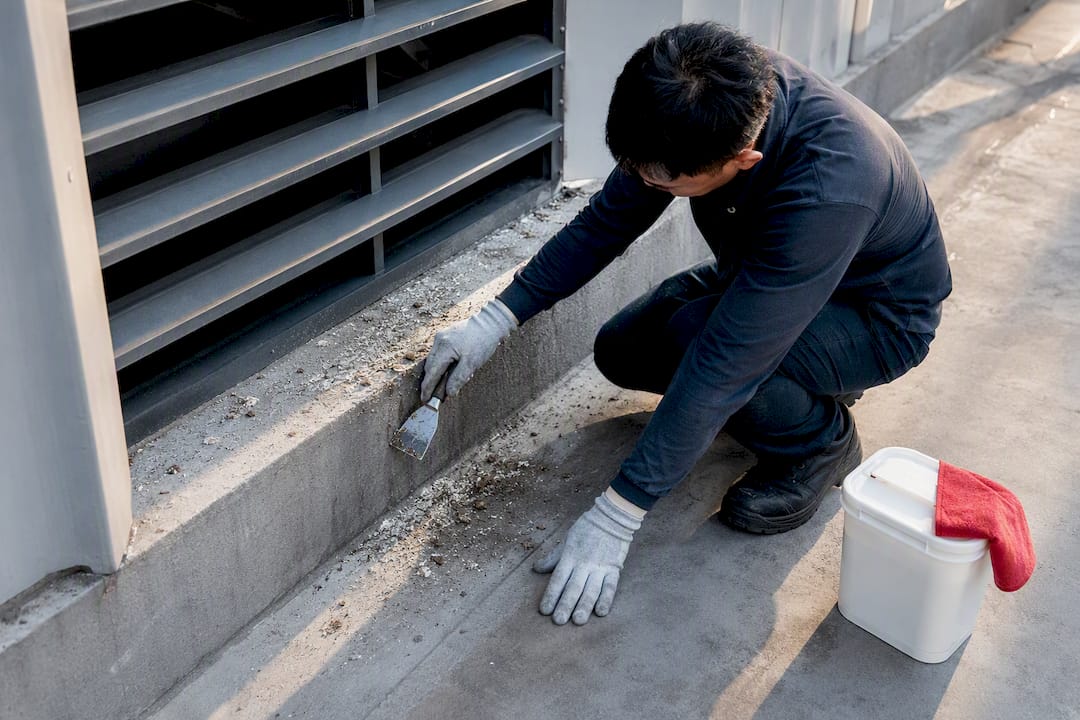
A few red flags mean it's time to call a professional rather than attempt a DIY fix: roof or facade access that requires fall protection, colony sizes in the dozens or more, repeated failed attempts with retail deterrent products, or any site with food-safety compliance requirements. Ongoing droppings accumulation near HVAC intakes or walkways is also a signal to escalate quickly, since bird droppings can carry pathogens that pose real health risks during cleanup.
Installing and Maintaining Humane Deterrents Without Losing Effectiveness
Habituation is the single biggest reason humane bird control fails. Birds are intelligent, adaptive, and quick to learn that a stationary owl decoy or a recorded hawk call poses no real threat. The fix isn't a stronger deterrent. It's combining and rotating several at once.
Before installing anything, complete three habitat tasks that most installations skip:
- Clean existing droppings and nesting debris so the site loses its "safe roost" signal to returning birds.
- Secure garbage and food waste in closed containers, since exposed food undoes almost any deterrent you install afterward.
- Seal gaps, vents, and eaves wider than an inch, which birds use as nesting entry points year-round.
Once exclusion hardware and deterrents are in place, track results on a simple schedule: count birds at the same time each week, log droppings volume, and note which deterrents are still triggering avoidance behavior versus which birds have started ignoring. Predator-mimicking drone systems like RobotFalcon have shown they can clear fields of flocks immediately with no measurable habituation over months of trials, which makes rotation between low-tech and high-tech deterrents a genuinely effective long-term strategy rather than just a theoretical one.
| Maintenance task | Frequency | Why it matters |
|---|---|---|
| Inspect netting/spikes for gaps | Monthly | Wear and debris create re-entry points |
| Refill or recharge MA vapor units | Per manufacturer schedule | Effectiveness drops sharply once vapor output stops |
| Log bird counts and droppings | Weekly | Confirms whether the current method is still working |
| Rotate or reposition sensory deterrents | Every 2–4 weeks | Prevents habituation to a fixed device |
Rooftop work around vapor units and netting anchors should always follow fall-protection protocols, and any droppings cleanup near HVAC systems is worth handing to a specialist. If a colony keeps rebounding after exclusion and repellents, that's the signal to escalate to a population-level program, like fertility control, or a standing maintenance contract rather than repeating the same short-term fix.
How Do Professionals Apply Humane Bird Control?
A professional IPM survey starts by diagnosing why birds keep coming back to a specific site, whether that's an open food source, a sheltered nesting ledge, or a nearby water source. Skipping that diagnosis is the most common reason exclusion hardware fails within months.
A well-run professional program typically includes:
- An on-site survey identifying species, population size, and attraction sources
- Targeted exclusion installation matched to the structure (netting, spikes, wire)
- MA vapor deployment where repellents are the better fit than hardware
- Fertility-control program management for chronic colony-level infestations
- Scheduled monitoring visits and a maintenance contract for long-term sites
Every product used in this kind of program should be non-toxic and safe around people and pets, consistent with the eco-friendly standards behind broader pest control programs. For droppings cleanup on active sites, pairing professional bird control with safe droppings-removal procedures closes the loop between deterrence and hygiene.
Why We Back Humane, IPM-Based Bird Control
Lethal control tends to fail for a predictable reason: removing birds from a site creates a vacuum that surviving or neighboring birds quickly fill, since the underlying food and shelter that drew them in remain untouched. Humane methods succeed because they remove the reason birds showed up at all. Start with an honest survey and habitat fixes before buying a single deterrent. Everything else is easier from there.
— Bespoke-Enviro Services
Ready for a Professional Humane Bird-Control Survey?
Professional pest control services in Singapore bring extensive experience to bird management, applying the IPM diagnosis process used for termites and rodents, rather than a one-size-fits-all spike order. The team assesses species, attraction sources, and access constraints on-site, then builds a program from exclusion hardware, MA vapor deployment, and monitoring visits, using non-toxic products safe for people and pets.
Requesting a survey is straightforward: a technician visits the property, documents the attraction sources driving the problem, and proposes a plan with realistic timelines rather than a guess. For sites needing ongoing coverage, our general pest control programs can fold bird monitoring into a standing maintenance contract alongside other pest concerns. Reach out to book a site survey and get a written plan before any product goes on your roof.
Sources
- Methyl anthranilate and other bird repellents (technical review)
- Gov
- CDC: Histoplasmosis — environment and bird droppings
FAQ
How Do You Stop Nuisance Birds Without Harming Them?
Remove food and water sources first, then combine physical exclusion like netting or spikes with rotated sensory deterrents so birds don't habituate to any single device.
What Should You Do If You Find an Injured Bird?
Avoid handling the bird directly, use gloves or a towel if you must move it to safety, and contact a local wildlife rescue or NParks for guidance on next steps.
How Do You Scare Away Mynah Birds?
Mynahs respond to a rotation of visual and auditory deterrents combined with sealed food sources; a 24 to 72 hour humane deterrent routine can produce noticeable results without poisons.
How Do You Get Rid of Pigeons Long-Term?
Long-term pigeon control combines exclusion hardware with habitat cleanup, and for large chronic colonies, fertility-control programs have reduced populations by over 55 percent in documented multi-year field trials.
Are Sticky Gels a Safe Bird Deterrent?
No. Sticky repellent gels can trap feathers and feet, causing injury, and welfare-focused guidance recommends exclusion, repellents, or fertility control instead.