
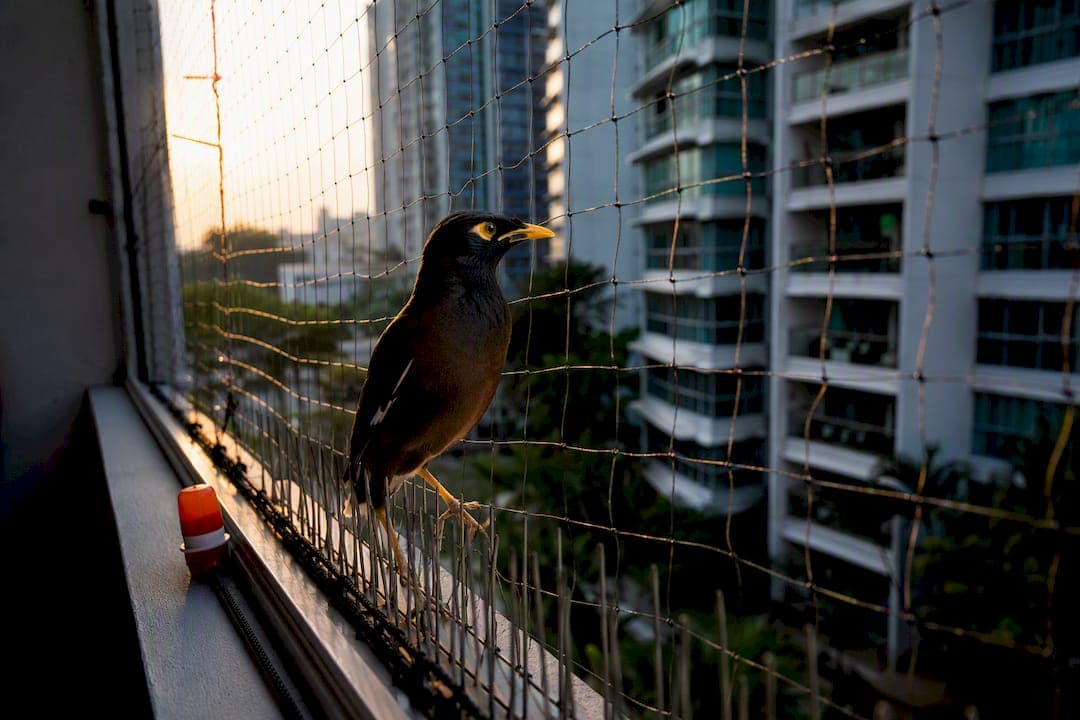
The fastest, most reliable way to keep mynahs away is to remove what draws them (food, water, and shelter) and then physically exclude them with netting or anti-roosting spikes. This combination is humane, and it typically breaks a roosting or feeding habit within days to a few weeks. Both NParks and practical integrated pest management (IPM) guidance point to this order of operations, not gimmicks or one-off scares, as the fix that holds.
TL;DR:
- Removing attractants such as open garbage, pet food, and fallen fruit is essential to reduce mynah visits before installing physical barriers.
- Proper installation of netting, spikes, and sealing openings is crucial, and professional help is recommended for heights or complex spaces.
- Visual or audio deterrents only work temporarily; rotating methods every few weeks prevents habituation among the birds.
- Habitat modification, including pruning dense vegetation and removing old nests, addresses the root reasons for persistent mynah presence.
- Long-term control requires layered approaches, with attractant removal, exclusion, and professional interventions to effectively resolve the problem.
Table of Contents
- Quick Action Checklist: What to Do in the Next 24 to 72 Hours
- Remove Attractants: Deny Mynahs Food, Water, and Shelter
- Physical Exclusion: Netting, Spikes, and Sealing Openings
- Supplementary Deterrents: What Helps and What Fades Fast
- Troubleshooting: How to Tell If Your Efforts Are Working
- When to Call a Professional Bird-Control Service
- Habitat Modification: Pruning and Removing Nesting Sites
- Our Take: Why Layering Beats Any Single Fix
- Get a Site Survey and Long-Term Bird Control from Bespoke-Enviro
- Sources
Quick Action Checklist: What to Do in the Next 24 to 72 Hours
Before you tackle long-term exclusion, close off the easy wins. Mynahs return to the same spot because it keeps paying off in food, so cutting that off fast slows the visits while you plan a permanent solution.
- Secure garbage bin lids tightly and bag food waste before it goes outside.
- Bring pet food bowls indoors between feedings, even during the day.
- Clear fallen fruit, seed pods, and plant debris from balconies and yards daily.
- Screen or temporarily close vulnerable openings like roof vents, awning gaps, and air-conditioner ledges.
- Set up short-term deterrents (reflective tape, a decoy) only as a stopgap while you arrange netting or spikes.
None of these steps stops mynahs permanently on their own. They buy you time.
Remove Attractants: Deny Mynahs Food, Water, and Shelter
Food and water availability is the single biggest driver of mynah visits, according to NParks, and it's why attractant removal has to come before any deterrent. Skip this step and even professional-grade spikes will only push the birds a few feet over to your neighbor's ledge.
Work through these steps in order:
- Lock bin lids and store food waste in sealed bags until collection day.
- Bring pet bowls indoors immediately after feeding, rather than leaving them out.
- Clear balcony plant debris, dropped fruit, and food scraps at least once daily.
- Cover compost bins and any exposed organic waste completely.
- Check gutters and flat roof areas for standing water after rain.
If the mynahs are congregating around common areas like void decks, car parks, or shared bin points, the fix isn't fully in your hands. Insect Out recommends looping in your estate management, MCST, or town council, since a clean balcony won't matter much if the block's communal bin area is still an open buffet.
Track your results with a simple log: note the date, time, and number of birds you see each morning and evening. Many households see a noticeable drop in visits within a few weeks once food access is fully cut off. If nothing changes after three weeks, an attractant is still slipping through somewhere nearby.
Pro Tip: Photograph your balcony and yard once a week from the same angle. Side-by-side comparisons make it obvious when droppings, nesting material, or feeding activity are actually declining, instead of relying on memory.
Physical Exclusion: Netting, Spikes, and Sealing Openings
Removing food slows mynahs down. Physical exclusion is what stops them for good. NParks identifies netting and anti-roosting spikes as the most dependable long-term barriers, and Insect Out echoes the same recommendation for homes dealing with repeat roosting.
Match the method to the space:
- Netting works best on balconies, service yards, and recessed areas where birds need a clear flight path in and out.
- Anti-roosting spikes suit narrow ledges, railings, and window sills where birds land to perch or scout a nest site.
- Sealing closes off roof voids, gaps around air-conditioner units, and vent openings mynahs use to squeeze into cavities.
Installation details matter more than most homeowners expect. Spikes perform best mounted at an outward tilt, which stops birds from finding a flat landing angle. Loose fastening or debris buildup on the base of the strip can defeat spikes entirely within a season, so plan on a quick visual check every few months. Netting needs to be pulled taut with no gaps larger than about two inches, since mynahs will test edges relentlessly in the first week.
Netting for balconies and service yards, paired with correctly angled spikes on ledges, forms the exclusion combination that NParks and local pest guides point to as the most durable fix available to homeowners.
DIY spike strips work fine for a single low balcony rail. Once you're dealing with heights above the second story, awkward roof recesses, or a full-unit netting job, professional installation is worth the cost. A licensed installer also carries the ladders, harnesses, and warranty coverage that make a rushed weekend project unnecessary.
Supplementary Deterrents: What Helps and What Fades Fast
Visual and audio deterrents have a place, but only as a supporting layer, never the main plan. Mynahs are sharp, social birds, and they learn fast when a "threat" never actually does anything.
- Reflective tape and rotating mirrors can disrupt feeding for a week or two before birds habituate.
- Predator decoys (owls, hawks) work briefly, but lose all effect once mynahs realize the decoy never moves.
- Non-toxic scented gels, trialed by town councils in Bukit Batok and Choa Chu Kang, deter perching on ledges and lamp posts without harming the birds.
The pattern across all of these is habituation. A static object stops working the moment the flock figures out it's harmless, which is why practical guides recommend rotating the type and location every week or two rather than mounting one decoy and forgetting it. Stick to non-toxic products only. Anything marketed as a poison, sticky trap, or "quick kill" solution isn't worth the legal or ethical risk, and it rarely solves the underlying attractant problem anyway.
Troubleshooting: How to Tell If Your Efforts Are Working
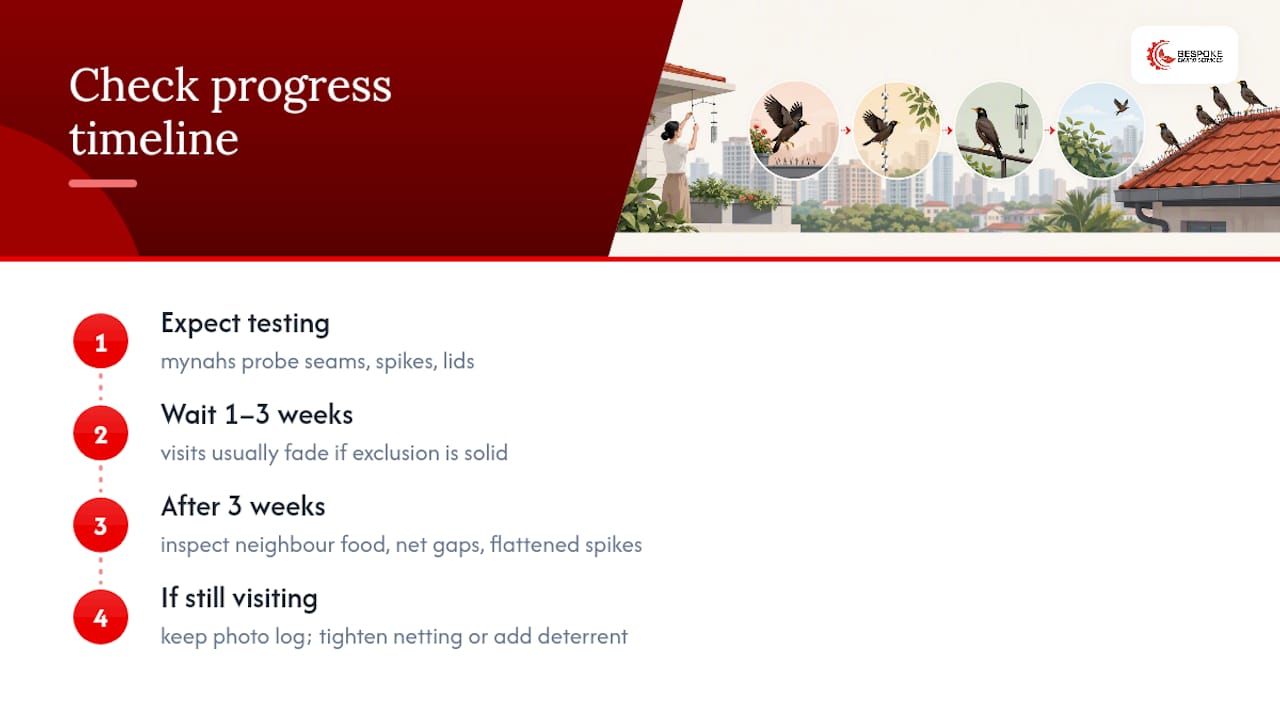
Expect mynahs to test your defenses before giving up. They'll probe netting seams, land near spikes to check for gaps, and circle back to check if the bin lid is still open. That's normal, and it usually fades over one to three weeks if your exclusion is genuinely solid.
If visits haven't dropped after three weeks, look for the usual culprits: a neighbor's open food source, a gap in the netting large enough to slip through, or spikes with debris flattening their angle. Keep the photo log running and switch tactics (tighter netting, an added deterrent layer) before assuming the whole approach failed.
When to Call a Professional Bird-Control Service
Persistent roosting in a roof cavity, nests built inside vents, or birds returning to the same ledge despite netting and spikes are all signs it's time to bring in a specialist. Roof-cavity nests in particular carry real fire-hazard and hygiene risks once droppings and nesting material accumulate, a concern NParks has flagged directly.
Licensed bird control providers typically handle:
- A full site survey to identify every entry point and roost location.
- Custom-fitted netting or spike installation for tricky recesses and heights.
- Safe, humane removal of existing nests.
- Scheduled maintenance checks to catch new attempts early.
Trapping and baiting, in particular, are specialist activities. Regional wildlife management guidance is clear that these methods require training, legal compliance, and community coordination, which is exactly why they sit outside the scope of a homeowner DIY project. Bespoke-Enviro brings over 30 years of pest management experience in Singapore and builds every bird job around IPM principles and non-toxic methods, prioritizing lasting exclusion over short-term scares.
Habitat Modification: Pruning and Removing Nesting Sites
Food removal and netting handle the immediate problem. Habitat modification handles the reason mynahs keep coming back to the same neighborhood in the first place. Mynahs favor dense, overgrown shrubbery and thick tree canopy for roosting because it offers cover from predators and easy access to nearby feeding grounds.
Pruning back dense hedges near windows, balconies, and rooflines removes the staging ground birds use before moving in closer to investigate your bins or ledges. Pay particular attention to overgrown palms, thick bougainvillea, and untrimmed hedges directly beneath roof overhangs, since these give mynahs a low-effort launch point onto your ledges.
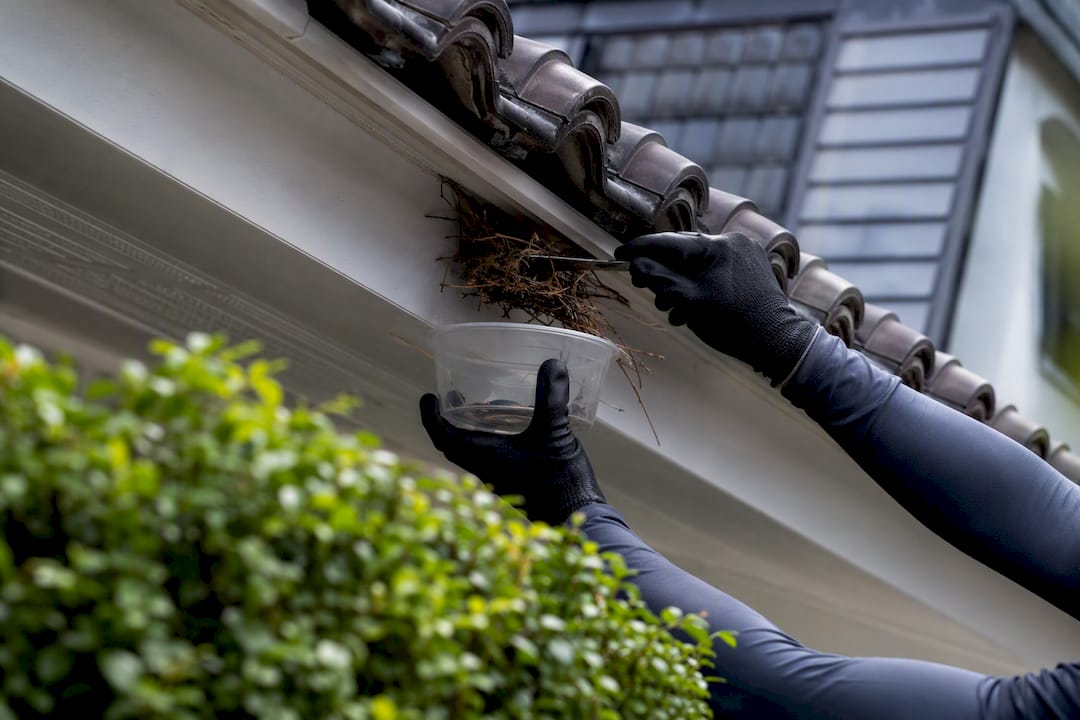
Old nests deserve equal attention. An abandoned nest in a roof void or gutter doesn't just sit there empty; it signals to other mynahs that the spot is safe and available, and a new pair will often move in within days of the old one clearing out. Clearing nesting material after birds have left, ideally outside breeding season, closes that loop.
Urban ecologists sometimes encourage replanting dense native shrubbery specifically to favor native bird species over mynahs, since native plants tend to support the seed and insect life mynahs are less adapted to exploit. That's a longer-term neighborhood strategy, though. For your own roofline and balcony today, the priority stays the same: prune what gives mynahs cover, and clear what tells them the spot is already claimed.
Our Take: Why Layering Beats Any Single Fix
The biggest mistake we see is homeowners betting everything on one deterrent, usually a decoy owl or a strip of reflective tape, and then feeling defeated when the birds adapt within a week. Mynahs are smart, social, and quick to test whatever changed in their territory. Attractant removal has to come first, exclusion has to follow, and any decoy or gel is just a rotating supporting layer, never the main event. When the problem spans a whole block, reaching out to your estate management makes more difference than anything you can do on your own balcony.
— Bespoke-Enviro Services
Get a Site Survey and Long-Term Bird Control from Bespoke-Enviro
If you've secured the bins, cleared the ledges, and the mynahs are still testing your balcony, it's time for a permanent fix rather than another round of decoys. Bespoke-Enviro is the direct alternative to piecing together DIY netting and spikes yourself: our technicians handle the site survey, the custom netting or spike layout, and safe nest removal in one visit, backed by 30-plus years of pest management experience across Singapore.
Every job follows an IPM-first, non-toxic approach, so you get lasting exclusion without chemicals near your family or pets. For rooftop or ledge debris left behind from an old roost, a service like Apache X's drone cleaning can clear droppings and nesting material from high areas without scaffolding. Most residential bird-control jobs are scheduled and completed within one to two weeks of your initial survey. Request a pest control assessment today and get a clear quote before a nesting problem turns into a roof-cavity fire hazard.
Sources
- Insect Out — How to Get Rid of Mynas & Crows
- Manage myna birds — Pacific regional guide (SPREP)
- Straits Times — Keeping the birds away with gel