
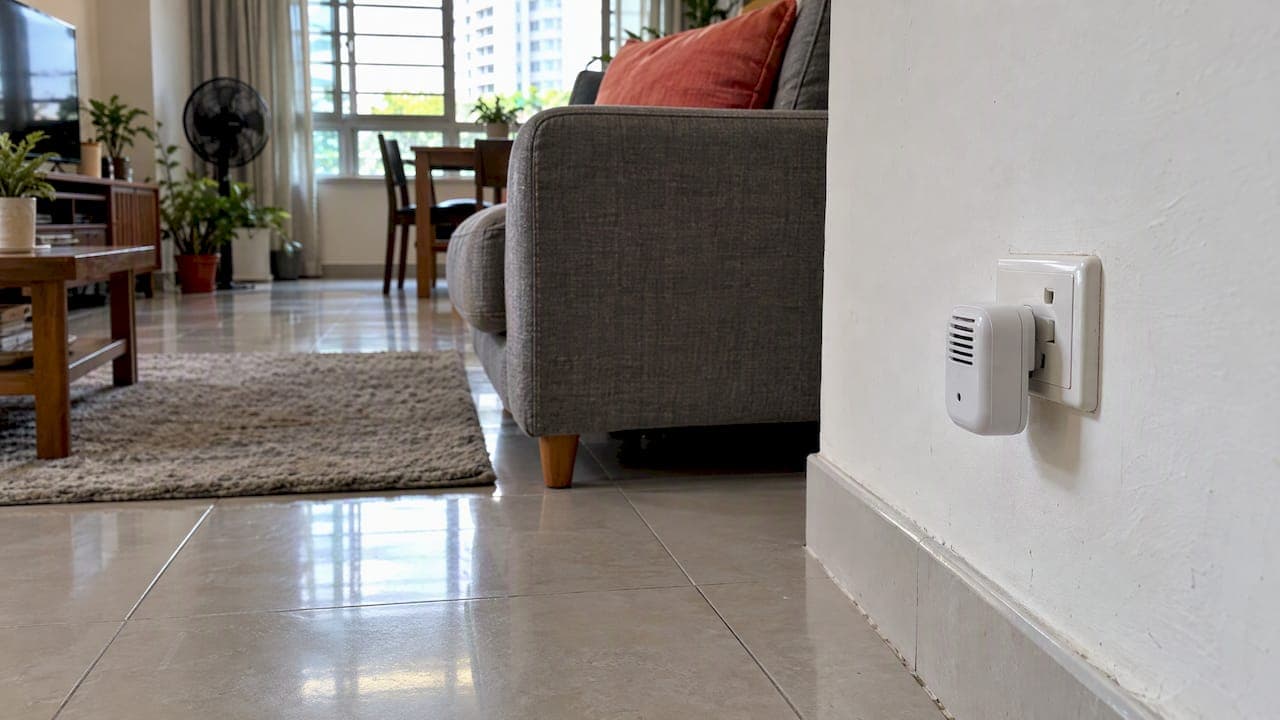
Ultrasonic pest repellers do not work well enough to rely on. Independent studies and Singapore's National Environment Agency (NEA) find no dependable, lasting effect on rats, mice, cockroaches, bed bugs or mosquitoes. Some devices cause a brief reaction in the first few days. After that, the pests carry on as before.
We are a licensed pest control company, and we are often asked about these plug-in devices. This guide covers what they claim, what the research found, why Singapore's rules matter, and what to do instead.
TL;DR
- Studies on commercial ultrasonic devices repeatedly show no behavioral change in pests such as German cockroaches and bed bugs.
- The NEA states that ultrasonic devices are ineffective at preventing mosquito bites.
- Rodents may react at first, then habituate within days, so any gain is temporary.
- A device can give a false sense of security while an infestation grows behind walls, in ceilings or under floors.
- What works is inspection, finding the source, sealing entry points, targeted treatment and follow-up, which is integrated pest management (IPM).
Table of Contents
- What ultrasonic repellers claim to do
- What the research found
- What Singapore's rules say
- Health and comfort: are they really silent?
- Why a false sense of security costs more than the device
- What actually works: integrated pest management
- Pest by pest: what to do instead of buying a repeller
- Our perspective
- When to call a professional
- FAQ
- Sources
What ultrasonic repellers claim to do
An ultrasonic repeller is a small plug-in unit. It emits sound above the range of human hearing, usually marketed as 20 kHz and higher. The sales pitch is simple: the sound irritates or frightens pests, so they leave your home without chemicals.
The appeal is easy to understand. The device is cheap, silent in theory, and has no sprays or baits, which matters if you have children, pets or a sensitive household. The McGill Office for Science and Society notes that sellers lean on the wish for a non-toxic magic bullet. The same article explains that ultrasound can change pest behavior under tightly controlled laboratory conditions. The consumer devices do not reproduce those conditions.
Typical claims include:
- Rats and mice leave the room or stop gnawing.
- Cockroaches, ants and spiders stay away from the sound.
- Mosquitoes, including biting females, avoid the area.
- One unit covers a whole flat or office.
Each claim can be tested, and researchers have tested them.
What the research found
Insects and other arthropods
The University of Arizona Cooperative Extension reviewed sonic and ultrasonic devices. Its summary says scientific studies show commercially available devices to be ineffective. Field and laboratory trials on German cockroaches and bed bugs found no behavioral change. Pests showed equal preference for rooms with or without the sound.
A 2021 study tested nine commercial ultrasonic devices against the Australian paralysis tick. The best repellency measured was below 19.5%, which is not enough to prevent tick bites. That is a tick, not a Singapore pest, but it shows the same pattern: a product that sounds technical and delivers little.
On mosquitoes, the NEA is direct. Its page on spatial repellents says studies show ultrasonic devices do not prevent mosquito bites, even though products claim to disturb the insects' senses. In Singapore, where dengue prevention is a public health matter, this is the most important point in the article. A device that does nothing against Aedes mosquitoes can leave a household feeling protected when it is not.
Rats and mice
Rodents are the pests these devices target most often. A 2026 review of ultrasonic pest control in domestic settings, covering 14 common pests, describes why results disappoint. Commercial units generally use generic, wide-spectrum tones, not signals tuned to a species or life stage. Even when rodents react, they habituate in roughly three to seven days. Once they learn the sound is not a threat, they ignore it.
There are other physical limits. Ultrasound is a high-frequency sound that travels in straight lines and loses energy quickly. Furniture, curtains, boxes and walls block or absorb it. A rat in a ceiling void, a wall cavity or a store room behind a closed door may never be exposed to it. Rats live where food, water and shelter are, and they will accept a bit of noise to reach them.

Why the lab and the home give different results
The McGill review makes a fair point. Sound can affect pests in some controlled experiments. Researchers can choose a species, a frequency pattern and a setting. A mass-market device has to work in a kitchen with a refrigerator, a pantry and a bin chute nearby. The Arizona summary says devices developed by researchers have shown promise, while the ones sold to consumers have not. That gap is why we tell customers to treat the technology as unproven for home use, not as impossible in principle.
What Singapore's rules say
The NEA regulates vector control products under the Control of Vectors and Pesticides Act. Its registration guidebook requires bio-efficacy study reports showing that a product works against its target vector when used as directed. Field trials may also be required.
This matters for a buyer in three ways:
- A product that claims to control or repel a vector, such as a mosquito, falls within this framework. The claim has to be backed by data, not by a packaging graphic.
- The guidebook sets out penalties for non-compliance, including fines of up to $20,000 and/or three months' jail for a first conviction. Check the guidebook for the exact offenses and wording.
- An online listing is not proof of registration. If a seller cannot show how a product that claims to repel vectors meets the NEA's requirements, treat the claim with caution.
The NEA's own approach to pest control is also worth knowing. It conducts inspections at homes and commercial premises and removes breeding habitats to prevent disease transmission. The emphasis is on finding and removing the cause, not on adding a gadget.
Health and comfort: are they really silent?
Many buyers assume that an inaudible device is harmless. That is not always the case.
Acoustic measurements of three commercial pest deterrents found that some emit faint audible sound in the 4 to 5 kHz range. The study also found ambiguity in whether they comply with exposure guidelines for very high-frequency sound. Younger people often hear high frequencies better, so a child may notice a whine that an adult cannot.
The evidence on harm is mixed. A double-blind provocation study of inaudible 20 kHz ultrasound was set up to test whether people who report nausea, dizziness or headaches from ultrasound in public places react to it under controlled conditions. A separate short-term exposure study of a rodent repeller examined the acoustic properties of a device and possible adverse factors. We will not claim that these devices damage health. Our practical advice is narrower:
- If anyone at home reports headaches, dizziness or irritation near a unit, unplug it and see whether the symptoms stop.
- If symptoms persist, see a doctor.
- Keep units away from bedrooms and children's rooms until you know they are not audible.
- Pets, especially small mammals, may be more sensitive to high-frequency sound than people. Ask your vet before using one in a home with rabbits, hamsters or guinea pigs.
Why a false sense of security costs more than the device
The unit itself is cheap. The real cost is what happens while you wait for it to work.
A rat colony that has settled in a ceiling can gnaw cables and insulation. Droppings and urine contaminate surfaces. A bed bug population that is not treated keeps spreading through mattresses, sofas and luggage. Termites feed unseen inside timber and are often found only when damage is visible. The 2026 review warns that standalone ultrasonic devices can delay proper professional pest control by creating confidence that is not earned.
There is also a pattern we see in practice. A customer plugs in several units, sees fewer signs for a week, and concludes the problem is solved. Then the activity returns and spreads. This is consistent with the habituation described in the research: a short quiet period, then normal behavior.
If you see any of these signs, skip the device and book an inspection:
- Droppings, grease marks along walls or gnaw marks on food packaging.
- Scratching or running sounds in ceilings at night.
- Small rust-colored spots or bites on skin in the morning.
- Mud tubes, discarded wings or hollow-sounding timber.
- Cockroaches seen in daylight, which often signals a large population.
What actually works: integrated pest management
The reliable approach is integrated pest management. It treats pests as a system of food, water, shelter and access, and fixes each part. This is the approach we use.
The steps
- Inspection. A technician identifies the species, traces activity and finds entry points, nesting areas and conditions that attract pests. We use tools such as thermal imaging for inspections where it helps find hidden activity.
- Source removal. Food storage, waste handling, standing water, clutter and moisture all get attention. For mosquitoes, this means removing breeding habitats, which is also the NEA's approach.
- Exclusion. Gaps around pipes, doors, vents and ducts are sealed so pests cannot return. For birds, this includes proofing such as spikes and netting.
- Targeted treatment. We use non-toxic, eco-friendly methods wherever they suit the pest and the site, and apply products only where they are needed.
- Monitoring and follow-up. Activity is checked after treatment. Ongoing sites, such as restaurants, offices and condominiums, get a schedule. Our guide to pest control frequency in Singapore explains how to set one.
Comparing the options
| Approach | Evidence of effect | Fixes the cause | Main risk |
|---|---|---|---|
| Ultrasonic plug-in device | Weak or none in independent studies | No | False confidence, possible audible noise |
| DIY sprays and glue boards | Limited, short-term | Rarely | Misuse, missed nests |
| Housekeeping and sealing gaps | Good as a base | Partly | Needs a trained eye to find all entry points |
| Professional IPM service | Based on inspection and targeted treatment | Yes | Needs a licensed, accountable provider |
Pest by pest: what to do instead of buying a repeller
Rats and mice. Find the runs and entry points, seal gaps and use tamper-resistant baiting or trapping placed by a trained technician. Our rodent control service follows this sequence.
Cockroaches and ants. These respond to sanitation, targeted gel baits and treatment of harborage areas. A noise has no effect on their search for food. See our general pest control service.
Bed bugs. They hide in seams, frames and furniture, and they are not deterred by sound. Treatment needs a careful inspection and a proper plan, as in our bed bug control service.
Termites and wood borers. Damage occurs inside timber, so the first step is detection and targeted treatment. Read our guide on eco-friendly termite treatment, or see powderpost beetle treatment.
Mosquitoes. Remove stagnant water weekly, check gully traps, plant pots and roof gutters, and follow NEA guidance. Do not rely on a plug-in sound device.
Birds. Mynahs and pigeons respond to physical proofing and removal of food sources, not ultrasound. Our steps for keeping mynahs away without poisons show what is practical for a home.
Our perspective
We have worked in pest control in Singapore for over 30 years. In that time we have seen many gadgets come and go. Our view is simple: a pest problem is a problem of a specific species in a specific building, and it needs a specific answer.
We understand why people want an ultrasonic device. They want something safe, quiet and simple. We share the first of those goals. Our technicians are NEA-licensed, and we build our work on integrated pest management, with non-toxic and eco-friendly treatments that put the safety of people and pets first. The difference is that we base safety on inspection and the right method, not on a device that does not solve the problem.

We also think customers deserve plain advice. If a device is not going to work, we would rather say so before you spend money and lose weeks. An inspection tells you what pest you have, where it lives and what it will take to remove it. It also tells you what you can do yourself, such as fixing a leak, storing food in sealed containers or closing a gap under a door.
If you already own a repeller, you do not need to throw it away in a panic. Just do not count on it, and do not delay an inspection because the device is running.
— Bespoke-Enviro Services
When to call a professional
Book a service if you see repeated signs of activity, if droppings or damage appear in food areas, if you have bites you cannot explain, or if you run a business where hygiene is audited. For landlords and property managers, a documented schedule is also easier to defend than a collection of devices.
We offer inspections and treatment for homes, offices, industrial sites and construction sites across Singapore, with 24/7 availability. Start with our general pest control service, or visit Bespoke Enviro Services to describe your problem. We do not publish prices, so the quote follows the inspection and covers what your site needs.
FAQ
Do ultrasonic pest repellers work?
Independent research says they do not work reliably. Studies on cockroaches and bed bugs found no change in behavior, and the NEA says ultrasonic devices do not prevent mosquito bites. Some users report a short dip in activity, which fits the quick habituation seen in rodents.
How long does it take for an ultrasonic repeller to work on rats?
Some sellers suggest a reduction after one to two weeks. The research points the other way: rodents that react at first tend to habituate in about three to seven days. A quiet week is not proof that the colony has left.
Are ultrasonic pest repellers safe for pets and children?
There is no clear proof of harm from typical use, but there are open questions. Some units emit faint audible sound, and young people often hear high frequencies better. If someone at home develops headaches or dizziness near a device, unplug it, and see a doctor if symptoms continue. Ask a vet about small pets.
Are ultrasonic repellers legal in Singapore?
The NEA requires products that claim to control or repel vectors to be registered, with efficacy data supported by bio-efficacy reports. If you are unsure about a product, check with the NEA before buying or selling it.
What should I do instead of buying a repeller?
Look for the source: food, water, shelter and entry points. Seal gaps, store food securely and remove standing water. If signs continue, have a licensed operator inspect the premises and set up a treatment plan.
Sources
- NEA: Types of spatial repellents
- NEA: Pest control overview
- NEA: Guidebook on the registration of pesticides and repellents against vectors
- University of Arizona Cooperative Extension: Sonic pest repellent
- Ultrasonic pest control in domestic settings: evidence, efficacy, and limitations
- McGill Office for Science and Society: Are ultrasonic pest repellers effective?
- Efficacy of ultrasonic pest repellent devices against the Australian paralysis tick
- Measurements of ultrasonic deterrents and an acoustically branded hairdryer
- Effects of very high-frequency sound and ultrasound on humans, Part II
- Assessment of short-term exposure to an ultrasonic rodent repellent device