
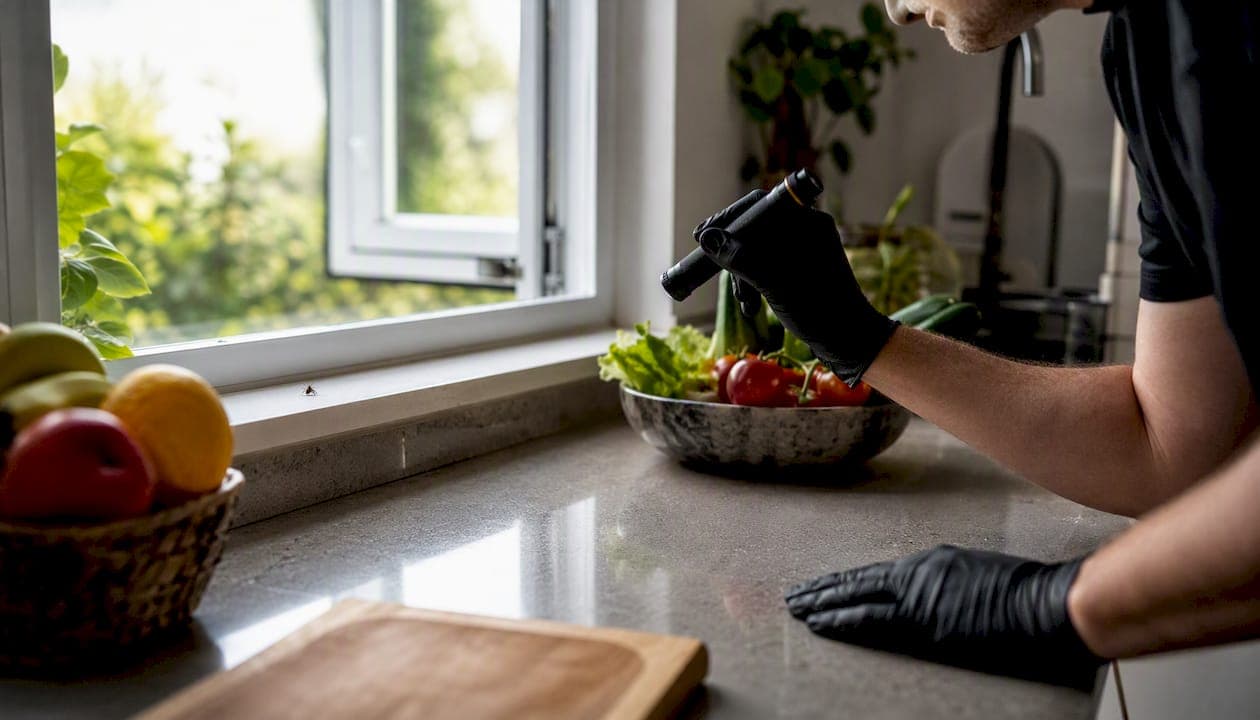
The most effective fly control follows a single sequence: remove what flies breed in, block their entry, then use traps or targeted treatments only where the first two steps fall short. That is the Integrated Pest Management (IPM) framework, and it outperforms any spray-first approach because it attacks the source rather than the symptom. Start with these three actions within the next 24 hours:
- Audit and remove breeding material. Empty trash cans, clean drains, and pull any wet organic matter from kitchens, dumpsters, or compost areas. Eliminating larval habitat is the preferred method for long-term fly suppression because it breaks the life cycle before adults emerge.
- Seal obvious entry points. Check door sweeps, window screens, and any gap around utility penetrations. Even a torn screen corner is enough for dozens of flies per hour.
- Place at least one trap near the primary problem area. A sticky ribbon in a utility room or a baited jar trap near a dumpster gives you immediate population data while sanitation takes effect.
Visible reduction typically follows within 3–7 days of consistent sanitation. If you still see heavy activity after two weeks, or if you find maggots inside a structure, that is the signal to bring in a professional.
Pro Tip: Before buying any product, spend 10 minutes tracing where flies rest during the day. Resting spots are almost always within 150 feet of the breeding site — and finding that site is worth more than any trap or spray.
Key Takeaways
Fly control that lasts requires removing breeding sites first, then layering exclusion and targeted treatments on top of that foundation.
| Point | Details |
|---|---|
| Sanitation comes first | Eliminating larval habitat breaks the fly life cycle and prevents adult production faster than any trap or spray. |
| Identify the species | House flies, fruit flies, drain flies, and blow flies each require different source-removal strategies — misidentifying costs time. |
| Layer your methods | Combining sanitation, physical exclusion, and targeted traps or treatments outperforms any single-method approach. |
| Monitor with trap counts | Weekly trap logs tell you whether a breeding site remains active and when re-treatment is needed. |
| Bespoke-enviro for persistent cases | When DIY methods fail or maggots appear inside a structure, Bespoke-enviro's IPM inspection locates hidden breeding sites and builds a multi-method plan. |
Table of Contents
- Which fly species do you actually have?
- Sanitation: the non-negotiable foundation of fly prevention
- How do you keep flies out before they become a problem?
- Traps and baits: which design works for which situation?
- Insecticides: when they help and when they backfire
- Do biological controls actually work?
- How do you monitor fly populations and know when to re-treat?
- When should you call a pest management professional?
- Bespoke-enviro brings professional IPM to your fly problem
- Sources
Which fly species do you actually have?
Getting the species right before choosing a fly control method saves you real time and money. A fruit fly trap does nothing for a blow fly infestation, and treating for house flies when you have drain flies means you will never find the actual source.
| Species | Size | Key breeding site | First control step |
|---|---|---|---|
| House fly (Musca domestica) | small size | Manure, garbage, decaying organic matter | Remove organic waste; clean dumpsters |
| Blow fly / bottle fly | 8–12 mm | Animal carcasses, exposed meat, wounds | Locate and remove carcass or meat source |
| Fruit fly (Drosophila spp.) | 3–4 mm | Overripe fruit, fermenting liquids, wet drains | Discard overripe produce; clean drain biofilm |
| Drain fly (Psychoda spp.) | 2–5 mm | Drain slime, sewage, wet organic buildup | Scrub drain interior; remove biofilm |
| Stable fly (Stomoxys calcitrans) | small to medium size | Wet straw, rotting vegetation, livestock bedding | Remove and dry wet bedding; compost management |
| Cluster fly (Pollenia rudis) | medium size | Earthworm hosts in soil; overwinters in walls | Seal wall voids and attic entry points in late summer |
| Face fly (Musca autumnalis) | small to medium size | Cattle dung in pastures | Pasture management; feed-through larvicides for cattle |
The lifecycle cue that matters most is the presence of larvae (maggots) or puparia near a suspected site. House fly eggs hatch in 8–20 hours under warm conditions, and the larva-to-adult cycle completes in as few as 7–10 days at 80°F. That speed is why a missed breeding site can repopulate a space faster than any trap can keep up.
Natural fly deterrents like basil or lavender can discourage small numbers of fruit flies near a kitchen counter, but aromatics are short-term deterrents for localized situations and will not address a blow fly problem originating from a carcass in a crawl space.
Sanitation: the non-negotiable foundation of fly prevention
No trap, spray, or barrier performs well when breeding material remains in place. Targeting larvae breaks the life cycle and prevents adult production — which is why every credible extension program puts sanitation first.
Room-by-room and site checklist
Kitchen and food prep areas
- Empty and rinse trash cans daily; use cans with tight-fitting lids.
- Wipe up spills immediately, especially fruit juice, grease, and sugary liquids.
- Store ripe fruit in the refrigerator or sealed containers.
- Clean drain interiors weekly with a stiff brush to remove biofilm.
- Check under appliances for food debris — the gap behind a commercial range is one of the most commonly missed hotspots.
Dumpsters and waste areas
- Rinse dumpsters regularly with hot water and a degreaser.
- Keep lids closed and latched; repair damaged lids immediately.
- Position dumpsters as far from building entrances as practical.
- Avoid placing dumpsters on bare soil where liquids can pool.
Animal and livestock zones
- Remove manure from stalls and pens regularly during warm months.
- Compost manure in covered, managed piles rather than open heaps.
- Replace wet bedding promptly; stable flies breed in wet straw within 48 hours.
Drains and compost
- Pour boiling water or an enzyme-based drain cleaner down slow drains weekly.
- Cover compost bins and turn them regularly to accelerate decomposition and reduce odor.
Pro Tip: Inspectors most commonly miss the drain floor drain in commercial kitchens and the gap beneath walk-in cooler doors, where condensation creates a permanent wet zone. Check both before assuming the breeding site is outside.
A layered approach — removing standing water, discarding uneaten food, and managing waste on a fixed schedule — gives the best protection for sensitive sites like restaurants and food-handling areas. For a residential kitchen, a 15-minute weekly cleaning routine covers most of it. For a restaurant, daily checks and a documented cleaning log are the standard.
| Site type | Cleaning frequency | Time estimate | Priority hotspot |
|---|---|---|---|
| Residential kitchen | Weekly deep clean + daily wipe-down | 15–20 min/week | Drain biofilm, fruit bowl |
| Restaurant / food service | Daily + twice-weekly dumpster rinse | 30 min/day | Floor drains, grease traps |
| Livestock / farm | 2–3x per week manure removal | Varies by herd size | Wet bedding, manure piles |
| Commercial dumpster area | Twice monthly rinse | 20–30 min/session | Dumpster base, surrounding pavement |
How do you keep flies out before they become a problem?
Physical exclusion is the second pillar of IPM, and properly maintained screens, air curtains, and closed doors are among the most reliable ways to prevent flies from entering buildings. The goal is to make entry physically difficult before any killing method is needed.

Window and door screens should use mesh no larger than 16 × 16 threads per inch for house flies, and 18 × 18 for smaller species like fruit flies. Inspect screens monthly for tears, bent frames, or gaps at the edges. A screen that fits poorly at the corner lets in as many flies as no screen at all.
Weatherstripping and door sweeps seal the gap at the bottom and sides of exterior doors. Brush-style sweeps work better than rubber blades on uneven thresholds. Replace them annually or whenever you can see daylight under a closed door.
Air curtains (also called fly fans) work by directing a continuous downward airflow across a doorway, making it difficult for flies to fly through. They are most effective at commercial entries with high foot traffic. Effective air curtains typically operate at high air velocities to prevent fly entry at doorways. The most common failure point is a unit that is too narrow for the door opening, leaving gaps at the sides.
Strip doors (PVC curtain strips) are a lower-cost alternative for loading docks and warehouse entries. They slow fly movement without requiring power, though they need regular cleaning since flies rest on the strips.
Self-closing and high-speed roll-up doors are the standard for food-processing facilities. A door left open during a delivery can admit dozens of flies.
Pro Tip: Air curtains are often installed but rarely tested. Hold a piece of tissue paper at the base of the doorway while the unit runs — if the paper doesn't deflect strongly toward the floor, the unit needs adjustment or the blades need cleaning.
Exclusion works best when breeding sources are already under control. If a dumpster sits 10 feet from a back door, even a perfect screen will not stop the pressure.
Traps and baits: which design works for which situation?
Traps are a monitoring tool first and a control tool second. They tell you where fly pressure is highest and whether your sanitation efforts are working. Used alone without source removal, they reduce adult numbers temporarily but cannot keep pace with active breeding.
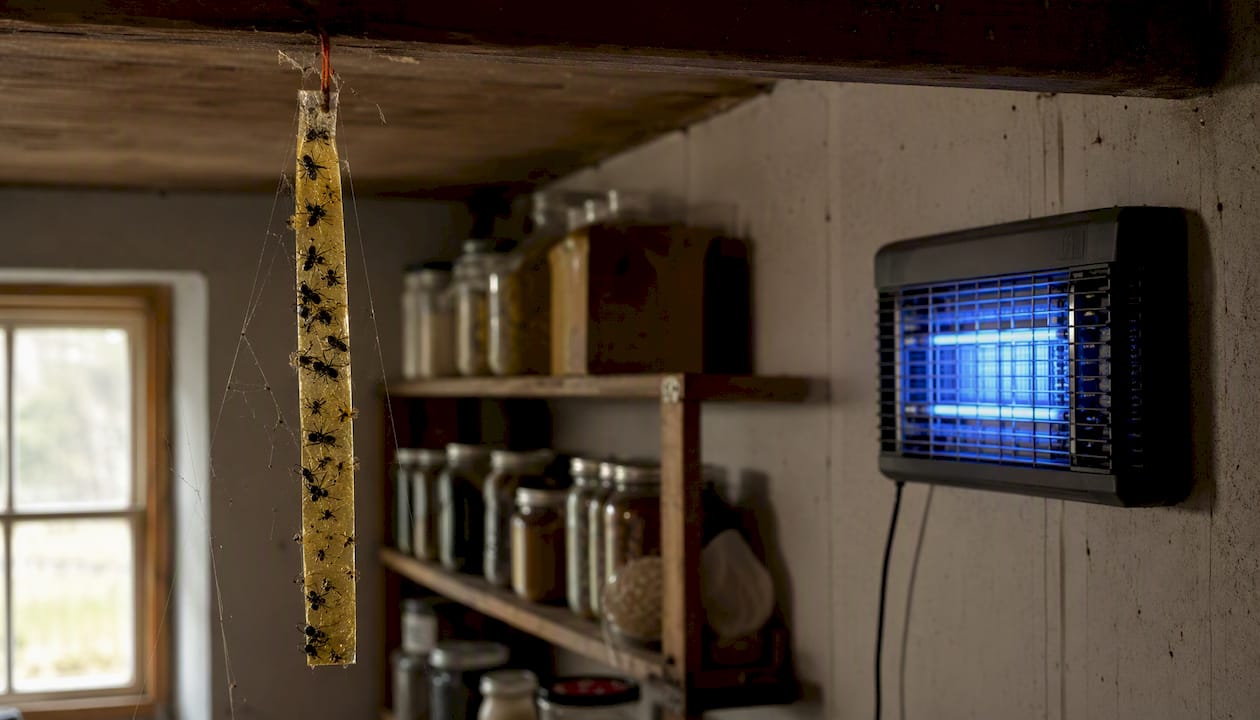
| Trap type | Best use | Placement | Odor/attractant | Maintenance |
|---|---|---|---|---|
| Sticky ribbon / pad | Indoor utility rooms, storage | Away from food prep; hang at fly-resting height | None | Replace when covered (weekly to monthly) |
| UV light electrocutor | Indoor commercial, warehouses | Away from windows; 5–6 ft height, not near food | None | Clean grid weekly; replace bulb annually |
| Inverted-cone attractant trap | Outdoor perimeter, dumpster areas | Downwind of entry points; 20+ ft from doors | Protein-based bait | Empty and refill weekly |
| Baited jar / DIY trap | Fruit flies, residential kitchens | Near fruit bowl or drain | Apple cider vinegar + dish soap | Replace solution every 3–5 days |
| Commercial bait station | Livestock, farms, large outdoor sites | Near manure or waste areas | Fly-specific granular bait | Replenish per label; check weekly |
Sticky fly paper works well in confined areas but is insufficient for heavy infestations. UV electrocutors perform best indoors when they are not competing with sunlight, and they must stay away from food-prep surfaces where dead insects could fall.
How to set and monitor traps effectively:
- Place traps at fly-resting height (4–6 feet for house flies, lower for fruit flies near drains).
- Record trap counts weekly on a simple log — date, location, count. A sudden spike tells you a new breeding site has opened.
- Rotate attractant baits every 7–10 days to maintain effectiveness.
- For outdoor perimeter traps, position them downwind of the building so the attractant scent pulls flies away from the entry rather than toward it.
- Never place protein-based attractant traps near doorways — the scent draws flies in before they reach the trap.
A homemade fly control solution for fruit flies: fill a small jar with apple cider vinegar, add two drops of dish soap to break the surface tension, and cover with plastic wrap punctured with small holes. Replace the solution every few days. It works for low-density kitchen situations but will not address a drain fly problem where the biofilm source remains intact.
Insecticides: when they help and when they backfire
Chemicals have a real role in fly management, but overuse of chemical sprays targets adults only and accelerates resistance development. The durable solution is always sanitation; insecticides buy time or handle acute pressure while source elimination catches up.
Chemical categories and their uses:
- Pyrethrins and pyrethroids (permethrin, cypermethrin, deltamethrin): fast knockdown, low mammalian toxicity at label rates. Used as residual surface sprays on resting surfaces and as space sprays for immediate adult kill.
- Organophosphates (malathion, dichlorvos): effective but many formulations are restricted or phased out for indoor use. Follow current EPA registration status before purchasing.
- Insect growth regulators (IGRs) (methoprene, cyromazine): disrupt larval development without killing adults. Most useful in manure, compost, or drain environments where larvae are present. Cyromazine is available as a feed-through product for livestock.
- Fly baits (imidacloprid, methomyl-based): granular or liquid formulations placed away from food contact surfaces. Highly effective for outdoor perimeter use near dumpsters and waste areas.
- Space sprays and fogs: no residual value; space sprays may need reapplication every 2–3 days during peak fly season, and residual sprays can break down within 2–3 weeks depending on heat, sunlight, and rain.
Label compliance is not optional. Every pesticide label is a legal document. Using a product in a manner inconsistent with its label — including applying it near food, using it in an unlisted location, or skipping required PPE — is a federal violation under FIFRA. Read the full label before every application, not just the first time.
Safety basics:
- Keep people and pets out of treated areas until re-entry intervals (listed on the label) have passed.
- Never apply residual sprays to food-contact surfaces, open food, or food-prep equipment.
- Wear nitrile gloves and eye protection at minimum; a respirator for space sprays.
- Store all pesticides in original containers, locked and away from children.
Pro Tip: Rotate between chemical classes (e.g., alternate a pyrethroid with an organophosphate or a bait) to slow resistance. Using the same active ingredient every cycle selects for resistant populations within a single season.
Do biological controls actually work?
Biological fly control has genuine value in specific settings, but it is not a standalone solution for most homeowners or urban businesses.
Commercially available options:
- Parasitic wasps (Muscidifurax, Spalangia, Pteromalus spp.): tiny, non-stinging wasps that lay eggs inside fly puparia. They work best in livestock facilities where puparia are concentrated in manure or bedding. Release timing matters — wasps need to be deployed before fly populations peak.
- Bacillus thuringiensis var. israelensis (Bti): a naturally occurring bacterium that kills fly and mosquito larvae in standing water. Applied as granules or dunks to water sources, it is safe for mammals, birds, and beneficial insects.
- Beneficial nematodes (Steinernema spp.): applied to moist soil or compost, they parasitize fly larvae in the substrate. Effective in garden compost and around outdoor waste areas.
- Entomopathogenic fungi (Beauveria bassiana, Metarhizium spp.): infect and kill adult flies on contact. Available in some commercial formulations; most useful as a complement to other methods.
Biological control is most effective as a supplement to cultural controls, not a replacement. Some regional trials with imported parasitic wasps have failed to show effective control, particularly where native wasp populations were already present or where fly breeding sites were too dispersed for wasp coverage to matter.
Where biologicals add clear value: large livestock operations, organic farms, and outdoor composting sites where chemical use is restricted or undesirable. Where they tend to underperform: urban settings, indoor environments, and any site where the breeding source has not been addressed first.
How do you monitor fly populations and know when to re-treat?
Monitoring turns guesswork into a decision. Without it, you either over-treat (wasting money and accelerating resistance) or under-treat (letting a population rebound).
Simple indicators to track:
- Weekly trap counts by location
- Fly speck density on walls, light fixtures, and window sills (specks increase near resting and feeding sites)
- Presence of larvae or puparia near suspected breeding sites
- Staff or resident complaints by zone (useful for commercial sites)
| Site type | Monitoring cadence | Threshold for action | Routine maintenance task |
|---|---|---|---|
| Residential kitchen | Weekly trap check | Any larvae found; trap count doubles week-over-week | Replace sticky trap; recheck drain |
| Restaurant / food service | Daily visual + weekly trap count | Any larvae in kitchen; trap count above baseline | Clean drains, check dumpster, log counts |
| Farm / livestock | Twice-weekly visual + weekly trap count | Visible fly clusters on animals; trap counts rising | Manure removal, bedding replacement |
| Warehouse / commercial | Weekly trap count | Trap count doubles; fly specks near product | Inspect loading dock seals, check drains |
After a sanitation intervention, expect trap counts to drop within 3–7 days as the adult population that emerged from the treated site dies off. If counts do not fall within two weeks, a breeding site remains active. After exclusion repairs, entry pressure should drop within 24–48 hours — if it does not, the gap has not been fully sealed.
When should you call a pest management professional?
DIY fly control fails in predictable ways: the breeding site is hidden, the infestation spans multiple zones, or the situation carries a health-code risk that requires documented treatment. Professionals perform comprehensive assessments and integrate sanitation, exclusion, and targeted interventions in ways that a single-product DIY approach rarely coordinates.
Red flags that signal a professional call:
- Maggots found inside a structure (wall voids, under flooring, inside equipment)
- Fly populations rebound within days of treatment
- Infestation near food prep, food storage, or patient-care areas
- A health inspection has cited fly activity or you face a re-inspection deadline
- You cannot locate the breeding site after a thorough search
Questions to ask any pest management contractor:
- What species are you targeting, and how will you confirm identification?
- Where will you inspect for breeding sites, and does that include drains, wall voids, and exterior waste areas?
- Which IPM methods will you use, and in what sequence?
- What pesticides will be applied, and what are the re-entry intervals for my space?
- What sanitation or structural changes do you recommend before or after treatment?
- Do you offer a follow-up inspection or a maintenance contract?
- Are you licensed by the state and do you carry liability insurance?
Rough cost ranges for common professional fly-control jobs in the US vary by region, site size, and infestation severity. Rough cost ranges for common professional fly-control jobs in the US vary by region, site size, and infestation severity. Farms and large outdoor sites are priced by acreage and method.
What experienced pest technicians know that most guides skip
The most common failure in commercial fly control is not a product failure. It is an air curtain that someone propped open with a box during a busy lunch service and never reset. That single gap, left open for a few hours each day, can admit enough flies to overwhelm any trap setup inside the building. One restaurant that added a door-closure alarm to its air curtain unit saw fly counts on interior sticky traps drop by more than half within a week, without changing any other part of the program.
The pro-level shortcut that cuts pesticide use: before any chemical application, spend 20 minutes with a UV flashlight checking drain covers, floor cracks, and the undersides of equipment. Fly puparia are cream-to-brown oval cases about 5–6 mm long, and finding them tells you exactly where to focus sanitation rather than spraying broadly. Targeted drain treatment with an IGR at that single location often resolves what looked like a building-wide problem.
Bespoke-enviro brings professional IPM to your fly problem

Persistent fly pressure in a food business or home is almost always a sign of a breeding site that has not been found yet. Bespoke-enviro's IPM-trained technicians locate those hidden sources — drains, wall voids, compost hot spots — using diagnostic inspection methods that go well beyond a surface spray. With over 30 years of experience delivering eco-friendly pest management for residential, commercial, and industrial clients, Bespoke-enviro builds a layered control plan: sanitation guidance, structural exclusion recommendations, targeted non-toxic treatments, and a monitoring schedule that keeps populations from rebounding.
If you are dealing with a fly problem that keeps coming back despite your own efforts, the next step is a professional inspection. Book a consultation with Bespoke-enviro to get a site-specific plan that addresses the source, not just the symptom.
Sources
The following sources formed the evidence base for this guide and are worth bookmarking for deeper reference:
- A Review of Alternative Controls for House Flies
- Flies / Home and Landscape / UC Statewide IPM Program (UC IPM)
- Fly Control (University of Nebraska Extension)