
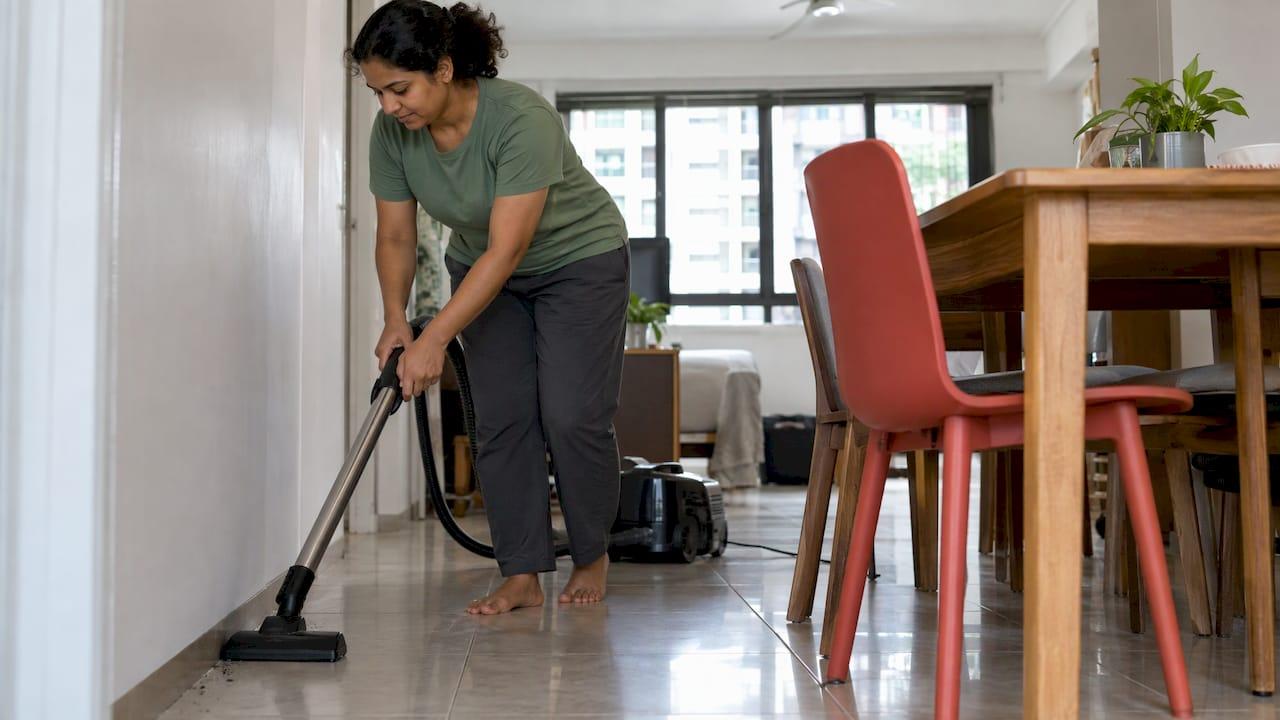
After a fumigation in Singapore, your cleaning starts only once the licensed fumigator has declared the premises safe to re-enter. Before that point, the fumigator, not you, removes fumigant residues and checks that the air, water fittings and soft items are clear. After that point, your job is ordinary and manageable: ventilate, wipe the surfaces people touch, vacuum up dead pests and debris, and wash the items you want to freshen. This guide explains each stage, what Singapore's rules say, and what to avoid.
TL;DR
- Do not enter until the licensed fumigator confirms re-entry is safe through the written declaration. Never judge safety by smell or by how long you have waited.
- The NEA code requires the fumigator to clear residues, run taps, empty cisterns and check bedding and soft items before declaring the area safe.
- Once you are cleared to go in, open windows, wipe high-touch surfaces and food-contact areas with soap and water, then vacuum dead pests, droppings and dust.
- Wash toys, kitchen appliances and anything you want freshened. Heavy washing of every item is not what the rules ask of you.
- If you feel unwell or notice an odor after re-entry, leave, ventilate and call your fumigator. In an emergency, call 995.
Table of Contents
- Who clears the home first: the licensed fumigator
- What the fumigator must do before you clean
- Fumigation, misting and spraying: different cleanup
- Step-by-step: how to clean after fumigation
- Room-by-room: what to clean and what to leave
- Do you need to wash everything?
- What not to do after fumigation
- When pests are dead: dealing with what remains
- If you smell something or feel unwell after re-entry
- Our perspective
- Pest control and fumigation handled end to end
- FAQ
- Sources
Who clears the home first: the licensed fumigator
Fumigation is not the same as spraying or misting. The Singapore Pest Management Association (SPMA) explains that fumigation uses a poisonous gas, such as methyl bromide or phosphine, and must be done by a fumigator licensed by the National Environment Agency. It adds that other chemical treatments, including thermal fogging, misting and spraying, are not fumigation. This matters for cleaning, because the steps after a gas treatment are different from the steps after a spray.
The key moment is the re-entry declaration. Under the NEA's Code of Practice for Fumigation Personnel, the fumigator must use gas monitoring equipment to confirm that the fumigant concentration is below 10% of the long-term permissible exposure level before issuing the written Form G declaration of safe re-entry. For the gases the code names, the thresholds are:
| Fumigant | Level required before re-entry declaration |
|---|---|
| Hydrogen cyanide | 0 ppm |
| Phosphine | Below 0.03 ppm (0.042 mg/m³) |
| Methyl bromide | Below 0.5 ppm (1.9 mg/m³) |
These figures come from the code, which applies them to the exposure limits in the Workplace Safety and Health (General Provisions) Regulations. That schedule lists, for example, 5 ppm (long term) for hydrogen cyanide and 19 ppm (long term) for methyl bromide. The re-entry threshold is a fraction of those limits.
The practical rule for residents is simple. Wait for the written declaration. Do not open sealed doors early, and do not send family members or pets in to check. If you want to know more about what a provider should verify before and after a job, our guide on fumigation safety checks walks through them. If you need to understand the paperwork, see our explainer on the fumigation certificate in Singapore.
What the fumigator must do before you clean
Many people assume the cleaning after fumigation is theirs from the start. In Singapore, a good part of it belongs to the fumigator. The NEA code says that before the re-entry declaration, all of the following must be done:
- All residues of fumigation materials are removed.
- All water taps are turned on for at least one minute, with the water run to waste.
- All water closet cisterns are emptied and the pans flushed.
- All other receptacles holding water or liquid that could absorb fumigant are emptied.
- Bedding, blankets, pillows, clothing, cushions and other articles liable to absorb fumigant are confirmed free from a dangerous concentration of fumigant.
This list is the reason you do not need to scrub the entire home out of fear of gas left behind. It is also the reason you should not run taps, flush toilets or move soft furnishings yourself during the clearance period. Those steps belong to the licensed person working with monitoring equipment.
Ventilation follows the same logic. The code states that ventilation of a fumigated area is carried out under the supervision of a licensed fumigator, who decides the rate by considering the fumigant concentration, the size of the area, wind and any fumigant recapture technology. Mechanical fans may be used to speed it up where it is safe and necessary, and ventilation is done during off-peak hours where possible. In a block of flats, that can mean the fumigator schedules airing around neighbors and common areas.
When you receive the all-clear, ask the technician to tell you three things: which areas were treated, whether anything in the unit should be handled in a particular way, and who to call if you notice a problem. Write down the technician's number and the time of clearance.
Fumigation, misting and spraying: different cleanup
Most home pest jobs in Singapore are not fumigations. Cockroach gel baiting, spraying and misting are far more common than gas treatments, and the cleanup differs. The SPMA says that in most cases you do not need to leave your home during a treatment, and that you only need to leave when gassing or misting is used, after which you can usually return within a few hours. For these jobs, it suggests storing food and kitchen utensils properly beforehand and washing toys and kitchen appliances before using them again.
The NEA's code for vector control operators sets out a similar routine for non-fumigation pesticide treatments. Clients are told to open all windows and doors to ventilate for at least 30 minutes (60 minutes for certain treatments). They are also told to wash and wipe down any pesticide that has landed on high-touch surfaces such as door knobs, tables and chairs, and on floors, using soap and water, and to avoid touching sprayed walls.
It also helps to know that cleaning and disinfection are separate things from pest treatment. If you are weighing a deep clean afterward, electrostatic disinfection explained shows what that type of service does and when it fits. It does not replace the fumigator's clearance, and it does not treat an infestation.
Step-by-step: how to clean after fumigation
Use this sequence once you hold the all-clear from your fumigator, or after a spray or mist treatment once the ventilation time has passed.
- Open the home up. Open windows and doors, and keep them open while you clean. If the unit has an exhaust fan in the kitchen or bathrooms, switch it on.
- Gather supplies. You need dish soap or a mild all-purpose cleaner, microfiber cloths, a vacuum cleaner, a mop, clean water for rinsing, and rubbish bags.
- Start with dust and dead pests. Vacuum floors, skirting, window tracks, the tops of cabinets and the corners of wardrobes. Vacuum first so you do not smear debris when you wipe. Empty the vacuum canister or seal the bag outside the unit.
- Wipe high-touch surfaces. Door handles, light switches, remote controls, tables, chair arms and handrails get a damp cloth with soap and water. Rinse the cloth often and bin disposable ones afterward.
- Clean food-contact surfaces. Wipe kitchen counters, shelves, the inside of cabinet doors and the dining table with warm soapy water, then wipe again with clean water.
- Wash what you will use directly. Toys, kitchen appliances, chopping boards and anything a child or pet puts in the mouth should be washed before use, in line with SPMA's advice.
- Mop the floors. Use soap and water, and rinse the mop between rooms.
- Dispose of waste. Bag dead insects, droppings and used cloths and take them to the rubbish chute or bin.
- Air the unit again. Leave windows open for a while after you finish, particularly bedrooms.
Avoid mixing cleaning products, especially bleach with anything else. Fresh air and plain soap do most of the work.
Room-by-room: what to clean and what to leave
| Area | What to do | Why |
|---|---|---|
| Kitchen counters and tables | Wipe with soapy water, then clean water | Food-contact surfaces, and where spray may have landed |
| Crockery, cutlery, pots | Wash if they were left out or uncovered during a spray or mist | Droplets or dust may have settled |
| Sealed food | Wipe packaging; discard open food left exposed | Open items cannot be cleaned reliably |
| Bedroom | Vacuum the mattress and floor; wash bedsheets and pillow covers | Removes dust and dead insects; freshens fabrics |
| Soft toys and children's toys | Wash before use | SPMA advises washing toys after treatment |
| Bathroom | Wipe surfaces, check drains and floor traps | Dead pests often gather near drains |
| Living room | Vacuum sofas and rugs, wipe the coffee table and remote controls | High-touch and soft surfaces |
| Balcony and service yard | Sweep and rinse | Dust and debris collect outdoors |
| Taps and toilets | Leave the fumigator's clearance steps alone; use normally once cleared | The NEA code assigns tap and cistern flushing to the fumigator |
For bedding and clothing, the code already requires the fumigator to confirm that these items are free of dangerous fumigant levels. Washing them afterward is a matter of freshness and, after bed bug or cockroach jobs, of removing dead pests and eggs. It is not a safety step that overrides the declaration.
Do you need to wash everything?
This is the question that splits online advice. One camp says to wash every dish, sheet and curtain. The other says nothing at all is needed. Both are partly right, because the answer depends on the type of treatment.
For structural gas fumigation in the United States, the manufacturer's planning guide for the fumigant Vikane says that washing dishes, linens and clothing is not necessary, because the gas dissipates from the structure and its contents. That guide describes California practice and a specific product. It does not set the rules in Singapore.
In Singapore, the controlling document is the NEA code. It puts the burden of clearing residues, flushing water and checking absorbent items on the licensed fumigator, and it makes safe re-entry depend on measured gas levels. If the fumigator has issued the declaration, you are not expected to decontaminate the home yourself. What you clean afterward is the physical aftermath of the pest problem and of the treatment: dead insects, droppings, dust, and any spray residue on surfaces.
My practical rule: wash what touches skin and mouths (bedsheets, pillow covers, toys, kitchen items that were uncovered), wipe what people touch, and vacuum the rest.
What not to do after fumigation
- Do not re-enter early. Smell is not a reliable test. The re-entry declaration is based on gas monitoring, not on whether you can detect an odor.
- Do not turn on taps or flush toilets before clearance. The code lists these as steps for the fumigator.
- Do not touch sprayed walls. The vector control code asks clients to avoid contact with sprayed walls while wiping other surfaces.
- Do not let children or pets handle debris. Vacuum and bin dead pests promptly.
- Do not combine cleaning chemicals. Soap and water are enough for the surfaces the NEA code mentions.
- Do not discard the paperwork. Keep the declaration and the service report. Property managers and landlords may ask for them.
When pests are dead: dealing with what remains
Some pests leave more cleanup than others, and a different follow-up applies.

Cockroaches and ants. Expect dead insects in kitchens, behind appliances and under sinks. Vacuum along cabinet edges and wipe shelves. Keep food sealed afterward so new pests are not drawn in.
Bed bugs. Wash and dry bedding at the hottest setting the fabric allows, vacuum mattress seams and bed frames, and bag the vacuum contents. Our bed bug control service includes follow-up guidance suited to the property.

Termites. Dead termites and wood dust can appear around affected timber. Vacuum rather than sweep, and leave the treated areas intact so the technician can monitor them. See our termite control and treatment page for how we approach these jobs.
Rodents. Wear gloves when you clean droppings and nesting material, ventilate the area, and wash hands afterward. Our rodent and rat control service also covers proofing, so the problem is addressed at the source.
For homes with young children, or if you are pregnant, read our guide on pest control when pregnant before you plan treatment and cleanup. For restaurants and food businesses, the kitchen pest checklist covers the cleaning and records that follow a treatment.
If you smell something or feel unwell after re-entry
If you notice an unusual smell, or you or someone in the household develops a headache, dizziness, nausea, breathing difficulty or irritation after you return, act at once:
- Leave the unit and take everyone, including pets, into fresh air.
- Call your fumigation provider and tell them what you noticed. A licensed fumigator can return to re-test the air.
- If symptoms are severe or someone has trouble breathing, call 995 for an ambulance.
- Do not go back in until the fumigator has re-checked the unit and confirmed it is safe.
People who have asthma, heart or lung conditions, as well as pregnant women, infants and the elderly, should speak with their doctor about any symptoms. Keep the service report to show what was used.
Our perspective
Most of the worry we hear after a treatment comes from not knowing who is responsible for what. In Singapore the answer is clear. The licensed fumigator controls the dangerous part: gas monitoring, residue removal and the written declaration. The homeowner handles the ordinary part: airing out, wiping, vacuuming and washing.
We build our work on integrated pest management, using non-toxic, environmentally safe methods wherever the job allows, because the best cleanup is one where there is less to clean. Our technicians are NEA-licensed, and we use technology such as thermal imaging to inspect, so we treat the right places rather than flooding a whole home.
We encourage every client to ask for a clear handover: what was treated, when it is safe to go back in, and what to wipe or wash. We explain this on every job because a home that is cleaned correctly stays pest-free longer, and families feel confident going back in.
Bespoke-Enviro Services
Pest control and fumigation handled end to end
We provide licensed fumigation services in Singapore and general pest control for homes, offices, industrial sites and construction sites. Our approach is based on integrated pest management with non-toxic treatments designed to protect people and pets, and we are available 24/7. We explain the re-entry process and cleaning steps before we start, so you know what to expect at handover.
To book an inspection or discuss a treatment, contact Bespoke Enviro Services. For recurring sites such as offices, food premises and hotels, our guide to pest control frequency explains how maintenance schedules are set.
FAQ
How long after fumigation is it safe to go home?
There is no fixed number of hours that applies to every job. In Singapore, you can go back once the licensed fumigator has confirmed through gas monitoring that the fumigant is below the required level and has issued the written re-entry declaration. Wait for that document rather than guessing from the clock or from smell.
What should I clean after fumigation?
Once you are cleared to re-enter, open windows, vacuum dead pests and droppings, and wipe door handles, tables and kitchen counters with soap and water. Wash bedsheets, toys and any kitchen items that were left uncovered. The fumigator is responsible for clearing residues, taps and cisterns before re-entry.
Do I need to wash all my clothes and dishes after fumigation?
Not as a safety requirement, if the fumigator has issued the declaration, because the NEA code requires absorbent items such as bedding and clothing to be confirmed free of dangerous fumigant levels. Washing is still sensible for items that touch skin or mouths, or that were uncovered during a spray or mist treatment.
Is it safe to use the kitchen and toilet right after fumigation?
Yes, after the written clearance. The code requires the fumigator to flush water lines and toilet cisterns before the declaration. After a spray treatment, wipe food-contact surfaces with soap and water and wash exposed utensils before you cook.
Who should I call if I feel unwell after returning home?
Leave the unit, get fresh air and call your fumigation provider so the air can be re-tested. If symptoms are serious or breathing is difficult, call 995 right away.
Sources
- Code of Practice for Fumigation Personnel, National Environment Agency
- Buyers of Pest Control Services, Singapore Pest Management Association
- Workplace Safety and Health (General Provisions) Regulations, First Schedule
- California Fumigation Planning Guide, Vikane