
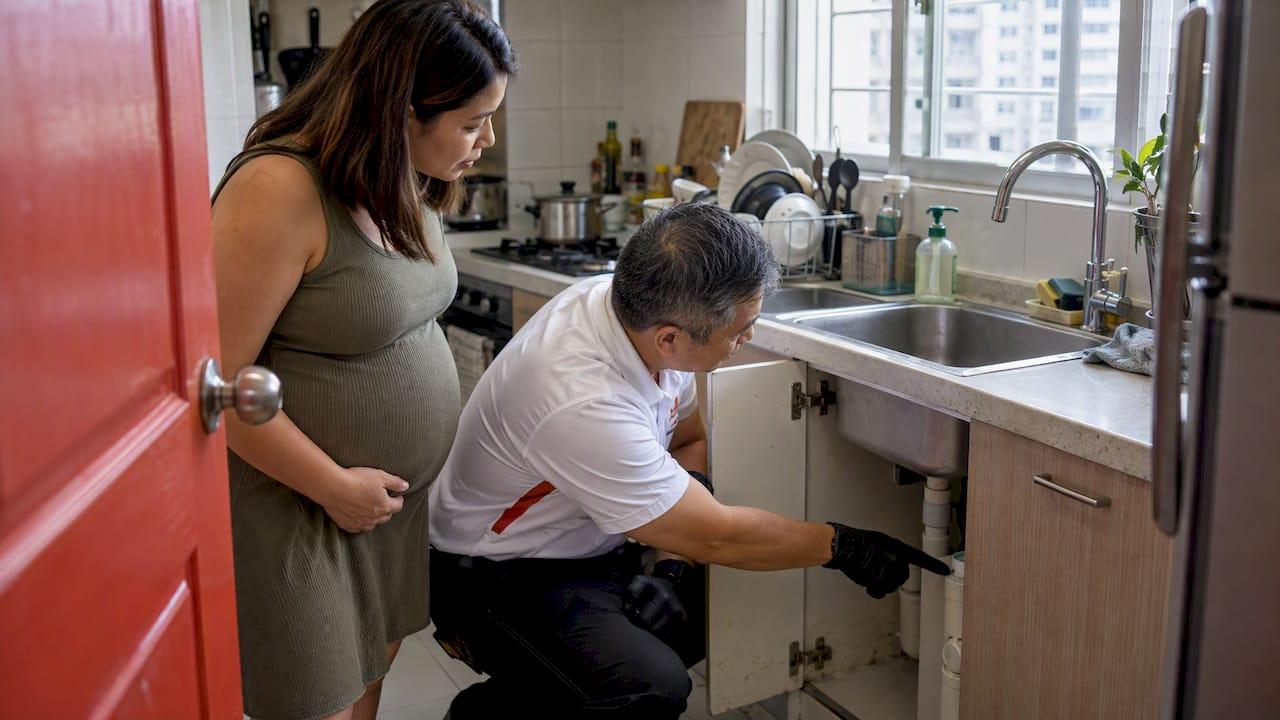
Yes, you can have pest control done while pregnant, but how it is done matters. The safest approach is to use a licensed operator, choose targeted, low-toxicity methods such as gel baits and traps, stay out of the home while spraying or fogging takes place, and ventilate before you return. Leaving an infestation untreated is rarely the better choice, so the goal is lower exposure, not no treatment.
This guide explains what Singapore's rules require, which methods reduce exposure, how to prepare your home, and what to do if you think you were exposed. We are a Singapore pest control company, and we write this from how our technicians plan jobs for expecting families.
TL;DR
- Hire an NEA-licensed operator and ask for targeted treatments, such as gel baiting, traps and sealing entry points, before any sprays or fogs.
- Leave the home during fogging or misting, and ventilate for the time Singapore's code of practice sets before you re-enter.
- "Natural" or "organic" does not automatically mean safer. Ask what product is used and where it goes.
- Tell your operator you are pregnant when you book, and tell your obstetrician about any treatment planned in your home.
- If you think you breathed in or touched a pesticide, seek medical advice promptly.
Table of Contents
- Is pest control safe during pregnancy?
- What Singapore's rules require of your pest control operator
- Methods that lower exposure
- How long to stay out and what to do afterward
- Pest by pest: what a pregnancy-conscious plan looks like
- Plan the timing
- If you think you were exposed
- Our perspective
- Talk to us before treatment
- FAQ
- Sources
Is pest control safe during pregnancy?
The honest answer is that it depends on the product, the method and your exposure. Pesticides are made to harm living organisms, which is why public health bodies advise pregnant people to limit contact with them. At the same time, a home with cockroaches, rats or bed bugs is not a healthy place for anyone, and DIY spraying with store-bought products often exposes you far more than a professional job does, because the product ends up in the open where you live.
Academic guidance points the same way. Columbia University's Mailman School of Public Health describes integrated pest management (IPM), which combines cleaning and structural repairs with low-toxicity products such as traps or gels, as a safer strategy for reducing harmful pesticide exposure for pregnant women and their babies. The same source says residential IPM reduces both pests and the amount of harmful pesticide reaching mothers, unborn babies and young children.
That is the principle we work from. Remove what pests need (food, water, shelter, entry points), use the least hazardous product that does the job, and keep the product away from where you eat, sleep and spend time.
A caution on medical questions: this article cannot tell you whether a specific product is right for your pregnancy. Your obstetrician or midwife can, especially if you have asthma, allergies, a high-risk pregnancy or a medical condition. Bring the product name from your operator's treatment plan to your appointment.
What Singapore's rules require of your pest control operator
Singapore regulates this work, and that regulation is useful to you as a pregnant client.
Under the Control of Vectors and Pesticides Act 1998, public health pesticides and repellents used against the five main vectors, which are mosquitoes, flies, rats, cockroaches and rat fleas, must be registered with the National Environment Agency (NEA). The NEA's code of practice adds that NEA-registered pesticides carry a registration mark on the label, made up of a registration number and a logo.
The NEA also restricts the higher-risk products. Its advisory says Restricted Use products may be handled only by registered Vector Control Operators, their licensed technicians and certified workers, because of higher toxicity or concentration or a need for specific equipment.
What this means in practice:
- Do not buy and apply restricted products yourself, and do not hire an unlicensed person who offers cheap spraying.
- Ask to see the product label and its NEA registration mark before any treatment in your home.
- Ask the operator for the product name, where it will be applied and the re-entry advice, in writing if possible.
Our technicians are NEA-licensed, and we are glad to answer these questions before a booking, not after.
Methods that lower exposure
Not every treatment is equal for a pregnant household. The table below sets out the common approaches by how much product ends up in your living space. It is a planning guide, not medical advice.
| Approach | Where the product goes | Typical exposure risk for a household | Planning note |
|---|---|---|---|
| Source reduction (removing standing water, food, clutter) | No pesticide | Lowest | The NEA code calls it the main strategy for vector control, especially mosquitoes |
| Sealing gaps, proofing, repairs | No pesticide | Lowest | Works well for rodents and birds |
| Traps and monitoring stations | Contained devices | Low | Place out of reach of pets and children |
| Gel baits | Small placements in cracks and voids | Low | Common for cockroaches |
| Residual spraying | Surfaces such as skirting and corners | Moderate | Stay out, then ventilate and let surfaces dry |
| Fogging or misting | Airborne, fills the room | Higher | Leave the premises for the treatment and ventilation period |
| Fumigation | Whole structure or enclosed items | Highest | Pregnant household members should not be on site |
The NEA's code of practice says source reduction remains the main strategy of vector control, especially for mosquitoes. That is good news for expecting parents, because the first step costs nothing and puts no chemical in your home. Our 30-minute mosquito source reduction checklist shows how to do it room by room.
Is natural or organic safer?
Not automatically. The University of Minnesota Extension states that natural or organic-labeled pesticides are not necessarily safer: all pesticides, including those derived from natural sources, carry risks and must be used according to label directions. It names products containing rotenone or pyrethrin as examples that still need correct use.
So "plant-based" on a spray bottle is not a reason to fog your bedroom with it. What reduces exposure is the method: contained baits, traps, proofing and careful placement. The product matters, but where and how it is applied matters just as much.
How long to stay out and what to do afterward
Singapore's code of practice gives concrete numbers, and they are worth knowing before treatment day.
- Cold fogging: the NEA code says the area should be vacated before treatment, and people re-enter only after it, with ventilation for at least 30 minutes.
- Indoor residual spraying: the same code says to ventilate and allow treated surfaces to dry for at least 60 minutes, and to clean any unintended pesticide deposits. Clients are to be told to re-enter only after treatment and to open all doors and windows for that time.
These are minimums set for the general public. If you are pregnant, we advise a more cautious plan: step out for the whole service, ask a family member to be home to let the technician in, and return only when the operator confirms the treatment is complete and the space has aired out. Waiting longer than the minimum costs you very little.
The Singapore Pest Management Association (SPMA) notes that in most cases residents do not need to vacate during standard pest control treatments, but should if insecticidal gassing or misting is performed, with re-entry permitted after a few hours. Because the answer differs by method, ask which method your job uses before you decide whether to stay.
Your before-and-after checklist
- When you book: say that someone in the household is pregnant. Ask for the product names, the method and the written re-entry advice.
- The day before: the SPMA advises residents to store food and kitchen utensils properly before treatment. Cover or pack away food, dishes, baby items and pet bowls.
- During treatment: be out of the home for sprays, mists and fogs. Take pets with you or confirm where they should stay.
- After treatment: open all doors and windows, run fans, and keep the home aired for at least the time stated above.
- Cleaning: the SPMA also advises washing toys and kitchen appliances after service. Wipe any surface where you prepare food or rest your hands, and avoid scrubbing treated skirting and corners, where the residual product is meant to stay.
- Following days: avoid sitting or lying on freshly treated surfaces, and let someone else do heavy cleaning if you can.
If bed bugs are the issue, preparation is more involved because bedding and clothing need handling. Our guide to bed bug treatment preparation lists what to do before we arrive, and a family member can do the lifting for you.
Pest by pest: what a pregnancy-conscious plan looks like
The right plan changes with the pest. Here is how we think about the common ones in Singapore homes.
Cockroaches
Cockroaches are the most common household complaint. Gel baits placed in cracks, behind appliances and under sinks keep product out of open air. Pair them with sealing gaps, fixing leaks and tidy food storage. Our general pest control service follows this IPM sequence of inspection, source removal, targeted treatment and follow-up.
Mosquitoes
Mosquito control in Singapore starts with removing breeding sites, since this is the NEA's main strategy. This matters for pregnant residents in particular. During the 2016 Zika outbreak, the Ministry of Health urged residents in affected areas to cooperate with NEA officers who inspect for mosquito breeding and spray insecticide, in an announcement that also reported a pregnant woman testing positive. Check flower pot plates, gully traps, roof gutters and air-con trays weekly, and let the NEA's officers in when they call.

Rodents
Rats are best handled by proofing: sealing entry points, removing food sources and using contained bait stations or traps placed out of reach. Poison scattered openly is the worst option for any home with a pregnant person, children or pets. Our rodent control service concentrates on finding how they get in.
Bed bugs
Bed bugs live where you sleep, so the treatment sits close to you. That makes the stay-out period and aftercare especially important. Our bed bug control service uses an inspection first, then a plan that fits the level of infestation. Keep the bedroom closed until we confirm it is safe to return.
Termites
Termite work often involves soil or wall treatments and baiting. Much of it is outside living areas, but drilled-in or injected treatments are near where you may sleep. Ask where the product goes and whether baiting can be used. See our termite control service for the approach.
Fumigation
Fumigation involves gas and requires everyone to leave. A pregnant person should not be on site or return until the operator clears the space. Our fumigation service is planned around the re-entry clearance, and we agree the timing with you in advance.
Birds
Pest birds are controlled with physical measures such as spikes, netting and repellents, and trapping where permitted. Because these are mostly non-chemical, they suit a pregnant household well. See our bird control and proofing service.
Plan the timing
There is no single perfect week in pregnancy to schedule treatment, and we do not claim one. Practical timing tips:
- Treat early rather than late. A small infestation needs less product than a large one. Waiting until the third trimester can force a heavier treatment at a tiring time.
- Avoid the days around your due date, when you may want the home settled and fully aired.
- Plan ahead of the baby's arrival. If you will soon have a newborn, our guide on pest control with a newborn at home explains how to sequence work before and after the birth.
- Ask about preventive visits. Regular inspections catch problems early. Our article on pest control frequency in Singapore explains how schedules are set.
If you think you were exposed
If you breathed in a spray, touched a treated surface before it dried or feel unwell after a treatment, act promptly and do not wait for symptoms to build.
Singapore's clinical guidance on poisoning says that in suspected pesticide exposure you should seek immediate medical evaluation, where doctors assess the route of exposure and the specific toxin to decide treatment, protecting both mother and fetus. The first response depends on how the exposure happened: move out of the area if you inhaled it, or remove contaminated clothing and shower if it touched your skin. The same guidance says antidotes should not be withheld from pregnant women in severe or life-threatening poisoning.
In practice:
- Get to fresh air, or wash skin with soap and water.
- Keep the product label or take a photo of it, so the doctor knows the active ingredient.
- Go to a clinic or the emergency department for any worrying symptoms, and tell your obstetrician afterward.
- Call your pest control company and ask for the product details and safety data sheet.
Most routine, well-executed treatments do not lead to this. But knowing the steps is part of a safe plan.
Our perspective
We treat homes for expecting families regularly, and our advice is consistent: do not put off dealing with an infestation, and do not try to handle it yourself with store-bought sprays.
Our approach is built on integrated pest management. We inspect first, using tools such as thermal imaging where it helps us find the source without opening walls. We then remove what feeds the pests, proof the entry points and use targeted, non-toxic or low-toxicity treatments in the places that matter. Our technicians are NEA-licensed, and we are available 24/7 for urgent problems.
When a client tells us someone is pregnant, we change the plan around them: the method, the product placement, the timing and the written re-entry advice. We would rather explain every step than have you wonder what was applied in your home.
Bespoke-Enviro Services
Talk to us before treatment
If you are pregnant and have a pest problem, tell us when you call. We will inspect, explain the options in plain terms and propose a plan that keeps exposure low while solving the problem.
Start with our general pest control service in Singapore or reach us through our website. Pricing depends on the pest, the size of the home and the level of infestation, so we quote after an assessment.
FAQ
Is pest control safe during pregnancy?
It can be, when a licensed operator uses targeted, low-toxicity methods and you stay out during spraying or fogging. IPM, which relies on cleaning, repairs, traps and gels, is regarded by academic sources as a lower-exposure approach. Ask your obstetrician about your own situation, especially if you have a high-risk pregnancy.
Do I need to leave my home during pest control?
For fogging, misting and fumigation, yes. For standard gel baiting, you often do not need to leave, though many pregnant clients choose to step out anyway. Singapore's code of practice sets minimum ventilation times of 30 minutes after cold fogging and 60 minutes after indoor residual spraying.
Are natural pest control products safer for pregnant women?
Not necessarily. University extension guidance says natural or organic products still carry risks and must be used per the label. Focus on the method and placement, and ask your operator to name the product.
What should I do if I think I was exposed to pesticide while pregnant?
Move to fresh air or wash your skin, keep the product label, and seek medical evaluation promptly. Tell the doctor you are pregnant so they can assess the exposure route and the product.
Can I do pest control myself while pregnant?
We advise against it. DIY products are applied in your living space, and restricted-use products are legally limited to licensed operators. If you want to help, do the no-chemical steps: remove standing water, store food in sealed containers and fix leaks.
Sources
- Code of Practice for Vector Control Operator, Technician and Worker, NEA
- Advisory on Handling of Public Health Pesticides and Repellents in Singapore, NEA
- Pesticides, Columbia University Mailman School of Public Health
- Pesticide safety in the home, University of Minnesota Extension
- Buyers of Pest Control Services, Singapore Pest Management Association
- Potential Zika Cluster at Bedok North Ave 3 and First Case of Pregnant Woman Tested Positive, Ministry of Health
- Management of Poisoning, Singapore clinical guidance