

A fumigation certificate in Singapore is the treatment proof issued after a regulated fumigation carried out under a valid NEA permit, and for export shipments, following NParks' Treatment Provider Scheme (TPS) endorsement. The National Environment Agency (NEA) regulates the fumigator licence and the job-specific permit. NParks, through the TPS, governs certificates tied to phytosanitary export approval. Before any gas-based job proceeds, we recommend you verify three things:
- The technician's fumigator licence number
- The NEA fumigation permit reference for that specific job
- A signed copy of the treatment certificate showing TPS approval if the shipment is for export
One statutory framework covers all of it: the Hydrogen Cyanide (Fumigation) Act 1947.
Key Takeaways
A compliant fumigation in Singapore requires a valid fumigator licence, a job-specific NEA permit, and, for exports, a properly completed TPS treatment certificate.
| Point | Details |
|---|---|
| Two separate documents | Confirm both a fumigator licence and a job-specific NEA permit before treatment begins. |
| Certificate fields matter | Missing TPS fields like dosage, exposure period, or signature can block export endorsement. |
| Apply early for exports | Book fumigation and permits at least a week ahead of shipping deadlines, longer if an FMP applies. |
| Verify, don't assume | Ask for licence numbers and permit references in writing, not verbal assurance. |
| Choose a documented provider | Bespoke-enviro supplies fumigator licence references, NEA permit numbers, and TPS-backed treatment certificates with every regulated job. |
Where to Verify Fumigation Rules and Forms Directly
- NEA's fumigation page covers permit rules, Code of Practice guidance, and FMP requirements.
- The GoBusiness Licensing Portal hosts fumigator licence and permit applications.
- NParks' TPS document includes the sample treatment certificate format.
Keep copies of every permit and certificate with your shipment paperwork. Customs and quarantine officers ask for them without warning.
Table of Contents
- Fumigator Licence Vs Fumigation Permit: What Each One Covers
- How To Get a Fumigator Licence: Eligibility, Documents, and Fees
- Applying for a Fumigation Permit for Each Job
- What a Fumigation Treatment Certificate Must Include
- Who Can Legally Perform Fumigation, and How to Check Credentials
- Safety Rules and How to Prepare for a Fumigation Job
- What Fumigation Actually Costs and How Long It Takes
- Bespoke Enviro Services: Documentation Built for Compliance
- Penalties for Non-Compliant or Fraudulent Fumigation Certificates
- Our Take on Singapore's Fumigation Compliance System
- Get Compliant Fumigation Documentation From Bespoke-Enviro Services
- Sources
Fumigator Licence Vs Fumigation Permit: What Each One Covers
These two documents get confused constantly, and the confusion causes real compliance gaps. A Fumigator Licence is issued to an individual, allowing that person to handle restricted fumigants such as Methyl Bromide, Hydrogen Phosphide, or Hydrogen Cyanide. A Fumigation Permit is issued per job, authorizing a specific operation at a specific site on a specific date. Both trace back to the Hydrogen Cyanide (Fumigation) Act 1947, which still governs how fumigants are licensed and applied for in Singapore.
Before work starts, ask for:
- The technician's fumigator licence number, valid for the calendar year
- The permit reference number tied to that exact job, not a generic company registration
- Written confirmation that the permit covers the fumigant type being used
Pro Tip: A company can be a registered pest control business and still have zero fumigator licences on staff. Registration and licensing are not the same thing, so always ask the question directly.
How To Get a Fumigator Licence: Eligibility, Documents, and Fees
Becoming a licensed fumigator involves more than passing a test. NEA sets eligibility around education, health, and hands-on experience, so plan the pathway well before you need to bill your first job.
- Minimum GCE 'O' Level qualification (or equivalent)
- Medical fitness certification confirming you can safely work with toxic gases
- Basic first aid certification
- Completion of an 18-month apprenticeship under a licensed fumigator
- A pass on the official NEA fumigator examination
On fees, the licence costs $170 per fumigant, and the examination itself carries a $180 fee. Licences run until December 31 of the calendar year, so renewal timing matters. Applications go through the GoBusiness Licensing Portal. The most common mistake we see: applicants submit before completing the full apprenticeship period, which triggers an automatic rejection.
Applying for a Fumigation Permit for Each Job
Every fumigation job needs its own permit, separate from the technician's personal licence. Here's the general workflow:
- Submit the application through GoBusiness or directly with NEA, and note that third-party filers, such as your pest control provider, are allowed to submit on your behalf.
- Apply early. NEA guidance indicates permit processing can happen within one working day for straightforward jobs, but larger or more complex operations take longer.
- If the enclosure being fumigated exceeds roughly 1,000 cubic meters, expect NEA to require a full Fumigation Management Plan (FMP) before approval.
NEA reviews FMPs for ventilation strategy, gas containment, and emergency response steps, and a thin or incomplete plan gets bounced back for revision. On-site, NEA inspectors can show up unannounced during or after treatment, so signage, exclusion zones, and permit paperwork all need to be physically available, not just filed somewhere in an office.
What a Fumigation Treatment Certificate Must Include
A treatment certificate that's missing a required field is functionally useless for export purposes. Under the TPS specimen certificate, a valid certificate needs:
- Supplier and client names and addresses
- Commodity description and quantity treated
- Treatment type, dosage, and exposure period
- The TPS provider number
- Signature of an authorized technician
| Certificate Element | Why It Matters |
|---|---|
| TPS provider number | Confirms the issuing company is officially approved, not just registered |
| Dosage and exposure period | Verifies the treatment meets phytosanitary thresholds |
| Authorized signature | Without it, the certificate cannot support endorsement |
For wood packaging specifically, treatment under ISPM 15 and the associated IPPC mark often runs alongside the TPS certificate, since some destination countries require both. NParks has confirmed that treatment certificates are a required submission when applying for a phytosanitary certificate, so a gap in the paperwork can stall an entire shipment at the dock.
Who Can Legally Perform Fumigation, and How to Check Credentials
Not every pest control technician is qualified to run a gas fumigation, even if their van says "fumigation services" on the side. Vector Control Operator (VCO), Vector Control Technician (VCT), and Vector Control Worker (VCW) registrations cover general pest management, not restricted fumigants. Only a holder of a proper fumigator licence may legally use Methyl Bromide, Hydrogen Phosphide, or Hydrogen Cyanide.
Before booking, ask for:
- The technician's fumigator licence number, checked against the current calendar year
- TPS approval status if the treatment supports an export shipment
- The specific NEA permit reference for your job, not a blanket company credential
Pro Tip: Watch for vendors who describe heat treatment or standard insecticide spraying as "fumigation." These are different processes entirely, and neither substitutes for a licensed gas fumigation when a certificate is legally required.
Safety Rules and How to Prepare for a Fumigation Job
NEA's Code of Practice sets the baseline for how a fumigation must run, and it triggers an FMP requirement for larger or higher-risk enclosures. As a client, your preparation checklist should look like this:
- Confirm signage and access restrictions will be posted before gas is introduced.
- Clear the area of people and pets for the full exposure and ventilation window, not just the exposure period.
- Move or cover sensitive goods that could absorb residual gas or odor.
- Confirm a post-treatment aeration and clearance check before re-entry.
- Request written confirmation of clearance readings if the space will be occupied immediately after.
Pro Tip: If your fumigation supports an export shipment, ask whether post-treatment sampling feeds into the phytosanitary certificate application. Some exporters lose time simply because they didn't know this step was needed until after treatment finished.
What Fumigation Actually Costs and How Long It Takes
Budgeting for a compliant fumigation means accounting for licensing fees, permit turnaround, and the treatment itself.
- Fumigator licence fee: $170 per fumigant type
- NEA examination fee: $180
- Standard permit processing: often same-day to a few working days for routine jobs
- FMP-required jobs: longer review windows, especially around large enclosures or holiday periods when NEA processing slows
For export shipments with tight sailing dates, we advise booking your fumigation and permit application at least a week ahead, longer if the enclosure size will require an FMP. Waiting until days before a container deadline is the single most common reason exporters miss their booked shipping window.
Bespoke Enviro Services: Documentation Built for Compliance
With over 30 years in Singapore's pest control industry, Bespoke-enviro built its fumigation process around integrated pest management (IPM) principles and non-toxic treatment options wherever they meet the job's requirements. When a job calls for regulated fumigation, we handle the paperwork alongside the treatment itself.
Documentation we provide includes:
- Fumigator licence reference for the technician performing the work
- NEA permit reference specific to your job
- Signed treatment certificate with TPS credentials, where the shipment requires export endorsement
Ask any provider, including us, for these three references in writing before treatment begins. A verbal assurance is not proof, and customs or NParks will not accept one.
Penalties for Non-Compliant or Fraudulent Fumigation Certificates
Skipping a permit, using an unlicensed technician, or submitting a falsified treatment certificate carries consequences that go well beyond a failed inspection. Because fumigation with restricted gases falls under the Hydrogen Cyanide (Fumigation) Act 1947, operating without a valid licence or permit is a statutory offense, not just a paperwork lapse.
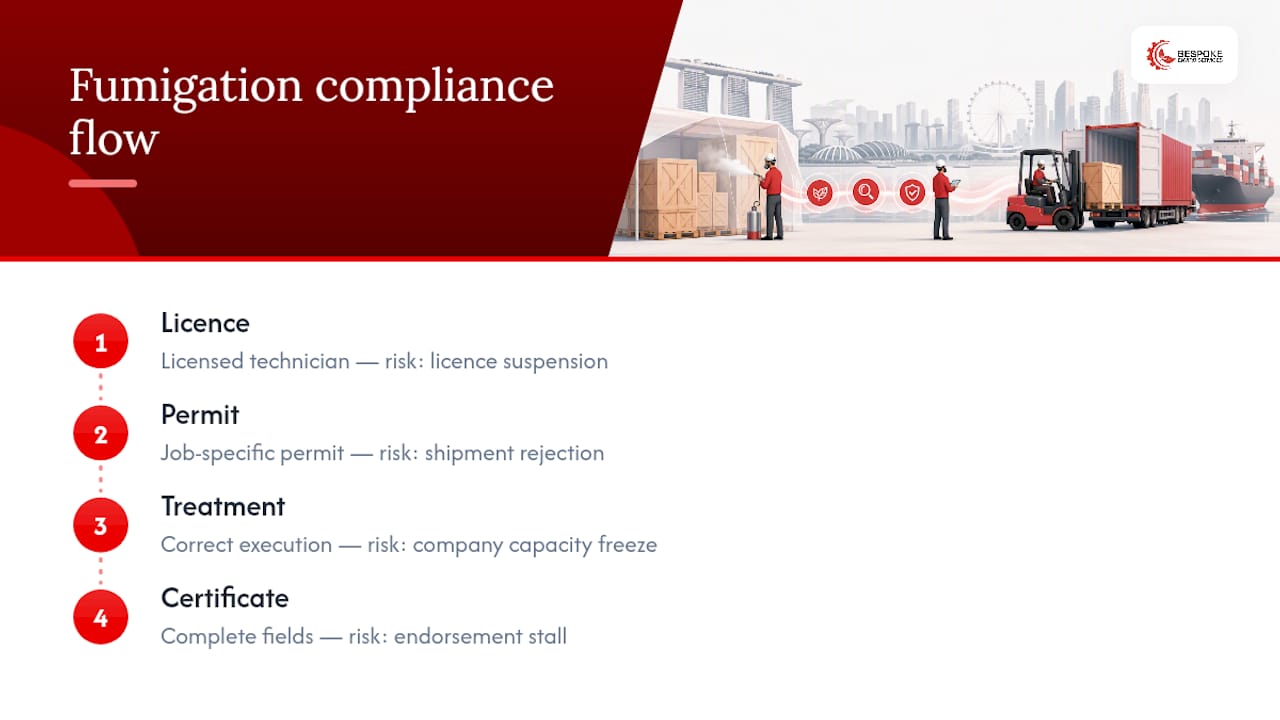
For businesses, the practical fallout tends to hit in three places. First, a shipment relying on a fraudulent or incomplete treatment certificate risks outright rejection at customs or by the destination country's plant quarantine authority, which can mean a container sitting at port accruing demurrage charges while the exporter scrambles for a redo. Second, NEA can suspend or revoke a fumigator's licence for violations, which shuts down that individual's ability to legally work at all, and a company relying heavily on one licensed technician can find its entire fumigation capacity frozen overnight. Third, NParks has made clear that TPS-approved providers are expected to supply accurately completed certificates, and inspectors reject certificates missing required fields, which means the phytosanitary endorsement process simply stalls until corrected paperwork appears.
There's also a quieter cost: reputational damage with freight forwarders and buyers overseas. A rejected shipment traced back to a bad certificate tends to follow an exporter into future dealings, and buyers who've been burned once often demand extra verification steps on every subsequent order. The safest position is always the same: confirm the licence, confirm the permit, and confirm the certificate fields before treatment starts, not after a shipment gets flagged.
Our Take on Singapore's Fumigation Compliance System
Most guidance on this topic treats "fumigation certificate" as a single, simple document to collect at the end of a job. That framing undersells how the system actually works. The certificate is the last link in a chain that starts with an individual's licence, continues through a job-specific permit, and only then produces paperwork that customs or NParks will accept.
The gap we see most often isn't fraud. It's clients assuming a pest control company's general registration covers gas fumigation, when it doesn't. That assumption causes more shipment delays than anything else in this space.
Our position: don't treat certificate collection as a final step. Treat licence verification and permit confirmation as the first step, before a technician sets foot on site. Exporters who build that habit rarely face a rejected certificate later, because the compliance groundwork was already solid before treatment even started.
— Bespoke-Enviro Services
Get Compliant Fumigation Documentation From Bespoke-Enviro Services
Bespoke-enviro handles the fumigation and the paperwork together, so you're not left chasing a technician for a licence number after the job is done. Our fumigation process runs on IPM principles and pairs eco-friendly treatment methods with the compliance documentation Singapore exporters, importers, and facilities teams actually need.
When you book with us, we provide the fumigator licence reference, the NEA permit number tied to your specific job, and a signed treatment certificate carrying TPS credentials when your shipment requires export endorsement. Ask for these documents up front during your booking call, and we'll confirm exactly what your job requires before treatment starts. Visit Bespoke Enviro Services to request a quote and get your fumigation scheduled with the paperwork already accounted for.
Sources
- Fumigation — National Environment Agency (NEA)
- Fumigator Licence | Licence & Accreditation — GoBusiness
- Treatment Provider Scheme (TPS) — NParks (PDF)
- Hydrogen Cyanide (Fumigation) Act 1947 — Singapore Statutes Online