
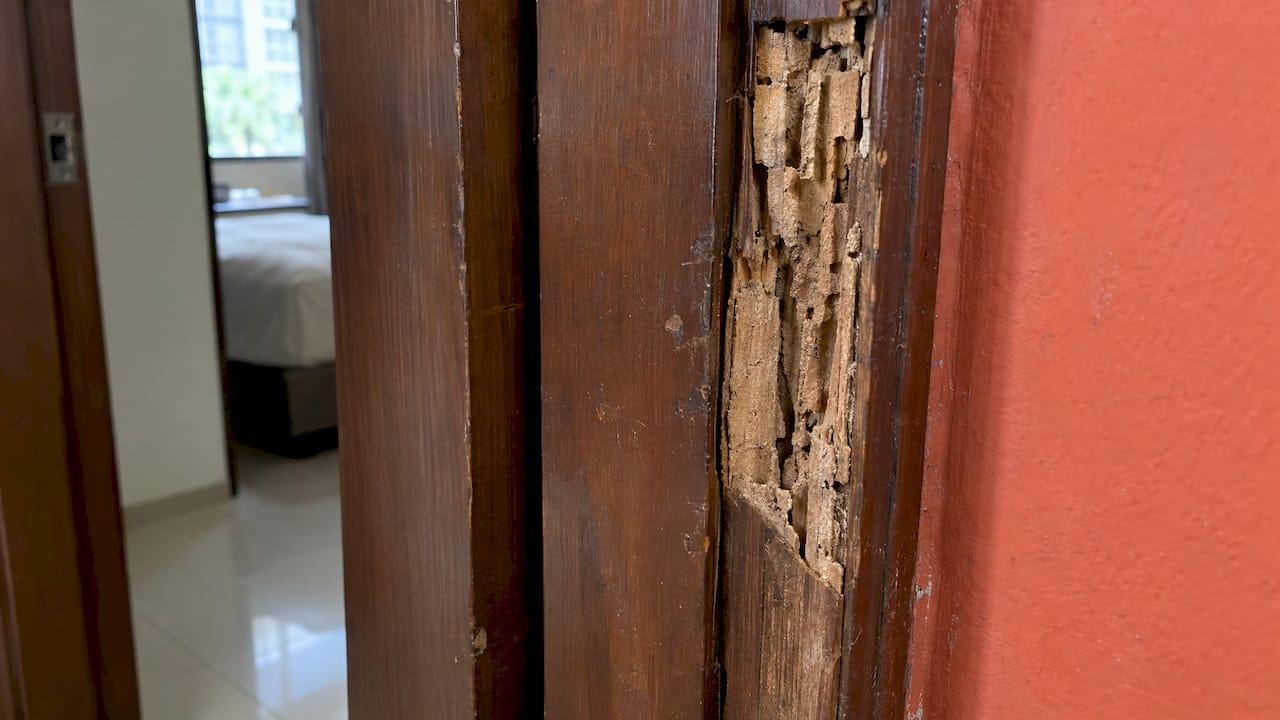
Drywood termites live and feed inside the timber they infest, so they do not need soil contact the way subterranean termites do. They can go unnoticed until you find tiny pellets, kick-out holes or damaged wood. They do not go away on their own. If you suspect them, the sensible step is a professional inspection by an NEA-certified technician, followed by a treatment plan matched to what the inspection finds. This guide explains what to look for, how an infestation is confirmed, what damage it causes and how treatment is approached in Singapore.
TL;DR
- Drywood termites nest inside dry timber such as furniture, door frames, window frames, flooring and roof timbers, so there is often no mud tube or soil trail to follow.
- The first signs are usually small kick-out holes, fine fecal pellets below them and, at times, winged swarmers inside the property.
- An infestation does not clear by itself. The colony keeps feeding inside the wood until it is treated.
- Confirming activity, mapping the affected timber and choosing a method is work for licensed technicians. Singapore's national IPM standard sets the framework.
- We offer termite control and treatment in Singapore for homes, offices, industrial sites and construction sites.
Table of Contents
- What drywood termites are and how they differ from other termites here
- First signs of drywood termites in your home
- How an infestation is confirmed
- Do drywood termites go away on their own?
- How drywood termite control is approached in Singapore
- Choosing a licensed provider
- Preventing and monitoring drywood termites
- Our perspective
- Book a termite inspection
- FAQ
- Sources
What drywood termites are and how they differ from other termites here
Singapore's termites are commonly grouped into subterranean, drywood and dampwood types. Subterranean termites build colonies in the soil and travel to your building through mud tubes. Drywood termites do not rely on that connection. They enter sound, dry wood, often through small cracks or joints, and set up their colony within it.
This difference changes how you find them and how you treat them:
- Subterranean termites: Activity is often visible as mud tubes on walls, skirting boards or foundations. Treatment usually targets the soil and the points where termites enter the building.
- Drywood termites: Activity is hidden inside timber. The visible evidence is small: pellets, tiny exit holes and discarded wings.
- Dampwood termites: These favor damp, decaying wood, so moisture problems are the usual cause.
If you want photographs and a comparison of the species found locally, see our guide to termite species in Singapore. Because the colony sits in the wood, a drywood problem can start in a single piece of furniture or a single door frame. That is also why it can spread unnoticed to other timber in the same unit.
First signs of drywood termites in your home
Drywood termites are quiet and secretive, so you need to look for indirect evidence. These are the signs we ask Singapore homeowners and property managers to check.
Kick-out holes and fecal pellets
Drywood termites push their droppings out of the wood through small holes. Their galleries contain fecal pellets, and the pellets collect in small piles on the surface below. Texas A&M's extension service describes swarmers emerging from small kick-out holes as usually the first sign of infestation, and says that if they appear inside a structure, the colony is almost certainly in the structural timbers.
Check the places where timber meets air: window frames, door frames, skirting, built-in wardrobes, picture frames, wooden furniture legs and exposed roof timbers.
Swarmers and discarded wings
Winged reproductives leave the colony to start new ones. Finding swarmers indoors, or small piles of shed wings near windows and light fittings, points to a colony inside your building rather than outside. Swarming in Singapore is often linked to weather. Our article on termite swarm season in Singapore covers what to do when you see them.

Damaged or hollow wood
Timber can sound hollow when tapped, or look blistered or thin on the surface. Texas A&M notes that drywood termites eat both the soft and the hard parts of the wood grain, so their galleries look smooth and sculpted, with pellets inside. Cutting into wood is a job for a technician, because it can scatter pellets and make the evidence harder to read.
Quick checklist
- Look for small piles of tiny pellets under wooden items and frames.
- Look for pinhole-sized openings in timber surfaces.
- Check windowsills and light fittings for shed wings.
- Tap wooden surfaces and listen for hollow sounds.
- Photograph anything you find and note the date.
How an infestation is confirmed
Finding pellets is not always proof that termites are active today. Pellets can remain after a colony has died. The University of California's IPM program suggests a simple method: clean up pellets near a kick-out hole and check again a few days later. If fresh pellets have appeared, the colony is active.
You can do this before you call us. It gives the technician a useful starting point. A full inspection goes further:
- Visual inspection of exposed timber, joints, frames and fittings.
- Moisture and temperature checks. We use advanced technology, including thermal imaging, in our inspections to help locate activity that cannot be seen on the surface.
- Mapping of affected and at-risk timber, so treatment is aimed at the right places.
- A written recommendation that explains what was found and what we propose.
If you are buying a home, an inspection before purchase helps you learn about hidden timber problems before you commit. See our guide to pre-purchase pest inspection in Singapore.
Do drywood termites go away on their own?
No. A colony that has settled inside timber has its food, shelter and protection in one place, so it has no reason to leave. Left alone, it keeps feeding and the damage grows. The pellets you see are a sign that the colony is feeding and expanding inside the wood.
The damage is mostly structural and cosmetic. Furniture can be hollowed out. Door frames and window frames can weaken. Roof timbers and built-in carpentry can lose strength. Because damage builds behind a thin intact surface, it often looks worse once it is opened up.
A Singapore example
Termite problems in newer buildings make the news. In 2026, AsiaOne reported that at least 50 units at The Tre Ver condominium in Potong Pasir were believed to have had drywood termite issues since December 2022. It also reported that the Building and Construction Authority said termite infestations are considered a defect under its CONQUAS assessment system. The case shows that termites are not only a problem of old houses. Buyers and owners of new units should also check timber fittings.
For managing agents and owners' committees dealing with defects across a block, a professional assessment helps separate what is a termite issue from what is not. Readers who manage residential blocks may also want to read about insurer surveys for blocks, which explains what compliance means when buildings are inspected.

How drywood termite control is approached in Singapore
There is no single treatment for every drywood case. The right method depends on how many pieces of timber are affected, where they are, whether the timber is fixed or movable, and whether the property is occupied. A technician decides this after the inspection.
| Situation | Typical direction | What decides it |
|---|---|---|
| One infested piece of movable furniture | Treat or remove the item | Size of the item and extent of damage |
| Localized activity in fixed timber (a frame, a skirting section) | Targeted treatment of the affected timber | Inspection findings and access |
| Activity in several rooms or in roof timbers | A wider treatment plan, sometimes with fumigation | Spread of the colony and building layout |
| New or renovated unit | Inspection and preventive measures | Timber used and defect history |
This table is a guide to how we think about the decision, not a fixed rule. Each property needs its own inspection.
Integrated pest management
Singapore has a national framework for this work. Singapore Standard SS 721:2025 was developed by a working group co-led by NEA and the Singapore Pest Management Association. According to NEA, it sets a national framework for pest management services built on IPM principles: prevention, a multi-method approach, risk-based assessment, reduced chemical dependency and continuous monitoring. It applies to termites among other pests.
That approach matches how we work. We combine inspection, targeted treatment and follow-up monitoring, and we prefer non-toxic, environmentally safe methods that protect people and pets.
When fumigation is considered
Fumigation is one option for infestations that are widespread through a structure or hard to reach. It is tightly regulated. NEA's code of practice states that the Hydrogen Cyanide (Fumigation) Act 1947 and its Regulations apply to all fumigations in Singapore. The same document says fumigation companies, fumigators, staff, employers and occupiers must also comply with other legislation, including the Workplace Safety and Health Act 2006, the Control of Plants Act 1993, the Environmental Protection and Management Act 1999 and the Fire Safety Act 1993.
For occupiers this means one thing in practice: follow the technician's instructions on vacating the premises, covering or removing items, and when you may re-enter. Do not return early. Our fumigation services in Singapore are carried out by NEA-licensed technicians.
Choosing a licensed provider
Termite work involves chemicals, enclosed spaces and your property. Choose carefully.
- Check certification. All vector control workers and technicians in Singapore must be certified by NEA. The Straits Times reports that the joint ITE-NEA certification is a three-month part-time course with 66 hours of theory and practical lessons.
- Ask what happens after treatment. A good plan includes a follow-up visit and monitoring, not just a single application.
- Ask about safety around children and pets. The provider should explain which methods will be used and what you need to do before and after.
- Ask for a written scope. It should state which areas and which timber are covered.
Prices vary with the size and complexity of the job, and we do not publish a fixed price because each inspection differs. For general budgeting, our termite treatment cost guide for Singapore explains the factors that affect quotes.
Preventing and monitoring drywood termites
You cannot make timber completely safe, but you can lower the risk and catch problems early.
- Inspect regularly. Check frames, skirting and wooden furniture every few months, and after any swarm.
- Seal gaps. Cracks and joints in timber give reproductives a place to enter.
- Be careful with second-hand furniture. Look over used wooden pieces for pellets and holes before bringing them inside.
- Keep records. Photos and dates help a technician judge whether activity is new.
- Schedule professional inspections. For homes and sites with a lot of timber, a regular schedule works better than waiting for signs. See our guide to pest control frequency in Singapore.
Wood-boring beetles can also leave holes and dust that look similar to termite signs. Our article on wood borer treatment in Singapore helps you tell them apart.
Our perspective
Most drywood cases we see begin the same way: a homeowner notices a small pile of pellets, wipes it away and hopes it was a one-off. The pellets return because the colony is still inside the timber.
We approach every case with inspection first. Drywood termites are hidden by nature, so we use advanced technology, including thermal imaging, to locate activity before deciding what to treat. We would rather aim a treatment at the affected timber than apply it broadly.
Our work follows integrated pest management: prevention, targeted treatment and continuous monitoring. We use non-toxic, environmentally safe methods that put the safety of people and pets first. Our technicians are NEA-licensed, and we are available 24/7 because an active infestation does not wait for office hours.
With over 30 years in pest control in Singapore, we have worked in homes, offices, industrial sites and construction sites. Whatever the property, the goal is the same: find the colony, treat it properly and put monitoring in place so it does not come back.
Bespoke-Enviro Services
Book a termite inspection
If you have found pellets, kick-out holes or swarmers, a licensed inspection tells you what is happening inside your timber and what it will take to deal with it. We handle homes, commercial premises, industrial sites and construction sites across Singapore.

Speak to our team about termite control and treatment, or visit Bespoke Enviro Services to see everything we cover, from rodents and bed bugs to cockroaches, flies and mosquitoes.
FAQ
Do drywood termites go away on their own?
No. The colony lives inside the wood, which supplies both food and shelter, so it keeps feeding until it is treated. Pellets that keep reappearing after you clean them are a sign of ongoing activity. A professional inspection will confirm this and show how far it has spread.
What are the first signs of termites in a house?
For drywood termites, the first signs are usually small kick-out holes, tiny pellets below them and winged swarmers or shed wings indoors. For subterranean termites, mud tubes on walls or foundations are the more common sign. If you see either, photograph it and arrange an inspection.
What is the difference between drywood and subterranean termites?
Subterranean termites nest in soil and reach buildings through mud tubes. Drywood termites live entirely inside dry timber and do not depend on soil contact. This is why drywood infestations can appear in furniture, frames and upper floors, and why treatment is planned around the affected wood.
Can I treat drywood termites myself?
Surface products rarely reach a colony inside the timber, and the evidence you need to read can be disturbed. In Singapore, pest control technicians must be NEA-certified, and fumigation is governed by specific law. We recommend a licensed inspection to confirm what is active and what needs treatment.
Are termites a defect in a new condominium unit?
According to AsiaOne's 2026 report, the Building and Construction Authority said termite infestations are considered a defect under CONQUAS. If you find signs in a new unit, document them and report them through the proper channels, and have the timber inspected by a licensed technician.
Sources
- Drywood Termites, Texas A&M AgriLife Extension
- Drywood Termites, UC Statewide IPM Program
- Tre Ver condo grapples with termite trouble, AsiaOne
- Background on Singapore Standard 721:2025, NEA
- Code of Practice for Fumigation Personnel, NEA
- Pest control service, The Straits Times