
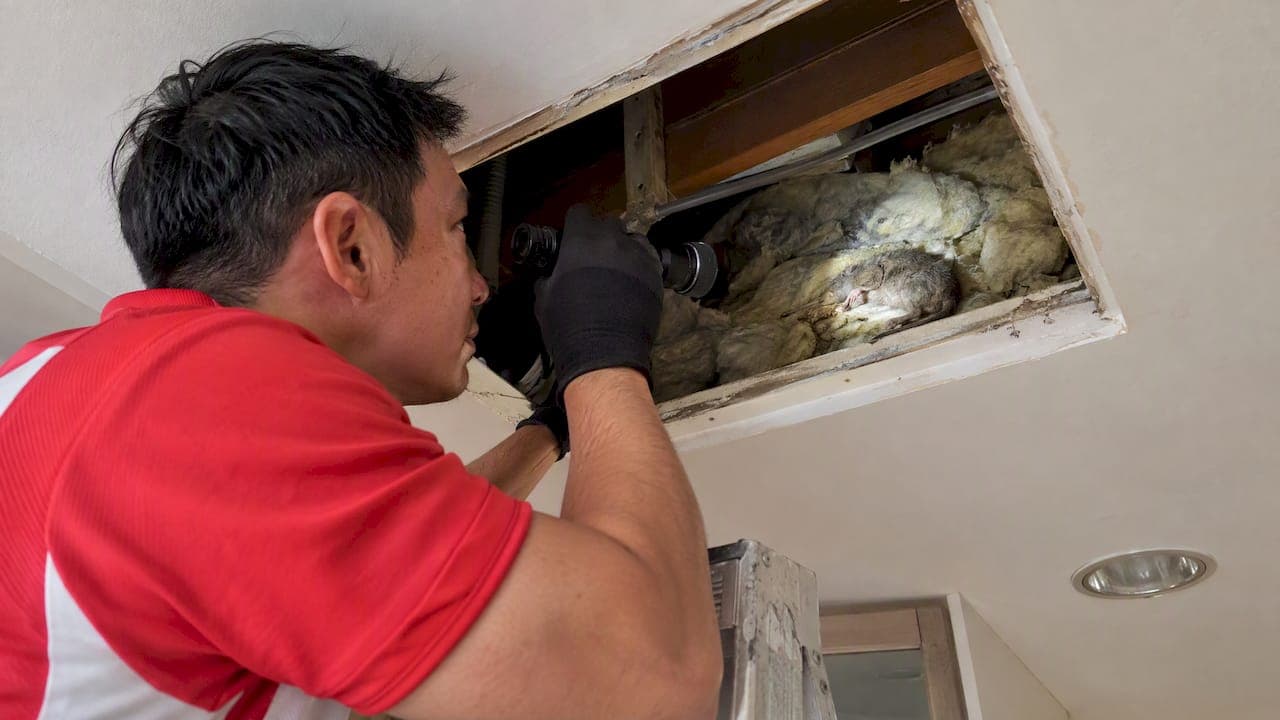
The only way to remove dead rat smell for good is to find and remove the carcass, then disinfect the area and ventilate it. Air fresheners, baking soda and vinegar bowls can take the edge off, but the smell comes back while the source is still there. If the rat has died inside a wall, ceiling, duct or other void you cannot open safely, stop DIY work and call a licensed pest control team.
This guide covers what the smell tells you, how to locate the source, the safe cleanup sequence, what does not work, and how to stop another rat from dying in the same place.
TL;DR
- Odor removal starts with source removal. Find the carcass, remove it, then clean and disinfect the spot.
- Never sweep or dry-vacuum rodent waste or carcasses. Wet the area with disinfectant first, as CDC guidance advises.
- Masking products and ozone machines are not a fix. Ozone is unsuitable for occupied spaces, and the smell can return if the carcass stays.
- Carcass inside a wall, ceiling or duct? Ventilate and call a professional. In Singapore, NEA guidance supports engaging a registered vector control operator when infestation is detected.
- A repeat smell points to a rat entry or food problem. Fix that, or it will happen again.
Table of Contents
- What a dead rat smell tells you
- Step 1: Locate the carcass
- Step 2: Remove it safely
- Step 3: Remove the odor itself
- What does not work
- When the rat is inside a wall, ceiling or duct
- Why the smell comes back: it is a pest management problem
- For businesses, property managers and construction sites
- Our perspective: treat the cause, not the smell
- When to call a professional
- Preventing the next one
- FAQ
- Sources
What a dead rat smell tells you
People describe the odor as strong, nauseating and rotten. McGill University's Office for Science and Society explains that decomposition produces compounds such as putrescine, cadaverine and sulfur compounds. Some consumer guidance compares it to rotten cabbage.
The exact smell varies. It depends on how far decomposition has gone, how damp the spot is, how well the area is ventilated, and which materials soak up body fluids. Carpet, insulation and plasterboard hold odor far longer than tile or metal.
Three signs suggest a hidden carcass rather than a passing smell:
- The odor gets stronger over several days instead of fading.
- Flies gather around one wall, ceiling, cabinet or air vent.
- The smell is concentrated in one spot, not spread evenly through the room.
Singapore's warm, humid climate does not help. Heat and moisture tend to speed decomposition and let odor spread, so a hidden carcass is usually noticed quickly.
How long does the smell last?
There is no honest single number. A small rodent in an open, ventilated spot can be dealt with in a day once it is removed and cleaned. A carcass sealed in a wall or ceiling void, or one that has soaked into insulation or wood, can keep smelling for as long as the material remains contaminated. Do not wait it out. The smell may fade, but contamination and the rodent problem behind it remain.
Step 1: Locate the carcass
Start by following your nose, then confirm with your eyes.
- Open windows and run fans to move air out of the room before you search.
- Walk the room slowly and note where the smell is strongest. Check the corners, behind and under appliances, inside cabinets and under sinks.
- Look for flies and for droppings, grease marks along walls or gnaw marks. These show the rat's travel routes and often lead to where it died.
- Check vents and false ceilings. If the smell is strongest at an air vent, the carcass may be in the ductwork. HVAC.com notes that a carcass in ducts can cause health issues if left untreated, so do not run the air conditioner at full blast to "push" the smell out.
- Check balconies, service ducts and car parks if the smell is near the entrance of your unit. Rats often die near where they entered.
If the carcass is accessible, move to step 2. If the smell seems to come from inside a wall, ceiling or duct, skip to the section on inaccessible carcasses below.
Step 2: Remove it safely
A dead rat is not only a smell problem. Rodent waste and carcasses can contaminate surfaces and air, which is why the cleanup order matters. The sequence below follows the CDC's guidance on cleaning up after rodents.
- Ventilate first. Open doors and windows and leave the area before you start work.
- Put on gloves. Wear rubber or disposable gloves. Many people add a mask and long sleeves.
- Wet everything with disinfectant. Spray the carcass, nest material, urine and droppings. Let the disinfectant soak for five minutes, or for the contact time on the product label if it is different.
- Double-bag the carcass. Use a tied bag inside a second tied bag, with the wet material wiped up using paper towels.
- Dispose of it in a covered rubbish bin or the refuse chute system your building uses, with the bags sealed.
- Clean the surface with disinfectant, then wash your hands thoroughly after removing the gloves.
What not to do
- Do not sweep or dry-vacuum droppings, urine, nests or carcasses. CDC guidance warns this can put contaminated droplets or particles into the air.
- Do not touch a carcass with bare hands.
- Do not cut into walls or ceilings without knowing what is behind them. Wiring, pipes and building structure are common reasons to call a professional instead.
If anyone in your home develops an illness after rodent exposure, the CDC advises talking to a healthcare provider and mentioning the exposure.
Step 3: Remove the odor itself
Once the carcass and contaminated material are gone, deal with what is left in the air and on surfaces.
- Ventilate with cross-flow air for as long as practical. Fresh air is the most reliable odor remover once the source has gone.
- Replace what absorbed fluids. Soaked carpet, cardboard, fabric or insulation may need to be thrown away, not cleaned.
- Use an enzyme cleaner on hard surfaces. BPCA, the UK pest management association, notes that enzyme sprays are usually effective at removing airborne odors quickly, but they must come into contact with the source of the odor. That makes them a finishing step after the carcass is found, not a replacement for finding it.
- Use absorbers as a temporary measure. Charcoal bags, baking soda and bowls of vinegar can reduce the smell you notice, but they do not remove the cause.
For workplaces, shops, warehouses and construction sites, the cleaning job after a carcass is removed is often larger than in a home. Surfaces that touch food, staff or the public need proper disinfecting. A published industrial cleaning safety checklist is a useful reference for planning protective equipment, ventilation and chemical handling before any cleaning crew starts.
What does not work
| Approach | What it does | Why it falls short |
|---|---|---|
| Air fresheners and sprays | Cover the smell for a short time | The carcass keeps decomposing and the smell returns |
| Vinegar, baking soda, charcoal | Absorb some odor from the air | Do not remove the source or stop rats entering |
| Coffee grounds or heat tricks | Mask odor | No effect on contamination |
| Ozone generators | Chemically change odor molecules | People and animals must stay out while running, the area must be aired afterward, and the smell can come back if the carcass remains, according to BPCA |
| Enzyme sprays alone | Break down odor compounds | Only work where they touch the source |
The pattern is the same each time: anything that treats the smell without removing the carcass is temporary.
When the rat is inside a wall, ceiling or duct
This is the most common reason people search for help. You cannot see the source, you cannot reach it and the smell fills the room.
What you can do safely while you arrange professional help:
- Ventilate the room and keep the affected area closed off from children, elderly family members and pets.
- Use absorbers only as a stopgap.
- Note where the smell is strongest, when it started, and whether you have seen droppings, heard scratching or noticed flies.
- Do not break open walls or ceilings yourself.
A professional can locate the carcass using inspection tools. We use thermal imaging for inspections, which helps us trace activity behind surfaces without opening everything up. We can then recommend the least invasive way to reach and remove the source.
In Singapore, NEA's pest management guidance supports using professional pest management that focuses on prevention and root causes, not only on treating symptoms.
Why the smell comes back: it is a pest management problem
If you have cleaned thoroughly and a second or third rat dies in the same area, cleaning was never the real issue. Rodents are entering, feeding and nesting somewhere nearby.
NEA describes integrated pest management (IPM) as putting prevention first, removing the root causes of infestation and combining physical, biological and chemical controls as appropriate. Singapore Standard SS 721:2025 is the national framework for professional pest management and applies IPM principles to rats and other pests.
In practice, recurring dead rat odor usually traces back to one or more of these:
- Open food sources, such as unsealed bins, pet food or leftover food in kitchens
- Refuse storage that is not covered or is left too long
- Gaps around pipes, doors, ducts and false ceilings
- Drains and loading areas that give rats a route in
- Cluttered storage or construction-site materials that give them shelter
Removing one carcass does nothing about any of these.
What to ask for in an inspection report
A good pest control visit does more than spray. Ask for an inspection report that records likely entry points, food and refuse conditions, voids, monitoring locations and corrective actions. If a provider offers only deodorizing or fogging, that is a warning sign.
For businesses, property managers and construction sites
A dead rat in a restaurant, hotel, warehouse or managed building is more than a nuisance. It points to a gap in your pest management programme, and you need records of what was done.
NEA's environmental sanitation guidelines for high-risk non-healthcare premises recommend a comprehensive pest management survey at least once every six months, with more frequent surveys for premises that have an infestation history. A one-off deodorizing visit does not meet that kind of need. Ongoing, documented control does.
Our related guides cover this in more detail:
- Pest control schedules for Singapore sites
- Kitchen pest control checklist for foodservice managers
- Restaurant pest control requirements in Singapore
- Hotel pest control checklist
Our perspective: treat the cause, not the smell
We have more than 30 years of experience in pest control and fumigation in Singapore, and the pattern in dead rat calls is consistent. Customers usually try to fix the smell first. They buy sprays, run fans and wait. The odor fades for a day or two and returns, because the carcass or the rat activity behind it is still there.
Our approach follows integrated pest management. We start with inspection to find where the rats are getting in, where they are feeding and where they have died. Our technicians are NEA-licensed, and we use non-toxic, environmentally safe methods that put the safety of people and pets first. That matters in a home where children and pets are in the same rooms, and in a business that cannot close for days.

We also push back on quick fixes. Fogging a room with fragrance does not make it safe, and a treatment that is wrong for an occupied space is the wrong treatment. Removing the source, cleaning properly, closing the entry points and monitoring afterward is slower to explain than a spray, but it is what lasts.
If the smell comes back, we want to know why. Usually the answer is a gap, a bin or a drain, and those can be fixed.
— Bespoke-Enviro Services
When to call a professional
Call a licensed pest control provider if any of these apply:
- The smell is coming from a wall, ceiling, duct or other space you cannot safely open
- You have found more than one dead rat, or you see droppings, gnaw marks or nests
- The smell persists after you have removed what you found and cleaned
- Vulnerable people, such as infants, elderly relatives or people with health conditions, live in the property
- The premises is a food business, hotel, warehouse, managed property or construction site where records matter
We handle these through our rodent and rat control service: inspection to find the source and entry points, removal, and a prevention plan built on IPM. We are available 24/7, so a smell that appears on a weekend does not have to wait. If rodents are part of a wider problem, our general pest control service covers other pests at the same time. You can also reach us through our main site to arrange an inspection.
Preventing the next one
Once the smell is gone, a few habits reduce the chance of repeat incidents:
- Store food, including pet food, in sealed containers.
- Use covered bins and take refuse out regularly.
- Seal gaps around pipes, cable entries and doors, and keep drains covered.
- Reduce clutter in storerooms, balconies and service yards.
- Check regularly for droppings, gnaw marks and grease trails along walls.
- For commercial and managed sites, keep a monitoring schedule with written records.
If rats are living in your property, poison baits can lead to the very problem you are trying to solve: a rat that dies somewhere out of reach. A plan that blocks entry and removes food sources avoids that, which is why we focus on IPM first.
FAQ
Will a dead rat smell go away on its own?
Often it fades as decomposition finishes, but how long that takes depends on the size of the animal, the heat, the moisture and the ventilation. Contaminated materials can keep smelling, and the rodent problem behind the death stays. Locating and removing the source is the safer route.
How long does a dead mouse smell last?
There is no fixed time. A mouse in an open, ventilated spot is much quicker to clear than one inside a wall or soaked into insulation. If the smell is getting stronger or flies are appearing, look for the carcass instead of waiting.
What will mask the smell of a dead rat?
Charcoal, baking soda, vinegar bowls and air fresheners can reduce how strongly you notice the odor. They do not remove the carcass or stop other rats from entering. Treat them as a short-term measure while you arrange removal.
Is it safe to clean up a dead rat myself?
If the carcass is in the open, yes, if you follow the right order. Ventilate, wear gloves, soak with disinfectant for five minutes or the label time, double-bag, dispose of it in a covered bin and wash your hands. Never sweep or dry-vacuum, and call a professional if it is inside a wall, ceiling or duct.
Can ozone machines remove dead rat smell?
They can alter odor, but BPCA states that people and animals must not be present while one operates, the area must be aired afterward and the smell can return if the carcass is still there. For occupied homes and workplaces, source removal and cleaning are safer priorities.
Sources
- CDC: How to Clean Up After Rodents
- McGill Office for Science and Society: Can you remove dead mouse smell without putting holes in your walls?
- BPCA: Dealing with dead rodent odours
- NEA: Integrated Pest Management and Singapore Standard 721:2025
- NEA: Environmental Sanitation Guidelines for high-risk non-healthcare premises
- HVAC.com: Dead animal smell coming from air vents