
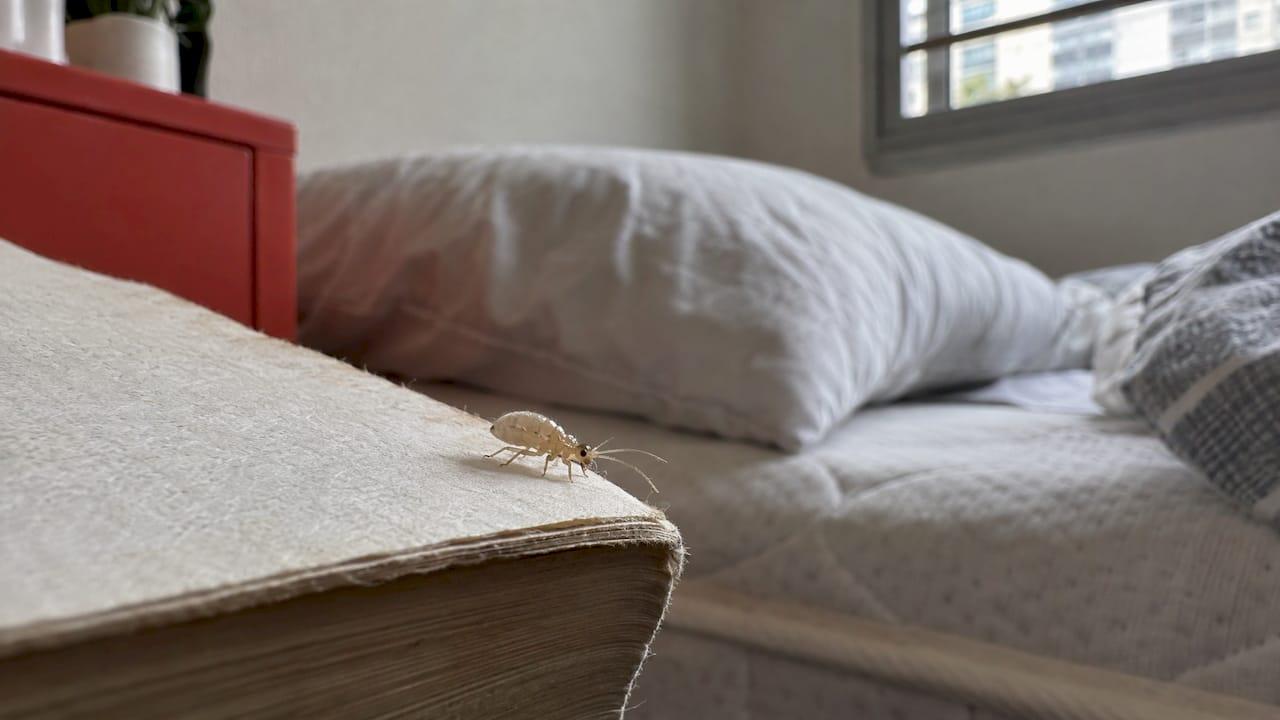
If you can see a tiny pale speck crawling across a book, a shelf or a wardrobe wall, it is almost certainly a booklouse, not a dust mite. Dust mites are too small to see without a microscope, they live in bedding and upholstery, and they cause allergy symptoms. Booklice are visible, feed on mould, do not bite, and signal a damp spot in your home. The two problems have different causes and different fixes, and this guide shows you how to tell them apart and what to do about each.
TL;DR
- Size is the quickest test. Booklice measure about 1 to 2 mm and can be seen moving. Dust mites measure about 0.2 to 0.3 mm and cannot be seen without a microscope.
- Food is the second test. Booklice eat mould and fungi. Dust mites eat skin flakes from people and pets.
- Harm differs. Booklice do not bite or spread disease. Dust mite droppings can trigger asthma, rhinitis and eczema.
- Booklice follow humidity. Bringing indoor humidity below about 50% is the most effective single step, and it works best when moisture sources and mould are dealt with too.
- Persistent infestations in homes, offices or new flats call for a proper inspection. We can help through our general pest control service.
Table of Contents
- Booklice vs dust mites at a glance
- How to tell them apart by appearance
- Where each one lives in a Singapore home
- Are they harmful?
- Booklice vs bed bugs
- Why booklice appear in new flats and older homes
- How to get rid of booklice
- How to reduce dust mites
- Our perspective on booklice
- Offices, shops and property managers
- When to call a professional
- Professional help from Bespoke Enviro
- FAQ
- Sources
Booklice vs dust mites at a glance
| Feature | Booklice (psocids) | Dust mites |
|---|---|---|
| Size | About 1 to 2 mm | About 0.2 to 0.3 mm |
| Visible to the naked eye | Yes, as a moving pale speck | No, needs a microscope |
| Colour | Translucent white to pale grey | Whitish, not visible individually |
| Food | Mould, fungi, starchy material | Human and pet skin flakes |
| Typical places | Bathrooms, wardrobes, kitchen cabinets, bookshelves, window sills | Mattresses, pillows, sofas, soft toys, carpets |
| Bites people | No | No |
| Health effect | None directly | Allergy and asthma trigger |
| What drives them | Humidity and mould | Warmth, humidity and skin flakes |
| Main fix | Lower humidity, remove mould, treat affected areas | Hot washing, damp cleaning, humidity control |
How to tell them apart by appearance
Start with what you can actually see. Booklice are soft-bodied, translucent white to pale grey, and measure roughly 1 to 2 mm, wingless when found indoors. Under magnification they resemble a tiny termite worker or a slender aphid. They tend to move in short, quick bursts across paper, cardboard or a painted wall.
Dust mites are a different scale entirely. They are about 0.2 to 0.3 mm and invisible without a microscope. The practical rule: if you can see a speck moving, it is not a dust mite. People often say they have "dust mites" when they see tiny crawling specks, but those specks are usually booklice, springtails or another small insect.
Signs you are dealing with booklice
- Tiny pale specks moving on books, cardboard boxes, shelves or the inside of cabinets
- A musty smell or faint mould film in the same area
- Specks in stored dry goods such as flour or grains, since booklice are associated with starchy products
- Activity that rises after rainy weeks or when a room has been shut for a long time
Signs you are dealing with dust mites
- Sneezing, a blocked nose, itchy eyes or wheezing that is worse in bed or after sitting on upholstery
- Eczema flare-ups that follow the same pattern
- No visible creature at all
Dust mite problems are diagnosed by symptoms and by a doctor, not by spotting an insect. If you suspect an allergy, see a general practitioner or an allergy specialist.
Where each one lives in a Singapore home
Booklice need damp conditions. They thrive above 60% relative humidity and reproduce fastest around 75 to 90%. In Singapore homes that means bathrooms, bomb shelters, wardrobes, kitchen cabinets, aircon ledges, window sills, bookshelves, stored paper, and the space under mattresses or headboards. They feed on the invisible film of mould that grows on paper, cardboard, wallpaper paste, book bindings, plaster, grout and wardrobe backing boards.
Dust mites live where people shed skin: mattresses, pillows, sofas, carpets and soft toys. In Singapore, they are especially prevalent in warm, humid climates and can be found all year round. Their growth conditions are a temperature of 22 to 26°C and relative humidity above 55%, which describes a typical air-conditioned bedroom closely.
The overlap is humidity. Both creatures prefer moist air, which is why the same damp home can have both. But they sit in different places and eat different things, so a booklice fix does not solve a dust mite allergy, and the reverse.

Are they harmful?
Booklice
Booklice are a nuisance rather than a danger. They do not bite, do not spread disease, and do not directly damage paper, fabric or other non-food items. Their droppings can contaminate stored food, so discard open dry goods that show activity. Extension entomologists also note that booklice are rarely damaging inside homes and harmless to people or pets.
The real message of a booklice outbreak is moisture. Where there are booklice, there is usually mould, and mould is worth fixing for the sake of the building and the air you breathe.
Dust mites
In Singapore the common house dust mites are Dermatophagoides species and Blomia tropicalis. According to National University Hospital, their droppings may trigger asthma, allergic rhinitis and eczema. If you or your child have recurring symptoms, speak to a doctor. A clinic can assess whether allergens are the cause; a pest controller cannot diagnose an allergy.
Booklice vs bed bugs
People searching for booklice often wonder if they are bed bugs, because both show up near beds and wardrobes. The differences are clear once you look closely.
| Feature | Booklice | Bed bugs |
|---|---|---|
| Size | 1 to 2 mm | Larger, visible, apple-seed shape as adults |
| Colour | Translucent white to pale grey | Brown to reddish-brown |
| Bites | No | Yes, causing itching and discomfort |
| Food | Mould and fungi | Blood |
| Where | Damp, undisturbed spots, paper, cabinets | Mattress seams, bed frames, headboards |
| Signs | Moving specks, musty smell | Bites, dark spots on bedding, live bugs |
NEA states that bed bugs are not known to transmit diseases, but their bites can cause discomfort, itching and allergic reactions. NEA also advises that premises with an infestation engage a pest management company. If you wake with fresh bites in a line or cluster, treat it as a bed bug possibility first, not booklice. Our bed bug control service covers inspection and treatment, and our guide to fleas vs bed bugs helps with another common mix-up.
Why booklice appear in new flats and older homes
A common surprise is booklice in a freshly renovated or newly collected flat. Several things cause this:
- Drying building materials. New plaster, screed, grout and wardrobe backing boards hold moisture, and mould can grow on them quickly.
- Closed-up rooms. Units left shut with the aircon off during renovation or before move-in build up humidity.
- Cardboard. Moving boxes and packing paper are ideal food for mould, and booklice follow.
- Cabinets and storage. Dark, undisturbed shelves behind closed doors suit them.
Female booklice can produce about 60 eggs in warm months, and the life cycle can finish in under a month in warm conditions. Singapore's year-round warmth means a small group can turn into a visible colony fast.
If you are about to move into a new home, a pre-move check is sensible. Read our guides on the move-in pest inspection and the pre-purchase pest inspection.
How to get rid of booklice
The approach that works is to remove what booklice need: moisture and mould. Extension entomologists report that psocids do not survive when humidity falls below roughly 45 to 50%, and that reducing moisture is the best way to manage them in homes. Follow these steps.
- Measure humidity. Buy a hygrometer. A basic one costs around S$15 to S$25 in Singapore. Check the affected room, not just the living area.
- Lower humidity. Aim for 50 to 55% or lower using a dehumidifier or the dry mode on your aircon. Lowering relative humidity to below 50% prevents mould growth and booklouse development.
- Fix the moisture source. Look for leaks, damp walls, poor bathroom ventilation, wet aircon ledges and condensation. Without this, booklice return.
- Remove visible mould. Use a mould remover or diluted 3% hydrogen peroxide on hard surfaces, and keep the room ventilated while you work.
- Clear their food. Dry, discard or seal cardboard, old paper and stored dry goods that show activity. Throw out infested open food packs.
- Vacuum the area. A HEPA vacuum along shelves, cabinet corners, skirting and window sills removes insects, eggs and mould debris.
- Improve airflow. Leave small gaps between books, keep wardrobes slightly open when conditions allow, and avoid pushing boxes tight against walls.
- Watch for two to three weeks. If specks keep appearing, humidity or a hidden damp source is still the issue.
Humidity thresholds are easy to underestimate: moisture control matters in other parts of the home too. A guide on humidity levels for wood floors shows why keeping indoor air in a moderate range protects timber as well as keeping pests away.
What about insecticides?
Insecticides are not normally needed for booklice in homes, because remedying water issues is more effective. Extension entomologists add that insecticides will not work while moisture is still a problem, and that products typically available to residents are generally not effective on psocids. So the order matters: fix humidity first, and use targeted treatment on the affected areas as part of a plan.
If a treatment is used indoors, safe use matters. Read and follow the label, wear covering clothing, closed shoes and gloves, open windows for fresh air, and keep products in their original containers. Keep children and pets away from treated areas until the label says it is safe to return. Professional treatment removes the guesswork, because a licensed technician chooses products and methods suited to the premises.

How to reduce dust mites
Dust mites are controlled by changing the environment, not by spraying. The Singapore Centre for Asthma, Allergy and Immunology notes that using chemicals to kill dust mites or denature allergens has only marginal effects and is not recommended. The same source advises keeping indoor humidity below 50%, and notes that in a tropical climate air-conditioning helps because windows and doors can stay closed.
National University Hospital's advice for Singapore households includes:
- Wash bedsheets and pillowcases in water of at least 60°C every week or fortnight
- Avoid natural-material bedding, limit stuffed toys and avoid thick curtains
- Use damp cleaning rather than dry dusting
- Deep-clean air-conditioners regularly
- Avoid carpets and rugs in the bedroom
Upholstery holds allergens too. If your sofa is a concern, HEPA extraction for upholstery is one way cleaners lift dander and fine dust from fabric. A hygrometer in the bedroom is useful for both problems, since one reading guides your booklice and dust mite measures.
Our perspective on booklice
We see booklice enquiries in two forms. In the first, the household sees pale specks and assumes the worst: bed bugs, termites or dust mites. In the second, someone has sprayed a shelf repeatedly and the specks come back within weeks. Both are the same story. Booklice are a sign of a damp, mouldy micro-environment, and a lasting result means dealing with that environment.
This is why we work through integrated pest management (IPM). We inspect first, identify the pest correctly, find the conditions supporting it, and then choose the least harmful method that solves the problem. Our approach uses non-toxic, environmentally safe methods that prioritize the safety of people and pets, and our technicians are NEA-licensed.
Correct identification matters because a bed bug, a termite and a booklouse call for entirely different responses. A homeowner who treats the wrong pest wastes money and time. Our inspections use advanced tools, including thermal imaging, to find hidden moisture and activity that the naked eye misses, and we are available 24/7 when an issue cannot wait.
For homes, we pair treatment with practical guidance on humidity, storage and ventilation so the problem does not return. For businesses and property managers, we build that into an ongoing maintenance plan.
Bespoke-Enviro Services
Offices, shops and property managers
Booklice are not just a home issue. They turn up in storerooms with paper archives, food stores with open dry goods, and shared basements or bomb shelters. For managers of commercial properties, NEA's guidelines for high-risk non-healthcare premises call for a comprehensive pest management survey every six months. They also say that when an infestation occurs, surveillance and control should be stepped up and a registered vector control operator should carry out surveillance and treatment.
In practice, a good routine looks like this:
- Record humidity in storerooms and archives monthly
- Keep cardboard off floors and away from walls
- Report recurring specks to your pest controller early, with the location and date
- Include moisture findings in your regular pest survey
If you are comparing do-it-yourself steps with a contract, our guide on DIY vs professional pest control sets out how to decide.
When to call a professional
Call for an inspection if any of these apply:
- The specks return after humidity has been lowered and mould removed
- You cannot tell if you are dealing with booklice, bed bugs or another pest
- Activity is in several rooms, in food stores or in a workplace
- There is hidden damp behind walls, in ceilings or in built-in cabinets
- You are managing a property and need documented, repeatable control
Professional help from Bespoke Enviro
We provide pest control and fumigation across Singapore for homes, offices, industrial sites and construction sites. When you book our general pest control service, our technicians inspect the affected areas, identify the pest, and recommend a plan built on integrated pest management with non-toxic, environmentally safe methods.

We also handle related problems such as termites, rodents, bed bugs, cockroaches, flies and mosquitoes. To discuss your situation, visit our main site and request an inspection. Pricing is not published online, so we assess each property before advising.
FAQ
Are booklice the same as dust mites?
No. Booklice are insects about 1 to 2 mm long that feed on mould and can be seen moving. Dust mites are microscopic arachnids that feed on skin flakes in bedding and upholstery. Only dust mites are a common allergy trigger.
Can booklice bite me or make me sick?
No. Booklice do not bite and are not known to carry disease. Their droppings can contaminate open food, so discard affected dry goods. If you are getting bites, look for bed bugs or fleas instead.
What humidity level stops booklice?
Keep indoor humidity below about 50%. Extension sources report that this prevents mould growth and booklouse development, and that psocids struggle to survive below roughly 45 to 50%. A hygrometer lets you check each room.
Do I need an insecticide to get rid of booklice?
Usually the first step is moisture control, since insecticides do not work while dampness remains. If booklice persist, a licensed pest controller can inspect, find the damp source and apply a suitable treatment safely around people and pets.
Sources
- Booklice, Penn State Extension
- Psocids (barklice, booklice), UMN Extension
- Pesticide safety in the home, UMN Extension
- Management of Bed Bugs, NEA Singapore
- Environmental sanitation guidelines for high-risk non-healthcare premises, NEA
- How to Avoid House Dust Mites, National University Hospital
- Dust mite control, Singapore Centre for Asthma, Allergy and Immunology
- Indoor allergies, Clarityn Singapore
- Booklice in Singapore homes, Pico X Health
- Remove pet dander from upholstery with HEPA extraction
- Hardwood floor humidity level