
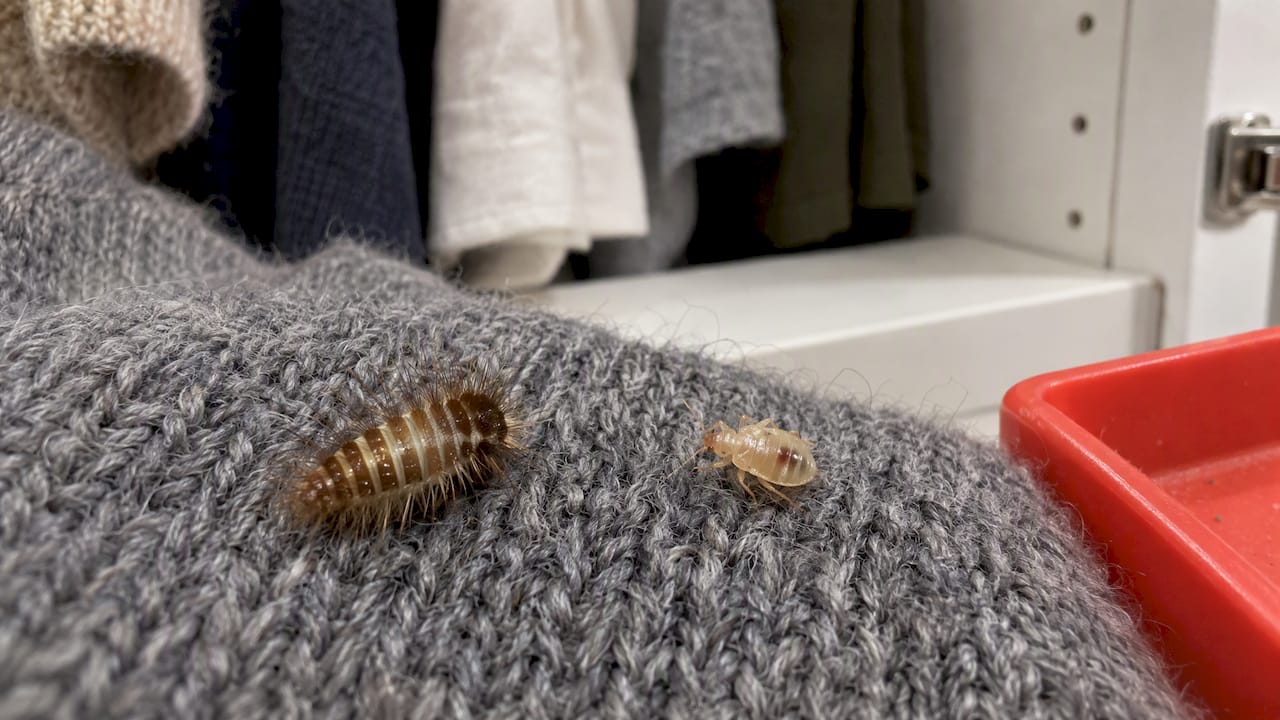
The quickest way to tell them apart is to look at what the insect does and where it hides. Bed bugs are flat, reddish-brown insects that feed on blood and hide near where people sleep. Carpet beetles are rounded beetles whose hairy larvae feed on fabric, lint and natural fibers. If you have found something small in your bed, this guide shows you how to identify it, what evidence confirms it and what to do next in a Singapore home.
TL;DR
- Bed bugs are flat and black, brown or maroon. They hide in mattress seams, bed frames and behind picture frames, and they bite.
- Adult carpet beetles are small, rounded and often patterned. Their larvae are bristly and feed on fabrics, which is why they turn up in wardrobes, carpets and bedding.
- A cast skin or a hairy larva is not proof of bed bugs. Rusty spots on mattress seams and live bugs in crevices point to bed bugs.
- Bite-like marks alone do not tell you which pest you have. Match them with physical evidence in the room.
- Bed bugs hide in many cracks, so NEA advises hiring a pest management company. Carpet beetles are usually solved by finding and removing the source.
Table of Contents
- Why people confuse the two
- Carpet beetle vs bed bug: side-by-side comparison
- How to identify bed bugs
- How to identify carpet beetles and their larvae
- Carpet beetle larvae vs bed bug: the quick checks
- What about bite marks?
- A 30-minute bedroom inspection
- Can both pests be present at once?
- What to do if you have bed bugs
- What to do if you have carpet beetles
- Our perspective
- When to call a professional
- Get the right treatment for the right pest
- Preventing both pests
- FAQ
- Sources
Why people confuse the two
Both pests are small. Both turn up in bedrooms. Both leave behind tiny shed skins and specks that look alike to an untrained eye. And both are often discovered at the same moment: you wake up with itchy skin, then find a strange insect on the sheets.
The confusion matters because the two problems need different responses. A bed bug problem is about a blood-feeding insect living close to you. A carpet beetle problem is about larvae feeding on materials such as wool, silk, feathers, fur and stored items. Treating the wrong one wastes time and lets the real problem grow.
In Singapore's air-conditioned, closed-up flats and condominiums, bedrooms are stable environments year-round. That makes careful identification more useful than guessing from a single photo.
Carpet beetle vs bed bug: side-by-side comparison
Use this table as a first filter. It is built from official descriptions of each pest plus the practical checks we use on site.
| Feature | Bed bug | Carpet beetle |
|---|---|---|
| What it is | A true bug that feeds on blood | A beetle; the larvae feed on fabric and fibers |
| Adult shape | Flat, oval | Rounded, oval, beetle-like |
| Adult size | Up to about 10 mm | Roughly 1/10 to 3/16 inch (about 2.5 to 5 mm) for common species |
| Color | Black, brown or maroon | Dark brown to black, or a patterned mix of white, brown and yellow scales |
| Young stage | Nymphs from about 1 mm | Hairy larvae with short, stiff bristles or tufts |
| Where found | Mattress seams, bed frames, behind picture frames, mattress pads | Carpet edges, wardrobes, stored clothing, windowsills, under furniture |
| Feeds on | Human blood | Pollen and nectar as adults; fabrics and natural fibers as larvae |
| Damage | Bites, itching, allergic reactions in some people | Holes and thinning in susceptible fabrics |
| Best response | Professional treatment | Locate the source, clean, remove infested items; call a professional if widespread |
The sizes and colors come from two official pages: the National Environment Agency's guidance on bed bugs, which gives a range from 1 mm for young bugs to 10 mm for adults in black, brown or maroon, and the US Defense Centers for Public Health carpet beetle page, which describes black carpet beetle adults at 1/8 to 3/16 inch and variegated adults at about 1/10 inch.
How to identify bed bugs
Bed bugs are specialists at hiding. NEA notes they shelter in sleeping areas, behind picture frames and inside mattress pads. Look for these signs:
- Live insects that are flat and reddish-brown to dark, especially along mattress piping and seams.
- Small dark spots on bedding or mattress edges. These are often fecal marks.
- Shed skins from nymphs growing, usually clustered where the bugs hide.
- Small bloodstains on sheets or pillowcases.
- Clusters of bites appearing after nights spent in the room.
The young are the tricky part. A 1 mm nymph is easy to overlook, so a bed that looks clean can still hold an early infestation.
How to identify carpet beetles and their larvae
Adult carpet beetles are small, and some are strikingly patterned. The variegated type has wavy white, brown and dark yellow scales. The black type is dark brown to black. Their larvae are the stage that usually causes trouble, and they have short, stiff hairs or dense tufts of hair, which gives them a bristly, almost fuzzy look.
That hairy body is the clearest difference. Bed bug nymphs are smooth, pale and translucent before feeding, and they turn redder after a blood meal. A bristly, brown, worm-like creature is not a bed bug.

According to UC Statewide IPM, adult carpet beetles feed on pollen and nectar and may enter homes from flowers. Management is needed when larvae are developing in fabrics or other indoor areas. In practice, that means an adult on a windowsill is not necessarily a sign of trouble, while larvae and shed skins in a wardrobe are.
Carpet beetle larvae in bed
Finding larvae in bed is common enough to worry people. It usually means one of three things:
- Larvae have moved from a nearby source such as a wool rug, stored clothing or a pet bed.
- Feathers, wool blankets or other natural-fiber bedding are the food source.
- Adults flew in and laid eggs somewhere with lint, hair or dead insects, such as under the bed or inside a bed base.
Check the underside of the bed, the carpet edges and the wardrobe next to it. If you find larvae and shed skins there but no bloodstains or fecal spots on the mattress seams, carpet beetles are the more likely explanation.
Carpet beetle larvae vs bed bug: the quick checks
If you have an insect or a clear photo, run through these questions.
- Is it hairy? Bristles or tufts mean carpet beetle larva. Bed bugs are not hairy in that way.
- Is it flat? A flat, wide, oval body points to a bed bug. Carpet beetle adults are rounded and domed.
- Does it have a pattern? Scaled patterns of white, brown and yellow belong to a beetle.
- Where did you find it? Mattress seams and bed frame joints favor bed bugs. Wardrobes, carpet edges and stored wool favor carpet beetles.
- Is there damage? Irregular holes or worn patches on natural fabrics suggest larval feeding.
- Are there blood spots or dark specks? These favor bed bugs.
Keep the insect. Tape it to a card or place it in a sealed container so a technician can confirm the identification.
What about bite marks?
This is where most people get stuck. NEA states that bed bugs are not known to transmit diseases to humans, but their bites can cause discomfort, itching and allergic reactions in some people. Reactions vary widely: some people show clear welts, others show almost nothing.
That variation is why skin marks alone cannot identify the pest. Itchy spots can come from other insects, from irritation caused by fabrics, or from skin conditions. If you cannot find any bed bug evidence, do not assume carpet beetles are the cause either. Look at the room evidence first. If the rash is severe, spreading, painful or you suspect an allergic reaction, see a doctor.
A 30-minute bedroom inspection
You do not need special equipment. A flashlight, a credit card and a sealable bag are enough.
- Strip the bed. Check sheets and pillowcases for dark specks or bloodstains.
- Follow the mattress seams. Run the card along piping and tags. Look at both sides of the mattress.
- Inspect the bed frame and headboard. Check joints, screw holes and any gaps where the headboard meets the wall.
- Check behind picture frames and wall decor near the bed. NEA lists these as common hiding places.
- Examine the carpet edges, under-bed storage and the wardrobe. Look for shed skins, larvae and thinned fabric.
- Look at the windowsills. Dead adult beetles often collect here.
- Write down what you find and where. A simple floor sketch helps a technician work faster.
If you find nothing, that does not guarantee nothing is there. Early bed bug infestations can be small and well hidden.
Can both pests be present at once?
Yes. They are unrelated, so having one does not rule out the other. A home can have larvae feeding in a wool rug and bed bugs hiding in the headboard. This is a common reason why a DIY treatment seems to work partly and then the problem returns. If your evidence is mixed, treat the identification as unsettled and get an inspection.
What to do if you have bed bugs
NEA describes typical bed bug treatment as a mix of non-chemical and chemical methods: vacuuming, hot laundering, steam and heat treatment, removing harbourages and using insecticides. Because bed bugs can occupy many cracks and crevices, NEA advises premises with an infestation to engage a pest management company.
While you wait for a technician:
- Wash bedding and clothing on a hot cycle and dry on high heat.
- Vacuum mattress seams, bed frame and floor edges, then seal and dispose of the bag outside.
- Do not move infested furniture to other rooms, which can spread the problem.
- Avoid spraying random household insecticides. They can scatter bugs and make later treatment harder.
To understand what a professional approach looks like, read our guides on bed bug heat treatment and what bed bug treatment costs in Singapore. If you rent, our article on who pays for pest control under Singapore tenancy clauses explains how responsibility is usually decided.
What to do if you have carpet beetles
Carpet beetle control is about removing the food and the breeding spot, not just killing what you see.
- Find the source. Check wool, silk, fur, feathers, stored clothing, pet bedding and the edges of rugs.
- Vacuum thoroughly. Focus on carpet edges, under furniture, wardrobe floors and baseboards. Dispose of the bag outside.
- Launder or heat-treat affected items. Hot washing suits items that can take it; dry-clean the rest.
- Store textiles properly. Use sealed containers for items you keep long term.
- Clear lint, hair and dead insects from places where larvae can feed unseen, such as under heavy furniture or inside vents.
- Close entry points. Adults can enter from outdoors, so check window screens and gaps.
If larvae keep returning after cleaning, the source may be hidden inside walls, ducts or stored items that are hard to reach. That is when a professional inspection pays off.
Our perspective
We see the same pattern again and again in Singapore homes. A resident finds a small insect, searches online, decides it is a bed bug or a carpet beetle, and starts treating. Often the guess is wrong, or only half right.
Our view is that identification comes first and treatment second. That is the basis of integrated pest management: inspect, identify, remove the conditions that allow the pest to thrive, then use the least hazardous effective control. It is also the approach that Singapore's national framework for professional pest management, SS 721:2025, describes, with prevention, habitat modification and judicious pesticide use.

For bed bugs, we do not believe in spraying and hoping. The pest hides in many places, so a methodical inspection matters, and so does using non-toxic and low-risk methods wherever they work, especially in bedrooms where families and pets sleep. Our technicians are NEA-licensed, and we use tools such as thermal imaging during inspections.
For carpet beetles, the answer is usually less dramatic. Cleaning, proper storage and finding the source solve most cases. We would rather tell you that than sell you a treatment you do not need.
— Bespoke-Enviro Services
When to call a professional
Call for an inspection when:
- You find live bugs or fecal spots on mattress seams or in bed frame joints.
- You are getting repeated bite-like marks and cannot find the cause.
- You have cleaned thoroughly and larvae or shed skins keep coming back.
- You manage a rental unit, hotel, serviced apartment or dormitory where an infestation affects several rooms.
- You cannot tell what you are looking at.
For businesses and managed properties, NEA's environmental sanitation guidelines for high-risk non-healthcare premises say owners or operators should conduct a comprehensive survey every six months. If an infestation is detected, the same guidance says to step up surveillance and control and hire a registered vector control operator. Our guide to pest control frequency in Singapore shows how to set a schedule.
Get the right treatment for the right pest
We inspect first, so you pay for the problem you actually have. Our bed bug control service covers homes, serviced residences and commercial premises, using eco-friendly, non-toxic treatments built on integrated pest management. If your inspection points to carpet beetles or a mix of pests, our general pest control service covers the wider job, and we are available 24/7.

Before we arrive, keep any insects you have found, note which rooms are affected and leave bedding in place so we can inspect the seams.
Preventing both pests
Prevention overlaps more than you might expect.
- Reduce clutter around beds and in wardrobes. Fewer hiding places make inspection easier.
- Inspect secondhand furniture and luggage before bringing them inside. Bed bugs travel on belongings.
- Keep textiles clean and sealed if you store them for long periods.
- Vacuum regularly along carpet edges, under beds and along skirting.
- Check mattress seams every few weeks. Early detection is the most effective safeguard.
- Seal gaps and cracks around skirting and furniture where insects can shelter.
- Wash bedding regularly on a hot cycle where the fabric allows.
If you manage a condominium, the four-part IPM approach for MCSTs shows how to build prevention into your routine.
FAQ
Do carpet beetles bite like bed bugs?
Adult carpet beetles feed on pollen and nectar, and it is the larvae that feed on fabrics. Bed bugs are the pest that feeds on blood. If you have bite-like marks and no sign of bed bugs, see a doctor if they persist and have the room inspected, because many other causes can produce similar marks.
Can I find carpet beetle larvae in my bed without having bed bugs?
Yes. Larvae in a bed usually come from nearby wool, feathers, stored clothing or lint, and the presence of larvae alone does not mean bed bugs. Check mattress seams and the bed frame for bloodstains or dark fecal specks to rule bed bugs in or out.
How big is a bed bug compared with a carpet beetle?
NEA says bed bugs range from about 1 mm when young to 10 mm as adults. Common carpet beetle adults are around 1/10 to 3/16 inch, roughly 2.5 to 5 mm. Shape is the more reliable clue: flat for the bed bug, rounded for the beetle.
Can I treat bed bugs myself?
Hot laundering and vacuuming help, but bed bugs hide in many cracks and crevices. NEA advises premises with an infestation to engage a pest management company. A professional inspection also confirms whether you are dealing with bed bugs at all.
Is carpet beetle damage a health risk?
Carpet beetles mainly damage fabrics and stored items. Bed bugs are not known to spread disease, though their bites can cause itching and allergic reactions in some people. If you develop a strong reaction, see a doctor.
Sources
- Management of Bed Bugs, National Environment Agency
- Carpet Beetles, Defense Centers for Public Health
- Carpet Beetles, UC Statewide IPM Program
- Background on Singapore Standard 721:2025, National Environment Agency
- Environmental Sanitation Guidelines for high-risk non-healthcare premises, NEA, November 2024