
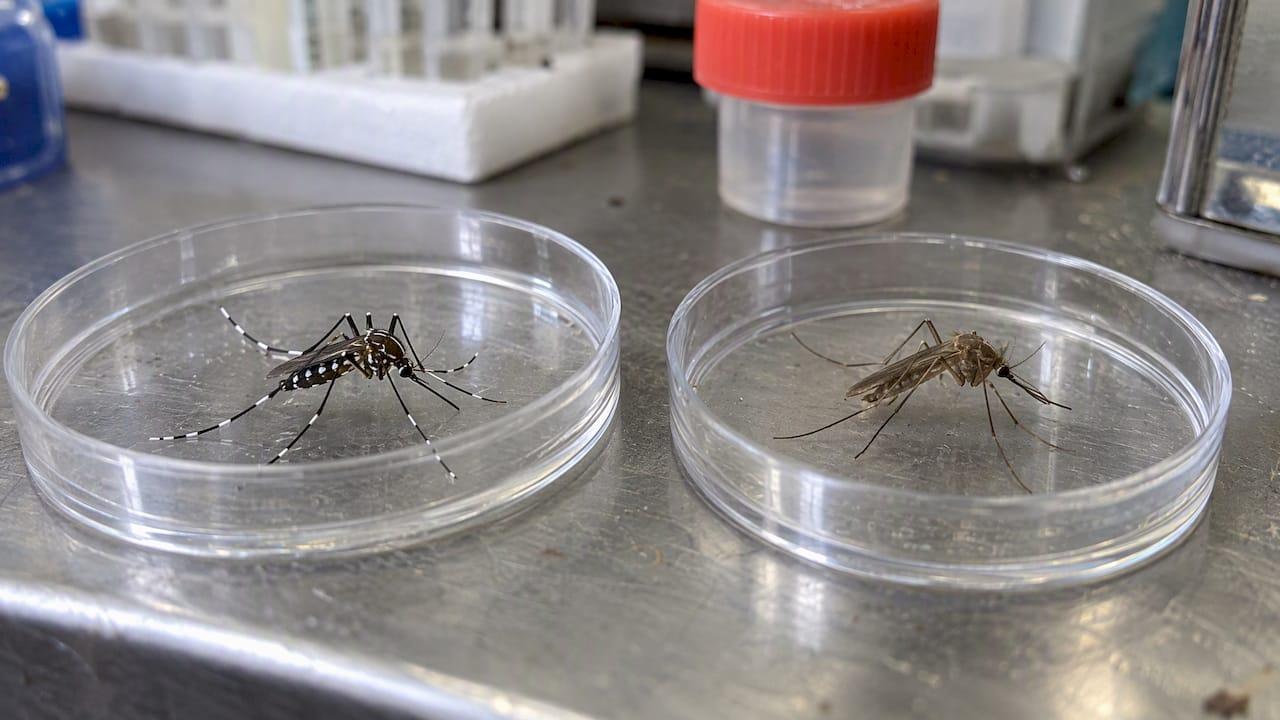
The quickest way to separate the two is by stripes and by the clock. Aedes mosquitoes have black-and-white striped bodies and legs and usually bite in the daytime. Culex mosquitoes are plain greyish-brown to dark and bite at night. In Singapore the difference matters because Aedes is the genus behind dengue, while the Culex species found here are not linked to locally endemic mosquito-borne disease. Below we explain how to identify each one, where each breeds, what risk each carries and what you can do about it at home or on site.
TL;DR
- Look: Aedes has white stripes on the body and legs. Culex is greyish-brown to dark with no bold pattern.
- Bite time: Aedes bites mainly by day, though it may bite at night in lit areas. Culex bites at night.
- Breeding: Aedes uses small containers of stagnant water. Culex favors blocked drains and, depending on species, dirty or clear water.
- Risk in Singapore: Aedes aegypti is the main dengue vector. The diseases listed for Culex, Japanese encephalitis and filariasis, are not endemic here.
- Action: Remove stagnant water weekly with the B-L-O-C-K steps and call a licensed pest control provider if breeding keeps returning.
Table of Contents
- Aedes vs Culex at a glance
- How to identify an Aedes mosquito
- How Culex looks and behaves
- Breeding sites: where each one starts
- Biting patterns: day versus night
- Health risks in Singapore
- What to do about Aedes at home
- What to do about Culex
- Construction sites and managed properties
- Other efforts you may hear about
- Our perspective
- When to call a professional
- FAQ
- Sources
Aedes vs Culex at a glance
The table sums up what the National Environment Agency (NEA) says about the two groups, using the species most people meet in Singapore: Aedes aegypti, Aedes albopictus and Culex quinquefasciatus.
| Feature | Aedes | Culex |
|---|---|---|
| Appearance | Black body with white stripes on body and legs | Greyish-brown to dark; C. quinquefasciatus is golden-brown with a dark proboscis |
| Abdomen shape (field key) | Pointed | Rounded |
| Main biting time | Daytime, sometimes at night in lit areas | Night |
| Egg laying | Eggs laid singly | Eggs laid in rafts on the water surface |
| Typical breeding sites | Containers holding clean stagnant water | Blocked drains; dirty or clear water depending on species |
| Diseases linked | Dengue, Zika, chikungunya | Japanese encephalitis, filariasis (not endemic in Singapore) |
Sources for the table: the NEA overview of Singapore's mosquito landscape, the NEA mosquito and mosquito-borne disease guide and the ECDC identification key for the abdomen shape.
How to identify an Aedes mosquito
If you want to identify an Aedes mosquito, start with the legs and the back. NEA describes Aedes as having white stripes on the body and legs, which gives it a distinctly banded look compared with the dull colors of Culex. You will not usually see this from a distance, so a mosquito that has landed on a wall or your arm is easiest to judge.
Two Aedes species matter in Singapore, and the pattern on the thorax (the back, behind the head) tells them apart:
- Aedes aegypti: two silvery-white stripes on the thorax, curving in a lyre shape. Per NEA's landscape overview, it is the primary dengue vector in Singapore.
- Aedes albopictus: one distinct white stripe down the middle of the back. It is often called the Asian tiger mosquito.
Some practical cues help when you cannot look closely:
- Time of day. A striped mosquito biting you in the morning or afternoon is very likely Aedes.
- Where it bites. Aedes often goes for ankles and lower legs, so a bite while you sit at a desk or in a living room with the lights on is a hint.
- Where you find it. Mosquitoes hovering around plant pots, bathrooms and shaded corners of the home point to container breeding nearby.
Identification by eye is only a guide. NASA's public health material notes that people cannot easily tell whether an individual mosquito is carrying a disease, which is why community-level data and habitat mapping matter more than guessing from a single insect. Treat every Aedes as a potential dengue carrier and deal with the breeding source.
How Culex looks and behaves
Culex mosquitoes are less showy. NEA describes them as greyish-brown to dark, without the bold white banding of Aedes. Culex quinquefasciatus, the southern house mosquito, is golden-brown with a dark proboscis. Under a magnifier, the ECDC's identification key points to a rounded abdomen in Culex versus a pointed one in Aedes.

Culex is a night biter. You are most likely to meet it when you are sleeping or sitting outdoors in the evening, particularly near drains, ponds or drainage channels. NEA's guide says Culex typically bite at night, a pattern that is consistent with the LTA Vector Control Guidebook's description.
Bites from Culex usually cause itching and a red bump, though reactions vary from person to person. A bite alone does not tell you which mosquito did it, so use the time of day and the location as clues.
Breeding sites: where each one starts
This is the difference that decides what you should do. Mosquitoes cannot breed without standing water, and each group chooses a different kind.
Aedes: small, clean containers
Aedes aegypti breeds in clean stagnant water in domestic containers, which means the places inside and around your home. Aedes albopictus breeds outdoors, in discarded containers and in natural sites such as tree holes or leaf axils. According to the gov.sg dengue explainer, Aedes aegypti has adapted to live in urban residential areas close to people, which raises the dengue risk in those zones. The same page notes that dengue risk is lower in forested and green spaces, where Aedes albopictus is more common, than in residential estates.
Aedes lays its eggs singly, according to NEA, rather than in a clump. That makes eggs hard to see and means a dry container can still hold eggs on its walls. Wiping the inside of a vase or pot, not just emptying it, is the sensible habit.
Common household spots include:
- Plant pot plates and flower vases
- Air-conditioner drip trays and water dispensers
- Bathroom floor traps and bucket bases
- Roof gutters and covered drains that hold water
- Discarded cups, tins and tyres outside
Culex: drains and polluted water
Culex breeds in blocked drains, and depending on species, either in dirty, organically polluted stagnant water or in clear water, as the NEA guide states. Culex lays its eggs in rafts that float on the surface of the water, which you can sometimes see as a small dark cluster.
Typical Culex locations are:
- Choked roadside and compound drains
- Sumps, septic tanks and unmaintained water features
- Construction site pits, trenches and puddles
- Poorly drained roof surfaces
The takeaway: if mosquitoes bother you indoors by day, look for small containers. If they bother you at night near a drain or outdoors, look at drains and larger bodies of dirty water.
Biting patterns: day versus night
NEA's overview states that Aedes usually bite during the day and may also bite at night in lit areas, while Culex bite at night. The result is that no part of the day is fully free of mosquitoes.
- Morning and late afternoon: Aedes activity is the main concern, in stairwells, corridors and covered carparks as well as parks.
- Evening and night: Culex becomes the more likely biter, and Aedes can still bite where lights are on, such as a lit balcony or a shop front.
For a household this means a night-time net or fan protects against Culex, but daytime dengue protection relies on repellent and on removing breeding sites.
Health risks in Singapore
The disease picture is where the comparison matters most.
Aedes. Aedes aegypti is Singapore's primary dengue vector and also transmits Zika. Aedes albopictus transmits dengue and chikungunya. These are the infections that residents and property managers actually plan around.
Culex. NEA lists Japanese encephalitis and filariasis for Culex, and notes that neither is endemic in Singapore. That does not make Culex harmless as a nuisance, but it explains why national campaigns focus on Aedes.
For context, an academic review of Singapore's mosquito fauna records 182 mosquito species in the country, about 25 of them known or potential vectors, with nine recognized as vectors in Singapore. So Aedes and Culex are only two of many groups, but they are the two you will meet at home.
As for the often-asked "deadliest mosquito" question, NASA's public health material says mosquitoes as a group cause more human deaths worldwide than any other animal. That is a statement about the group, not about one species, and in Singapore the one that deserves your attention is Aedes.

What to do about Aedes at home
Because Aedes breeds close to where you live, prevention starts in your own flat or house. The official programme is called B-L-O-C-K, and the gov.sg explainer says regularly removing stagnant water on your premises effectively prevents Aedes breeding. Do it weekly:
- Break up soil: loosen the soil in potted plants so water does not collect.
- Lift and empty: lift flowerpot plates and empty them.
- Overturn: turn over pails and wipe the rims of containers.
- Clean: clean the roof gutters and the water-holding bases of household items.
- Keep: keep the floor traps and drains free of blockage.
This list mirrors what the official programme asks for, and we go through the weekly routine in more detail in our guides on stopping dengue at home with B-L-O-C-K and S-A-W and 10 weekly actions to prevent dengue.
Protecting yourself outdoors
In dengue cluster areas or green spaces, the same gov.sg page advises the Spray, Apply, Wear (S-A-W) actions: spray insecticide in dark corners, apply repellent, and wear long-sleeved, light-colored clothing. Reapply repellent as the label directs, and check the label for use around children, pregnant women or anyone with a medical condition, or ask a pharmacist or doctor.
What to do about Culex
Culex control is mostly about drainage. Keep drains flowing, clear leaves and debris, cover or empty water that sits for days, and fix areas where water ponds after rain. Screens on windows and doors and a fan or net at night cut down indoor bites. If your compound drains are blocked or you manage a larger area such as a condominium, a regular inspection routine is the practical answer, and our weekly mosquito calendar for Singapore condos sets out which tasks fall to managers and which to residents.
Construction sites and managed properties
Sites and estates face both mosquitoes at once: containers and tarpaulins for Aedes, trenches and drains for Culex. The LTA's Vector Control Guidebook sets out that contractors are required to carry out vector control at LTA construction sites. If you manage a site, our NEA audit-ready checklist for construction mosquito control turns that duty into a practical routine. For MCSTs, our note on weekly pest checks and liability covers the management side.
In all these settings, the useful records are simple: dated inspections, photos of problem spots, what was removed and what was treated. They help you spot repeat breeding places and show that checks were done.
Other efforts you may hear about
You may have heard of Wolbachia mosquito releases. This is a national programme aimed at reducing Aedes numbers, and it is no replacement for weekly checks at home. We summarize what residents should still do in our article on Wolbachia and Aedes reduction in Singapore.
Our perspective
We see the same pattern in homes, offices and sites across Singapore: people notice the mosquito, but the problem is the water. Telling Aedes from Culex is useful because it points you to where to look. Striped and biting by day means small containers close to where people live. Dark and biting at night means drains and larger bodies of water.
Our approach is built on integrated pest management (IPM). We inspect first, find the breeding sources, remove or correct them, and only then treat, using non-toxic, eco-friendly methods that put the safety of people and pets first. Our technicians are NEA-licensed, and we use technology such as thermal imaging in inspections.
We do not think a one-off spray is the answer to repeat mosquito problems. A properly planned inspection and maintenance routine, combined with the weekly habits residents already know, is what keeps numbers down. That is why we offer one-time treatments as well as ongoing maintenance contracts, and why we are available 24/7 when a problem cannot wait.
Bespoke-Enviro Services
When to call a professional
Weekly checks stop most breeding in a home. Call a licensed provider when:
- Mosquitoes keep returning even though you empty and wipe containers weekly
- You cannot reach or see the source, such as roof gutters, ceiling voids or shared drains
- You manage a condominium, commercial building or construction site and need documented inspections
- A dengue cluster has been reported near your home or workplace
We provide inspection-led mosquito prevention for homes, businesses, property managers and construction sites. Our general pest control service covers mosquitoes alongside cockroaches, flies and other common pests, using non-toxic treatments designed to be safe for people and pets.

Tell us about the property, whether it is a flat, an office or a site, and we will plan an inspection and a maintenance schedule that fits. You can reach us through the Bespoke Enviro Services site.
FAQ
Which is more dangerous in Singapore, Aedes or Culex?
Aedes. Aedes aegypti is Singapore's primary dengue vector and also transmits Zika, while Aedes albopictus transmits dengue and chikungunya. The diseases listed for Culex, Japanese encephalitis and filariasis, are not endemic here, so Aedes is the one that drives public health action.
How can I tell an Aedes bite from a Culex bite?
You usually cannot tell from the bite alone, since reactions vary between people. Time and place are better clues. A bite during the day, often on the ankles, points to Aedes, while a bite at night, especially near drains, points to Culex.
Do Aedes mosquitoes only bite during the day?
Mostly, but not only. NEA says Aedes usually bite by day and may also bite at night in lit areas. Keep using repellent and removing breeding sites rather than relying on the time of day.
Where do Aedes and Culex lay their eggs?
Aedes lays eggs singly in containers of clean stagnant water, indoors or outdoors. Culex lays eggs in rafts on the water surface, commonly in blocked drains or in dirty or clear standing water depending on the species.
Is the Aedes mosquito the same as the tiger mosquito?
The name usually refers to Aedes albopictus, which has a single white stripe down its back. Aedes aegypti, the main dengue vector in Singapore, has two silvery-white stripes in a lyre shape. Both are Aedes and both can carry dengue.
Sources
- Understanding Singapore's Mosquito Landscape, NEA
- Mosquitoes and mosquito-borne diseases, NEA
- Stop Dengue Now with B-L-O-C-K, gov.sg
- Mosquitoes (Diptera: Culicidae) of Singapore: Updated Checklist
- Vector Control at LTA Sites, LTA Vector Control Guidebook
- Mosquito-related disease and MHM app, NASA
- Reverse identification key for mosquito species, ECDC