
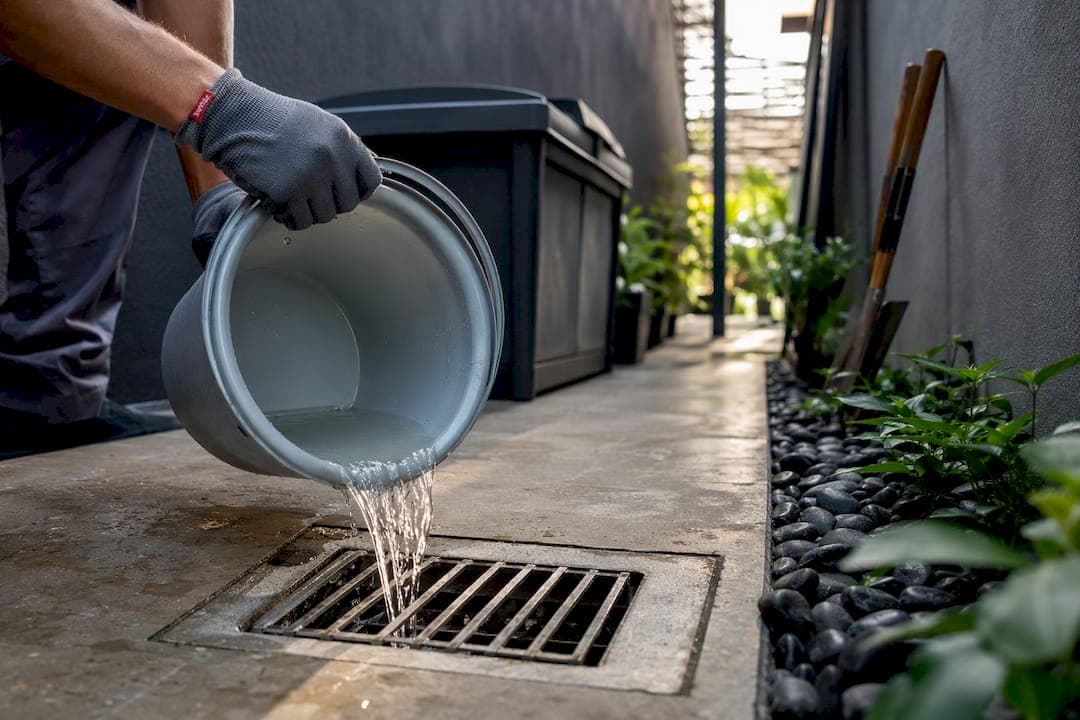
Source reduction means finding and permanently removing or altering the water-holding spots where mosquitoes breed, rather than spraying after adults appear. It works because it targets the larval stage, before mosquitoes exist at all. The single most effective action you can take this week is a walk around your property to empty, invert, or cover every container holding standing water and to clear your gutters. Doing this consistently cuts your reliance on chemical treatments dramatically.
TL;DR:
- Source reduction is most effective when targeting small, artificial breeding containers near homes, such as plant saucers, buckets, and discarded tires.
- Regular weekly inspections focused on containers, gutters, and low-lying areas can prevent larvae from developing into adult mosquitoes within a week.
- Infrastructure fixes like regrading drainage, repairing gutters, and installing mesh covers on ornamental water features provide long-term mosquito prevention.
- Larvicides like Bti are useful only in accessible and identifiable water sites when physical removal is impossible, and should complement habitat management.
- Community coordination is crucial because mosquitoes can fly only a few hundred meters, so neighborhood-wide efforts prevent re-infestation from unmanaged neighboring sites.
Table of Contents
- What Is Mosquito Source Reduction, and What's the Evidence Behind It?
- Why Species Behavior Changes Your Source Reduction Strategy
- How Do You Inspect and Remove Mosquito Breeding Sites at Home?
- What Infrastructure Fixes Prevent Mosquito Breeding Long-Term?
- When Should You Use Larvicides or Biological Controls?
- How Often Should You Inspect for Mosquito Breeding Sites?
- Why Does Community Coordination Matter for Mosquito Control?
- What Does a Professional Source Reduction Service Actually Do?
- Prioritizing Prevention: A Publisher's Perspective
- Getting Professional Help When Sources Won't Quit
- Sources
- FAQ
What Is Mosquito Source Reduction, and What's the Evidence Behind It?
Source reduction is the practice of identifying and eliminating or modifying water-holding habitats to prevent mosquito larvae from developing into adults. The CDC treats it as the most effective, environmentally responsible component of Integrated Mosquito Management (IMM). The logic is simple once you understand the mosquito life cycle: eggs need standing water to hatch, larvae need days in that water to mature, and pupae need the same water to become adults. Break that chain at the water stage, and you never have to fight the adult mosquito at all.
This is different from what most people picture when they think of mosquito control. Fogging trucks and yard sprays kill adult mosquitoes that already exist, and they do it temporarily. Source reduction removes the nursery. It's the difference between mopping up a leak and fixing the pipe.
Within the broader framework of integrated pest management, source reduction sits at the top of the priority list. The EPA defines IPM as a prevention-first, science-based approach that reduces pesticide reliance by managing the conditions, water, food, and shelter, that let pests thrive in the first place. Mosquitoes are a textbook case, because unlike cockroaches or rodents, their entire early life depends on one resource you can control directly: standing water.
The evidence supporting this approach is not anecdotal. A few consistent findings show up across program guidance and research:
- The WHO's operational manual on larval source management identifies container and waste management, environmental modification, and biological control as the core practical activities that reduce Aedes and Anopheles populations at scale.
- Peer-reviewed research on household behavior found that covering containers, discarding debris, and routine outdoor cleaning measurably improved household-level mosquito management, according to a study published in PMC.
- Vector-control specialists increasingly recommend shifting resources from reactive adulticide spraying toward proactive habitat modification paired with routine monitoring, a stance the CDC's own IMM guidance reflects.
- Integrated approaches that combine habitat modification with ongoing monitoring produce more durable reductions in mosquito numbers than insecticide use alone, per EPA program reviews.
For readers managing a single home, this translates into a clear priority order: inspect and modify first, treat with larvicide only where modification isn't possible, and reserve adult mosquito treatments for genuine emergencies. Our guide on integrated pest management principles walks through how that hierarchy applies across pest categories, not just mosquitoes.
Why Species Behavior Changes Your Source Reduction Strategy
Not all mosquitoes breed the same way, and that distinction changes what you should actually inspect. Aedes aegypti and Aedes albopictus, the species behind dengue, Zika, and chikungunya transmission, prefer small, artificial containers close to human dwellings. Think plant saucers, discarded bottle caps, clogged gutters, and buckets left in a corner. Other mosquito genera, like Culex and Anopheles, tend toward larger, more natural bodies of water: ditches, marshes, ponds, and slow-moving streams.
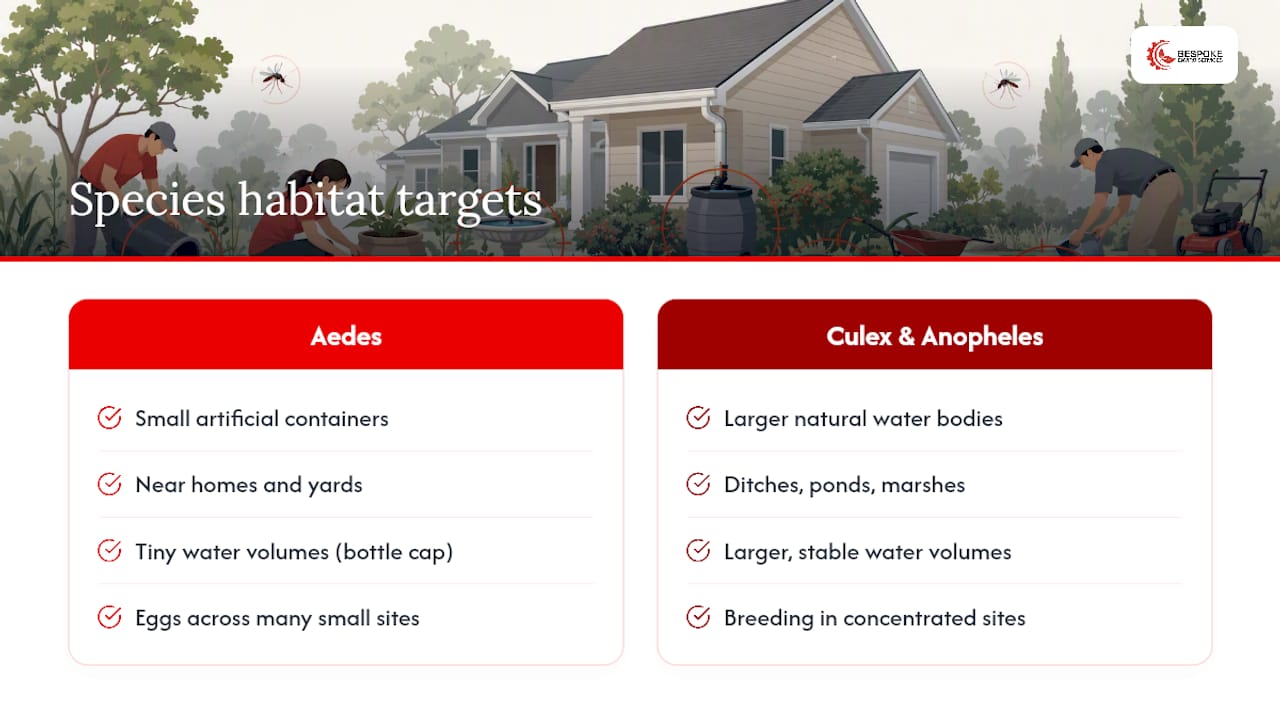
This matters because it determines where your effort should go. If your neighborhood's disease risk comes primarily from Aedes species, spending a weekend clearing a large drainage ditch does far less good than spending twenty minutes checking every flowerpot saucer on your patio. Aedes mosquitoes don't need much. Research on mosquito microhabitats shows that even a bottle cap's worth of water, left undisturbed for a week, can produce viable adult mosquitoes, according to findings on mosquito ecology and microhabitats. That's part of why these species have adapted so successfully to dense urban and suburban environments: humans unknowingly manufacture their breeding sites by the dozen.
A single female Aedes mosquito can lay eggs across multiple small containers in one breeding cycle, spreading her offspring's risk rather than concentrating it in one location. This is why practitioners describe Aedes control as a numbers game of many small sites rather than one large source.
The public-health payoff of removing these sites is direct. Fewer breeding sites means fewer adult mosquitoes emerging within their typical flight range, usually a few hundred meters from where they hatched. Fewer adults means fewer bites, and fewer bites means lower transmission risk for the diseases these species carry. Singapore's National Environment Agency frames source reduction as the foundation of its dengue-prevention strategy precisely because of this dynamic.
Source reduction has real limits, though. When breeding habitats are spread across a wide landscape, hidden underground in stormwater systems, or located on neighboring properties you don't control, household-level effort alone won't solve the problem. Widespread, cryptic, or landscape-scale habitats, flooded construction pits, blocked public drains, abandoned lots, require either engineering intervention or coordinated community and municipal action. That's the point where individual vigilance needs backup, a theme worth keeping in mind as you work through your own property.
How Do You Inspect and Remove Mosquito Breeding Sites at Home?
A thorough household check takes about 30 minutes once you know where to look. Mosquitoes don't need a pond. They need roughly the volume of water you'd find in a bottle cap, held still for about a week.
Work through your property in this order:
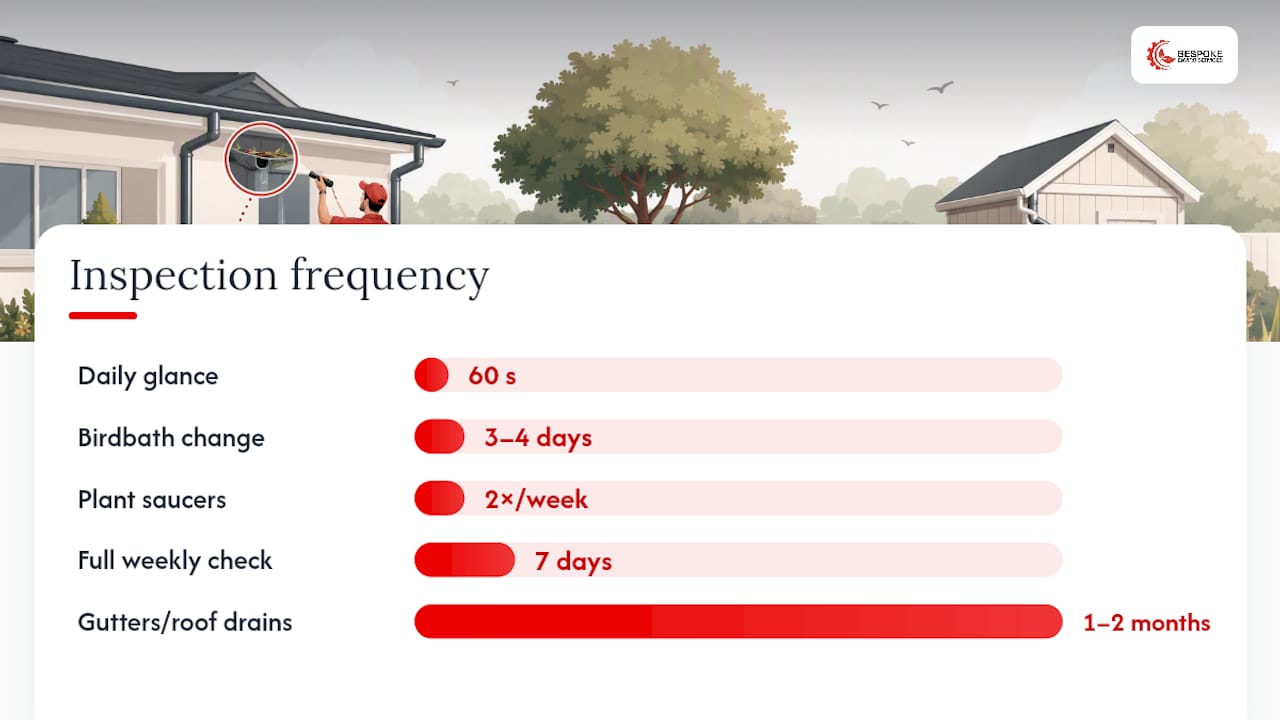
- Check every plant saucer and vase. Empty and dry them at least twice a week, or fill saucers with sand so water drains through instead of pooling.
- Clear gutters and roof drains. Leaves and debris create small dams that hold water for days; clean gutters every one to two months, more often during rainy seasons.
- Inspect buckets, tires, and outdoor toys. Store these upside down or under cover; a discarded tire alone can produce hundreds of mosquitoes per season if left exposed to rain.
- Empty pet water bowls and refill with fresh water daily. Stagnant bowls left more than a few days become viable breeding sites, especially in warm climates.
- Check air-conditioning drip trays and condensate lines. These are commonly overlooked because they're small and out of sight, but they hold water constantly during use.
- Look at ornamental containers, birdbaths, and rain barrels. Change birdbath water every three to four days; screen rain barrels with fine mesh at every opening.
- Walk the perimeter for clogged drains or low spots. Any depression that holds water more than four to five days after rain needs regrading or filling.
- Inspect flat roofs and tarps. Sagging tarps and flat roof sections pool water invisibly; tighten tarps and check roof drainage after storms.
Once you've found a site, you have four real options: empty it, invert it so it can't collect water, seal it permanently, or modify it so water drains rather than sits. For containers you can't discard, drilling drainage holes in the base is often the simplest permanent fix. For decorative items you want to keep dry-stored, flip them over between uses rather than leaving them right-side up "just in case."
A weekly routine works better than sporadic deep cleans. Set a recurring 15 to 20 minute check, ideally the same day each week, tied to trash day or another habit you already have. Between full checks, a 60 second daily glance at obvious containers (pet bowls, plant saucers exposed to rain) catches problems before they become week-old breeding sites. Our 7-day IPM plan for homeowners breaks this cadence down further if you want a printable schedule, and the weekly dengue-prevention checklist covers additional household habits worth building in.
Pro Tip: Keep a roll of fine fiberglass mesh and a handful of stainless washers on hand. Screening rain barrel openings and gutter down spouts costs under $10 in materials and stops mosquitoes from accessing water you can't practically empty every week.
What Infrastructure Fixes Prevent Mosquito Breeding Long-Term?
Household vigilance handles small containers, but standing water in your landscape or building infrastructure calls for engineering fixes rather than a weekly checklist. These solutions take more upfront effort but need far less ongoing maintenance once installed correctly.
Poor drainage is the most common structural cause of persistent mosquito problems. Any low point in a yard, driveway, or parking area that holds water for more than four to five days after rainfall qualifies as a functional breeding site, whether or not it looks like one. Regrading that area, even a modest slope of one to two percent toward a drain, eliminates the pooling permanently. For larger properties or shared spaces, installing a French drain or connecting to existing storm drainage solves the same problem at scale.
Gutters and downpipes deserve more attention than most property owners give them. A gutter with a slight sag or a clogged downpipe can hold water for weeks without ever overflowing visibly. Inspecting and repairing gutter slope, along with clearing debris every one to two months, prevents this entirely. Storm drains on the property line matter just as much. Grates that trap leaves and slow water flow create the kind of standing pools that go unnoticed because nobody expects to check a drain grate for mosquito larvae.
Ornamental water features present a specific challenge because homeowners want to keep them, not eliminate them. Fortunately, three options coexist well with an active pond or fountain:
- Aeration. Moving water disrupts the still surface mosquitoes need to lay eggs; a basic pump or fountain feature is usually enough.
- Larvivorous fish. Species that feed on mosquito larvae can be stocked in ornamental ponds as a self-sustaining biological check.
- Fine mesh covers. For decorative containers without fish, a mesh cover across the surface blocks egg-laying adults entirely.
Construction sites carry their own version of this problem, often at a larger scale. Excavation pits, stacked equipment, and stored materials all pool water quickly, and turnover on active sites means these hazards can appear and disappear within days. A functional construction-site IPM plan assigns a specific site manager to own mosquito prevention, mandates weekly water checks across the site, and requires drainage or covering of excavated areas that won't be filled within a few days. The CDC's guidance on integrated mosquito management notes that simple engineering modifications, regrading, drain installation, aeration, consistently outperform repeated larvicide applications for durability. Our detailed construction-site pest control guide covers the specific roles and documentation a site manager should maintain.
| Fix | Best for | Maintenance need |
|---|---|---|
| Regrading/drainage | Yards, driveways, low spots | One-time, minimal follow-up |
| Gutter repair | Roof-level water pooling | Every 1 to 2 months |
| Aeration | Ornamental ponds, fountains | Ongoing (equipment check) |
| Larvivorous fish | Fish-safe ornamental ponds | Periodic stocking review |
| Mesh covers | Decorative containers, rain barrels | Check after storms |
| Construction site drainage | Active build sites | Weekly during active phases |
When Should You Use Larvicides or Biological Controls?
Physical removal beats chemical treatment whenever it's possible, but not every water source can be drained, covered, or eliminated. Storm drains, septic systems, and some large or inaccessible water bodies fall into this category, and that's where larval source management (LSM) tools come in.
Bacillus thuringiensis israelensis, known as Bti, is the most widely used biological larvicide for exactly this gap. It's a naturally occurring bacterium that targets mosquito larvae specifically, without harming birds, fish, pets, or beneficial insects, which is why it's approved for use in many drinking water sources. Bti works best in small, findable habitats: storm drains, catch basins, ornamental ponds, and similar sites you can identify and treat directly. It's far less practical across large, open water bodies where consistent coverage becomes difficult.
The CDC's larval management overview lays out the fuller toolkit: environmental modification, draining and filling, larviciding, and biological controls, and notes that effectiveness depends heavily on habitat type and findability. That's a critical distinction. A larvicide applied to a site you can't reliably locate or revisit does little good, since most products need reapplication on a schedule ranging from days to a few weeks depending on the formulation.
Insect growth regulators (IGRs) work differently. Rather than killing larvae outright, they interrupt the molting process so larvae never reach adulthood. These tend to have longer residual activity than Bti in some formulations, which makes them useful for sites that are hard to revisit frequently.
Surface films and oils represent an older technique still in limited use. They work by reducing surface tension, which prevents larvae and pupae from breathing at the water's surface. The trade-off is environmental: these products can affect other aquatic life and oxygen exchange in the water, so they're generally reserved for non-ecologically sensitive sites like industrial catch basins rather than ponds with fish or amphibians.
A few rules of thumb keep these tools in proper perspective:
- Physical elimination or modification should always be attempted first; larvicides are a supplement, not a substitute, for removing the water itself.
- Bti and IGRs are appropriate for sites you can identify, access, and revisit on a set schedule.
- Surface films carry higher environmental trade-offs and belong in non-sensitive, engineered water systems only.
- Any larvicide application near drinking water, aquaculture, or protected wetlands should follow product labeling exactly and, where required, local regulatory approval.
LSM effectiveness tracks directly with habitat type: large, fixed water bodies respond best to environmental modification, while small, transient containers are better handled through repeated household maintenance and neighborhood-level action, according to the WHO's operational LSM manual. In practice, that means a homeowner rarely needs larvicide at all if the household checklist is followed consistently. Larvicide use tends to concentrate at the community and municipal level, where the water sources are bigger, less accessible, and shared.
How Often Should You Inspect for Mosquito Breeding Sites?
Consistency matters more than intensity when it comes to monitoring. A single thorough inspection followed by months of neglect accomplishes far less than short, regular checks, because Aedes mosquitoes can complete their larval stage in as little as seven days under warm conditions.
For a typical single-family home, a weekly walk-through covers the essentials: containers, gutters, and any low-lying areas. Apartment blocks and condominium complexes need more frequent attention because of shared common areas, roof drains, void decks, and landscaping that no single resident is responsible for; a biweekly or even weekly inspection by building management is a reasonable standard. Construction sites need the tightest schedule of all, given how quickly excavation and material storage generate new water sources; weekly checks during active construction phases, increasing to twice weekly during rainy seasons, is a defensible baseline.
Keeping a simple inspection log turns scattered effort into a trackable pattern. At minimum, a useful log includes:
| Field | What to record |
|---|---|
| Location | Specific spot (e.g., "rear gutter, north side") |
| Date | Date of inspection |
| Positive container | Yes/No, water present with larvae |
| Larvae count | Rough estimate (low, moderate, high) |
| Action taken | Emptied, treated, regraded, flagged for repair |
| Next check | Scheduled follow-up date |
A record like this does two things. It documents that you're following through, which matters if a property manager or health authority ever asks about your building's pest history. It also reveals trends before they become infestations. If the same container tests positive three weeks running despite being emptied, that's not bad luck, it's a sign the site needs a permanent fix, not a repeated temporary one.
Action thresholds give that trend data a purpose. A common rule of thumb: if the same location produces mosquito larvae in two or more consecutive inspections despite intervention, escalate to a professional service rather than continuing the same manual approach. Isolated, one-off findings that you resolve immediately don't need escalation. Repeated findings at the same site do. Using thresholds this way keeps pesticide use targeted and infrequent, applying it only where physical fixes have already failed, which lines up with the EPA's broader case for prevention-first pest management.
Why Does Community Coordination Matter for Mosquito Control?
Your own yard can be spotless and you'll still get bitten if the property next door has a clogged gutter or an uncovered rain barrel. Aedes mosquitoes typically fly only a few hundred meters from where they hatch, which means a single unmanaged breeding site within that radius can undo an entire block's worth of individual effort. This is the core argument behind community-level source reduction: it only works when it's collective.
Organizing a neighborhood cleanup doesn't require a formal program. A useful checklist for a community effort includes:
- Walking common areas (playgrounds, void decks, vacant lots) the same way you'd inspect your own yard.
- Identifying repeat offenders, properties with visibly neglected containers or standing water, and approaching owners directly before escalating.
- Coordinating with building management or a residents' committee to schedule shared-area checks on a recurring basis, not just after a dengue cluster is announced.
- Distributing simple printed reminders (in multiple languages where relevant) about container checks, since not every resident reads the same channels.
When a source persists despite reasonable outreach, especially on vacant land, abandoned properties, or public infrastructure, escalating to municipal or public health authorities is the appropriate next step rather than continued informal requests. Singapore's NEA and similar agencies elsewhere maintain reporting channels specifically for this purpose, and persistent, documented complaints tend to get faster action than one-off calls.
Property managers and schools carry a heavier version of this responsibility, since they're accountable for shared spaces used by dozens or hundreds of people. Regular scheduled inspections, clear internal reporting lines, and a documented response process protect against the liability of a preventable outbreak. Our piece on community dengue control efforts covers how population-level interventions complement, but don't replace, this kind of grassroots vigilance.
What Does a Professional Source Reduction Service Actually Do?
Persistent, cryptic, or large-scale breeding sources eventually outpace what a household checklist can solve, and that's the point where a professional IPM service earns its keep. The value isn't in some secret technique homeowners can't access; it's in the systematic process behind finding and fixing sources that keep getting missed.
A typical professional engagement follows a consistent structure:
- Risk assessment. A technician walks the entire property, indoors and out, identifying both obvious and cryptic water-holding sites, including ones a homeowner wouldn't think to check.
- Prioritized fixes. Findings get ranked by risk and feasibility, structural drainage issues first, minor container fixes second, so the highest-impact work happens first.
- Documentation. Photo records and written inspection logs create a baseline you can compare future visits against, catching rebound sites before they become active again.
- Scheduled follow-up. Rather than a single visit, an ongoing maintenance contract builds in periodic rechecks aligned to your property's specific risk pattern and seasonal rainfall.
This kind of documented, recurring process is what separates professional IPM from a one-time spray. It reduces long-term reliance on chemical treatment because most of the work is physical: fixing drainage, sealing containers, correcting the structural issues that keep producing new breeding sites season after season. Our overview of eco-friendly pest control methods covers how this prevention-first approach applies across pest categories beyond mosquitoes.
Prioritizing Prevention: A Publisher's Perspective
We built our approach around a fact most pest control marketing conveniently skips: spraying is the least durable solution available, and it's the one most companies lead with because it's the easiest to sell. Non-toxic, engineering-based source reduction takes more upfront diagnostic work. It also produces results that last months or years instead of days.
We've seen the pattern play out consistently. A property with a persistent mosquito problem almost always has one or two structural culprits, a sagging gutter, a low spot that never quite drains, a decorative pond nobody thought to aerate, doing most of the damage. Fix those, and the weekly maintenance checklist becomes almost unnecessary. Skip that diagnostic step and treat symptoms with spray instead, and the same complaint calls come in every few weeks, indefinitely.
The uncomfortable truth for homeowners is that most mosquito problems are self-inflicted, not through negligence, but through blind spots. Nobody thinks to check an air-conditioning drip tray. We think prevention deserves the same routine status as checking smoke detector batteries. And when a source turns out to be bigger than a weekend project, that's exactly when it makes sense to bring in a professional set of eyes rather than repeating a fix that isn't holding.
— Bespoke-Enviro Services
Getting Professional Help When Sources Won't Quit
Some breeding sources resist every household fix: a drainage problem that needs regrading equipment, a construction site generating new water pools faster than one person can track, or a recurring infestation that keeps returning despite your best weekly routine. That's the gap Bespoke-enviro is built to close. Where a checklist runs out of reach, we bring the structural fixes, monitoring tools, and follow-through that make the difference permanent instead of temporary.

A typical engagement with us starts with a full property inspection, indoors, outdoors, and any structural blind spots a homeowner would reasonably miss. From there, we prioritize fixes by risk and feasibility, document everything with photo records and inspection logs, and build a maintenance schedule around your property's actual risk pattern rather than a generic calendar. The technicians use methods that prioritize safety for people and pets during treatments. The company offers availability for urgent mosquito source reduction services.
If you're dealing with a mosquito problem that's outlasted your own efforts, or you manage a property where you can't afford to guess, request an inspection through our General Pest Control Services page and we'll help you find exactly where the water is hiding.
Sources
The recommendations throughout this guide draw on a small set of authoritative program manuals and studies worth bookmarking directly.
- Integrated Mosquito Management | CDC
- WHO operational manual on larval source management (LSM)
- What Is Integrated Pest Management? | EPA
- Source reduction with a purpose: Mosquito ecology and community perspectives
- Source reduction is key | NEA
FAQ
What Is the Best Way to Reduce Mosquito Populations?
The most effective method is source reduction, removing or permanently modifying every water-holding site where mosquitoes can breed, rather than relying on spraying adults after they've already emerged. The CDC identifies this as the core component of Integrated Mosquito Management because it interrupts the life cycle at its most vulnerable point. Pairing weekly household inspections with community coordination on shared spaces produces the most durable results.
What Is Source Reduction in Dengue Prevention?
In dengue prevention, source reduction means eliminating the small, artificial containers, plant saucers, buckets, discarded tires, that Aedes aegypti and Aedes albopictus mosquitoes prefer for breeding. Singapore's National Environment Agency treats this as the foundation of its dengue-control strategy, since these are the specific species responsible for transmission.
Why Does O+ Blood Type Attract Mosquitoes?
Research on mosquito attraction to blood type is mixed and far from conclusive, and no major public health body treats blood type as an actionable factor in mosquito control. Skin bacteria, carbon dioxide output, body heat, and sweat composition are far better established attractants, and none of them can be changed the way a breeding site can be eliminated. Focus your effort on source reduction, which is the variable you actually control.
What Is a Mosquito's Worst Enemy?
From a control standpoint, source reduction is the closest thing mosquitoes have to a true enemy, because it prevents them from ever reaching adulthood rather than fighting them after the fact. Biologically, larvivorous fish and Bti (Bacillus thuringiensis israelensis) are effective natural predators and pathogens for the larval stage specifically. Neither replaces the need to physically eliminate standing water wherever possible.
How Much Does a Professional Mosquito Source Reduction Service Cost?
Pricing depends on property size, the number and complexity of breeding sites, and whether ongoing maintenance is included. Bespoke-enviro's current rates for general pest control services are available directly through a quote request, since every property's inspection findings differ.