
The most effective way for Singapore residents to reduce dengue risk is an integrated approach: weekly household source reduction through B-L-O-C-K, consistent personal protection with DEET, picaridin, or IR3535 and window screens, and active participation in NEA programmes like Project Wolbachia and Gravitrap surveillance. No single tactic works alone. When breeding sites are inaccessible or a cluster keeps recurring near your home, that is the signal to call in a professional pest control team.
TL;DR:
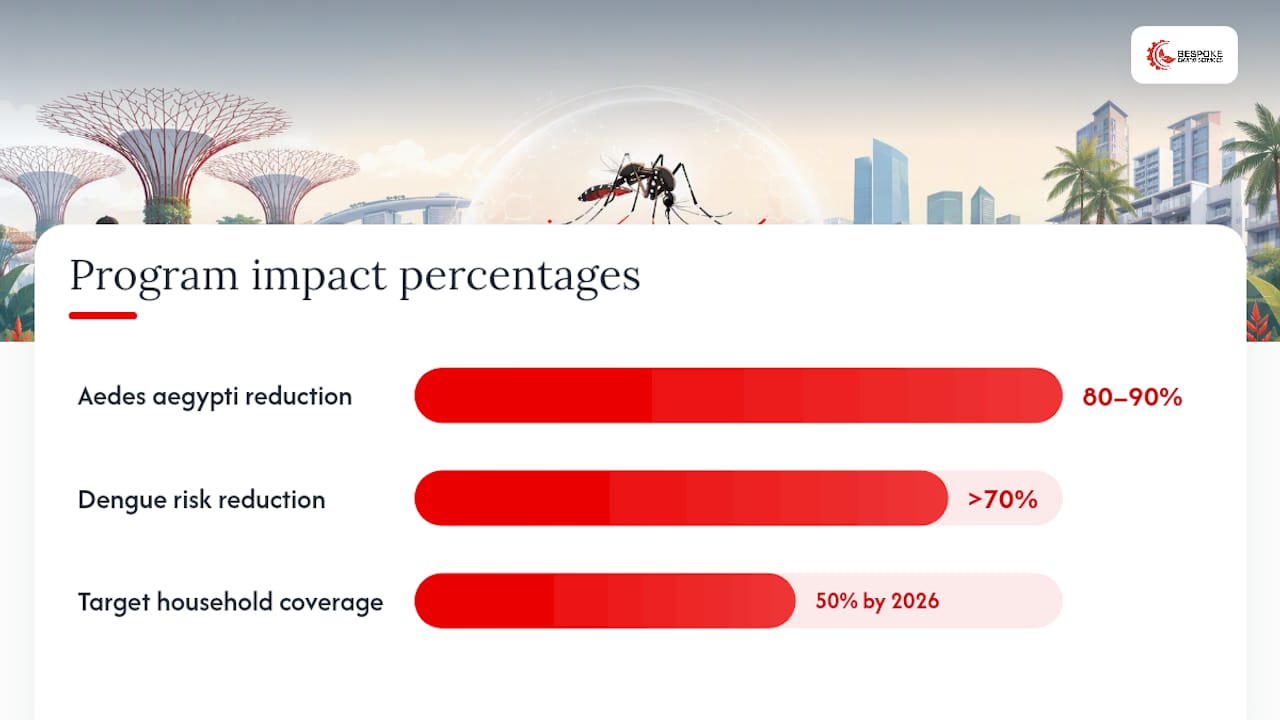
- Wolbachia mosquito releases reduce Aedes aegypti populations by 80–90%, with a goal to cover half of Singaporean households by 2026, but do not eliminate other mosquito species.
- Household source reduction, such as weekly checks for standing water and targeted use of biological larvicide, remains essential for controlling breeding sites, especially in hard-to-reach spots.
- Personal protection with effective repellents and physical barriers like window screens and long sleeves is critical, as Aedes mosquitoes bite during daylight hours.
- Professional pest control is recommended for inaccessible breeding sites, structural problems, or recurring clusters, with ongoing follow-up to ensure long-term effectiveness.
- Monitoring neighborhood risk via apps and community alerts helps tailor preventive actions and increases collective household engagement.
Table of Contents
- How Singapore's National Dengue Programmes Actually Work
- Your Weekly B-L-O-C-K and Mozzie Wipeout Routine
- Repellents and Physical Barriers That Actually Reduce Bites
- When DIY Isn't Enough: Calling in Professional IPM
- Tracking Local Risk: myENV, Gravitraps, and Reporting Breeding Sites
- Larvicides, Fogging, and the Outbreak Response Toolkit
- What Years of Inspections Have Taught Us
- Get a Professional Mosquito Inspection From Bespoke-Enviro
- Official Guidance and Studies Worth Reading
- Sources
How Singapore's National Dengue Programmes Actually Work
We think most residents underestimate how much of Singapore's dengue defense happens before a single mosquito ever reaches a bedroom window. The National Environment Agency runs a layered national system, and understanding how it operates helps you see where your own weekly effort fits in.
Project Wolbachia – Singapore is the centerpiece. NEA releases male Aedes aegypti mosquitoes carrying Wolbachia bacteria into targeted estates. These males mate with wild females, but the resulting eggs don't hatch, which suppresses the local mosquito population over time. Field results have been striking: NEA reports 80–90% reduction in Aedes aegypti populations at release sites, along with more than 70% lower dengue risk among residents in the study areas. NEA is expanding coverage with a goal of reaching half of all households by the end of 2026.
Here's what that means practically for you:
- Wolbachia suppression takes three to six months to build up in a release area, so it is not a rapid outbreak response tool.
- The technology only targets Aedes aegypti, the primary dengue vector in Singapore; it does not affect Aedes albopictus or other mosquito species that may still bite you.
- Coverage rolls out by estate, so your block might not be in an active release zone yet even if a neighboring one is.
- Wolbachia reduces the mosquito population baseline; it does not replace the need to clear standing water in your own home.
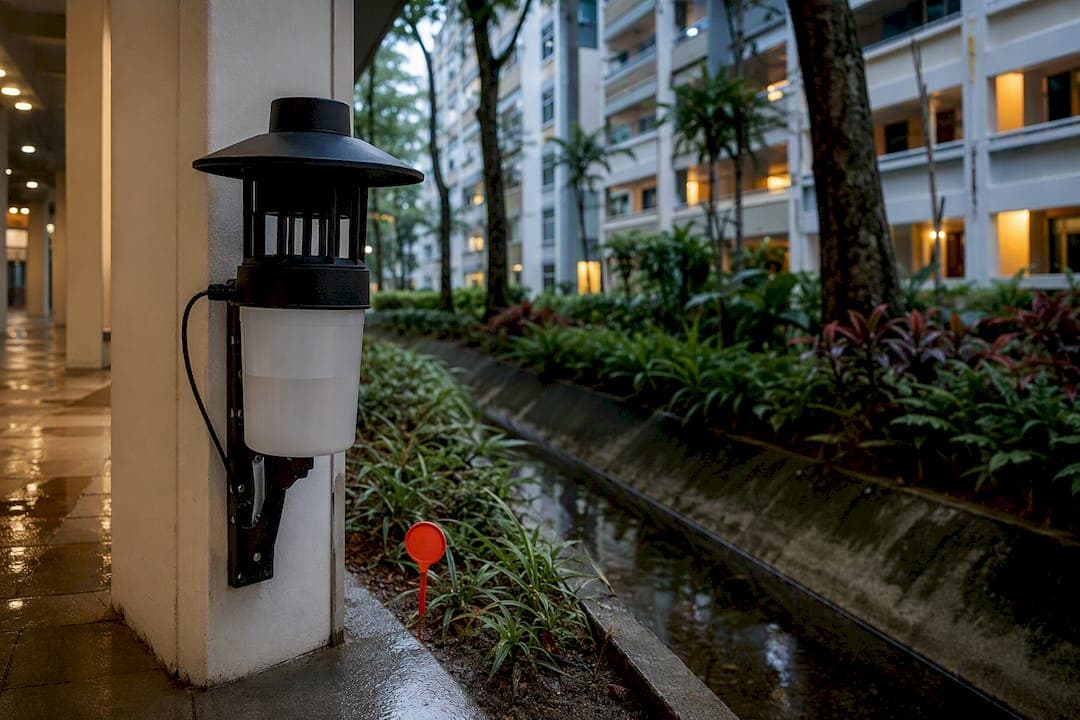
Alongside Wolbachia, NEA runs a nationwide Gravitrap network. These are simple black cylindrical traps placed throughout housing estates that capture female mosquitoes attempting to lay eggs. The data feeds directly into surveillance dashboards that help NEA identify where mosquito populations are climbing before a cluster of human cases even appears. When enough overlapping dengue cases turn up within a defined radius and timeframe, NEA declares a dengue cluster, which triggers intensified inspections, targeted larviciding, and public alerts for that specific neighborhood.
A peer-reviewed synthesis of Singapore's decades-long dengue program makes a point worth repeating: integrated vector control, surveillance, enforcement, and community engagement together explain the country's long-term success, and no single method has proven sufficient on its own. Wolbachia releases and Gravitrap data give NEA the intelligence to act fast, but the agency's own guidance is explicit that household cooperation remains the other half of the equation. Public health experts studying integrated control programs note that Wolbachia works best when it rides alongside persistent community environmental management, not instead of it, since reduced vector populations still depend on residents keeping breeding sites clear.
Your Weekly B-L-O-C-K and Mozzie Wipeout Routine
Ninety percent of dengue prevention in Singapore comes down to a ten-minute weekly habit that most households skip until a cluster notice lands in their lift lobby. NEA's B-L-O-C-K and Mozzie Wipeout framework exists precisely because Aedes mosquitoes breed in still water, and Singapore's climate produces that water constantly, whether from rain, air-conditioning condensation, or a forgotten vase.
Run through this checklist every week, ideally on the same day so it becomes routine:
- Break up hardened soil in flowerpot plates and trays; caked soil traps water just like a container does.
- Lift and clear plants that sit in water-collecting saucers, then flush the tray dry.
- Overturn pails, bottles, and any containers stored outdoors so they can't collect rain.
- Change the water in vases and bowls at least once a week, scrubbing the container sides where eggs stick.
- Keep roof gutters clear of leaves and debris so water doesn't pool after rain.
- Check gully traps and floor drains outside your unit, since these hold water constantly and are easy to overlook.
- Inspect air conditioner drip trays and outdoor condenser units, which collect just enough condensation to matter.
That last point deserves emphasis, because NEA's own toolkit material notes that Aedes mosquitoes can complete their breeding cycle in a puddle no larger than a 20-cent coin. Bamboo pole holders, the rims of potted plant saucers, upturned bottle caps, scupper drains behind bookshelves, and the folds of tarpaulins on construction hoarding all qualify. None of these look like "standing water" at a glance, which is exactly why they get missed week after week.
Pro Tip: Set a recurring phone reminder for the same day every week rather than relying on memory. Mosquito Wipeout checks work because they're routine, not because they're thorough once in a while.
For water features you can't simply empty, such as ornamental fountains, fish ponds, or perpetually damp gully traps, Bti (Bacillus thuringiensis israelensis) is the tool NEA specifically recommends. It's a biological larvicide, sold at local nurseries and gardening shops, that kills mosquito larvae without harming fish, pets, or the people using the water feature. Apply it according to the product label, reapply on the schedule stated (typically every few weeks, since it degrades over time), and avoid using more than directed. It targets larvae, not adult mosquitoes, so it works as prevention rather than an immediate fix for a room full of biting insects.

Repellents and Physical Barriers That Actually Reduce Bites
Source reduction stops mosquitoes from being born. Personal protection is what keeps the ones that are already flying around from biting you, and Singapore's climate makes this a daily habit rather than an occasional precaution.
NEA's guidance points to three active ingredients with a genuine track record: DEET, picaridin, and IR3535. All three are recognized as effective mosquito repellents, and NEA recommends them explicitly for personal protection against dengue vectors. Apply repellent to exposed skin after sunscreen, reapply according to the product's stated duration (heat and sweat shorten how long it lasts), and avoid spraying directly onto broken skin or into eyes.
Aedes mosquitoes are daytime biters, most active in the early morning and late afternoon, which runs against the common assumption that mosquito protection is mainly a nighttime concern. ECDC guidance on dengue vectors confirms this diurnal biting pattern and recommends protection throughout daylight hours, not just at dusk.
Beyond repellent, a few physical habits matter more than most people realize:
- Fit window and door screens in good repair; even a small tear lets mosquitoes in.
- Run air conditioning where possible, since Aedes mosquitoes are less active in cooler, drier air.
- Wear light, loose-fitting long sleeves and pants when spending time outdoors near vegetation or construction sites.
- Use mosquito nets for infants and young children who nap during the day, when Aedes activity peaks.
For pregnant women and young children, choose repellents formulated at pediatric or pregnancy-safe concentrations and check product labeling before use. If someone in your household has a confirmed or suspected dengue infection, protecting them from further mosquito bites during their illness matters just as much as protecting yourself. A mosquito that bites an infected person can pick up the virus and pass it to someone else, so screened rooms and repellent use for the patient help stop that chain.
When DIY Isn't Enough: Calling in Professional IPM
Household diligence handles the breeding sites you can see and reach. It does nothing for the ones you can't, and that gap is where professional pest control earns its place.
A few scenarios should push you toward hiring a licensed operator rather than tackling it yourself:
- Construction sites with pooling water in hoarding, trenches, or stored materials that shift daily.
- Condominium common areas, particularly roof gutters, void decks, and shared drainage that no single resident is responsible for.
- Gully traps, scupper drains, or ceiling voids that are structurally difficult to access or inspect properly.
- A dengue cluster reported within your estate more than once in a short period, which suggests a breeding source hasn't been found.
NEA's own guidance on mosquito control explicitly recommends bringing in a competent pest control operator for habitats that residents can't remove themselves, and this is where integrated pest management, or IPM, differs meaningfully from a one-off spray. An IPM-based inspection maps every potential breeding site on a property, applies targeted Bti where standing water can't be eliminated, recommends structural fixes such as re-grading a drain or resealing a crack, and sets up a monitoring schedule to confirm the problem stays solved. Fumigation is reserved for severe or structural infestations rather than used as a default first step.
If you're evaluating a contractor, ask direct questions before signing anything: What's the full scope of the inspection? Does the quote include follow-up visits, or is it a single treatment? What products are used, and are they safe around children, pets, and food preparation areas? How is Bti application documented?
Pro Tip: A one-time treatment without a follow-up visit rarely solves a recurring mosquito problem in a large property. Ask any contractor how they confirm the treatment actually worked weeks later, not just on the day of service.
Bespoke-enviro applies this same IPM discipline across residential, commercial, and construction sites in Singapore, using targeted, non-toxic methods first and reserving heavier intervention for situations that genuinely need it.
Tracking Local Risk: myENV, Gravitraps, and Reporting Breeding Sites
Knowing whether your neighborhood is in an active dengue cluster changes how seriously you should treat your weekly checks, and Singapore gives residents free tools to find that out in under a minute.
- Download the myENV app and check the dengue cluster map, updated regularly with active cluster locations and case counts by area.
- Note the cluster boundary and case count if you live near or inside one, since this signals NEA has already identified an active transmission risk nearby.
- If a cluster notification affects your estate, increase your Mozzie Wipeout checks to more than once a week and prioritize repellent use for children, elderly household members, and anyone with limited mobility.
- Report any standing water, uncovered containers, or suspected breeding sites you spot in common areas through OneService or directly to NEA, rather than assuming someone else will.
Community platforms tied to the Block Dengue initiative also notify residents when clusters emerge nearby, which tends to prompt a visible uptick in household action, more coordinated checks, faster reporting, and more consistent repellent use among neighbors who might otherwise skip it. That collective response matters more than any individual habit, because a single missed breeding site two doors down can undo a whole block's diligence.
Larvicides, Fogging, and the Outbreak Response Toolkit
When a cluster grows despite household action, NEA escalates to a specific set of operational tools, and it helps to understand what each one actually does before you see a fogging truck outside your block.
Bti, the biological larvicide already mentioned, is the preferred choice for treating water bodies where source reduction isn't feasible, drains, ponds, and ornamental water features. It targets larvae specifically and breaks down without leaving toxic residue, which is why NEA and pest professionals reach for it before chemical alternatives.
Chemical larvicides play a narrower role, generally applied to specific breeding sites that Bti can't reach effectively or where a faster knockdown is needed. Thermal fogging, the visible white mist sprayed in outbreak areas, kills adult mosquitoes on contact but has no effect on eggs or larvae, and its impact lasts only hours. It's a stopgap used during active clusters, not a substitute for removing breeding sites.
A few evidence caveats matter here. A scoping review of dengue vector control in high-income city settings found that most interventions, biocontrol and chemical methods alike, reliably reduce mosquito density but rarely get studied against actual human case counts. WHO guidance echoes this: many vector control measures show clear reductions in mosquito populations without a directly measurable drop in dengue incidence, because human transmission depends on so many overlapping factors. That's not a reason to skip any single measure. It's a reason to keep running all of them together.
What Years of Inspections Have Taught Us
Bespoke-enviro has walked into more properties than we can count where the homeowner insisted they'd checked everywhere, and the breeding site turned up in a spot nobody thinks to look: a bamboo pole holder wedged behind a laundry rack, a scupper drain hidden under a stack of storage boxes, soil crusting in a neglected pot on a common corridor. These aren't exotic hazards. They're ordinary household clutter holding a coin-sized puddle of water.

What separates a property that solves its mosquito problem from one that keeps seeing clusters return isn't the treatment itself. It's the follow-up. A single Bti application or one round of source reduction buys you weeks, not permanence, because new water collects the moment it rains again. That's why we build monitoring into every IPM plan rather than treating an inspection as a one-off event.
None of this replaces what residents do at home. Household vigilance and national programmes like Project Wolbachia handle the vast majority of the risk. Professional intervention exists for the gap those efforts can't reach alone.
— Bespoke-Enviro Services
Get a Professional Mosquito Inspection From Bespoke-Enviro
If your weekly checks keep turning up new breeding sites, or your condo's common areas have drains and voids no single resident can access, that's exactly the gap Bespoke-enviro's inspection teams are built to close.

Our IPM-based approach starts with a full property inspection to map every potential breeding site, followed by targeted Bti application where standing water can't be removed, structural recommendations for chronic problem areas like poor drainage or damaged gutters, and a monitoring schedule that confirms the treatment actually held weeks later, not just on treatment day. We use non-toxic, eco-friendly methods first, reserving fumigation for genuinely severe cases, which matters for households with children, pets, or food preparation areas. For construction sites, condominium common property, and commercial buildings where mosquito breeding tends to hide in spaces no individual resident controls, this kind of structured follow-up is often what finally breaks a recurring cluster.
Request an inspection through our general pest control service page to get a scoped assessment of your property, or explore our fumigation services if you're dealing with a larger structural issue that needs more than targeted larviciding.
Official Guidance and Studies Worth Reading
For readers who want to verify the details covered here or go deeper into the research, start with NEA's own Project Wolbachia programme page and Stop Dengue Now guidance. The peer-reviewed PMC review of five decades of Singapore dengue control offers the clearest picture of why integrated methods work. WHO's dengue fact sheet and ECDC's technical guidance round out the global public health perspective behind Singapore's approach.