
Larviciding is the targeted application of biological or chemical agents to kill mosquito larvae and pupae before they emerge as adults. The main, evidence-backed methods fall into four classes: bacterial larvicides (Bti/Bs), insect growth regulators like pyriproxyfen and methoprene, chemical larvicides such as temephos, and surface oils or films. Used correctly, larviciding works as a surveillance-driven complement to source reduction, never a replacement for it.
TL;DR:
- Larviciding is most effective when targeting fixed, accessible breeding sites confirmed through surveillance rather than applying it routinely.
- Bti and Bs provide short-term control and require frequent reapplications in flushed or exposed water, whereas insect growth regulators like pyriproxyfen work longer in stable habitats.
- Resistance to older chemicals like temephos is growing, so rotating larvicides and integrating source reduction boosts overall control success.
- Application techniques should match habitat characteristics, with handheld methods for small containers and specialized equipment for large or inaccessible sites.
- Combining targeted larviciding with community efforts and regular habitat inspections greatly improves mosquito population reduction over standalone measures.
Table of Contents
- Why larviciding matters in mosquito control
- Larvicide types and how each one works
- How larvicides get applied, from containers to large sites
- When and where to treat: surveillance-driven decisions
- How well larviciding actually works, and where it falls short
- Safety, non-target effects, and the environment
- Fitting larviciding into a broader IPM program
- Monitoring results and deciding when to reapply
- What professional inspection adds to larval control
- What this all adds up to
- How we support inspection and targeted larval control
- FAQ
- Sources
Why larviciding matters in mosquito control
A mosquito spends its larval and pupal stages confined to water. That single fact makes immature mosquitoes far easier to target than flying adults: they cannot escape a treated container, and a single breeding site often holds hundreds of individuals at once. Treating the water, rather than chasing adults after they disperse, interrupts the population at its most concentrated and vulnerable point.
Public health programs often describe priority habitats as "few, fixed, and findable." When breeding sites are limited in number, stay in the same location, and can be located through surveillance, larviciding becomes highly efficient: a technician treats a known drain or gully trap rather than searching an entire neighborhood for scattered puddles. When habitats are many, mobile, or hidden (a cracked flowerpot here, a clogged roof gutter there), larviciding still helps, but source reduction and community cooperation carry more of the load.
We view larviciding as one tool within integrated pest management (IPM), never a standalone fix. It complements adult control measures like fogging and works alongside household source reduction, which removes standing water before mosquitoes can breed in it at all. The WHO's operational manual on larval source management frames larviciding this way too: it recommends surveillance-driven application integrated with community participation and local habitat mapping, rather than routine spraying on a calendar. That framing matters because larviciding applied without evidence of active breeding wastes product, raises cost, and can accelerate resistance in the mosquito population it is meant to control.

Larvicide types and how each one works
Each larvicide class has a distinct mode of action, and matching the right one to the habitat is the core skill in larviciding. The CDC's larvicide overview groups the options into bacterial agents, insect growth regulators, spinosyns, organophosphates, and oils or films, each suited to different conditions.
- Bti (Bacillus thuringiensis israelensis): a naturally occurring bacterium whose toxins activate only after ingestion in a larva's gut, giving it a strong safety profile for non-target species, though its residual activity varies and often requires repeat applications in flushed or sun-exposed water.
- Bs (Bacillus sphaericus): effective against several mosquito species and sometimes blended with Bti in combination products, since the two bacteria can act on a broader range of larvae together than either does alone.
- Insect growth regulators (pyriproxyfen, methoprene): these disrupt the hormonal process larvae need to complete metamorphosis, preventing adults from emerging even when larvae survive to the pupal stage; they work at very low doses and are especially valuable where pupal control is the goal.
- Spinosad: a biologically derived compound with neurotoxic activity across a broad range of mosquito species, often positioned as an option where resistance to older chemicals has become a problem.
- Temephos and other organophosphates: longstanding, effective larvicides, though resistance has emerged in some mosquito populations and public acceptance of broader-spectrum chemicals has declined in many programs.
- Oils and films: these spread a thin layer across the water surface that physically suffocates pupae and late-stage larvae by blocking their access to air, making them a fast-acting option for stable surface habitats like ornamental ponds.
Peer-reviewed field trials of pyriproxyfen dissemination stations reported very large reductions in adult mosquito emergence across treated neighborhoods, demonstrating how far an insect growth regulator can reach when mosquitoes themselves help spread it between breeding sites (pyriproxyfen dissemination trial).
Common product forms make these active ingredients usable at different scales: dunks and briquettes for slow release in containers, granules and liquids for broader coverage, and dust formulations for dissemination stations placed where mosquitoes pick up residue and carry it to hidden breeding sites.
How larvicides get applied, from containers to large sites
Application method matters as much as the active ingredient itself. The right technique determines whether a larvicide actually reaches the water and stays effective long enough to matter.
- Container-level, homeowner use: dunks and granules work well in rain barrels, ornamental ponds, and other fixed water features, applied strictly according to label instructions for dose and reapplication interval.
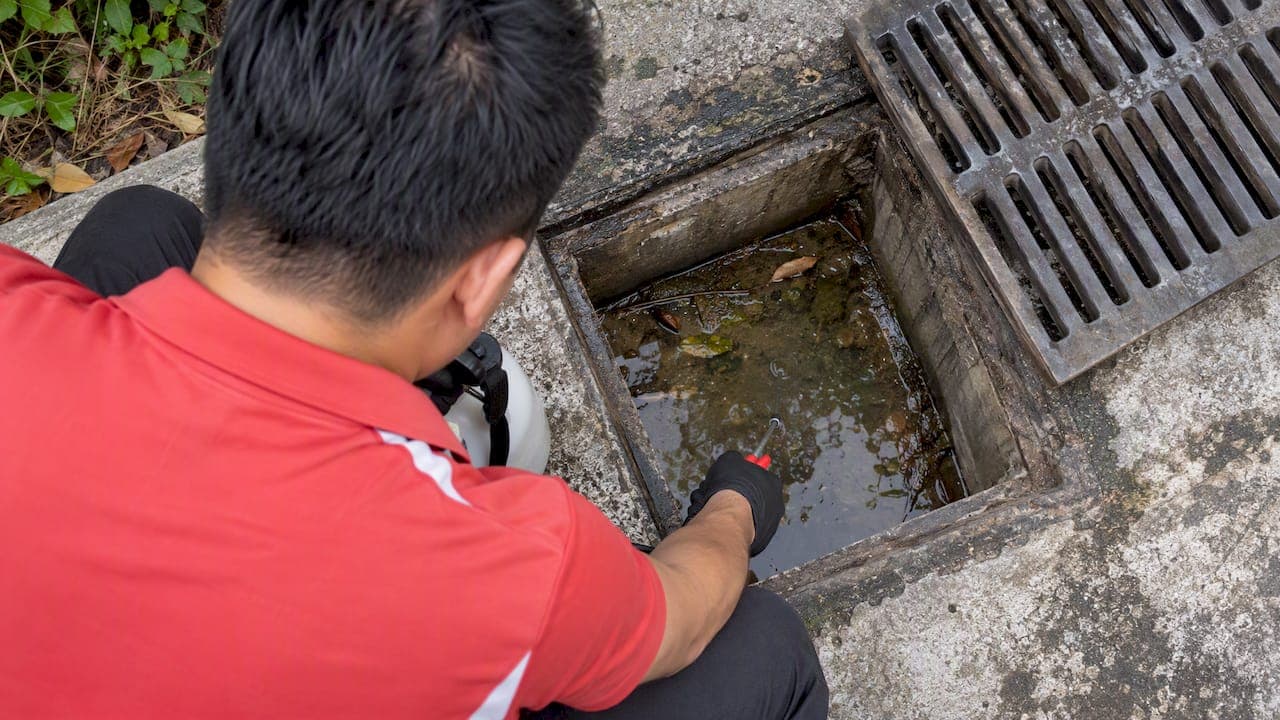
- Targeted professional ground application: backpack sprayers and hand-applied granules let trained technicians treat drains, gully traps, and catch basins that homeowners rarely inspect or access safely.
- Truck-mounted or aerial application: used where regulations and scale justify it, typically for large wetlands or extensive public drainage systems rather than residential sites.
- Dissemination stations: these exploit mosquito behavior, coating female mosquitoes with pyriproxyfen dust as they rest or oviposit, so they carry the compound to container habitats that inspection teams might never find directly.
Equipment choice affects both coverage and persistence. A granule applied by hand to a shaded, slow-draining ditch behaves very differently from the same product sprayed into a drain that flushes daily, which is one reason the NEA explains that Bti and temephos are the standard choices for drain and gully trap treatment in locations where water cannot be removed entirely.
When and where to treat: surveillance-driven decisions
Treatment decisions should follow evidence, not a fixed calendar. The clearest triggers are a confirmed finding of larvae or pupae during inspection, a rising trend in adult mosquito trap counts, or outbreak conditions reported in the surrounding area. Each of these points to active breeding that source reduction alone has not resolved.
Residual activity also shapes the schedule. Bti typically offers a short window of control and needs frequent reapplication, especially in water that gets flushed by rain or regularly refilled. Insect growth regulators like pyriproxyfen tend to persist longer in stable, undisturbed habitats, making them a better match for ornamental ponds or covered water storage than for drains that empty and refill daily.
Blanket, preventative spraying without evidence of breeding is rarely justified. It raises cost, increases non-target exposure, and contributes to resistance pressure on the mosquito population, all for a benefit that surveillance-driven targeting delivers more reliably.
How well larviciding actually works, and where it falls short
Field evidence shows meaningful differences in how long each larvicide class remains effective. A granular Bti and Bs combination produced large larval reductions with measurable residual activity lasting several weeks in vegetated ditches, according to a field trial on Bti and Bs residual activity, a notably longer window than Bti alone typically provides in more exposed water.
Species and habitat both affect outcomes. Aedes aegypti, which breeds in small, often hidden containers around homes, poses a harder surveillance challenge than species that favor large, fixed wetlands, simply because the breeding sites are so much more numerous and scattered.
Resistance is a real and growing concern, particularly for older organophosphates like temephos. The same field trial data point to alternative compounds, including spinosad and diflubenzuron, showing useful residual efficacy in locations where resistance to temephos has already developed. The practical response is to rotate modes of action rather than relying on a single product indefinitely, and to treat larviciding as one layer within a broader IPM program rather than the sole defense. Larviciding alone, applied without parallel source reduction and community engagement, is unlikely to meaningfully cut disease transmission in a community with widespread, scattered breeding sites.
Safety, non-target effects, and the environment
Bti and Bs stand out for their narrow activity against mosquito larvae and closely related insects, which is why public health agencies favor them for sites near people, pets, and waterways. Broader-spectrum chemical larvicides carry more non-target risk and call for stricter label adherence and storage practices.
Regulatory guidance from agencies including the WHO, CDC, and NEA sets the baseline for safe use: follow label rates, store products away from children and pets, and dispose of containers according to local requirements. Fish and other beneficial aquatic organisms deserve particular attention in ponds and ornamental water features, where the wrong product choice can disrupt a balance that took years to establish.
Social acceptability also shapes how well a larviciding program actually gets used. Odor, visible residue, or discoloration in drinking water storage can quickly erode trust in a treatment, even when the active ingredient is well within safety guidelines. Choosing a well-tolerated formulation for visible or domestic settings often matters as much as choosing an effective one.
Fitting larviciding into a broader IPM program
Larviciding works best as one step in a sequence, not a stand-alone fix. Source reduction comes first: removing or covering standing water eliminates breeding sites before any chemical or biological agent is even needed. Weekly household checks, often organized around simple routines, catch new breeding sites before they produce adult mosquitoes.
- Check gutters, flowerpot trays, and other small containers weekly, since these are the sites homeowners most often overlook.
- Add larvicide only to fixed water features that cannot be drained or removed, such as ornamental ponds or water storage tanks.
- Pair chemical and biological tools where appropriate: Wolbachia-based programs have reduced local Aedes populations by 80 to 90 percent in some released sites, working alongside, not instead of, source reduction.
- Coordinate with neighbors or a managing agent so surveillance covers an entire block or compound rather than one isolated property.
Communities that combine consistent weekly habits with targeted larviciding see more durable results than those relying on either approach alone.
Monitoring results and deciding when to reapply
Tracking a few clear indices tells you whether a treatment is working. Larval and pupal counts in known breeding sites are the most direct signal, while adult trap trends over time show whether population pressure in the surrounding area is rising or falling.
Most programs recheck treated sites within one to two weeks, adjusted to the product's expected residual window. Finding live larvae again before that window has elapsed is a strong signal of product failure, resistance, or a habitat that was missed during the original inspection.
When repeated reapplication fails to bring counts down, it is time to escalate: broaden the inspection area, consider rotating to a different mode of action, or bring in a professional inspection to locate hidden or inaccessible breeding sites.
What professional inspection adds to larval control
In pest management, it is known that the breeding sites homeowners miss are rarely the obvious ones. Roof gutters, gully traps, and low-lying drain depressions account for a disproportionate share of hidden breeding, which is why NEA guidance prioritizes these sites for drain treatment. Technicians select formulations based on how often a site's water turns over, rotate active ingredients to manage resistance, and build a remedial plan around what inspection actually finds, not a generic checklist.

What this all adds up to
Larviciding earns its place when breeding sites are confirmed, fixed, and hard to remove, not as a routine precaution. The practical sequence holds up across every habitat we have assessed: survey first, reduce sources wherever possible, apply the right larvicide class to what remains, then monitor and adjust. Programs that treat these steps as a loop, rather than a one-time fix, are the ones that keep mosquito counts down season after season.
— Bespoke-Enviro Services
How we support inspection and targeted larval control
Recurrent breeding despite diligent source reduction, hard-to-reach drains, or a larger compound with multiple water features are all good reasons to bring in a licensed professional rather than keep treating by guesswork. We combine inspection with IPM strategies that prioritize non-toxic treatments safe for people and pets.

- A full-site inspection that locates hidden and fixed breeding sites, including gutters, gully traps, and drains.
- Targeted larviciding matched to each habitat's water turnover and species present.
- An IPM plan that pairs larviciding with source reduction and scheduled rechecks.
- Ongoing maintenance contracts for sites with recurring risk.
Our General Pest Control Services start with that inspection, giving you a clear picture of where breeding is happening and a plan to stop it.
FAQ
What is the most effective method for mosquito control?
Integrated pest management, which combines source reduction, surveillance, and targeted larviciding, is considered the most effective overall strategy by the EPA. No single method matches the results of pairing habitat removal with evidence-based treatment of remaining sites.
What is the best time to apply larvicide?
Apply larvicide as soon as surveillance confirms larvae or pupae in a fixed water source, rather than on a fixed schedule. Reapplication timing then depends on the product's residual window and how quickly the habitat refills or flushes.
What can kill mosquito larvae naturally?
Bacterial larvicides like Bti and Bs occur naturally and kill larvae after ingestion with minimal non-target impact, according to the CDC. Biological predators such as dragonfly nymphs also reduce larval numbers in some natural settings.
What is the most effective chemical for mosquito fumigation?
Fumigation targets adult mosquitoes rather than larvae, so it works alongside larviciding rather than replacing it. For breeding sites themselves, Bti and temephos remain the standard chemical choices for drains and hard-to-empty sites, as NEA guidance confirms.
Sources
- CDC — Larvicides
- WHO — Operational manual on larval source management: control of Anopheles and Aedes mosquito vectors
- NEA Vox — Why are NEA officers scattering chemicals into drains and are they safe?
- Mosquito-disseminated pyriproxyfen trial
- Field trial: Bti + Bs residual activity in vegetated ditches