

Preventing dengue mosquitoes in Singapore comes down to three habits repeated every week: clear standing water through the Mozzie Wipeout, apply NEA-recommended repellent and keep screens shut during the day, and stay alert to community alerts from Gravitrap and myENV. If mosquitoes keep showing up indoors or NEA reports a cluster near your block despite these steps, that's the signal to bring in a professional sanitising and disinfecting service rather than reach for a fogging can.
TL;DR:
- Weekly inspection and removal of stagnant water indoors and outdoors are crucial, as a tiny puddle can produce hundreds of mosquito larvae within days.
- Using repellents with active ingredients like DEET, Picaridin, or IR3535, along with sealing screens and wearing permethrin-treated clothing, provides personal protection during daylight hours.
- Long-term prevention benefits from regular maintenance such as clearing gutters, repairing leaks, and sealing large water containers to reduce breeding sites.
- Persistent mosquito sightings or nearby dengue clusters signal the need for professional IPM-based inspections focused on source identification and targeted larvicide application.
- Community engagement, data sharing, and neighborhood clean-up efforts amplify household actions, especially as Singapore’s Wolbachia program shows significant reduction in dengue incidence across districts.
Table of Contents
- How to Do the Weekly Mozzie Wipeout at Home
- Choosing the Right Repellent and Physical Barriers
- Home and Garden Fixes That Cut Breeding Risk Long-Term
- When to Call a Professional Pest Control Service
- Using Local Data and Wolbachia to Cut Neighborhood Risk
- Quick Checklist: 10 Actions to Complete This Week
- Environmental Management Beyond the Home
- Why Community Engagement Programs Actually Change Outcomes
- How Government Vector Control Programs Fit In
- Why Recognizing Symptoms Early Still Matters for Prevention
- Publisher Perspective: Why We Favor IPM and Community Partnership
- How Bespoke Enviro Supports Your Dengue Prevention Plan
- Sources
- FAQ
How to Do the Weekly Mozzie Wipeout at Home
Aedes mosquitoes need almost nothing to breed. The National Environment Agency warns that a puddle the size of a 20-cent coin is enough to raise a new batch of larvae, which is why a five-minute glance around the living room doesn't cut it. You need to physically check every container that can hold water, indoors and outdoors, once a week.
Work through your home in this order:
- Bedrooms and living areas: check flowerpot saucers, vases, and any decorative water dishes.
- Kitchen: pull out the fridge and empty the drip tray behind or underneath it.
- Bathroom: flip over buckets and pails not in daily use.
- Balcony and corridor: clear gutters, check spirit house cups, and tip out birdbaths.
- Yard or void deck area: turn over toys, tires, and any plant trays left outside.
For each spot, follow one of four actions:
- Empty and scrub vases and saucers, since eggs stick to the container walls even after the water is poured out.
- Flip over pails, tires, and empty pots so they can't collect rain.
- Cover tightly water storage containers that must stay full.
- Discard items you no longer use, like cracked pots or old bottle caps.
If a water body can't be emptied, such as a decorative pond or a scupper drain, treating it with Bti-based larvicide is appropriate. Bti is not for drinking water sources, so reserve it strictly for non-potable water.
Choosing the Right Repellent and Physical Barriers
The Centers for Disease Control and Prevention and NEA both point to the same short list of proven active ingredients, and Aedes bites mostly during daylight hours, so protection matters most between sunrise and dusk, not just at night.
- DEET works well at concentrations of 20 to 30 percent for several hours of protection; reapply per the label, especially after sweating.
- Picaridin offers similar protection with a lighter feel on skin and less odor.
- IR3535 is a gentler option often found in family-friendly formulas.
- NEA also advises checking window and door screens for holes. Patch them promptly since a coin-sized gap is all an Aedes mosquito needs to slip through.
- Bed nets or closed, air-conditioned rooms help daytime sleepers, including infants and shift workers.
- Permethrin-treated clothing adds a layer of protection for outdoor work but should never be sprayed directly onto skin.
Mosquito coils and vaporizers reduce indoor numbers but work best in enclosed rooms with some ventilation, since smoke buildup isn't ideal for children or people with respiratory conditions.
Pro Tip: Keep a small bottle of repellent by your front door. Applying it before you step out, rather than after you're already bitten on the porch, is the difference that actually matters.
Home and Garden Fixes That Cut Breeding Risk Long-Term
Weekly wipes work faster when your property itself doesn't create new hiding spots. A few maintenance jobs, done once every few months, make the weekly routine far less of a chore.
- Clear gutters every three months, since decomposing leaves plus rainwater is a favorite Aedes combination.
- Repair leaking pipes and taps that create small puddles under sinks or near outdoor faucets.
- Seal or net large water storage containers, common in older HDB blocks and landed properties with rooftop tanks.
- Fill tree holes with sand or soil if you have older trees on your property.
- Rotate potted plants to check saucers, and avoid overwatering, which leaves runoff sitting in trays for days.
Landscaping choices matter too. Dense, shaded shrubbery near walls gives adult mosquitoes a cool place to rest between feedings, so trimming back overgrown greenery near entry points reduces resting sites even if it doesn't touch breeding directly. Larvicide tablets or granules have a place in ornamental ponds or gully traps that can't be dried out, but always follow label instructions on dosage and keep them away from pets and children.
When to Call a Professional Pest Control Service
Household effort has limits. If you're still spotting adult mosquitoes indoors after weeks of consistent wipe-outs, or NEA flags an active dengue cluster near your address, it's time to escalate beyond DIY measures.
Watch for these red flags:
- Adult mosquitoes appearing indoors repeatedly despite no obvious breeding site you can find.
- Breeding recurring in the same spot even after you've emptied and scrubbed it.
- An NEA cluster alert covering your street or block.
A proper IPM-based inspection doesn't start with a spray can. It starts with identifying every breeding source on the property, applying targeted larvicide only where needed, and setting up monitoring to confirm the population actually drops. NEA itself notes that fogging is a temporary knockdown of adult mosquitoes, not a fix, because eggs and larvae already in the environment simply hatch again days later. Any treatment plan that skips source reduction is treating a symptom, not the cause.
Before a technician arrives, cover exposed food and utensils, move pet water bowls indoors, and be ready to step out of treated rooms briefly. Expect a follow-up visit scheduled within a few weeks to confirm results, not a single one-off spray.
Pro Tip: Ask any pest control provider what happens after the first visit. A real IPM plan includes a second inspection, not just an invoice.
Using Local Data and Wolbachia to Cut Neighborhood Risk
Your own yard is only part of the picture. Singapore's Gravitrap network and myENV app track live mosquito populations across neighborhoods, giving residents a way to see whether Aedes numbers near them are climbing before a cluster gets declared.
- Check myENV for dengue cluster alerts in your area and adjust your vigilance accordingly.
- Report standing water or suspected breeding in common areas or construction hoardings to NEA or your town council.
- Organize a block-level clean-up day, especially in older estates where common corridors and void decks collect debris.
Singapore has also run large-scale releases of Wolbachia-carrying male mosquitoes, which mate with wild Aedes females to produce eggs that don't hatch. Trial sites have recorded dengue incidence drops of roughly 76 to 77 percent where releases ran at scale. That's a genuine population-level tool, but it works over months and across whole districts. It doesn't replace the saucer you forgot to empty this week.
Quick Checklist: 10 Actions to Complete This Week
- Empty and scrub flowerpot saucers (5 minutes, anyone home).
- Clean the fridge drip tray (5 minutes, kitchen duty).
- Flip over unused pails and buckets (5 minutes).
- Clear visible debris from gutters if accessible (15 minutes, adult).
- Check and patch window screens for holes (10 minutes).
- Apply repellent before leaving home in daylight hours (2 minutes, everyone).
- Tip out birdbaths or decorative water dishes (5 minutes).
- Rotate potted plant trays and check for pooling (5 minutes).
- Check myENV for cluster alerts near your address (2 minutes).
- Report any standing water in common areas to your town council (5 minutes).
Save this list to your phone or print it, and set a recurring weekly reminder through myENV or your calendar app.
Environmental Management Beyond the Home
Dengue prevention doesn't stop at your front gate. Construction sites are a well-known risk factor because uncovered containers, discarded tires, and pooled rainwater on hoardings can breed mosquitoes faster than a residential unit ever would, simply due to scale. Site managers are expected to run scheduled inspections and document source reduction as part of a documented site IPM plan, not an occasional spray when inspectors are due.

Public parks and green corridors carry a different kind of risk. Ornamental ponds, storm drains, and dense foliage near water features create resting and breeding habitat that no single household can manage. Town councils and the National Parks Board handle larvicide application and drain maintenance in these shared spaces, but residents play a role by flagging clogged drains or pooling water spotted during a walk.
Older estates with common corridors, void decks, and shared gardening plots sit in a gray zone. These areas often fall to management corporations or town councils, and delays in reporting are one of the more overlooked reasons a cluster persists in one part of an estate despite good household hygiene next door. If you spot a chronic wet patch in a common area, reporting it to your town council or via NEA's feedback channels closes a gap that individual wipe-outs can't reach.
Why Community Engagement Programs Actually Change Outcomes
A single tidy household surrounded by ten neglected ones doesn't stay protected for long, since adult Aedes mosquitoes fly and rest across property lines. Community-level engagement, not just individual compliance, tends to determine whether a neighborhood's mosquito population actually falls or just shifts from one block to the next.
Programs that combine door-to-door education with visible local data, like posted Gravitrap results or cluster maps, tend to shift household behavior more than generic reminders alone. When residents can see that mosquito counts near their own block are rising, the weekly wipe-out stops feeling like an abstract chore and starts feeling like a direct response to a measurable local problem.
Grassroots organizers, resident committees, and school programs all have a role here. A short briefing at a town hall meeting, a poster in the lift lobby showing where the last cluster was found, or a coordinated weekend clean-up across a whole block does more for collective risk reduction than any single family's diligence. Schools that run dengue education modules also tend to see kids carry the habit home, checking pot saucers and reminding parents about screens, which extends the reach of any campaign beyond its intended audience.
The takeaway is straightforward: household prevention and community prevention are not separate tracks. They're the same effort viewed at two different scales, and neither one substitutes for the other.
How Government Vector Control Programs Fit In
Singapore's dengue strategy rests on a layered system, and understanding where government action starts and household responsibility begins helps explain why some neighborhoods see faster results than others.
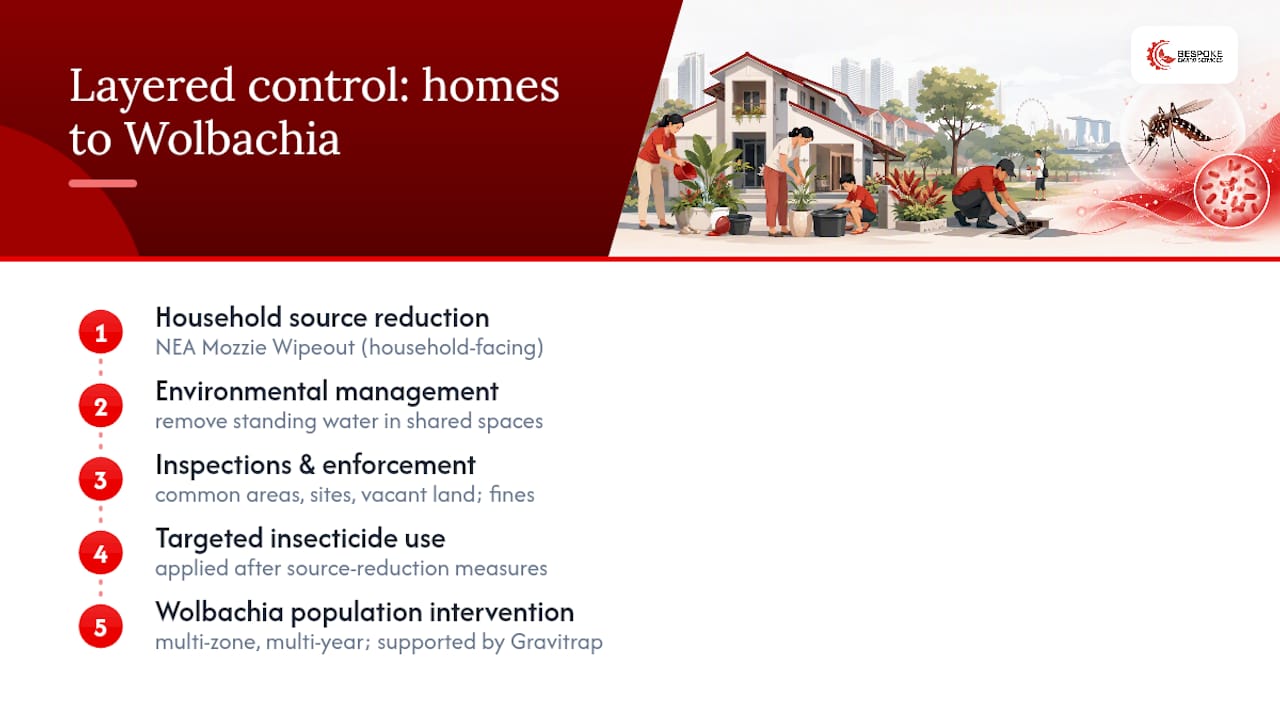
NEA runs the Mozzie Wipeout campaign as the household-facing layer, but behind it sits routine inspection of common areas, construction sites, and vacant land, along with enforcement action against property owners who allow breeding to persist. Repeat offenders can face fines, which signals that source reduction isn't treated as optional even for landlords or site managers who might otherwise deprioritize it.
Above that sits population-level intervention, including the Wolbachia release program covered earlier, which requires government coordination across large geographic zones and years of monitoring to confirm results. That kind of intervention isn't something any household or even a single town council can replicate on its own.
The WHO frames vector control as the central pillar of dengue prevention globally, and Singapore's approach largely mirrors that framing: environmental management first, targeted insecticide use second, and biological tools like Wolbachia layered on top where scale allows. What changes between countries is enforcement capacity and data infrastructure, and Singapore's Gravitrap network is a genuine outlier in how granular and current its surveillance data is compared to most cities.
Why Recognizing Symptoms Early Still Matters for Prevention
Prevention and early detection work together, not separately. Dengue symptoms typically include sudden high fever, severe headache, pain behind the eyes, joint and muscle pain, and a skin rash appearing a few days after fever onset. Warning signs that call for immediate medical attention include persistent vomiting, abdominal pain, bleeding gums, or unusual fatigue.
Early diagnosis matters for two reasons that go beyond individual care. First, prompt medical attention reduces the risk of the illness progressing to severe dengue, which carries real complications if missed. Second, confirmed cases feed directly into NEA's cluster mapping system, which is what triggers the alerts you see on myENV and the additional inspections that follow in that area.
A household that recognizes symptoms early and seeks testing isn't just protecting itself. It's feeding the surveillance system that helps neighbors respond faster too. That's part of why NEA treats reporting and testing as inseparable from the broader prevention program rather than a purely medical afterthought.
Publisher Perspective: Why We Favor IPM and Community Partnership
A provider with extensive experience in integrated pest management across Singapore properties notes that the households that see the fewest mosquitoes aren't necessarily those using the strongest chemicals, but those combining weekly source reduction with community reporting. For readers who want the technical detail behind Wolbachia's role here, our team's breakdown of the local trial data is worth a read. Professional treatment works best as reinforcement, not a replacement, for the habits covered above.
— Bespoke-Enviro Services
How Bespoke Enviro Supports Your Dengue Prevention Plan
Weekly wipe-outs and repellent get most households most of the way there, but a property with recurring breeding sites, hard-to-reach drains, or a nearby cluster alert needs eyes that know what to look for. Bespoke-Enviro Services runs full IPM-based inspections that map every water source on a property, apply targeted larvicide where source removal isn't possible, and schedule follow-up visits to confirm the population has actually dropped.
An inspection typically ends with a clear quote, a treatment recommendation matched to what our technicians actually find, and a maintenance schedule if your property has recurring risk factors. Where adult mosquito pressure is severe, fumigation can form part of that broader plan, always paired with the source reduction work that makes results last. If you've run through the checklist above and mosquitoes keep coming back, book an inspection and let a technician find what the weekly wipe-out missed.
This article is general information, not a substitute for advice from a qualified doctor. Consult a qualified healthcare professional about your own circumstances before acting on anything here.
Sources
- NEA – Stop Dengue Now
- WHO – Dengue and severe dengue
- CDC – Preventing mosquito bites
- TechGov.sg – Gravitrap project and mosquito monitoring
- PMC — Interventions for preventing dengue: mapping review and country examples
FAQ
How Often Should I Do the Mozzie Wipeout?
Weekly, without exception. Aedes eggs can hatch in as little as a 20-cent coin's worth of stagnant water, so a gap of even ten days gives mosquitoes enough time to complete a breeding cycle.
Which Repellent Ingredient Works Best for Dengue Prevention?
NEA and CDC both point to DEET, Picaridin, and IR3535 as the most reliable active ingredients, with DEET offering the longest protection window at higher concentrations.
Does Fogging Get Rid of Mosquitoes Permanently?
No. Fogging kills adult mosquitoes present at that moment, but NEA is explicit that it's a temporary measure that needs source reduction to prevent the population from rebounding within days.
What Is Wolbachia and Does It Replace Household Prevention?
Wolbachia is a bacterium introduced into male mosquitoes that prevents wild Aedes eggs from hatching when they mate, and trial sites have shown dengue drops of roughly 76 to 77 percent. It works at a district scale over months and complements, rather than replaces, weekly household action.
When Should I Book a Professional Pest Control Inspection?
If mosquitoes keep appearing indoors after consistent weekly wipe-outs, or NEA declares a cluster near your address, an IPM-based inspection can find breeding sites a household check might miss.