
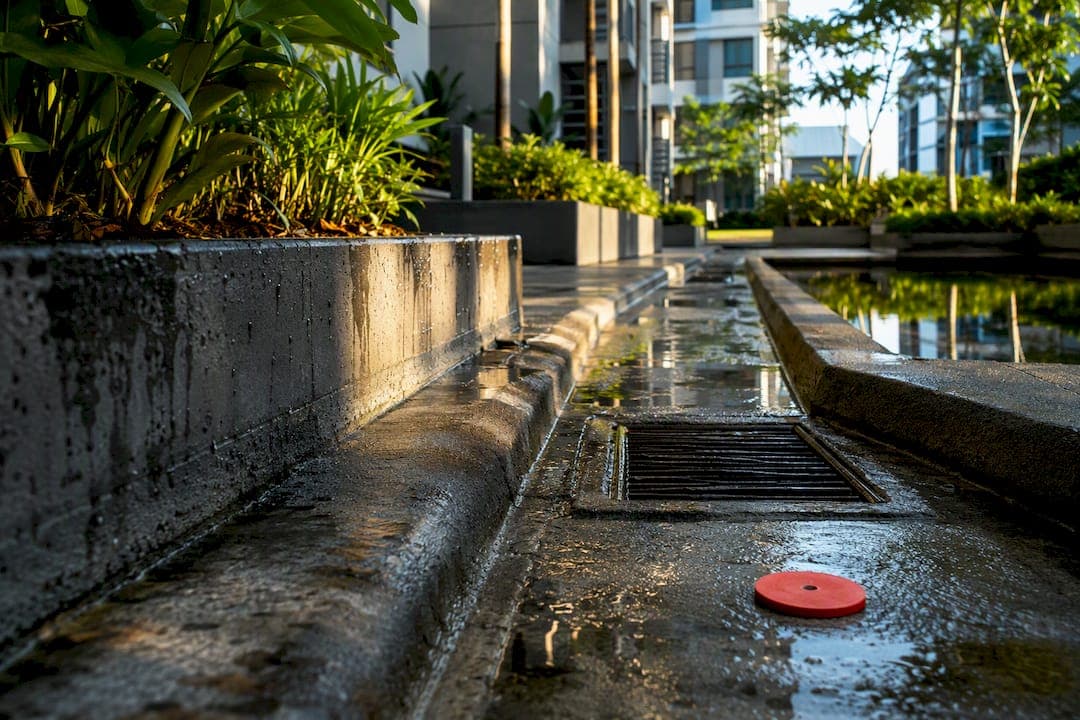
The most effective mosquito control for condos is weekly source reduction paired with coordinated property-wide inspections, not fogging. NEA guidance and integrated pest management (IPM) both point to the same conclusion: destroy breeding water before it produces adults. Start today by checking plant trays for standing water and inspecting gully traps near your unit and common areas.
TL;DR:
- Weekly inspections and prompt removal of standing water in plant trays, AC condensate trays, and drainage systems are critical to prevent mosquito breeding.
- Proper documentation of inspections, treatments, and resident reports supports compliance and helps identify recurring problem spots.
- Routine fogging is ineffective for long-term control and should only be used for active nuisance or disease outbreaks; larvicides are safer and more targeted.
- Resident participation, through simple habits like emptying containers and reporting issues, significantly boosts the effectiveness of condo-wide mosquito control efforts.
- Professional pest control services provide licensed, traceable treatments for persistent hotspots and structural issues that residents cannot handle alone.
Table of Contents
- What Does Mosquito Control for Condos Actually Involve?
- Building a Weekly and Fortnightly Maintenance Calendar
- Where Do Mosquitoes Actually Breed in a Condo?
- What Can Residents Do Without Calling a Professional?
- Larvicides and Professional Treatment: What's Actually Safe
- What Should MCSTs and Property Managers Do Each Month?
- A Practitioner's 7-Day IPM Plan for Condo Teams
- How Do Mosquito Populations Shift Through the Year?
- How Should Condo Landscaping Be Designed to Limit Mosquitoes?
- What Health Risks Do Condo Residents Actually Face?
- How Can Condo Communities Get Residents Actually Involved?
- A Property Manager's Quick Triage for a Sudden Spike
- Get Professional Mosquito Support for Your Condo
- Sources
- FAQ
What Does Mosquito Control for Condos Actually Involve?
Mosquito control for condos works best as a shared job, split cleanly between residents and the managing agent. Mosquito larvae can mature in stagnant water in as little as seven days, which is why weekly checks, not monthly ones, are the baseline NEA recommends for condo estates. Waiting even ten days between inspections gives a breeding cycle enough time to complete.
Here is who owns what in a typical condo:
- Plant trays and saucers (resident): tip out weekly, wipe dry.
- AC condensate trays (resident): check for pooling, clear drain lines.
- Bin corners and chute rooms (MCST/maintenance): inspect for cracked bins holding rainwater.
- Gully traps and scupper drains (MCST/maintenance): clear debris, confirm water flows freely.
- Immediate fix for any standing water: cover it, tip it, or clear the drain the moment it's found. Don't wait for the next scheduled round.
Building a Weekly and Fortnightly Maintenance Calendar
A written schedule turns "someone should check that" into an actual habit. Here's a practical cadence condo teams can lift directly:
- Weekly, unit level: residents check planters, saucers, pet bowls, and AC trays. Takes under five minutes per unit.
- Weekly, common areas: maintenance staff spot check gully traps, void deck drains, and bin centers.
- Fortnightly: clear gutters, roof drains, and bin center sumps where leaves and silt collect and slow drainage.
- As needed: treat gully traps and manholes with a sand granular insecticide when they hold water that can't be fully drained.
- Every visit: log the location, what was found, the action taken, and a photo. A simple spreadsheet or a property management app works fine.
Treatment logs matter more than most MCSTs realize. They prove due diligence if NEA ever inspects the estate, and they show which spots recur so you can fix the underlying drainage issue instead of clearing the same drain every month.
Where Do Mosquitoes Actually Breed in a Condo?
Breeding sites in condos are rarely dramatic. They're small, easy to miss, and often hidden in plain sight. The most common outdoor hotspots include:
- Gully traps: the classic offender, especially when the grating is clogged and water backs up.
- AC condensate trays and pipes: overlooked because they're mounted high or tucked behind units.
- Roof drains and gutters: leaf litter creates pooling that lasts long after rain stops.
- Plant saucers and decorative ponds: ornamental water features without fish or circulation are prime targets.
- Leaf axils on plants like bromeliads or banana palms, which cup rainwater naturally.
- Lightning conductor pits and valve chambers: rarely opened, frequently flooded, almost never inspected.
To check for larvae without chemicals, shine a torch into the water at an angle. Wrigglers move in a distinctive S-shaped motion near the surface. If you see them, treat or drain that spot the same day rather than waiting for the next scheduled round.
What Can Residents Do Without Calling a Professional?
Most of the reduction in mosquito numbers around a condo unit comes from habits, not products. CDC guidance recommends emptying and scrubbing containers weekly, repairing torn screens, and running air conditioning, all of which keep both breeding sites and adult mosquitoes out of the living space. For planters, swap saucers for ones with drainage holes, or drill a small hole yourself. Pet bowls should get fresh water daily rather than topped up. Bird baths need a weekly scrub, not just a refill.

Skip the bug zappers. They kill far more harmless insects than mosquitoes, since female mosquitoes are drawn to carbon dioxide and skin scent, not UV light. "Mosquito plants" like citronella-scented geraniums do little on their own unless the leaves are crushed and applied directly to skin, which isn't practical. A better investment is a fan on the balcony. Mosquitoes are weak fliers and struggle against even light airflow.
Pro Tip: For personal repellents, look for products with DEET or picaridin as commonly recommended active ingredients. Both are well studied for safety at labeled concentrations and outperform natural alternatives like citronella oil in duration of protection.
Larvicides and Professional Treatment: What's Actually Safe
Not every breeding site can be drained. Gully traps, storm drains, and ornamental ponds hold water by design, which is where larvicides come in. Bti (a biological larvicide) and methoprene (an insect growth regulator) both target mosquito larvae specifically and are generally safe for people, pets, and other wildlife when applied according to label instructions. Slow-release briquettes can protect standing water for multiple weeks, which suits fixtures that can't be emptied on a weekly cycle.
Fogging is a different story. NEA guidance is explicit that fogging is not a preventive tool and should be reserved for confirmed nuisance complaints or active disease clusters, a point echoed in reporting on fogging practice in Singapore. Routine fogging kills adult mosquitoes on contact but does nothing for the larvae still developing in a gully trap, so the problem returns within days.
Before hiring a contractor, ask for:
- The specific treatment area and chemicals used
- Confirmation the technician is NEA-licensed
- Re-entry time for treated common areas
- A written inspection and treatment log for your records
What Should MCSTs and Property Managers Do Each Month?
Compliance here isn't complicated, but it does need structure. A condo that runs inspections on paper but never assigns follow-up action will keep finding the same breeding sites.
- Assign SLAs to maintenance staff: a gully trap flagged during a weekly walk should be cleared within 24 to 48 hours, not at the next scheduled visit.
- Open a resident reporting channel: a WhatsApp line, an email address, or a ticket in a property management platform like KnowSpan all work, provided residents know it exists and get a response.
- Escalate to NEA when needed: if breeding is confirmed on common property despite repeated treatment, or a resident reports a suspected dengue case, notify NEA and retain your inspection and treatment logs as evidence. MCSTs that skip this step risk fines that run into the thousands, a real cost worth reviewing before it happens.
A Practitioner's 7-Day IPM Plan for Condo Teams
Weekly checklists work better when they follow a fixed sequence instead of an ad hoc walk-through. Bespoke Enviro's Homeowners' Mosquito Control 7 Day IPM Plan breaks the week into daily actions aligned with CDC and EPA guidance, giving property teams a repeatable structure rather than a vague reminder to "check for mosquitoes."
The core of it translates into what we call Weekly B-L-O-C-K Checks:
- Bowls and planters emptied
- Larvae checked in standing water
- Outdoor drains and gutters cleared
- Containers scrubbed, not just tipped
- Known hotspots re-inspected from the prior week's log
Pair that with S-A-W: Screens intact, Adulticide used only when justified, Water removed at the source. For area-wide context, Singapore's Wolbachia program has cut Aedes populations by roughly 80 to 90 percent in treated zones, a reminder that unit-level diligence works best alongside national efforts, not instead of them.
— Bespoke-Enviro Services
How Do Mosquito Populations Shift Through the Year?
Mosquito activity in condos doesn't stay flat across the year. Singapore's climate keeps temperatures warm enough for year-round breeding, but rainfall patterns still drive noticeable swings in population density. The wetter months, typically November through January during the northeast monsoon, create more standing water opportunities: overflowing gutters, waterlogged planters, and gully traps that fill faster than they drain. Inspection frequency matters more during these stretches, not less, because a single missed weekly check during heavy rain can allow two or three breeding cycles to complete before anyone notices.
Drier months don't eliminate the problem so much as concentrate it. When rainfall drops, residents and maintenance staff sometimes assume mosquito risk drops with it. In practice, mosquitoes simply shift to the water sources that persist regardless of rain: AC condensate trays, ornamental ponds, pet bowls, and vases. These become the dominant breeding sites in dry spells, which is why a checklist built only around "check after it rains" misses a meaningful share of condo breeding activity.
Time of day also shapes bite pressure more than most residents realize. Aedes mosquitoes, the species behind dengue, are most active during dawn and dusk, while Culex species tend to bite later into the evening. A condo common area that feels mosquito-free at noon can still be a significant biting zone during the first and last hour of daylight. Scheduling outdoor maintenance work, landscaping, or resident events around these windows reduces exposure without spending a dollar on treatment.
How Should Condo Landscaping Be Designed to Limit Mosquitoes?
Landscaping choices made at the design stage save years of maintenance headaches later. Dense ground cover and thick foliage near walkways create shaded, humid microclimates where adult mosquitoes rest during the day, so condos renovating common areas should favor open, breathable plantings over solid green walls wherever security and privacy needs allow.
Water features deserve particular scrutiny. Ornamental ponds and fountains look attractive in a condo's landscaping brochure, but a static pond is functionally a large, permanent breeding container unless it includes fish, moving water, or a functioning filtration system. If a pond can't support any of those, it's worth asking whether the feature is worth the ongoing risk.
Drainage grading around planters and hardscaping matters just as much as the plants themselves. Landscaping installed without a slight slope toward drains creates pooling after every rain, exactly the kind of standing water that breeds mosquitoes within a week. Retrofit grading fixes are more expensive than getting it right during initial construction, which makes this a conversation worth having with landscape contractors before, not after, work begins.
Storage areas and utility corners often get left out of design discussions entirely, yet they're where lightning conductor pits, valve chambers, and spare planter stacks accumulate rainwater unnoticed. Building these into the routine landscaping walk, rather than treating them as separate from the "garden," closes a gap that many condo maintenance plans leave open.
What Health Risks Do Condo Residents Actually Face?
Dengue is the primary concern for condo residents in Singapore, transmitted by Aedes mosquitoes that breed in the same small containers and drains covered throughout this guide. Symptoms range from high fever and joint pain to, in severe cases, dangerous drops in blood platelet count that require hospitalization. Because dengue has no widely available treatment beyond supportive care, prevention through source reduction remains the most reliable defense available to residents and property teams alike.
Chikungunya, also spread by Aedes mosquitoes, produces similar fever and joint pain, sometimes lasting weeks longer than dengue's acute phase. Zika, while less commonly reported locally, carries particular risk for pregnant residents due to its association with birth defects, making it a relevant consideration for family-dense condo communities.
What makes condo living distinct from landed housing isn't the diseases themselves, it's the density of shared risk. A single untreated gully trap or blocked roof drain can produce mosquitoes that bite residents across several nearby units, since Aedes mosquitoes typically stay within 200 to 300 yards of where they hatch. One neglected breeding site becomes a shared health liability for an entire block, not just the unit closest to it.
This is precisely why individual vigilance without property-wide coordination falls short. A resident who diligently empties their own planters every week is still exposed if the common-area gully trap three floors down goes unchecked. Health risk in a condo setting is a collective outcome, which is exactly why NEA frames mosquito control as a shared MCST and resident responsibility rather than a purely private one.
How Can Condo Communities Get Residents Actually Involved?
Most mosquito control failures in condos trace back to communication gaps, not lack of effort. Maintenance teams clear the drains they know about, but residents rarely report the ones tucked behind their own balconies or inside storage units they rarely visit.
A simple, well-publicized reporting channel closes that gap fast. Whether it's a dedicated WhatsApp number, a ticket system inside a property management platform, or a laminated QR code posted at the lift lobby, the channel only works if residents know it exists and see a response within a reasonable window. Operational checklists paired with clear response SLAs measurably cut the time hotspots sit unaddressed, which matters given how fast larvae mature.
Beyond reporting, a short seasonal reminder before the monsoon months, distributed through the MCST newsletter or notice board, reinforces the weekly habits residents are supposed to already know. Photos of actual condo hotspots (with identifying details removed) tend to land better than generic warnings, since residents recognize their own building's plant trays and gully traps far more readily than stock images.
Some condos have had success turning inspection walks into a shared activity, inviting residents to join maintenance staff on a monthly common-area check. It costs almost nothing to organize, and it turns an abstract MCST obligation into something residents can see and participate in directly. Transparency around treatment logs, even a simple notice board summary of what was found and fixed each month, builds the kind of trust that keeps residents reporting problems instead of assuming someone else will notice.
A Property Manager's Quick Triage for a Sudden Spike
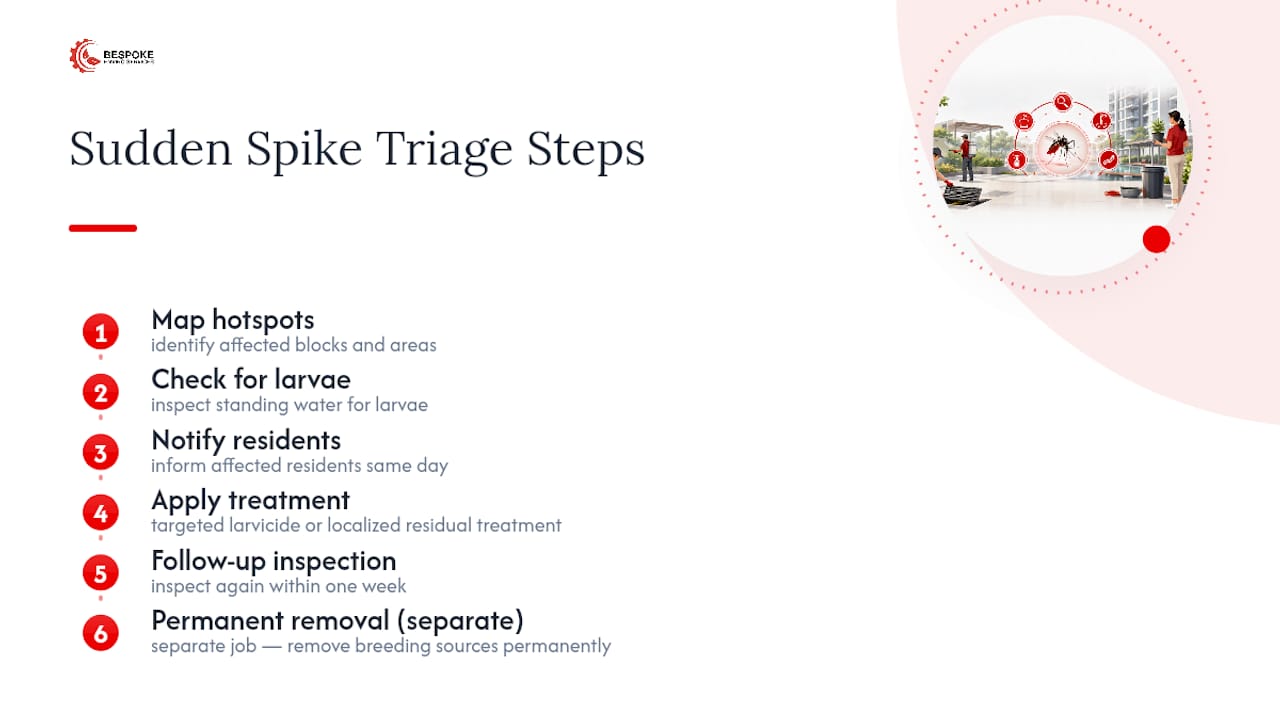
When bite complaints spike suddenly, we map hotspots first, check for larvae, and notify affected residents same day. Targeted larvicide or a localized residual treatment handles the immediate spike; a follow-up inspection within a week confirms it worked. That's suppression. Removing the breeding source permanently is the separate job that actually prevents a repeat.
Get Professional Mosquito Support for Your Condo
Professional pest control companies provide condo managers with NEA-licensed technicians, documented IPM methods, and inspection logs that hold up if NEA ever asks for evidence of due diligence.

When a gully trap keeps breeding despite weekly clearing, or a bin center sump needs targeted larviciding that residents shouldn't handle themselves, that's the point to bring in a professional rather than keep repeating the same weekly fix. Our technicians survey the property, identify the hotspots your maintenance team may be missing, and apply non-toxic treatments safe for residents and pets, backed by a written log of what was treated, where, and when. For condos dealing with a confirmed nuisance spike or wanting a standing maintenance contract that keeps inspections consistent month to month, our general pest control services cover exactly this kind of ongoing, condo-scale mosquito management. Reach out for a property survey and quote before your next MCST meeting.
Sources
Readers who want the primary guidance directly should check NEA's mosquito control page, CDC's home mosquito control guidance, and the peer-reviewed research on mosquito flight range.
- Mosquito Control in Condominium Estates — NEA
- Mosquito flight range and ecology — PMC/peer-reviewed article
- Backyard mosquito control guide — Texas A&M AgriLife Extension
FAQ
How Do I Get Rid of Mosquitoes in My Condo Unit?
Start by removing standing water from planters, saucers, and AC trays, since larvae can mature in as little as seven days. Repair window screens and run air conditioning where possible, both of which reduce indoor mosquito entry according to CDC guidance.
How Can I Permanently Get Rid of Mosquitoes?
Permanent control means removing or treating every breeding source, not just killing adult mosquitoes, since fogging offers only short-term relief. Weekly source reduction combined with larvicides like Bti in drains that can't be emptied gives the most lasting results.
What Is the Best Mosquito Spray for Condos?
For personal protection, sprays containing DEET or picaridin are the most reliably effective active ingredients at labeled concentrations. For treating standing water that can't be drained, Bti or methoprene larvicides work better than any surface spray because they target the larvae directly.
What Is the Most Effective Mosquito Repellent Available?
DEET remains among the most extensively studied repellents for consistent protection, with picaridin a close alternative that some residents prefer for its lighter scent. Neither replaces source reduction. They protect the person wearing them, not the property where mosquitoes are breeding.
When Should a Condo Call Bespoke-enviro Instead of Handling It In-House?
Call in professional support when a hotspot keeps recurring despite weekly clearing, when a confirmed dengue case is reported in the building, or when common-area sites like bin center sumps need targeted larvicide application. Bespoke-enviro's general pest control services include NEA-licensed inspection and treatment with documented logs for MCST records.