
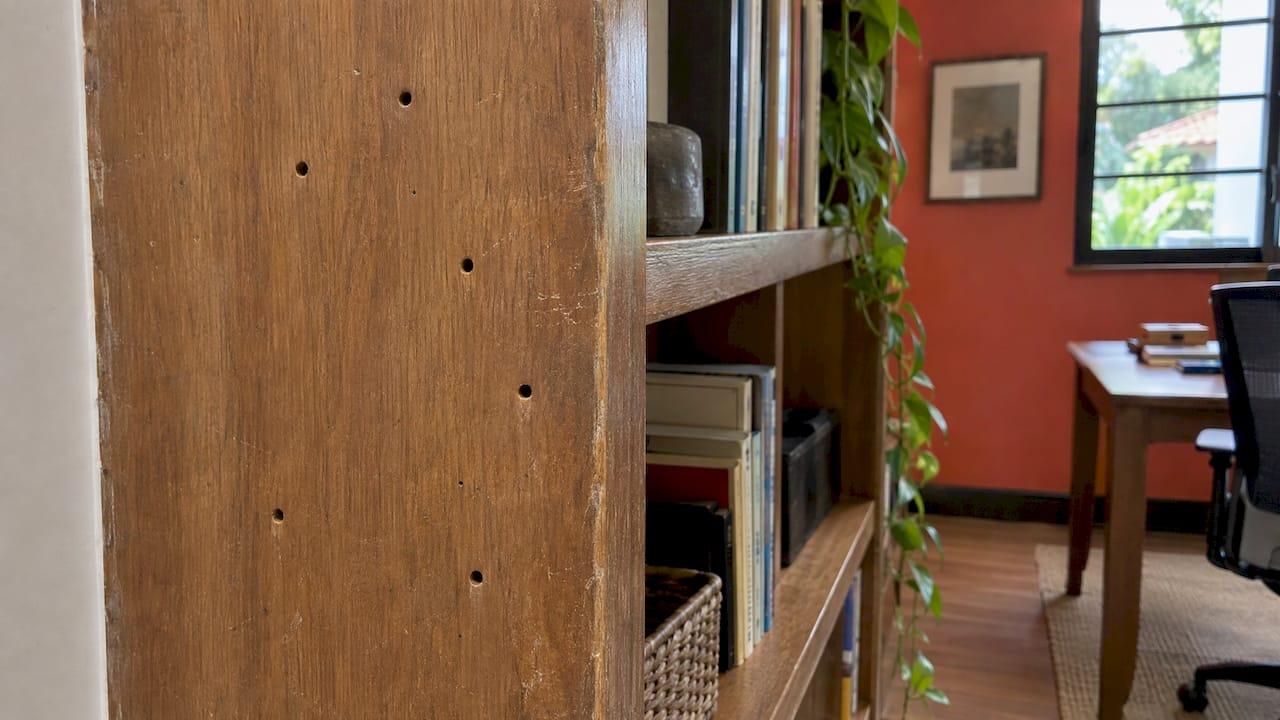
Wood borer holes are small, round (sometimes oval) exit holes, usually about 1 to 3 mm across, with a light dusting of fine powder called frass beneath them. Clean, bright-edged holes with fresh powder point to a recent emergence. Dark, dusty holes with no new powder usually point to old damage. Because the larvae feed inside the timber for months or years, the holes tell you only part of the story. If you find them in structural timber, doors, flooring or built-in furniture, our team can inspect the wood and confirm what is going on before you spend money on repairs.
TL;DR
- Wood borer exit holes are round or oval, from about 0.8 mm to 3 mm for powderpost and furniture beetles, and up to about 10 mm for larger borers.
- Fine, flour-like powder below the holes is frass, the borer's waste. Fresh, pale powder suggests recent activity.
- Clean, light-edged holes suggest recent emergence. Dark, weathered holes with no new dust are more often old.
- Termites and wood borers can look alike in the early stages. Hole size, frass texture and the wood affected help separate them.
- If holes appear in structural or built-in timber, book an inspection rather than guessing.
Table of Contents
- What wood borer holes look like
- Frass: the second clue
- Active infestation or old damage?
- How the life cycle explains what you see
- Borer, termite or something else?
- Where to look in a Singapore home or building
- What to do after you find holes
- Treatment options in outline
- Our approach to wood borer problems
- Book an inspection
- Our perspective
- FAQ
- Sources
What wood borer holes look like
A wood borer hole is the exit tunnel of an adult beetle. The beetle spends its larval stage feeding inside the wood, then chews a way out to mate and lay eggs. The hole is what you see. The damage is inside.
The shape and size tell you a lot:
- Shape: Most are round. Larger borers, such as the old house borer, leave oval holes with ragged edges, about 1/4 to 3/8 inch (roughly 6 to 10 mm), according to University of Maryland Extension guidance on that species' group of beetles and its old house borer fact sheet.
- Powderpost beetles: Round exit holes that range from 1/32 to 1/8 inch in diameter, or about 0.8 to 3 mm. That is roughly a pinhead to a small nail tip.
- Furniture and deathwatch beetles: Round holes of about 1/16 to 1/8 inch, or 1.6 to 3 mm, according to Texas A&M's urban entomology program.
- Clean edges: Fresh holes look sharp and pale inside. Older ones darken and collect dust.
- Pattern: Scattered pinholes, sometimes in clusters, often along the grain or at joints and end cuts.
If your holes are smaller than a match head and perfectly round, a small powderpost-type borer is the likely cause. If they are oval and clearly larger, a bigger species is at work, and the structural stakes are higher.
Frass: the second clue
Frass is the powder or pellets pushed out of the holes. Check the surface below the wood, such as a shelf, a floor or the rim of a skirting board.
- Texture: Bore dust often appears in piles below wooden objects and is white and powdery or yellow and clumpy, a Singapore timber supplier explains.
- Feel: Rub it between your fingers. Very fine, smooth, flour-like powder is typical of powderpost beetles. Gritty powder with tiny pellets points to a different group.
- Colour: Fresh frass is pale, like newly cut wood. Yellow, clumpy dust usually means the larvae have become adults and left the wood.
Frass is also where homeowners confuse borers with termites. Termite droppings are hard, six-sided pellets, while borer frass is powdery. Our guide to termite droppings versus sawdust shows the difference with photos.
Active infestation or old damage?
This is the question that matters most, because treating dead damage wastes money and ignoring live damage costs more.
Signs the attack is active
- Fresh, pale frass that reappears after you wipe the area clean.
- Holes with bright, clean edges and light-coloured interiors.
- New holes appearing over weeks.
- Faint tapping or rustling in quiet rooms (more typical of some deathwatch species).
Signs the attack is old
- Dark, dusty holes with cobwebs or paint over them.
- No new powder after cleaning.
- Dry wood in a well-ventilated room. In heritage guidance from the UK, if the timber is dry and relative humidity is below 55%, the infestation is probably long dead.
A caution: the Society for the Protection of Ancient Buildings notes that many beetle attacks in old buildings are extinct, and that activity is often falsely assumed when dust is merely dislodged from old holes. Dust that falls when you move a piece of furniture does not prove a live problem.
A simple monitoring test
The University of Kentucky suggests sealing existing holes, then re-checking the following spring. New holes or fresh dust mean activity. It works, but it is slow, and in Singapore's warm, humid climate a live attack does not wait for a season. For timber you depend on, an inspection gives a faster answer.
How the life cycle explains what you see
Wood-boring beetles pass through egg, larva, pupa and adult stages. Larvae burrow into and feed on sapwood, taking from a month to 12 years to develop, and the adults make the tiny emergence holes you notice.
That has three practical consequences:
- Holes appear late. By the time you see an exit hole, larvae may have been feeding for years. Old house borer larvae, for instance, can take three to five years or more to mature.
- Timing varies. In the US, powderpost beetles usually emerge from April through July. That is a temperate-climate pattern. Do not assume Singapore's year-round warmth follows a season, and treat any fresh hole as worth checking.
- Larvae are rarely seen. If you do open the wood, borer larvae are usually white to cream, segmented and fleshy, with a hardened brownish head capsule.
Borer, termite or something else?
Tiny holes in wood have several causes. The three most common in Singapore homes are wood borers, termites and, less often, carpenter ants.
| Sign | Wood borer | Termite | Carpenter ant |
|---|---|---|---|
| Holes | Round or oval exit holes in the surface | Often no visible holes, or small irregular openings | Clean, round openings near the nest |
| Frass | Fine powder or pellets | Hard, six-sided pellets, or mud | Coarse shavings, often with insect parts |
| Surface | Sound surface, hollow interior | Blistered or papery surface, mud tubes | Smooth galleries |
| Wood | Often dry, seasoned timber | Damp or dry wood, soil contact | Damp or decayed wood |
This is a starting guide, not a verdict. Cornell's IPM program stresses that identification is most reliable with a specimen, but specimens are rarely available, so hole size, frass texture and wood type become the main tools.
One field trick comes from the University of California: a click-type ballpoint pen tip inserted into an exit hole helps distinguish groups of beetles by how far it fits. Use it gently, and only on holes you can easily reach.
For deeper comparisons, see our guides on powderpost beetle versus termite, carpenter ants versus termites and the warning signs of termites.
Where to look in a Singapore home or building
Borers favour seasoned, unfinished or lightly finished timber with enough starch. Check these places first:
- Wardrobes, cabinets and built-in joinery, especially the unseen backs and undersides.
- Timber door frames, skirting and window frames.
- Solid wood furniture, picture frames and wooden crates or pallets.
- Roof timbers and exposed beams in landed homes, shophouses and older buildings.
- Timber hoarding, formwork and stored lumber on construction sites.
For wooden floors, a careful look at the surface before any restoration is sensible, and a hardwood floor inspection guide explains what to check on the finish. If you see pinholes with powder on a floor, do not sand or refinish until the cause is known, because sanding hides the evidence and does nothing for the larvae inside.
Use a torch held at a low angle across the surface. Holes and ridges show up in raking light. Tap along the grain with a screwdriver handle: a dull or hollow sound can mean galleries underneath.
What to do after you find holes
- Photograph the holes with a coin or ruler beside them, plus any frass.
- Do not clean the dust away yet. Collect a small sample in a sealed bag or sheet of paper. It helps identification.
- Mark the area with a pencil dot beside each hole. New holes in weeks mean activity.
- Isolate movable items such as furniture or boxes so a live infestation does not spread to other timber.
- Book an inspection if holes are in structural timber, fitted joinery, a roof or a floor, or if frass keeps returning.
Resist spraying household insecticides into holes. Larvae feed deep inside the wood, so surface sprays rarely reach them, and the residue lands in rooms where people and pets live. The UC Statewide IPM Program notes that because larvae feed deep inside wood, prevention, such as sealing surfaces with paint or varnish, is the most effective management strategy.
Treatment options in outline
Treatment depends on the species, the wood and how far the attack has gone. Borate-based products can be applied to unfinished wood to treat infestations and help prevent them. Heavily damaged members may need replacing, and furniture can sometimes be treated separately from the building.
For homeowners, the sensible order is: confirm the pest, confirm whether it is active, treat the timber at the source, then seal or finish the wood to reduce future attacks. Our articles on wood borer treatment in Singapore and borates first for powderpost beetles cover each step in more detail.

Our approach to wood borer problems
When you ask us to look at suspect timber, we work from integrated pest management (IPM): identify the pest, find out how far it has spread, treat what needs treating and reduce the conditions that let it return. Our technicians are NEA-licensed and use non-toxic, environmentally safe methods that put people and pets first. We also use advanced technology, including thermal imaging, in our inspections.
That matters for borers because the visible holes are rarely the whole picture. A professional inspection checks the surrounding timber and rules out termites at the same visit, so you are not treating the wrong pest.

Book an inspection
If you have found holes in doors, cabinets, flooring or roof timbers, we can identify the cause and advise what the timber needs. We handle residential, commercial, industrial and construction sites across Singapore, and we are available 24/7. Start with our termite control and treatment service if holes could be linked to termites, or contact us through our general pest control page for any other wood-damaging pest.

Property managers and contractors can also ask us about regular inspections of timber fittings and stored lumber, so problems are caught before handover or fit-out.
Our perspective
Most of the calls we get about wood borers begin the same way: a homeowner finds a few pinholes and a little powder, and wants to know whether it is serious. The honest answer is that the holes alone cannot tell you. Size, edge, frass and the wood itself all matter, and so does what is happening inside the timber.
That is why we start with identification, not spraying. Our inspections use thermal imaging alongside a hands-on check of the timber, so we look beyond the visible surface. Our technicians are NEA-licensed, and our methods are non-toxic and environmentally safe, designed around the safety of the people and pets who live and work in the space.
We believe an integrated pest management approach gives the best result: find the cause, treat it precisely, and cut off the conditions that let it come back. For wood borers, that means treating the timber and also looking at nearby wood, moisture and finishing.
Bespoke-Enviro Services
FAQ
What causes tiny holes in wood?
Most tiny round holes are exit holes made by adult wood-boring beetles leaving the timber. Termites, carpenter ants and old nail or screw holes can also be responsible. Hole size, frass texture and the type of wood help separate them.
How big are wood borer holes?
Powderpost and furniture beetle holes are about 1/32 to 1/8 inch, or roughly 0.8 to 3 mm. Larger borers, such as the old house borer, leave oval holes of about 6 to 10 mm. Measure a few holes with a ruler and photograph them for comparison.
How can I tell if wood borers are still active?
Look for fresh, pale powder that returns after cleaning, and for holes with clean, bright edges. Dark, dusty holes with no new frass are more often old. If you cannot tell, mark the holes and watch for new ones, or ask us to inspect the timber.
Are wood borers the same as termites?
No. Wood borers are beetles whose larvae tunnel in wood and leave round exit holes with powdery frass. Termites leave hard pellets or mud tubes and often show no holes at all. They need different treatment, so identification comes first.
How long does a wood borer attack take to show?
It can take a long time. Larvae develop for anywhere from a month to 12 years depending on species and conditions, and holes appear only when adults emerge. A first hole can mean the larvae have been feeding unseen for years.
Sources
- Powderpost Beetles, University of Maryland Extension
- Furniture and Deathwatch Beetles, Texas A&M Urban Entomology
- Tackling Wood Borers: Identification, Treatment and Prevention, Timber Actually
- Pest Fact Sheet No 2: Furniture Beetle or Woodworm, English Heritage
- Wood-boring insects, SPAB
- Powderpost Beetles, University of Kentucky fact sheet
- Wood-boring Beetles, Connecticut Agricultural Experiment Station
- Powderpost Beetles and Other Wood-Infesting Insects, University of Florida IFAS
- Wood-boring Beetles of Structures, Texas A&M AgriLife Extension
- Wood destroying insects, Cornell IPM
- Wood-Boring Beetles in Homes, UC Statewide IPM Program