
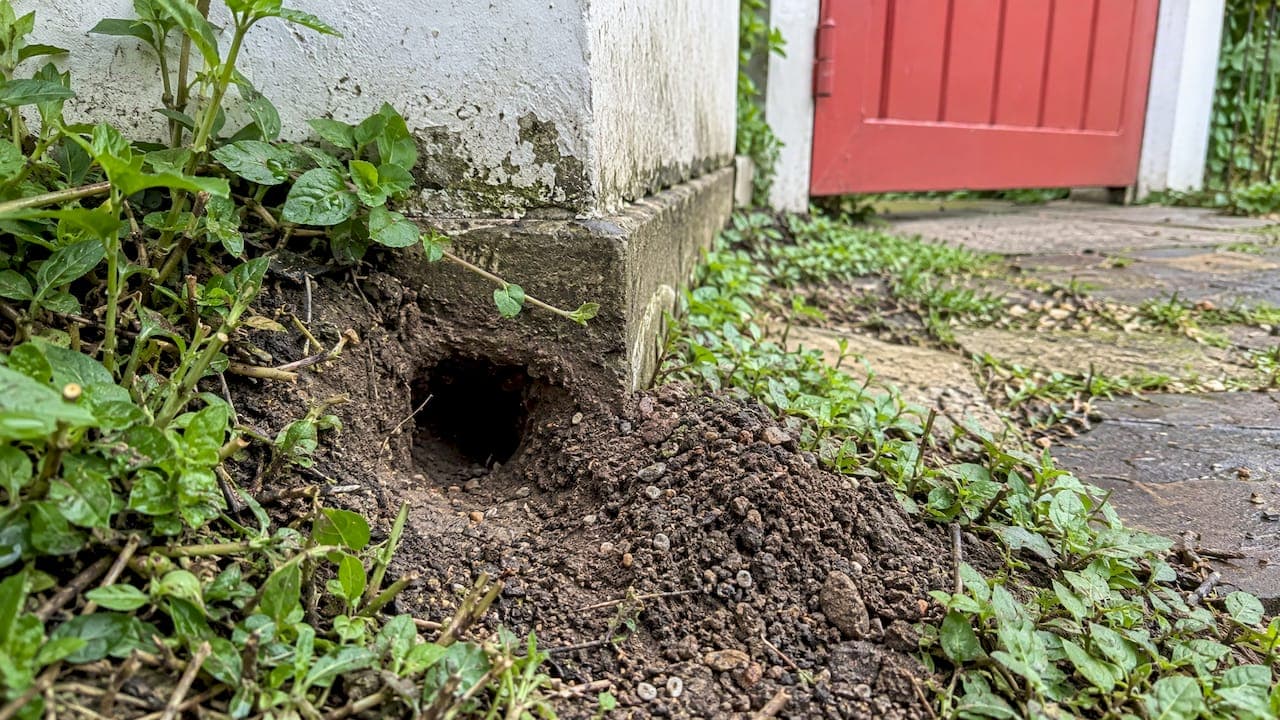
A round hole about 5 to 10 cm across, with loose soil around it, is the classic sign of a rat burrow. If you find one in your Singapore garden, do not block it or poke at it. Keep your distance, note what you see and call a licensed pest control operator, because the burrow is usually the visible end of a larger problem. This guide shows you how to identify a burrow, what else to look for, why it matters for health, and how to deal with it safely.
TL;DR
- Rat burrows are round openings of roughly 2 to 4 inches (5 to 10 cm), often with disturbed soil around them, according to NEA Singapore.
- Fresh, orange-colored soil and bare patches in the grass can point to a newly dug burrow.
- Rats spread diseases such as leptospirosis, murine typhus and hantavirus infection, so do not try to catch or handle them yourself.
- Treat the rats before the burrow is filled in. Filling a burrow first only hides the problem.
- Cut off food, water and shelter, and engage a licensed pest control operator for any active burrow.
Table of Contents
- How to tell a rat burrow from other holes in the garden
- Which rats dig burrows in Singapore
- Why rats dig in your garden
- Should you be worried about rats in the garden?
- What to do when you find a rat burrow
- How to keep rats from digging in your garden again
- Quick guide: what you find and what it likely means
- Our approach to garden rat burrows
- Our perspective on garden burrows
- FAQ
- Sources
How to tell a rat burrow from other holes in the garden
Not every hole in the ground is a rat burrow. Gardens in Singapore also have holes made by earthworms, crabs, skinks, monitor lizards, ants and the occasional drainage gap. The shape, size and surroundings usually tell you which one you have.
NEA describes rat burrows as round openings about 2 to 4 inches across, which may be surrounded by disturbed soil. That is the starting point. Then look at the details.
Signs that point to rats
- Size and shape: a clean, round entrance roughly the width of a fist, not a ragged crater.
- Smooth, packed edges: repeated traffic wears the rim smooth. A hole with crumbly, collapsing edges is less likely to be in regular use.
- Fresh soil: CNA reports that NEA officers treat freshly overturned soil, usually more orange, and a lack of grass on turf as signs of a newly dug burrow.
- Runways: worn, flattened paths in the grass or along a wall or fence line leading to the hole.
- Droppings, gnaw marks and grease: NEA lists droppings, gnaw marks, rub marks and footprints in dusty areas as general signs of rat activity.
- Several openings: burrows often have more than one entrance, usually near cover such as shrubs, planters, drains or the base of a wall.
Signs that point to something else
- A tiny hole of a few millimeters with a small mound of fine soil is more likely earthworms or ants.
- A wide, shallow scrape is often an animal foraging rather than nesting.
- A hole beside a drain that has no loose soil and no droppings may simply be a gap in the concrete.
If you are not sure, take a clear photo with something for scale, such as a coin, and keep your distance. A photo helps a technician judge the situation faster, and it is also the kind of detail NEA asks for when you report sightings.
Which rats dig burrows in Singapore
NEA names three common rodent species in Singapore: the Norway rat, the roof rat and the house mouse. Only some of them are likely to be digging in your garden.
According to NEA's rat brochure, Norway rats tend to live in the lower levels of buildings and burrow in gardens, fields, beneath building foundations and in rubbish dumps. Roof rats, by contrast, are excellent climbers that tend to nest above ground, in trees, roof spaces and similar spots.
So a burrow in the lawn or a flower bed usually points to Norway rats, also called sewer rats. CNA notes that sewer rats have tails as long as, or slightly shorter than, their bodies, while roof rats have tails longer than their bodies. If you also hear scratching in the ceiling, you may have both. Our guide to identifying roof rats in Singapore explains how to tell them apart.
NEA also notes that rats can live in flower pots, so a planter close to your door is worth checking when you inspect the garden.

Why rats dig in your garden
Rats dig where three things come together: food, water and shelter. NEA states that rats are commonly found where these are available, including turf areas where they can burrow.
In a typical Singapore home garden, that often means:
- uncovered or overflowing rubbish bins and bags left on the ground
- leftover pet food, or bird feed that spills onto the soil
- fallen fruit from trees such as mango, rambutan or banana
- compost heaps that are not properly contained
- stagnant water, leaky taps and blocked drains
- thick shrubs, stacked pots, wood piles and clutter that give cover along fences and walls
- gaps beneath fences, sheds, steps and building foundations
The food source matters most. NEA Executive Manager Tan Guan Qun told CNA that to eliminate rats, the team has to find the food source, and that blocking it out brings the population down. A big infestation of around 100 rats needs a consistent supply. A burrow near your bins or a neighbor's food waste can be fed from a distance, so the cause is not always in your own garden.
Should you be worried about rats in the garden?
Yes, and the reason is health, not only damage. NEA states that rats can carry and spread diseases such as leptospirosis, murine typhus and hantavirus infection by contaminating the environment, food and water. NEA's pest control overview also lists the rat as a vector for rat bite fever and leptospirosis, and the rat flea as a vector for murine typhus and plague.
These diseases can pass to people in several ways. NEA says transmission can happen through direct contact, by breathing in dust contaminated with rat urine or droppings, or through a flea bite from an infected rat. A 2022 study in Scientific Reports notes that leptospirosis spreads through contact with excreta from infected mammals, with an estimated 1.03 million cases and 58,900 deaths a year worldwide, mainly in tropical regions.
That is why a burrow in a garden where children play, pets roam or people garden barefoot deserves quick action. NEA also warns that a live rat sighting can indicate a larger infestation, and that early detection prevents things from getting worse.
If you or someone in your household develops a fever or feels unwell after contact with soil or water that rats may have contaminated, see a doctor and mention the possible exposure.
What to do when you find a rat burrow
The safest sequence is simple: observe, record, report and get the infestation treated.
- Keep back and keep others back. NEA advises that you should not attempt to catch or handle rats yourself. Keep children and pets away from the area.
- Record what you see. Take photos or short videos. Note the location, the time of day, the direction the rats travel, roughly how many you see and how often.
- Do not fill the hole yet. NEA officers advise property owners to take pest control measures, including poisoning or culling, before the burrows are filled in. Sealing a burrow with rats inside can push them to dig new exits elsewhere, often closer to your house.
- Report where needed. If the burrows are in a public or shared area, such as a park, drain or common garden, NEA asks you to report rat sightings through the OneService app with the details above.
- Engage a licensed pest control operator. NEA's rat brochure advises engaging a licensed pest control operator and specifying the right scope of work when necessary. An active burrow is a clear case.
Why professional inspection helps
A hole in the lawn is only one part of the picture. NEA's own rat control officers use a videoscope to find rats inside burrows, and a camera fixed under a drain cover to learn when and how often rats move and which direction they come from. That is the logic of a proper inspection: find the burrows, the runways, the food source and the entry points to the house, then treat them in order.
We approach it the same way. Our technicians are NEA-licensed, and our inspections can include thermal imaging, which helps us look for activity that is not visible from the surface. We build the treatment plan around integrated pest management, using non-toxic, eco-friendly methods designed with the safety of people and pets in mind.
How to keep rats from digging in your garden again
Treatment removes the rats you have. Prevention decides whether new ones move in. NEA's advice and brochure give a clear checklist.
Remove the food
- Dispose of rubbish in sealed bins, and keep bags off the ground.
- Store food in tightly covered containers and clean up crumbs and spills.
- Clear leftover pet food after each feeding.
- Clear fallen fruit promptly.
Remove the shelter
- Keep the space clean and free of clutter. Move stacked pots, planks, old furniture and bags away from walls and fences.
- Trim dense ground cover and shrubs that touch the house.
- Keep grass short around the base of fences and walls so burrow entrances are easy to see.
Close the entry points
NEA's brochure advises checking and sealing potential entry points with wire mesh and metal guards, making sure floor traps, gullies and downpipes are covered with grating, and sealing holes, crevices and openings in ceilings, walls, ground and floors.

Do this after the rats have been dealt with, not before. Sealing first can trap rats on the wrong side.
Share the responsibility
The same brochure states that preventing rat infestation is a shared duty of landlords and tenants, and that it takes good housekeeping and waste management from everyone involved. If you rent, or manage a property with shared grounds, it helps to agree early who handles inspections and treatment. Our article on how tenancy clauses decide who pays for pest control covers this in detail.
Quick guide: what you find and what it likely means
| What you see | What it likely means | What to do |
|---|---|---|
| Round hole of about 5 to 10 cm, loose or orange soil, bare turf | Newly dug rat burrow | Photograph it, keep back, call a licensed pest control operator |
| Smooth, worn runways along fences or walls | Regular rat traffic | Record when and where, then book an inspection |
| Droppings or gnaw marks near bins or pet bowls | Active feeding site | Secure the food source and have the area inspected |
| Several holes along a foundation or under a shed | Established colony, possible entry to the building | Do not fill them in, arrange professional treatment first |
| Tiny holes with fine soil mounds | Likely ants or earthworms | Monitor, and call if rat signs appear |
| Scratching in the ceiling as well | Possible roof rats in addition | Ask for a full property inspection |
Our approach to garden rat burrows
If you have found burrows at your home, shophouse, condo common area or construction site, our rodent and rat control service covers inspection, treatment and proofing. We find where the rats live and feed, treat them with non-toxic, eco-friendly methods, and then advise on closing the entry points so the problem does not return. We are available 24/7, which matters when you spot rats at night.
If you manage several properties or want ongoing monitoring, our general pest control service can sit alongside it. Contact us through our website to arrange an inspection.

Our perspective on garden burrows
In our experience, a burrow is rarely the whole story. It is evidence that rats have found food, water and cover close to your home, and the real work is finding and removing all three.
We start with a thorough inspection. Thermal imaging and careful ground checks help us understand where the rats are moving, where they are nesting and where they might enter the building. Treatment follows that map, not a guess.
We favor integrated pest management because it deals with the cause. Non-toxic, eco-friendly treatments protect the people and pets who use your garden, and proofing and sanitation advice keep new rats from settling in after we leave.
Our NEA-licensed technicians work with homeowners, property managers and businesses. We believe a rat problem handled early is simpler, safer and less disruptive than one left to grow.
Bespoke-Enviro Services
FAQ
How deep are rat burrows?
Rat burrows commonly go down around 45 to 60 cm, and some run deeper, especially when rats dig beneath a structure. A burrow system can have several entrances and chambers, so the visible hole shows only a small part. For that reason, an inspection should trace the whole system before anything is sealed.
Can I just fill in the hole myself?
We advise against it. NEA officers recommend carrying out pest control measures before burrows are filled in, and NEA says not to catch or handle rats yourself. Filling a hole while rats are inside can push them to dig a new exit or move into your home. A licensed operator can treat first and then close the burrow.
Are rat holes in the garden dangerous for children and pets?
The holes themselves are not the main risk. The rats, their droppings, urine and fleas can spread diseases such as leptospirosis and murine typhus, according to NEA. Keep children and pets away from the area until it has been inspected and treated. See a doctor if anyone becomes unwell after contact.
Why are rats digging in my garden when I keep it clean?
Rats travel to food, so the source may be next door, in a shared bin area or in a drain nearby. Pet food, fallen fruit, compost and standing water in your own garden can also be enough. An inspection helps identify where the rats are feeding and which entry points they use.
When should I call a pest control company?
Call as soon as you see a fresh burrow, droppings, gnaw marks or a live rat, since NEA notes that sightings can indicate a larger infestation and that early detection stops it from worsening. NEA's brochure also advises engaging a licensed operator when needed. Choose one that inspects first and defines the scope of work clearly.
Sources
- NEA Singapore: Rat prevention and control for the general public
- NEA Singapore: Norway rats brochure
- NEA Singapore: Pest control overview
- NEA Vox: the difference between a rat and a shrew
- CNA: The rat busters, on the hunt with NEA officers
- Scientific Reports: VKORC1 mutations in rodent populations of a tropical city-state