
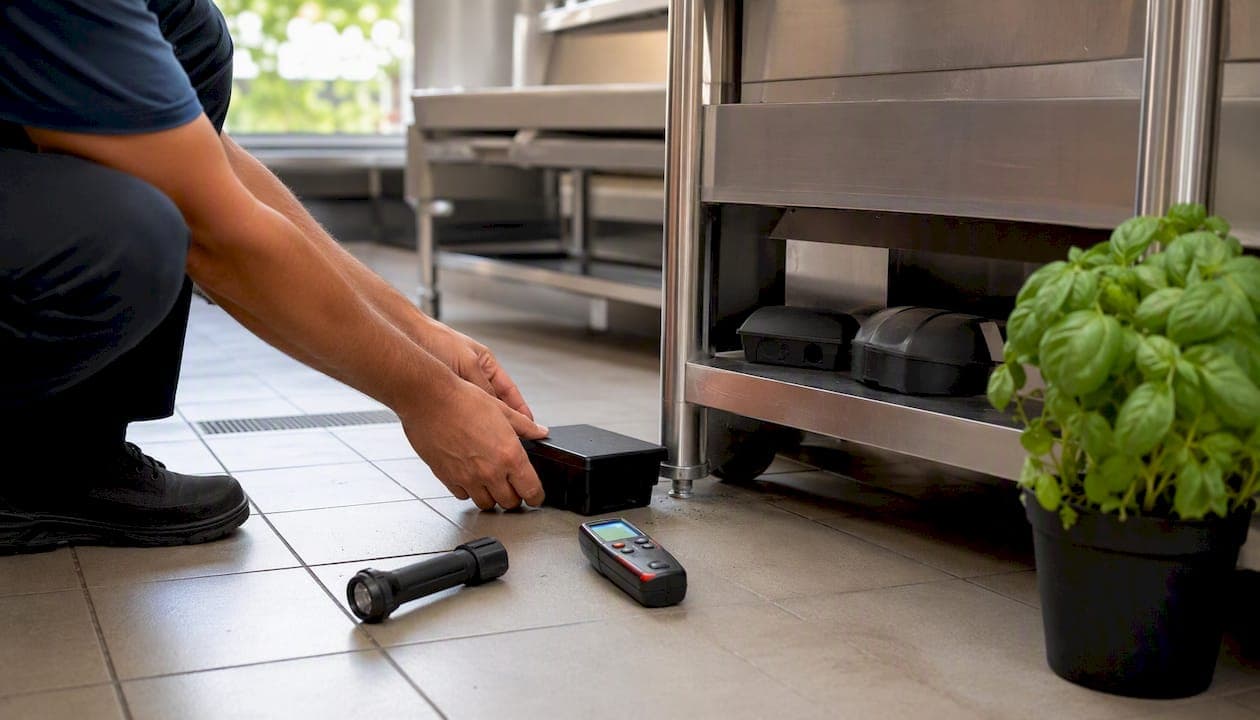
Integrated pest management (IPM) is a sustainable, science-based process that combines biological, cultural, physical, and chemical tools to manage pests while minimizing risks to human health, property, and the environment. The goal is not to eliminate every pest on sight, but to keep populations below the level where they cause real harm, using the least-toxic methods that actually work. Here is the core IPM flow at a glance:
- Monitor your space regularly for pest activity and conducive conditions
- Identify the pest correctly before taking any action
- Set an action threshold — the point at which pest pressure justifies a response
- Prevent by removing food, water, shelter, and entry points
- Control using the least-risky effective method, escalating only when needed
- Evaluate results and adjust the plan
When to DIY vs. when to call a professional: If you are dealing with a single ant trail near a door or a few fungus gnats in a potted plant, sanitation and exclusion steps are a reasonable starting point. Call a professional when you suspect structural damage (termites, wood-boring beetles), when a pest poses a direct health risk (rodents, stinging insects in walls, bed bugs), or when two rounds of corrective action have not moved the needle.
Key Takeaways
Effective integrated pest management requires consistent monitoring, written thresholds, and a commitment to least-toxic control methods before any chemical treatment is considered.
| Point | Details |
|---|---|
| Monitor before you act | Deploy sticky traps, bait stations, and regular inspections to build data before choosing any control method. |
| Set thresholds in writing | Define the pest level that justifies treatment for your specific setting; one cockroach in a kitchen is not the same risk as one spider in a storeroom. |
| Prevention outperforms treatment | Sanitation, exclusion, and moisture control reduce pest pressure without chemical input and lower long-term costs. |
| Document every visit | Dated records of trap counts, sightings, and actions taken are what let you evaluate progress and defend the program. |
| Bespoke-enviro for professional IPM | With 30+ years of experience and a documented, non-toxic approach, Bespoke-enviro delivers structured IPM programs for homes, businesses, and industrial sites in Singapore. |
Table of Contents
- What is integrated pest management, and why does it matter?
- Core principles and components of IPM
- The IPM process, step by step
- Monitoring techniques and tools that actually work
- Prevention strategies you can start today
- Choosing and sequencing control methods
- How IPM works across different settings
- How to start an IPM program in 90 days
- What a professional IPM program looks like in practice
- Recordkeeping and evaluating whether your IPM program is working
- Benefits and real limitations of IPM
- The case for treating IPM as a management mindset, not a product
- Bespoke-enviro's IPM-based pest control services
- Sources
What is integrated pest management, and why does it matter?
Routine pesticide spraying on a fixed calendar schedule treats pest control like a subscription service: spray on Tuesday, repeat in 30 days, regardless of whether pests are present or absent. IPM works differently. It starts with understanding why pests are there, removes the conditions that attract them, and applies a targeted treatment only when monitoring data shows a threshold has been crossed.
The US EPA frames IPM as an environmentally friendly, common-sense approach that focuses on long-term prevention by managing the ecosystem and using pesticides only when monitoring and thresholds indicate they are needed. That framing matters because it shifts the decision from "spray now" to "is treatment actually warranted?"
IPM applies across nearly every setting: homes, schools, commercial kitchens, hospitals, urban green spaces, and farms. The FAO defines it as the careful consideration of all available pest control techniques, integrating measures that discourage pest population development while using ecosystem-based strategies and prioritizing prevention. That breadth is the point. Whether you are managing cockroaches in a food service facility or aphids on a rooftop garden, the underlying decision logic is the same.
The economic case is straightforward. IPM often proves more cost-effective over time because it reduces emergency call-outs and the volume of pesticides required, while protecting indoor air quality and minimizing chemical residues. The up-front investment in inspection and monitoring pays dividends when you are not re-treating the same infestation six months later.
Core principles and components of IPM
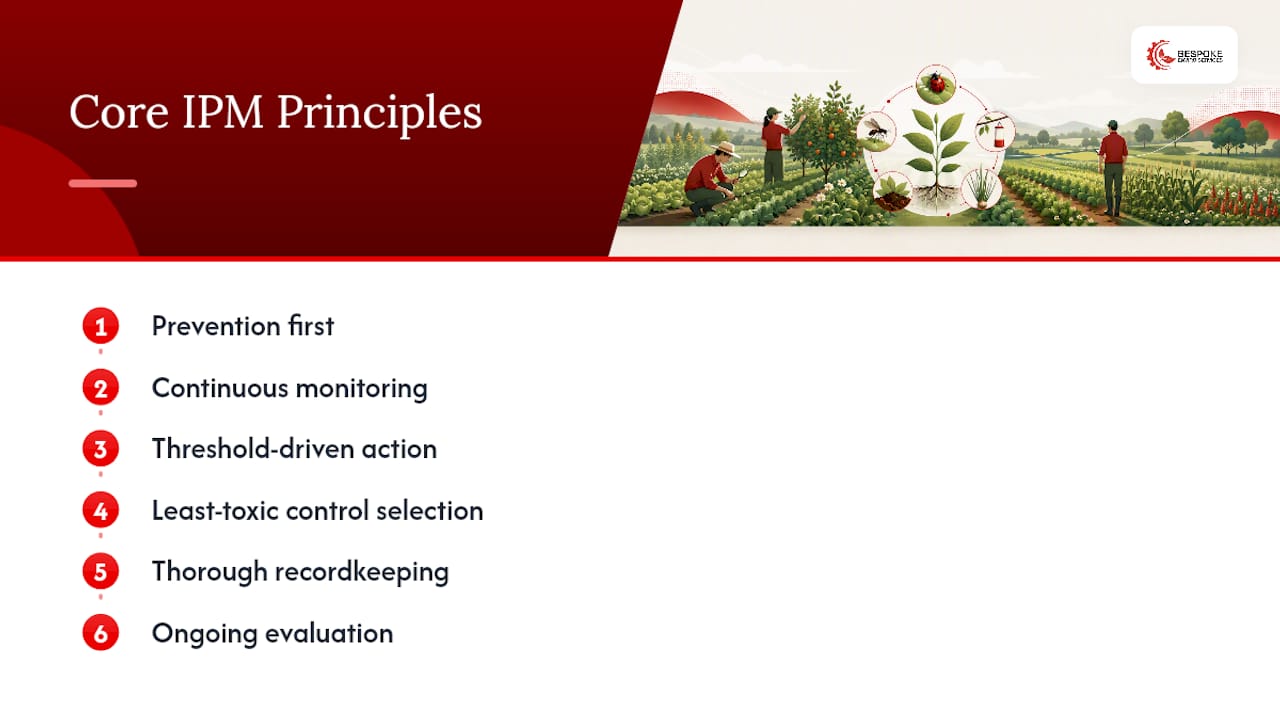
IPM is built on six interlocking principles: prevention first, continuous monitoring, threshold-driven action, selection of the least-toxic effective control, thorough recordkeeping, and ongoing evaluation. Remove any one of them and the system degrades into reactive spraying with better branding.
The EPA's IPM principles organize control tactics into four components, each representing a different category of tool:
Biological controls use natural enemies, competitors, or pathogens to suppress pest populations. Releasing Bacillus thuringiensis (Bt) to target mosquito larvae in standing water is a practical urban example. Encouraging predatory wasps in a vegetable garden is another.
Cultural controls modify the environment or human practices to make conditions less hospitable to pests. Crop rotation breaks pest cycles in agriculture. In a commercial kitchen, switching from cardboard storage boxes to sealed plastic bins removes a cockroach harborage site without a single spray.
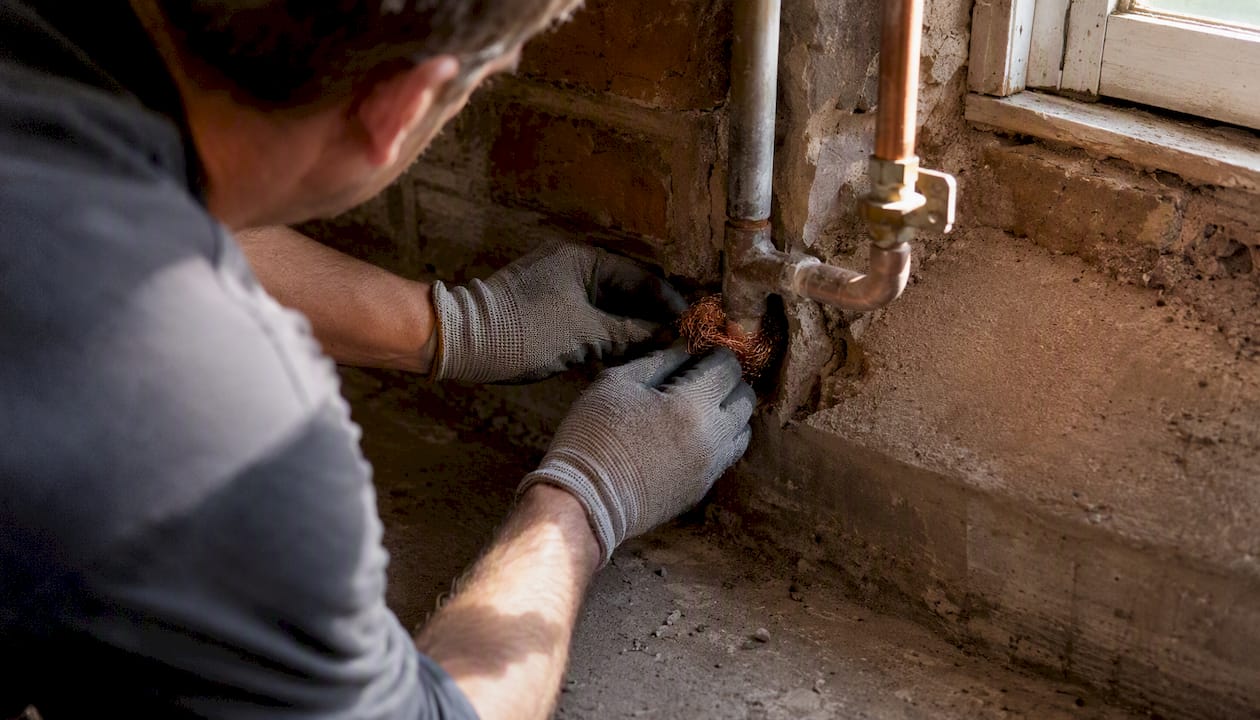
Mechanical and physical controls create barriers or directly remove pests. Door sweeps, copper mesh stuffed into rodent entry points, sticky traps, and UV light traps for flying insects all fall here. These are often the fastest wins in a new IPM program.
Chemical controls remain part of the toolkit, but in IPM they are selected for specificity and applied only when other methods have not kept pest pressure below the action threshold. Targeted bait gels, bait stations, and crack-and-crevice treatments are preferred over broadcast sprays. A recent PMC review of IPM's role in sustainable intensification confirms that combining these strategies reduces pesticide reliance while supporting ecosystem services, a finding that holds across both agricultural and structural pest management contexts.
The pesticide question is worth addressing directly. Pesticides are not banned under IPM. They are the last rung on a ladder, chosen for the narrowest possible spectrum and the lowest risk to non-target organisms. That discipline is what separates IPM from conventional spray programs.
The IPM process, step by step
UC ANR's IPM program describes the standard components as pest identification, monitoring, action thresholds, prevention, a combination of management tools, and after-action assessment. Here is how those components translate into an ordered sequence of decisions:
-
Conduct a baseline inspection. Walk the entire space, inside and out. Note moisture sources, cracks, gaps, food storage conditions, and any existing pest evidence (droppings, damage, shed skins, live or dead insects). Photograph everything.
-
Identify the pest correctly. Misidentification leads to the wrong treatment. A "termite" that is actually a carpenter ant requires a completely different response. Use close-up photos, a field guide, or send samples to a local extension service if you are unsure.
-
Set action thresholds. An action threshold is the pest population level or damage point at which you decide intervention is justified. One cockroach sighting in a commercial kitchen crosses the threshold immediately because of food safety regulations. A single spider in an office storage room likely does not. Thresholds vary by setting, pest species, and the risk tolerance of the occupants.
-
Implement prevention measures first. Before reaching for any control product, address the underlying conditions: seal entry points, fix leaks, remove harborage, improve sanitation. These steps reduce pest pressure without any chemical input.
-
Select and apply the least-risky control method. Work up the ladder: mechanical removal or trapping first, then biological options, then targeted chemical treatments if the threshold remains exceeded after non-chemical steps.
-
Evaluate and document results. Return to the monitoring data. Did trap counts drop? Did sightings decrease? If the population is still above threshold after a reasonable interval (typically two to four weeks), revise the plan rather than simply repeating the same treatment.
-
Schedule the next monitoring visit. IPM is a cycle, not a one-time event. Set a follow-up date before you leave the site.
Monitoring techniques and tools that actually work
Monitoring is where IPM succeeds or fails. Without reliable data on what pests are present, where they are concentrated, and at what population level, every subsequent decision is a guess.
Inspection checklist for structures:
- Check all plumbing penetrations, utility conduits, and expansion joints for gaps
- Inspect food storage areas, waste bins, and recycling stations for pest evidence
- Look behind and under appliances, especially refrigerators and dishwashers
- Examine window and door frames for damaged seals and weatherstripping
- Check attic and crawl space access points for rodent entry signs
For landscapes and gardens:
- Inspect the undersides of leaves for eggs, larvae, and feeding damage
- Check soil moisture and mulch depth (excess mulch against foundations invites termites and rodents)
- Look for ant trails, which often indicate aphid colonies or structural entry points nearby
| Monitoring tool | Best use | Recommended frequency |
|---|---|---|
| Visual inspection | General pest activity, structural conditions | Weekly (high-risk areas), monthly (low-risk) |
| Sticky traps (flat or delta) | Flying and crawling insects; population trending | Check every 1–2 weeks; replace monthly |
| Bait stations (rodents) | Rodent activity detection and control | Inspect every 2 weeks; service monthly |
| Pheromone traps | Species-specific moths, beetles, stored-product pests | Check weekly during active season |
| Moisture meter | Identify conditions conducive to termites and mold-associated pests | At each inspection in high-risk zones |
According to University of Minnesota's IPM World, monitoring schedules should be tailored to the pest species and setting, not applied as a blanket routine. A restaurant needs weekly trap checks; a low-occupancy warehouse may need only monthly rounds.
Pro Tip: When you find an unfamiliar insect, photograph it next to a coin for scale, capture a specimen in a sealed zip-lock bag if safe to do so, and send both to your local agricultural extension office or a licensed pest professional. A correct ID in 24 hours beats a wrong treatment applied immediately.
Prevention strategies you can start today
Prevention is the highest-leverage part of any IPM program because it reduces pest pressure before it becomes a problem, and it costs far less than reactive treatment. The EPA's IPM guidance is explicit: diagnosing and fixing underlying causes like moisture, structural gaps, and food sources is what prevents resurgence after treatment.
Sanitation checklist:
- Store all food (including pet food) in sealed, hard-sided containers
- Empty indoor waste bins daily in kitchens and food prep areas
- Clean grease traps, drains, and behind appliances on a regular schedule
- Fix dripping taps, leaking pipes, and condensation issues promptly
- Remove clutter from storage areas, which provides harborage for rodents and cockroaches
Exclusion steps:
- Seal gaps around pipes, cables, and conduits with copper mesh or expanding foam rated for pest exclusion
- Install or replace door sweeps on all exterior doors; a gap of 6mm is enough for a young mouse
- Repair or replace damaged window and door screens
- Caulk cracks in foundations, walls, and around window frames
- For significant structural gaps or damaged soffits, engage a contractor before pest treatment
Landscape and cultural measures:
- Keep mulch at least 30cm away from building foundations
- Trim vegetation so branches and shrubs do not contact the building envelope
- Time irrigation for early morning so soil dries before evening, reducing moisture that attracts pests
- For gardeners: rotate crops annually to break soil-dwelling pest cycles; remove spent plant material promptly rather than leaving it as a harborage site
A before-and-after example worth noting: a commercial kitchen that switched from open-top waste bins to pedal-operated sealed bins and moved its cardboard recycling outside reduced cockroach trap counts by a measurable margin within the first monitoring cycle, without any pesticide application.
Choosing and sequencing control methods
Once prevention measures are in place and a threshold has been crossed, the question becomes which control method to use and in what order. The principle is straightforward: start with the least-risky option that is likely to be effective, and escalate only when monitoring data shows it is not working.
Physical and mechanical controls come first. Snap traps for rodents, sticky boards for crawling insects, and exclusion repairs address the immediate population without introducing chemical residues. Biological controls, where applicable, come next: Bt for mosquito larvae, beneficial nematodes for soil-dwelling grubs, or predatory insects for garden pests.
When chemical treatment is warranted, targeted formulations outperform broadcast sprays on every relevant metric. Bait gels applied in crack-and-crevice locations for cockroaches, bait stations for rodents, and spot treatments for ant trails all deliver the active ingredient where pests encounter it, not where people and pets do. The PMC sustainability review documents that this kind of targeted application, combined with non-chemical tactics, is what drives the reduction in pesticide reliance that IPM promises.
Resistance management matters. Repeated use of the same chemical class selects for resistant pest populations. Rotating modes of action (for example, alternating between a pyrethroid and an insect growth regulator for mosquito control) slows resistance development. Blanket sprays accelerate it.
Safety considerations when chemical treatment is necessary:
- Read the label in full; the label is the law
- Use the lowest effective rate and the most targeted application method
- Vacate treated areas for the time specified on the label
- Store all pesticide products in original, labeled containers away from food and children
- Request Safety Data Sheets (SDS) from your pest professional for every product applied in your space
How IPM works across different settings
The core IPM logic stays constant, but priorities and thresholds shift significantly depending on where you are applying it.
Homes and residential buildings
In a home, the most common IPM targets are cockroaches, rodents, ants, mosquitoes, and termites. Prevention (sanitation, exclusion, moisture control) carries the most weight. Thresholds are set by the homeowner's risk tolerance and the pest's health implications: a single rodent dropping in a kitchen warrants immediate action; a lone ant near a window may not. Termite monitoring requires professional-grade tools (moisture meters, acoustic detection) and should not be treated as a DIY task.
Schools and daycare centers
The EPA specifically promotes IPM for schools because it reduces children's exposure to both pests and pesticide residues. In these settings, thresholds are set conservatively, chemical treatments are scheduled during non-occupancy hours, and all products used must be disclosed to parents and staff. Sanitation protocols and structural maintenance are the primary tools.
Restaurants and commercial kitchens
Food safety regulations in most jurisdictions set the effective action threshold at zero for cockroaches and rodents in food contact areas. IPM in a commercial kitchen means daily sanitation, weekly trap checks, monthly professional inspections, and immediate corrective action on any pest evidence. The EU's sustainable use framework and equivalent regulations in Singapore both require documented pest management programs for licensed food businesses.

Small farms and urban agriculture
Here, biological controls take on greater importance. Companion planting, beneficial insect habitat, and crop rotation are primary tools. Chemical applications, when needed, are timed to minimize impact on pollinators and are selected for the narrowest possible spectrum. The FAO's IPM framework emphasizes growing healthy crops with minimal disruption to agro-ecosystems, which translates practically to soil health, plant nutrition, and water management as pest prevention tools.
How to start an IPM program in 90 days
Starting an IPM program does not require a large budget or a specialist on day one. What it requires is a structured approach and consistent follow-through.
-
Week 1: Baseline inspection. Walk the entire property with a flashlight and a notepad. Document every pest sign, every potential entry point, and every conducive condition (moisture, clutter, food sources). Take photographs.
-
Week 1–2: Quick fixes. Address the easiest prevention items immediately: seal obvious gaps, fix leaking taps, move stored materials off the floor, install door sweeps. These actions reduce pest pressure before any monitoring data comes in.
-
Week 2: Deploy monitoring tools. Place sticky traps in corners, along walls, and near known pest activity. Set rodent bait stations at exterior entry points if rodent evidence was found. Label each trap with a number and location.
-
Week 4: First monitoring review. Check all traps. Record counts by location. Identify any new pest evidence. Decide whether any threshold has been crossed and, if so, select the appropriate least-toxic control response.
-
Days 30–90: Adjust and document. If a control measure was applied, evaluate its effectiveness at the next monitoring visit. Revise the plan if trap counts are not declining. Schedule a quarterly review date.
Key questions to ask a pest professional before signing a contract:
- What pests did you find during the inspection, and what conditions are contributing to them?
- What non-chemical options will you use first?
- What pesticides might be applied, and can I see the Safety Data Sheets?
- How will you document each visit and share records with me?
- What is the monitoring cadence, and what triggers an unscheduled visit?
- What does the warranty or service guarantee cover, and what are the contract terms?
A professional who cannot answer these questions clearly is not running a genuine IPM program.
What a professional IPM program looks like in practice
A reputable IPM provider does not arrive with a backpack sprayer and a fixed schedule. The service starts with a documented inspection report that identifies the pest species present, maps entry points and harborage sites, notes conducive conditions, and prioritizes corrective actions by urgency.
From that report, the provider develops a written action plan that specifies the goals (reduce rodent activity below threshold within 30 days), the tactics chosen (bait stations at six exterior points, exclusion repairs at three identified entry points), the safety procedures for each product used, and the monitoring schedule going forward.
What to expect from a quality IPM provider:
- A written inspection report with pest ID, entry points, and prioritized action list
- Safety Data Sheets for every product applied on your property
- A documented action plan with stated thresholds and chosen tactics
- Scheduled follow-up visits with written reports after each one
- Searchable service records you can access for compliance or audit purposes
- Clear communication about what non-chemical options were tried before any pesticide was used
- Disclosure of any regulatory requirements relevant to your setting (food safety, school notification laws)
| Service element | What it looks like in practice |
|---|---|
| Inspection report | Written document with pest ID, map of findings, conducive conditions, and action priorities |
| Action plan | Stated goals, thresholds, chosen tactics, safety notes, and monitoring schedule |
| Safety Data Sheets | Provided for every product before or at time of application |
| Follow-up reports | Written summary after each visit: trap counts, observations, actions taken, next steps |
| Service records | Dated, accessible log of all visits, findings, and treatments |
Bespoke-enviro applies this professional structure across residential, commercial, industrial, and construction settings, with over 30 years of field experience and a documented commitment to non-toxic, targeted treatments. The NEA's Singapore Standard 721-2025 formalizes exactly this kind of science-based, risk-minimizing IPM framework for pest control providers operating in Singapore.
Recordkeeping and evaluating whether your IPM program is working
Documentation is not paperwork for its own sake. It is the mechanism that tells you whether the program is working, where it is failing, and what to do next. Without records, you are repeating the same actions and hoping for different results.
Sample IPM log fields:
| Field | What to record |
|---|---|
| Date and time | When the inspection or service visit occurred |
| Inspector name | Who conducted the visit |
| Trap counts by location | Number of insects or rodents captured at each labeled trap |
| Live sightings | Species, location, and estimated number |
| Environmental observations | Moisture readings, new structural damage, sanitation issues noted |
| Actions taken | Products applied (name, rate, location), mechanical repairs, sanitation corrections |
| Follow-up date | When the next visit is scheduled |
Review cadence and escalation triggers:
Review monitoring data monthly for low-risk settings, weekly for high-risk ones (food service, healthcare). A program is performing well when trap counts trend downward over two to three consecutive monitoring periods and no new pest evidence appears between visits.
Escalate the plan when trap counts plateau or increase after two consecutive monitoring periods, when a new pest species appears, or when structural damage is found that requires contractor work. Consult a public health authority or extension service when a pest poses a direct public health risk (rodents in a food facility, mosquito breeding in a dengue-risk area) or when you are uncertain about the regulatory requirements for your setting. The IPMnet program at University of Maryland Extension offers regionally specific monitoring protocols and identification resources for practitioners who need supplemental technical guidance.
Benefits and real limitations of IPM
IPM delivers on several fronts that routine spraying does not.
Benefits:
- Reduced pesticide exposure for occupants, workers, and non-target organisms
- Lower long-term costs through fewer emergency treatments and reduced chemical volume
- Slower development of pesticide resistance in target pest populations
- Improved indoor air quality and reduced chemical residues in food environments
- Compliance support for regulated settings (food service, schools, healthcare)
- Documented service records that demonstrate due diligence to auditors or insurers
The EPA's IPM introduction specifically highlights the health benefit for schools: IPM reduces children's exposure to both pests and pesticide residues, which is a meaningful distinction when the alternative is routine broad-spectrum spraying in occupied buildings.
The limitations are real and worth stating plainly. IPM takes longer to show results than a blanket spray. It requires active cooperation from the client: a pest professional cannot maintain a cockroach-free kitchen if the client's sanitation practices create new harborage every week. The Straits Times has reported that IPM requires active partnership between the client and the pest professional, with client actions like sanitation, fixing leaks, and sealing entry points often being decisive for success. Up-front inspection and monitoring costs more than a single spray visit, and some structural exclusion work requires a contractor, adding to the initial investment.
Pro Tip: Set expectations before the program starts: IPM manages pest populations below a damage threshold, not to zero. A client who expects zero pests after the first visit will be disappointed. A client who understands that the goal is a sustained downward trend in pest activity will recognize success when they see it.
The case for treating IPM as a management mindset, not a product
Most pest control failures we see come from the same source: treating a pest problem as an event rather than a condition. A cockroach infestation in a food facility is not an event that a spray visit resolves. It is a condition created by moisture, harborage, and entry points that will reassert itself until those drivers are addressed.
The practitioners who get the best long-term results are the ones who set thresholds in writing before they start, document every visit without exception, and resist the pressure to spray when monitoring data does not justify it. Two practical habits that separate effective IPM from well-intentioned but ineffective programs: first, never skip a monitoring visit even when conditions look clean, because that is exactly when early warning signs are missed; second, document the reason for every decision not to treat, not just the decisions to treat. That record is what lets you defend the program to a client or regulator and what lets you learn from it over time.
The long-term risk of repeated broad-spectrum spraying is not just resistance, though that is real and documented. It is the destruction of the beneficial insect populations that provide natural pest suppression. Once those populations are gone, the pest pressure that returns is harder to manage with the same tools. IPM preserves that natural buffer while keeping pest populations at manageable levels.
Bespoke-enviro's IPM-based pest control services
For property owners and facility managers who want a professional IPM program without the guesswork of building one from scratch, Bespoke-enviro brings over 30 years of field experience to every engagement. The difference from a standard spray service is structural: every job starts with a documented inspection, a written action plan with stated thresholds, and a monitoring schedule, not a fixed spray calendar.

Service features include thorough pest inspections with written reports, customized IPM plans for residential, commercial, industrial, and construction settings, non-toxic and targeted treatment options for termites, rodents, cockroaches, mosquitoes, bedbugs, and pest birds, scheduled monitoring visits with written follow-up reports, and full documentation for compliance and audit purposes. Bespoke-enviro's approach aligns with the NEA's Singapore Standard 721-2025 framework for science-based, risk-minimizing pest management.
To book an inspection or discuss a maintenance contract, visit Bespoke-enviro and request a site assessment. The inspection is where every effective IPM program begins.
Sources
- Introduction to Integrated Pest Management — US EPA
- What is IPM? — UC ANR
- Integrated Pest Management: An Update on the Sustainability Approach to Crop Protection — PMC/NCBI
- Background on Singapore Standard 721-2025 — NEA