
Deploy a construction focused IPM plan built on four pillars: weekly inspections, pre-construction termiticide barriers, strict site sanitation, and a named site contact who owns follow-through. That combination, run against NEA guidance and documented through handover, is what keeps a site out of trouble with mosquitoes, termites, and rodents alike. Bespoke Enviro Services builds this exact structure into every commercial site contract we run, because a static pest plan written once and filed away is the single most common failure we see.
Act on these within 24 to 72 hours:
- Inspect the site for standing water and container storage regularly.
- Secure food waste and eating areas with sealed, rodent-proof bins.
- Confirm pre-construction soil treatment has been scheduled or completed if applicable.
- Appoint one named site contact responsible for pest coordination.
Pro Tip: Put the site contact's name and phone number on the site notice board next to the pest control schedule. Workers report problems faster when they know exactly who to call.
Key Takeaways
Construction site pest control succeeds when weekly IPM inspections, pre-construction termiticide barriers, and strict sanitation run together under one accountable site contact.
| Point | Details |
|---|---|
| Lead with IPM structure | Build the pest plan around survey, monitoring, targeted control, and maintenance through handover. |
| Treat mosquitoes weekly | Remove standing water and inspect containers on a weekly cycle rather than reacting to complaints. |
| Install termiticide barriers early | Document soil treatment before groundbreaking and re-verify after any design change. |
| Assign one site contact | A named foreman or manager prevents accountability gaps between contractor, client, and pest operator. |
| Partner for full coverage | Bespoke Enviro Services runs surveys, termiticide installation, weekly monitoring, and emergency response under one contract. |
Table of Contents
- What Does Construction Site Pest Control Involve for Mosquitoes?
- How Do You Prevent Termites Before Construction Starts?
- Site Sanitation, Material Storage, and Rodent Control
- How Do You Stop Standing Water From Attracting Mosquitoes?
- Building an Inspection and Monitoring Schedule
- How to Implement IPM on a Construction Project
- Typical Costs and Timelines for Construction Pest Control
- A Site-Ready Pest Control Checklist You Can Use Today
- Get Compliance-Ready Pest Protection for Your Site
- Frequently Asked Questions
- Sources
What Does Construction Site Pest Control Involve for Mosquitoes?
Mosquito controls involve treating stagnant water, inspecting water-holding containers, and removing standing-water habitats regularly to prevent breeding. NEA's guidance for construction sites centers on exactly this cycle of source reduction backed by targeted treatment.
- Treat unavoidable standing water with larvicide where drainage isn't possible.
- Drain or cover small containers like buckets, tarps, and equipment trays every few days.
- Remove straw or silt socks once they've served their erosion-control purpose, since they hold water long after installation.
- Reserve fogging and residual spraying for confirmed adult mosquito activity, not as a default weekly measure.
Insecticide application on active sites carries real safety weight. Schedule treatments outside peak worker shifts and give notice to adjacent residences when spraying near site boundaries.
Pro Tip: Coordinate mosquito treatment timing with your site's shift changeover. A ten-minute buffer before workers arrive keeps everyone clear of fresh spray without delaying the schedule.
How Do You Prevent Termites Before Construction Starts?
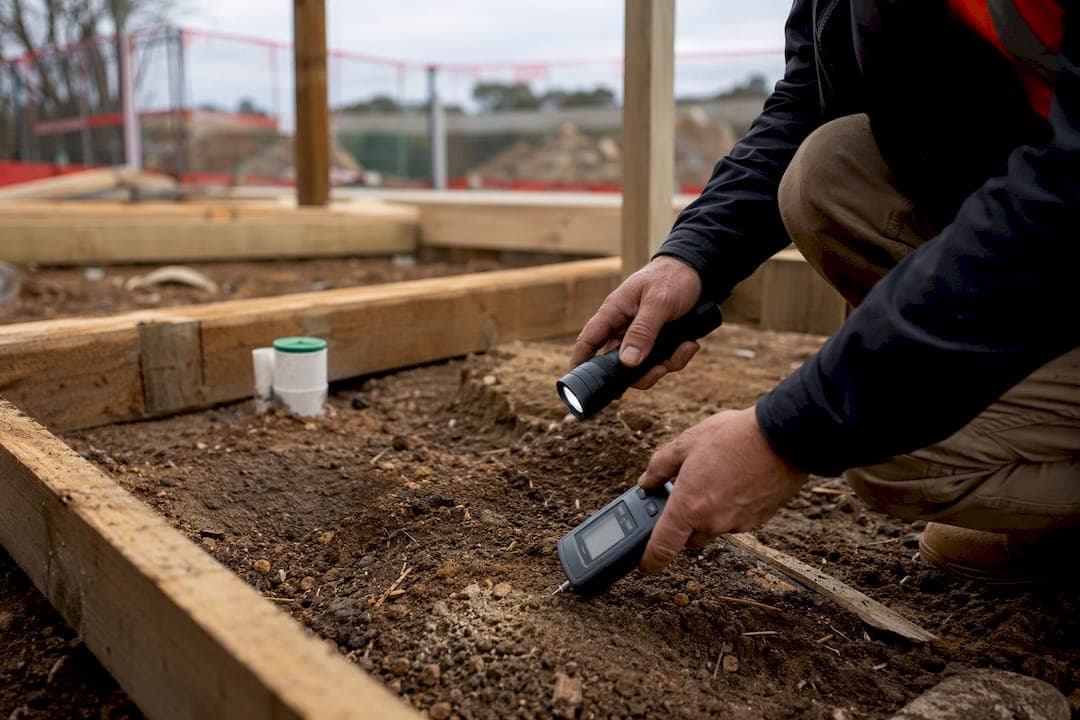
Install a pre-construction soil termiticide barrier and document its installation before any structural work begins. Subterranean termites move through soil undetected, and a gap in the barrier at foundation stage is nearly impossible to fix later without invasive remediation.
The process runs in three stages:
- Site survey to map soil conditions, drainage, and termite pressure specific to the plot.
- Barrier specification and verified installation, confirmed by a qualified applicator, not assumed from a general contractor's schedule.
- Sign-off and recordkeeping that follows the project through every trade change and into handover documentation.
If the building design changes after the barrier goes in, notify the termite installer immediately. The AEPMA Code of Best Practice frames this as whole-of-building management, not a one-time task, because a single unprotected penetration point undermines protection for the structure's full lifespan.
| Stage | What Happens |
|---|---|
| Survey | Assess soil type, moisture, and existing termite activity on the plot |
| Installation | Apply termiticide barrier per specification, verified by a qualified installer |
| Sign-off | Document installation with photos, product data, and installer certification |
| Handover | Transfer records to the building owner for long-term reference |
Site Sanitation, Material Storage, and Rodent Control
Good sanitation, correct material storage, and regular debris removal do more to prevent rodent and fly problems than any single treatment. Industry guidance points out that excavation itself displaces rodents from their existing burrows, pushing them toward whatever food and shelter your site offers next.
Site sanitation rules worth enforcing daily:
- Designate specific eating areas away from material storage and open trenches.
- Use sealed, rodent-proof bins and empty them on a fixed daily schedule.
- Maintain portable toilets regularly, since they attract flies fast in warm weather.
- Clear debris piles before they sit long enough to become harborage.
Material storage matters just as much as cleanup. Palletize stock, keep it under covered storage where possible, and maintain clearance from the ground and site perimeter fencing.
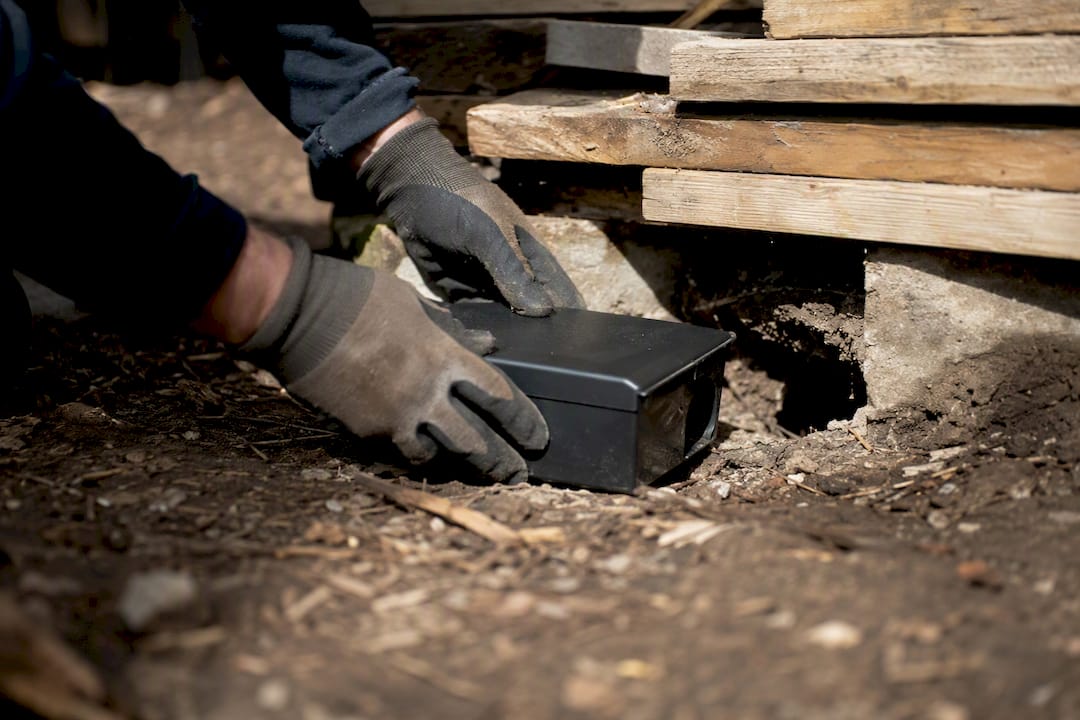
A rodent program includes burrow control before disruptive work begins, followed by bait-station placement and regular inspections. Record every sign you find, droppings, gnaw marks, tracks, with date, location, and photo.
Pro Tip: Walk the storage perimeter at the end of each week, not just the active work zones. Rodents nest where materials sit undisturbed longer than the construction schedule itself.
How Do You Stop Standing Water From Attracting Mosquitoes?
Eliminate standing water, keep drains clear, and inspect the site after every storm event. This single habit prevents more mosquito activity than any chemical treatment applied afterward.
- Check containers, equipment trays, and tarps for pooled water weekly.
- Inspect temporary ponds and open trenches for stagnant conditions.
- Examine silt socks and straw bales, both of which trap water long after rain stops.
- After storms, drain what you can immediately and apply larvicide to water that can't be removed within 24 hours.
- Log every action taken, including date, location, and method, for your inspection record.
Building an Inspection and Monitoring Schedule
Adopt a documented inspection schedule that starts before ground is broken and intensifies during disruptive construction phases. Harvard's EH&S guidance calls for eradicating detectable rodents before work starts, then running weekly surveys of both the construction zone and bordering areas throughout the project.
| Phase | Inspection Frequency |
|---|---|
| Pre-construction baseline | One-time survey before groundbreaking |
| Active construction | Weekly |
| Excavation or demolition (disruptive phases) | Twice weekly, plus targeted follow-up |
| Handover period | Final inspection with full documentation transfer |
Assign roles clearly:
- The site foreman acts as the on-site contact for daily pest issues.
- The pest operator handles treatment, monitoring, and technical reporting.
- Both parties keep records accessible for audit, since repeated worker complaints or a public nuisance report can trigger escalation and regulatory scrutiny fast.
How to Implement IPM on a Construction Project
Implement IPM as a sequence, not a one-time service call: initial survey, baseline treatments, sanitation contracts, ongoing monitoring, targeted intervention, and maintenance through occupancy. NEA frames IPM for construction sites as identifying root causes rather than reacting to visible pests, which changes how the whole schedule gets built.
- Client commissions an initial survey before or at groundbreaking to establish baseline conditions.
- Pest operator installs baseline treatments, including termiticide barriers and initial rodent control.
- Contractor manages sanitation under a written agreement covering waste, storage, and site cleanup.
- Pest operator runs weekly monitoring, adjusting frequency during disruptive phases.
- Targeted interventions address confirmed activity rather than blanket spraying.
- Maintenance continues through handover, with records transferred to the building owner.
Track these metrics at every visit:
- Inspection date and location
- Pest evidence type (droppings, gnaw marks, larvae, adult insects)
- Actions taken and materials used
- Bait consumption levels
- Photo documentation
Typical Costs and Timelines for Construction Pest Control
Budget for four line items: an initial survey, pre-construction soil treatment, recurring weekly maintenance visits, and reserve funds for one-off emergency response. Costs shift based on site size, existing pest pressure, site accessibility, and how many inspections the schedule requires.
- Initial survey: typically a single visit before groundbreaking, scoped to site size.
- Pre-construction soil treatment: a one-time cost tied to the building footprint and soil conditions.
- Weekly maintenance: an ongoing line item that scales with construction duration.
- Emergency response: budgeted as a contingency reserve, not a fixed recurring cost.
If budget is tight, prioritize prevention and sanitation first. A clean, well-managed site with proper storage reduces the need for reactive treatments later, helping control costs.
A Site-Ready Pest Control Checklist You Can Use Today
A compact, printable checklist covering daily, weekly, and phase-specific items keeps pest control consistent even as crews and subcontractors rotate through the project.
| Frequency | Checklist Item |
|---|---|
| Daily | Trash removal, food waste sealed, eating area kept clean |
| Weekly | Site survey for standing water, rodent sign, insect activity |
| Phase-specific | Termiticide re-verification after design changes, post-storm water check |
| Ongoing | Inspection log updated with date, location, evidence, action, and responsible person |
Set clear escalation triggers: an active rodent burrow found on-site, more than three mosquito breeding sites identified in one inspection, or repeated worker complaints about pest activity. Any of these should prompt an immediate call to your pest operator rather than waiting for the next scheduled visit. Store inspection records centrally, ideally with the site foreman, so they're ready for audit or handover without a scramble.
A Practical Perspective From Bespoke Enviro Services
Construction sites fail at pest control when the plan sits in a binder instead of a weekly routine. We've found that sites with a named contact and consistent documentation avoid the delays and complaints that stall handover. Contact us for a site survey before your next phase begins.
Get Compliance-Ready Pest Protection for Your Site
Bespoke-enviro is the practical alternative to piecing together pest control from multiple contractors on a construction site: one team handles the survey, the termiticide barrier, the weekly monitoring, and emergency response, all under a single point of contact and one set of records.

Our construction service package covers site surveys, pre-construction termiticide installation, weekly monitoring contracts, and emergency response when something turns up between scheduled visits. It means fewer delays from pest-related stop-work risk, compliance-ready documentation your project team can hand straight to the client at closeout, and eco-friendly treatment options that keep the site safer for workers and neighboring residents. Whether you're scoping a new build or need to fix gaps in an existing pest plan mid-project, reach out through Bespoke Enviro Services to request a quote and schedule a site visit before your next construction phase begins.
Frequently Asked Questions
How often should a construction site be inspected for pests? During active construction, inspections should occur regularly, with increased frequency during disruptive phases like excavation or demolition, based on Harvard's construction pest guidance.
Is pre-construction termiticide treatment required before building starts? Soil termiticide barriers should be installed and documented before structural work begins, since retrofitting protection after foundations are poured is far more disruptive and costly.
What's the fastest way to reduce mosquito breeding on an active site? Remove or treat standing water in containers, trenches, and equipment weekly. This single step addresses the root cause NEA identifies for construction-site mosquito breeding.
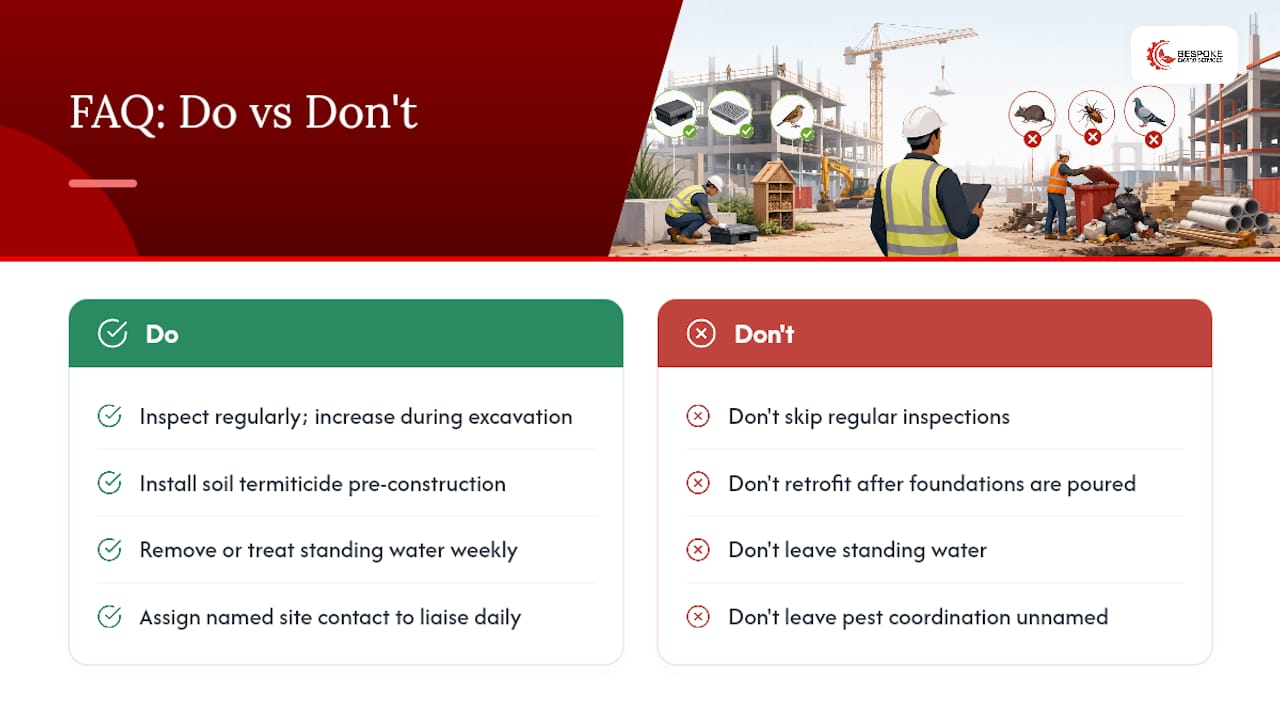
Who should be responsible for pest control coordination on-site? A named site contact, usually the foreman, should liaise daily with the pest operator and enforce sanitation rules, closing the accountability gap that causes most pest plan failures.
Sources
- Mosquito control in construction sites (NEA)
- Working with contractors to keep construction sites pest-free (PCT Online)
- Pest control requirements for construction projects (Harvard EH&S)
- AEPMA Code of Best Practice for Termite Management During Construction