
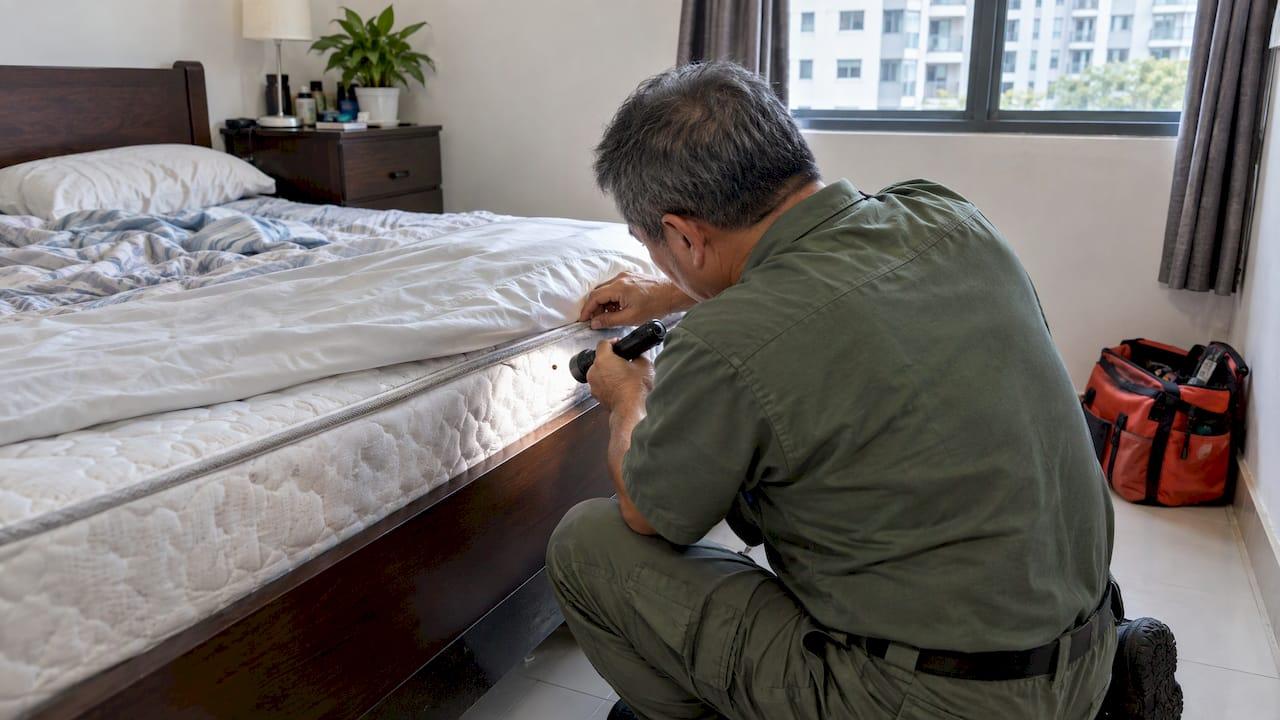
Bed bugs that survive a treatment are common, and the cause is usually one of a few things: bugs hiding where the treatment did not reach, eggs that hatched after it, preparation that was incomplete, or insecticide-resistant bugs. A single visit rarely settles a full infestation. The way forward is a proper inspection of what is left, a follow-up plan, and a method that does not rely on one product alone. That is how we approach bed bug control at Bespoke Enviro Services, using integrated pest management (IPM), which combines inspection, several control methods and monitoring.
This guide is for Singapore homeowners, property managers and business owners who have had treatment and still see bugs, bites or stains. It explains why it happens, how to check whether bed bugs are really still active, and what to do next.
TL;DR
- Seeing a bed bug days after treatment does not always mean the treatment failed. Eggs can hatch afterward, and a follow-up visit is normally part of the plan.
- The US EPA lists missed hiding places, poor preparation, untreated nearby areas, no follow-up and resistance as the main causes of failure.
- Check for new activity: bites, fresh stains on sheets, live bugs. Several weeks without any sign, with monitoring in place, is the accepted standard for elimination.
- Do not use bug bombs or throw out furniture in a panic. Both can scatter bugs or spread them to other rooms and units.
- Ask for a fresh inspection of the whole unit and neighboring rooms, and a combination of methods rather than a repeat of the same one.
Table of Contents
- Why bed bugs survive a treatment
- Is it still active? How to check after treatment
- What to do if you find a bed bug after treatment
- What a proper follow-up looks like
- Should you replace your mattress?
- Reinfestation or survivors? Telling them apart
- Our perspective
- Get the bed bugs out for good
- Preventing bed bugs from coming back
- FAQ
- Sources
Why bed bugs survive a treatment
Bed bugs are built to hide. The US EPA notes that they can live in a crack as thin as a credit card, which makes them hard to reach. Its list of reasons treatments fail is a useful checklist for any home:
- Bed bugs or hiding places were missed.
- The home was not prepared properly.
- Nearby areas were not treated.
- A pesticide was applied at the wrong rate.
- No follow-up took place after eggs hatched.
- A slow-acting product was not given enough time.
- The bugs were resistant to the product.
Each of these can happen in a Singapore flat. Look at how the pests behave. They shelter in mattress seams, bed frames, headboards, sofa joints, skirting boards, curtain folds, power sockets and behind picture frames. In a dense building with shared walls and ceiling voids, they can also move between units.
Eggs and the hatching gap
Eggs are the most common reason people see bugs again a week or two later. According to UF/IFAS Extension, one female can lay 200 eggs in her lifetime, and it may take more than one treatment to kill adults, nymphs and eggs. Many treatments reach the bugs that are active but not every egg. Young bugs that hatch afterward are the reason a second visit is planned.
This is why a bed bug seen a few days after the first visit is not automatic proof of failure. It does mean you should report it and have the area inspected, so the plan can be adjusted.

Preparation that falls short
Treatment only works on what it can reach. Bedding left in piles, clutter under the bed, items stacked against walls and furniture pushed against skirting boards all give bugs places to survive. Our guide on bed bug treatment preparation explains what to do before we arrive, room by room. Good preparation and a thorough inspection together give the treatment its best chance.
Untreated neighboring areas
Bed bugs do not stay in the bed. The EPA lists untreated nearby areas as a cause of failure. If bugs are in the sofa, a spare room or a neighbor's unit and only the main bedroom is treated, the survivors will return. In offices, hotels and serviced apartments the same thing happens with adjoining rooms, which is why our guides on bed bugs in offices and the hotel pest control checklist stress inspecting beyond the first complaint.
Insecticide resistance
Resistance is a real factor worldwide. A 2017 peer-reviewed review of bed bug resistance attributes the global resurgence of bed bugs largely to insecticide resistance. It describes several mechanisms: a thicker outer shell that slows penetration, more detoxifying enzymes, and genetic mutations (known as kdr) that make bugs less sensitive to common insecticides.
The EPA adds that resistance can only be confirmed in laboratory tests, so you cannot tell from looking at a surviving bug. What you can do is choose a method that does not depend on a single chemical. A Tennessee Extension article reports that in one US test, at best 34% of a resistant strain died after almost a week on treated furniture material. It recommends rotating insecticide classes, direct spraying of bugs when residues do not work, and desiccant dust, which dries bugs out and is one of the few effective residual options.
This is the practical reason for a combined approach. Heat, vacuuming, steam, harbourage removal, dusts and targeted products attack the problem in different ways, so a bug that shrugs off one still meets another.

Is it still active? How to check after treatment
Before deciding the treatment failed, confirm what you are seeing. Fresh activity looks different from leftovers.
Signs that point to bed bugs
The EPA's inspection guide lists the physical signs to look for:
- Rusty or reddish stains from crushed bugs.
- Dark spots of excrement that may bleed on fabric.
- Tiny eggs, about 1 mm, and eggshells.
- Pale yellow shed skins from young bugs.
- Live bed bugs.
Old stains and shed skins can remain after treatment, so a stain alone does not prove a new problem. New stains on freshly changed sheets, new bites, or a live bug are what count. StopPests.org defines activity as any sign of bites, new fecal stains on sheets or sightings.
A simple routine for the weeks after treatment
- Note the date you last saw a bug, a bite or a fresh stain.
- Inspect with a flashlight the bed, mattress seams, headboard, upholstered furniture and fixtures within about 10 feet (3 meters) of the bed.
- Check adjacent rooms, not only the treated one.
- Use bed bug monitors under or near the bed legs, placed as the manufacturer directs.
- Keep a log of anything you find, with photos and dates.
StopPests.org advises evaluating each treatment within two weeks by interviewing occupants, inspecting treated and nearby rooms, and using monitors. It adds that no activity for 60 days with proper monitoring is generally accepted as proof of elimination. That gives you a clear finish line, and it also means one quiet week proves little.
Bites alone are not proof
Bites vary from person to person and look like many other skin reactions, so they are a weak guide. Singapore's National Environment Agency (NEA) says in a 2024 parliamentary reply that bed bugs do not transmit diseases but can cause discomfort, itching and allergic reactions. If you have a strong skin reaction, see a doctor. Treat bite marks as a reason to inspect, not as the diagnosis.
What to do if you find a bed bug after treatment
A live bug or fresh sign after treatment is frustrating, but there is a clear order of steps.
- Stay calm and do not self-medicate the room. The UF/IFAS guide says bug bombs and herbal remedies are ineffective. Spraying leftover products on top of a professional treatment can also disturb the residues and push bugs into new spaces.
- Document it. Take a photo, note the room and date, and keep the bug if you can in a sealed bag or tape.
- Do not move bedding and furniture around. Carrying bags of bedding through the home, or dragging a mattress to another room, spreads bugs. Seal items in bags before moving them.
- Contact your provider quickly. Report what you found and when. A prompt re-inspection finds out whether this is a new hatch, a missed hiding place or a new source.
- Keep sleeping arrangements consistent. Moving to the sofa or another bedroom can take bugs with you.
- Wash and dry bedding on high heat. Drying at the highest setting, about 140°F, for 20 to 30 minutes is recommended by UF/IFAS. Heat kills all stages.
If you live in a condominium or HDB block and suspect the bugs are coming from a neighboring unit, tell your property manager or management council. Shared walls and cable or pipe penetrations can let bugs travel, and one treated unit among several infested ones will not stay clear.
If you are in the middle of a contract with us, tell us right away. Our technicians are NEA-licensed and available 24/7, so a report does not have to wait for office hours.
What a proper follow-up looks like
Bed bug control is a process, not a single spray. The MSU Extension guidance says a conventional chemical program usually needs at least one follow-up treatment about two weeks later. The pest professional inspects to assess results, and if bed bug numbers have not clearly dropped, a combination of methods or an alternative treatment may be needed.
What a good re-inspection covers
- Bed frame, headboard, slats and mattress seams and tags.
- Upholstered furniture, cushions and joints.
- Skirting boards, wall cracks, sockets and behind frames.
- Curtains, bags, clothing storage and clutter.
- Adjacent rooms and any shared walls.
The aim is to find where the survivors are, not to repeat the first visit. Thorough inspection is the part of treatment that matters most, and it is also where technology helps. We use advanced tools such as thermal imaging in our inspections to help build a complete picture of a property.
Changing the method
If bugs survived one approach, the next visit should not simply repeat it. NEA's guidance on managing bed bugs describes a typical plan that combines vacuuming, hot laundering, steam and heat treatment, elimination of hiding places and insecticides, and advises infested premises to engage a pest management company. The combination is the point. Our article on bed bug heat treatment explains how heat works for homeowners, including why it reaches into places a surface application can miss.
Timeline and cost expectations
Expect weeks, not days. Treatment, a follow-up around two weeks later, then a monitoring period of up to about 60 days with no activity is a realistic picture. Cost depends on the size of the property, the extent of the infestation and the methods used. Our guide to bed bug treatment cost in Singapore explains what drives the price.
Should you replace your mattress?
Many people want to throw the mattress out immediately. In most cases that is unnecessary and can spread the problem if the mattress is dragged through corridors and lifts. Guidance on whether to replace a mattress after bed bugs points to treating first. A mattress and pillow encasement, recommended by UF/IFAS, traps any remaining bugs inside and gives you a cleaner surface to inspect. If a mattress is badly damaged, wrap it fully in plastic before moving it.
Reinfestation or survivors? Telling them apart
When bugs appear again, the question is whether they are survivors or newcomers. The answer changes what you do.
| Clue | Points to survivors | Points to reinfestation |
|---|---|---|
| Timing | Within roughly 2 to 3 weeks of treatment | Weeks or months of quiet first |
| Location | Same bed, same furniture | New rooms, luggage, a visitor's bag |
| Life stage | Small nymphs, fresh eggs | Mixed adults found in a new spot |
| Neighbors | No reports | Shared wall or adjoining unit reports |
This is a guide, not a diagnosis. Bugs can arrive on luggage after travel, on second-hand furniture, or on clothing from public places. NEA has advised the Civil Aviation Authority of Singapore, Changi Airport Group, the Singapore Tourism Board and the Singapore Hotel Association to check and clean beds, furniture and luggage areas, which shows how many places can be a source. NEA also encourages premises owners to engage professional pest control operators if infestations occur.
Our perspective
Most of the calls we hear about bed bugs that survived treatment come back to the same thing: the plan relied on one step. Bed bugs hide deeply, their eggs hatch on a schedule, and some populations tolerate common insecticides. That is why we build our work on integrated pest management: inspection first, then a combination of methods, then monitoring.
Our technicians are NEA-licensed, and we favor non-toxic, environmentally safe methods because the people sleeping in these rooms, including children and pets, matter as much as the result. We use tools such as thermal imaging to support inspection, and we are available 24/7 because a bed bug problem rarely waits for a convenient day.
If you still see bugs after a treatment, the answer is a careful re-inspection of the whole unit and its neighbors, and a method matched to what is found. That is what we aim to deliver for homes, offices and hospitality properties across Singapore.
Bespoke-Enviro Services
Get the bed bugs out for good
If bed bugs have survived a treatment in your home, office or rental property, you do not need to live with them. Our bed bug control service covers inspection and treatment for residential, commercial and industrial properties in Singapore, using non-toxic, eco-friendly methods that put people and pets first.

For property managers with several units or ongoing concerns, our general pest control service provides a structured approach to inspection and maintenance. Contact us through our website to arrange an inspection.
Preventing bed bugs from coming back
Once activity has stopped, keep it that way.
- Inspect the bed, headboard and sofa seams every few weeks.
- Keep monitors under the bed legs through the confirmation period.
- Reduce clutter near beds and along walls so any bug has fewer hiding places.
- After travel, unpack on a hard floor or in the bathroom and dry clothing on high heat.
- Inspect second-hand furniture before bringing it in.
- Seal gaps around skirting boards, sockets and wall cracks where practical.
- In shared buildings, report early so adjoining units can be inspected.
For businesses, add staff awareness: a short routine for housekeeping, front desk or facilities teams to report sightings immediately keeps a single bug from becoming an outbreak.
FAQ
Does seeing one bed bug after treatment mean it failed?
Not necessarily. Eggs can hatch after treatment, and a follow-up visit is normally planned for them. A single bug a few days later calls for a re-inspection rather than panic. If bugs keep appearing over several weeks, the method or its coverage needs to change.
How long should I wait to know the bed bugs are gone?
StopPests.org says no activity for 60 days with appropriate monitoring is generally accepted as proof of elimination. Evaluate the treatment within two weeks and keep checking after that. A few quiet days are not enough.
Can bed bugs be resistant to treatment?
Yes. Research links the global rise in bed bugs largely to insecticide resistance. Resistance can only be confirmed in a laboratory, so the practical answer is a combined approach using heat, vacuuming, steam, dusts and targeted products rather than relying on one.
Should I use a bug bomb when bugs survive?
No. UF/IFAS Extension lists bug bombs as ineffective against bed bugs, and they can scatter bugs into other areas. Report the survivors and have the home re-inspected.
Do bed bugs spread disease in Singapore?
According to NEA, bed bugs do not transmit diseases but can cause discomfort, itching and allergic reactions. If bites cause a strong reaction or you are unwell, see a doctor.
Sources
- When Treatments Don't Work, US EPA
- How to Find Bed Bugs, US EPA
- Insecticide resistance and resistance mechanisms in bed bugs, PMC
- Insec(tc)ure, Tennessee Extension
- Confirming bed bug elimination, StopPests.org
- What to expect after bed bug treatment, MSU Extension
- Written Reply to PQ on bedbugs, Ministry of Sustainability and the Environment
- Management of Bed Bugs, NEA
- Integrated Pest Management in the Home: Bed Bugs, UF/IFAS
- Replace your mattress after bed bugs, Guestly Sleep