
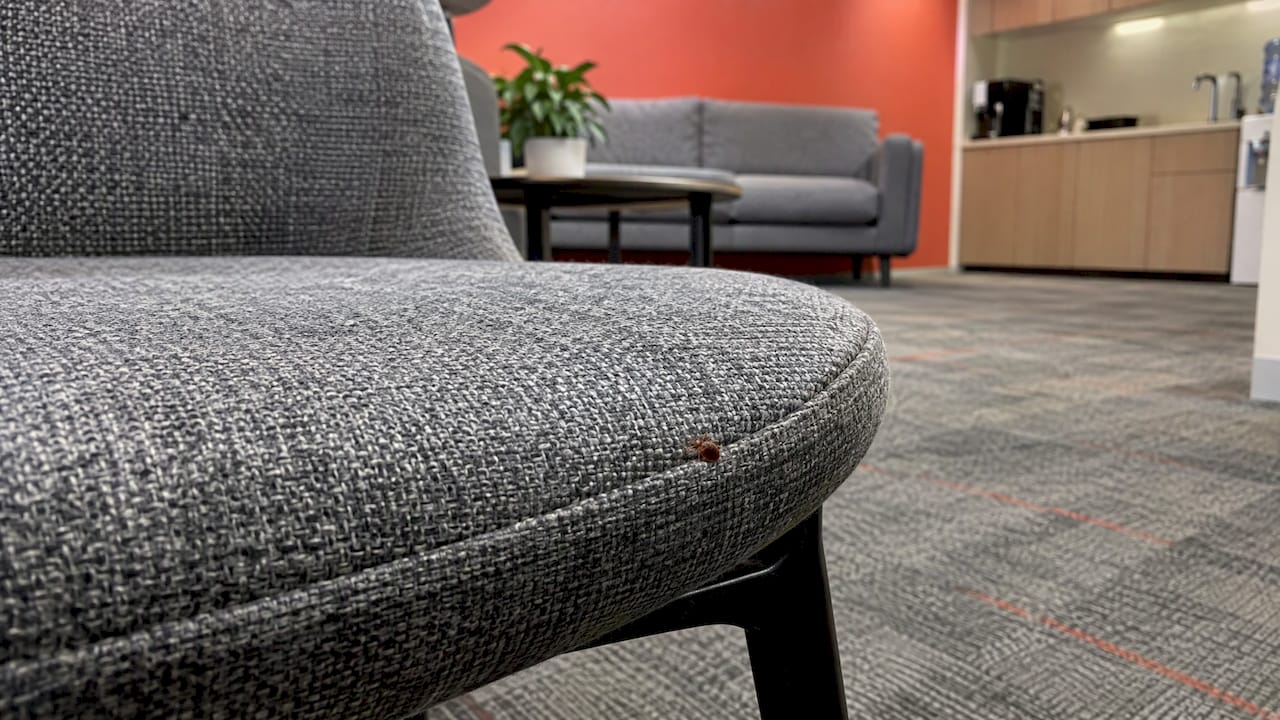
Bed bugs can turn up in an office, usually as hitchhikers carried in on bags, clothes and deliveries rather than as a colony that started there. The right response is the same either way: collect the specimen, have the area professionally inspected, treat confirmed activity outside working hours and monitor until the problem is gone. We are a Singapore pest control company, and this guide walks employers, property managers and staff through each step. If you suspect bed bugs at your workplace, our bed bug control service covers inspection, treatment and follow-up.
TL;DR
- Offices are mostly hit by bed bugs carried in by people and goods. Early inspection stops a few stray bugs from becoming a repeat problem.
- Bites alone prove nothing. Look for live bugs, shed skins, dark spots and pale eggs near upholstered furniture, seams and outlets.
- Report to your supervisor, keep the specimen in a sealed container, protect staff confidentiality and do not spray anything yourself.
- Treat after hours, in all confirmed areas, and keep monitoring until there are no sightings for at least two months.
- Prevention is a routine: less clutter, separate storage for belongings, staff education and regular checks of soft furnishings.
Table of Contents
- Can bed bugs really live in an office?
- How bed bugs get into an office
- Signs of bed bugs in a workplace
- What to do the moment someone finds a bug
- How a proper office inspection works
- Treating bed bugs in an occupied workplace
- Getting bed bug control for your office
- What employers should put in place
- Preventing bed bugs in the office day to day
- How staff avoid taking bed bugs home
- Our view: act early and treat the building, not just the desk
- FAQ
- Sources
Can bed bugs really live in an office?
Yes, they can be found in one. How likely a full infestation is depends on the setting. The US EPA says it is very unlikely, though not impossible, for an infestation to develop in an office, but adds that these sites can act as transfer hubs where bugs hitch a ride home with someone. Pest Control Technology notes that office complaints tend to be introductions rather than infestations, because the blood meals bed bugs need to produce eggs are hard to come by when nobody sleeps there at night.
That does not make the problem trivial. Repeated introductions can build up a population slowly, and the bugs wander into unpredictable places. An office with open-plan seating, a pantry sofa, a quiet room or a storage area with upholstered furniture gives them places to settle. Staff who are bitten or worried also lose focus, and a visible sighting can spread alarm quickly.
In Singapore, the topic has had official attention. In a written parliamentary reply in January 2024, the Minister for Sustainability and the Environment said bed bugs are not known to transmit diseases to humans but can cause discomfort, itching and allergic reactions. She also said that travellers returning to Singapore should take care not to bring bed bugs back into their work and living environments. A city with heavy business travel and shared commuting is exactly where hitchhiking happens.
How bed bugs get into an office
There are two routes, according to a workplace health and safety factsheet from a US public employee union:
- Hitchhiking. Bugs climb into or onto bags, clothing or other belongings and are carried by a person.
- Migration. Bugs walk to an adjacent unit through hallways, plumbing, electrical lines or other routes.
In practice, the common carriers in an office are:
- Backpacks, handbags, briefcases and laptop bags that spent time in a home, hotel, taxi or public seat
- Jackets and coats hung on shared racks
- Visitors, couriers and contractors who move between sites
- Second-hand furniture, such as a used sofa or chair brought in for a pantry or reception
- Luggage after business travel, especially when it is wheeled straight from the airport to the office
The migration route matters for property managers. In a multi-tenant building or a mixed-use block, a problem in one unit can reach the next through shared walls and service risers. This is one reason a building-wide view helps, and why management bodies have an interest in a documented pest programme. Our guide on the four-part IPM that Singapore MCSTs need covers that side.
Bed bugs are not a sign of dirt. The Arizona Department of Health Services toolkit stresses that their presence does not mean a place is unclean, and that they have been found in upscale accommodation as well as shelters and homes. Say so to your team early. Stigma makes people hide sightings, and hidden sightings are what let a small problem grow.
Signs of bed bugs in a workplace
Do not rely on bites. The US EPA explains that bites are a poor indicator: they can look like mosquito or chigger bites, eczema, fungal rashes or hives, and some people do not react at all. CCOHS adds that reactions can take up to 14 days to appear, so a bite today may not match the day or place of exposure.
Physical evidence is more reliable. The EPA lists these signs:
- Live bed bugs, small, flat and reddish-brown
- Dark spots, which are bed bug excrement
- Rusty or reddish stains on fabric
- Eggs and eggshells, about 1 mm and pale yellow
In an office, check the places where people sit, rest or leave belongings. The Arizona toolkit names upholstered chairs, desks, areas near electrical outlets, wall dividers, the space behind cove molding, behind hanging decorations, carpet seams, places where personal items are left, and gathering areas. Add the sofa in the pantry, coat racks and the storage room.
One difference from homes is worth knowing. Pest Control Technology reports that in offices bed bugs may start out active at night but, with no host to feed on, shift towards daylight hours. A bug seen on a desk at 3 p.m. is therefore not proof of a one-off. It is also why office inspections differ from apartment inspections: the bugs wander more and turn up in less predictable places.
What to do the moment someone finds a bug
The first hour sets the tone for the whole response. These steps draw on guidance from Canadian and US health and safety bodies, adapted to a Singapore office.
- Stay calm and report it. CCOHS advises staff to report suspected bed bugs to a supervisor, and to escalate to the health and safety committee or representative if the concern is not addressed in good time.
- Capture the specimen. The City of Hamilton guidance asks employees to collect specimens where possible so a qualified professional can identify them. A sealed container is enough. Photograph the bug next to a ruler or coin and note where and when it was found.
- Handle people privately. If a bug is found on a colleague, Manitoba's workplace guide advises meeting the person privately, away from others, and keeping the bug in a sealed container for identification. It also stresses confidentiality: you must not name staff who may or may not have brought bed bugs in.
- Do not bring in sprays. The Hamilton guidance says employees should not bring or use pesticides at work. Manitoba warns that self-treatment can harm health. Leave the treatment to a professional.
- Keep a record. CCOHS recommends employers keep records of where and when bugs were encountered and how extensive they were. A simple log with date, location, photo and who was informed is enough.
- Call a pest management company. Singapore's National Environment Agency (NEA) advises premises to engage a pest management company for bed bug control. Our technicians are NEA-licensed, and we are available 24/7, so a sighting on a Friday evening need not wait until Monday.
Tell staff what is happening in plain words, and what they can do to avoid carrying anything home. Hamilton's guidance asks employers to inform employees about how to prevent transporting bed bugs, and that is easiest when the message is calm and factual.
How a proper office inspection works
NEA states that detection is done by visual inspection of furniture and the placement of surveillance traps. Inspection is not a quick glance, though. In low-level infestations in apartments, Pest Control Technology cites Rutgers tests showing visual inspection was only about 50 percent accurate, and recommends following it with a few active monitors in the immediate area. Low numbers are exactly what an office is likely to have, so the method has to be thorough.
Our inspections use advanced technology, including thermal imaging, alongside a hands-on check of the usual harborage points. A good office inspection should cover:
- The reported area and everything within a few meters: chairs, desk edges, partitions, carpet seams and skirting
- Break rooms, lounges, reception and storage rooms with upholstered furniture
- Coat racks, lockers and bag storage
- Adjacent units or rooms when migration is possible
- A monitoring plan, with devices placed and checked on a schedule
Timing matters. Pest Control Technology and the Arizona toolkit both describe inspecting as soon as activity is reported. A 2017 workplace guide suggests doing it in off hours so staff are not disturbed and the area is not crowded. Arizona's toolkit also notes that canine scent detection can be more efficient than visual inspection and should be considered when possible.
If your property is part of a larger building, tell the building manager. A pest problem in a shared structure is easier to contain when everyone knows about it, and a single inspection report is useful evidence if more than one tenant is affected.
Treating bed bugs in an occupied workplace
NEA describes the typical control plan as a combination of non-chemical and chemical methods: vacuuming, hot laundering, steam and heat treatment, elimination of harbourages and the use of insecticides. That mix is integrated pest management, and it is the approach we follow. Singapore now has a national benchmark for it. Singapore Standard SS 721:2025, co-led by NEA and the Singapore Pest Management Association, sets a code of practice for pest management services built on IPM principles: prevention first, a multi-method approach, risk-based assessment, less reliance on chemicals and continuous monitoring.
What does that mean in an office?
- Treat every confirmed area. Hamilton's guidance says treatment should cover all areas where bed bugs have been confirmed, not only the desk where the first bug turned up.
- Keep people away from treated areas. CCOHS notes that to reduce exposure to chemicals, spraying should not take place while employees are in the area. Evenings and weekends are the natural slots for an occupied workplace.
- Use physical methods where they fit. Steam, vacuuming, heating and removal of badly infested items are part of the same toolkit. Manitoba's guide notes that many exterminators now use heat treatment instead of, or combined with, chemicals.
- Follow up. Hamilton says inspections and treatments should continue until there have been no confirmed sightings for at least two months.
Our treatments use non-toxic, environmentally safe methods that put the safety of people and pets first, which suits offices where staff may return the next morning. For a deeper look at the method, see our integrated pest management guide, and for the home side of the same problem, our guide on how to get rid of bed bugs.
Getting bed bug control for your office
We handle bed bug control for residential, commercial and industrial premises in Singapore, including offices. A site visit gives you an inspection, a treatment plan scheduled around your working hours and a follow-up routine. If you manage several floors or properties, our general pest control services can sit alongside it as a maintenance contract.
To arrange an inspection, start at the bed bug control page or contact us through bespoke-enviro.com.sg.

We do not publish prices, because the scope depends on the size of the premises, the number of affected areas and the layout. We scope each job after an inspection.
What employers should put in place
CCOHS frames bed bugs in the workplace as an occupational health and safety matter. A short written policy saves time when a sighting happens. Based on the CCOHS and EPA guidance, include:
- A reporting route. Who staff tell, and how, for sightings at work and at home or on business trips.
- A response sequence. Secure the specimen, call a pest management company, restrict the area if needed, log the case.
- Confidentiality. Never name staff in connection with a sighting.
- Education. Show all staff what a bed bug looks like and what to do. The EPA recommends educating staff and discouraging panic and stigma.
- Protective items where suitable. CCOHS suggests coveralls, shoe covers or gloves for workers in higher-risk roles, plus sealable plastic containers for equipment and belongings.
- A monitoring program. The EPA advises establishing one so that if a bug is found, the status of that area is formally tracked.
The EPA also notes that multiple sightings in the same area could point to an infestation or to repeated reintroductions from someone's home. Tracking dates and locations is how you tell the difference.
For roles at higher risk, such as staff who visit homes, hotels or other premises, the Hamilton guidance recommends policies for employees who meet the public or conduct home visits. It also suggests plastic rather than cloth chairs in waiting rooms, and monitoring traps in those rooms.

Preventing bed bugs in the office day to day
Prevention in an office is mostly about reducing hiding places and checking soft furnishings. The EPA and CCOHS agree on a short list:
- Reduce clutter. Fewer boxes and piles mean fewer hiding spots.
- Be vigilant where upholstery is. Break rooms, storage areas, lounges and offices with upholstered furniture need extra attention.
- Vacuum daily to pick up stray bugs before they settle in.
- Inspect used furniture before it enters the building, and clean it before use.
- Inspect regularly. CCOHS calls regular inspection for signs the best way to prevent infestations.
- Consider changing at work when there is a risk: put on work clothes and shoes on arrival and remove them before going home.
A scheduled inspection by a professional adds a layer your staff cannot easily provide, which is why many property managers pair prevention with a maintenance contract.
How staff avoid taking bed bugs home
The EPA warns that offices can be transfer hubs. The Arizona toolkit gives employees practical habits:
- Report any evidence of bed bug activity to the designated contact person
- Reduce clutter around your desk
- Visually check items you carry between home and the office each day, including lunch bags and clothing
- Keep your belongings separate from other people's, in a plastic bin
- Bring fewer items to and from work
- Tell management and facility staff about any concerns
If you travel for work, the MSE reply asks returning travellers to take care. Check luggage seams before it comes into your home or office, and wash and heat-dry clothing from the trip. If bugs find their way into your home, our guide on how to get rid of bed bugs explains what a treatment involves.
Our view: act early and treat the building, not just the desk
Most office bed bug cases we would expect to see begin as a single bug on a bag or jacket. The sensible response is to treat that first sighting as the start of a process, not the end of one: identify it, inspect around it, and keep watching.
We believe the best results come from integrated pest management. That means a careful inspection, including thermal imaging where it helps, targeted non-toxic treatment and monitoring afterwards, rather than a one-off spray. It keeps people and pets safe and avoids repeating treatments out of habit.
Offices also need discretion and speed. Our technicians are NEA-licensed and available 24/7, so inspections and treatments can be arranged around your working hours, and staff are not named or singled out.
If you have found a bug, or you manage a workplace where it could happen, the most useful step is a professional inspection before the problem has a chance to spread to a second room.
Bespoke-Enviro Services
FAQ
Can bed bugs live in an office with no beds?
They can be found there, mostly as hitchhikers. Pest Control Technology notes that office complaints tend to be introductions carried in on bags, clothes or deliveries. Without sleeping hosts at night, breeding is harder, but repeated introductions can still build a population over time.
How do I know if the bug I found is a bed bug?
Bed bugs are small, flat and reddish-brown, and they leave dark spots and pale 1 mm eggs. Because other insects look similar, put the specimen in a sealed container and have a pest management professional identify it. We can do this as part of an inspection.
Who is responsible for dealing with bed bugs at work?
The employer or the property manager normally arranges the response. CCOHS recommends that employers set up reporting procedures, keep records, educate workers and use a licensed pest management provider. Staff should report sightings to a supervisor and keep names out of it.
Is it safe to stay in the office after treatment?
Treatment should take place while employees are not in the area, as CCOHS advises, and it is easiest after hours. We use non-toxic, environmentally safe methods that put the safety of people and pets first, and we will tell you when an area can be used again.
How long until the office is clear?
Hamilton's guidance says inspections and treatments continue until there have been no confirmed sightings for at least two months. The timeline depends on how many areas are affected, so we set a monitoring schedule after the first inspection.
Sources
- Written Reply to Parliamentary Question on bed bug measures, Ministry of Sustainability and the Environment, 9 January 2024
- Management of Bed Bugs, National Environment Agency
- Background on Singapore Standard SS 721:2025, National Environment Agency
- Protecting Yourself from Bed Bugs in Public Places, US EPA
- How to Find Bed Bugs, US EPA
- Bed Bugs in Office Settings, Pest Control Technology
- Bed Bugs in the Workplace, CCOHS
- Bed Bugs in the Workplace, City of Hamilton
- Bed Bug Guide for Workplace, Province of Manitoba
- Bed Bug Toolkit, Arizona Department of Health Services
- Bed Bugs Health and Safety Factsheet, PEF, 2025