
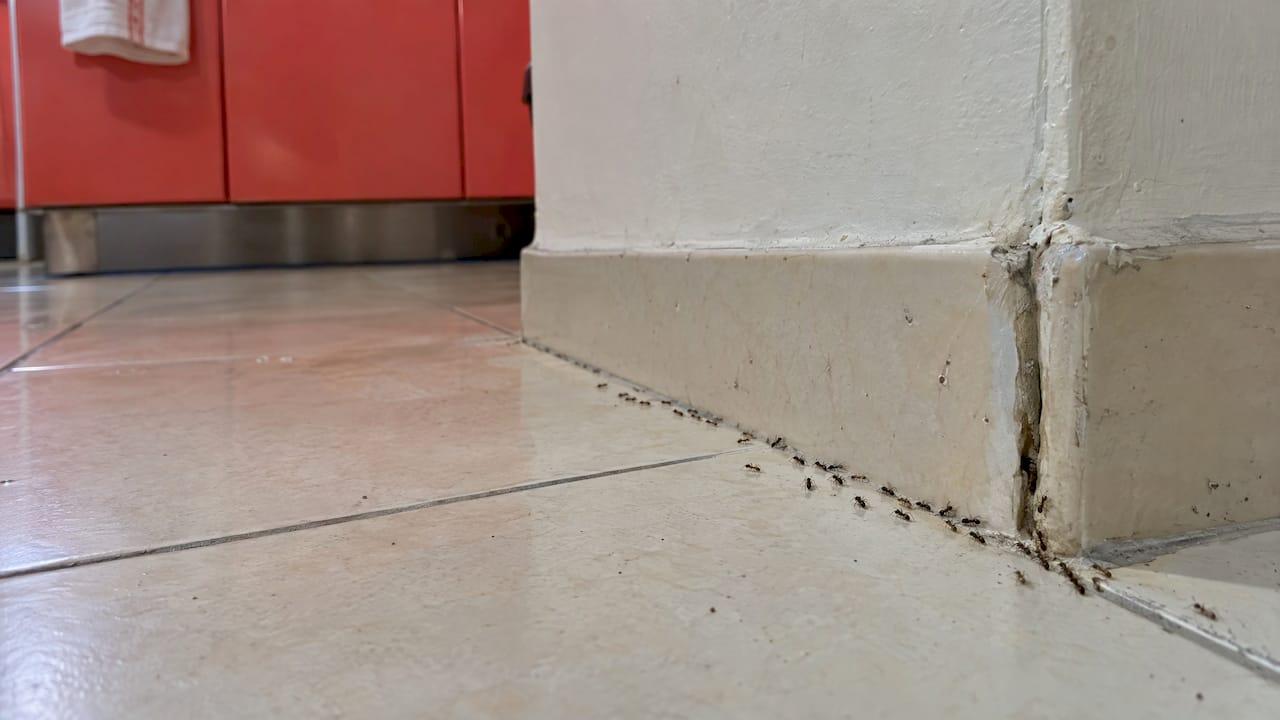
An ant trail is a line of ants following an invisible chemical path to food, water or shelter. A scout found something worth collecting, laid a scent on its way home, and the colony is now following it. The trail tells you two things: ants have found a reward inside your space, and a colony is close enough to send workers to it. Wiping the line away stops today's parade, but removing the colony is what stops the next one, and our technicians in Singapore handle that part through general pest control.
TL;DR
- An ant trail is a pheromone (chemical scent) path that scouts lay after finding food. Other workers follow and reinforce it.
- A visible trail shows where ants travel, not where the nest is. The colony can be metres away, outdoors, in a wall or behind a fixture.
- Cleaning the trail removes the scent cue for a while. It does not remove the colony that keeps sending workers.
- Sealing entry points, storing food airtight and fixing moisture reduce the reward that keeps a trail alive.
- A trail that returns after cleaning, or that appears in several rooms, calls for an inspection to find the source.
Table of Contents
- What an ant trail actually means
- How ant pheromone trails work
- When a trail points to a nest or infestation
- How to remove an ant trail
- Why the trail keeps coming back
- What to note before you call
- Our perspective
- Get the colony dealt with, not just the trail
- FAQ
- Sources
What an ant trail actually means
A single ant wandering across your counter is usually a scout. Scouts search at random for food and water. According to Washington State University's pest guide on sugar ants, a lone scout should not be ignored, because it will locate a food source and recruit the colony. Once it does, a trail can involve hundreds or thousands of ants moving between food and nest.
So a trail is not random behavior. It is a signal that something in your home or premises has become worth the trip. That could be:
- Sugary spills, syrup, honey or fruit juice, plus fats and meat, which the UC Statewide IPM Program lists among household ant foods.
- Water: condensation on pipes, a leaking tap, a damp bathroom corner.
- Shelter or refuge. The same UC source notes that ants may come indoors to escape hot, dry weather or flooded conditions.
A Mississippi State University Extension urban entomologist also points to moisture-damaged wood where carpenter ants nest, and even spilled toothpaste, as reasons ants enter a structure. In Singapore's humid climate and during heavy monsoon rain, the water and shelter triggers are common.
What a trail does not tell you
A trail shows the route, not the address of the nest. Straggling ants are scouts randomly searching for food or nesting sites, as the UC IPM guidance puts it. The line you see at the skirting board may start at a crack in an outside wall, a planter, a ceiling void or a neighbor's unit. Treat the trail as an observation. It is the best clue you have, and the next sections show how to use it.
How ant pheromone trails work
Ants communicate through chemical signals called pheromones. The Victorian Department of Health explains that ants use them to leave trails to food, send alarm signals and tell caste groups apart, and that they detect them with their long, thin antennae.
The cycle, as described in an educational information pack from South Australia's environment department, runs like this:
- Workers wander randomly until one finds food.
- The worker returns to the nest, laying a stronger trail pheromone on the way.
- Other ants follow the trail, find the food and reinforce the trail on their own way home.
- When the food runs out, workers stop reinforcing it and the volatile pheromone evaporates quickly.
That last point explains why trails come and go. A review of ant trail pheromones in the Journal of Insect Science, by Ali, notes that the number of workers on a trail is proportional to the amount of food available. A thick, busy trail means a rich or renewable source. A thin, fading one means the supply is shrinking.
Why ants walk in tidy lines
When workers find several paths to the same food, the shortest is chosen because it is reinforced faster, while the pheromone on longer paths evaporates. This is why ants seem to know the straightest route along a wall edge or pipe. They do not plan it. The scent does the sorting.
Trails are more layered than they look
Research on pharaoh ants, published in PLoS ONE by Czaczkes and colleagues, found two kinds of attractive trail pheromone. One decays within about 20 minutes. The other lasts longer and acts as a kind of external memory, letting the colony reuse trails laid one or two days earlier. The same work found that experienced foragers of another species, Lasius niger, walk faster and straighter on marked segments, using the scent as reassurance that they are on the right path.
For a homeowner, the practical meaning is simple: a wiped trail may not stay wiped if the food source is still there and the colony remembers the route.
When a trail points to a nest or infestation
One ant or a short-lived trail after a spilled drink is a housekeeping event. These patterns suggest a colony that needs a proper look:
- The trail returns within hours or days after you clean it and remove the food. The colony has a reason to keep coming, or it has an established route.
- Trails appear in more than one room, or on different floors. That points to a large colony or several satellite nests.
- Ants emerge from a fixed spot, such as a wall crack, a socket plate, a window frame or a skirting gap. The UC IPM guidance advises following ants to where they enter the building, and to the nest if you can.
- The trail is steady with no obvious food. Ants may be heading to water, to a hidden food source or to a nest inside the structure.
- Winged ants or sawdust-like frass near timber. These point away from simple foraging and toward wood-nesting insects. Our guide on carpenter ants versus termites shows three clues that help tell them apart.
- Ants in electrical outlets or switch plates. This needs two trades, an electrician and pest control, as we explain in why ants get into electrical outlets in humid Singapore homes.
Species matter too. Tiny ants that appear in large numbers around food and warm spots may be pharaoh ants, which respond best to a bait-first approach. Ghost ants are another common household visitor, and the rules on baiting them are worth checking before you start. Identifying the ant first decides what treatment will actually reach the colony.
How to remove an ant trail
Removing the trail is a sensible first move while you work out the source. Do it in this order.
Step 1: Observe before you disturb
Before you wipe, spend a minute noting where the line starts, where it ends, what it is heading for and roughly what time you see it. Take a photo. A trail followed back to its entry point tells a technician far more than a clean counter does. Avoid spraying the line, because scattering the ants can spread them into new routes.
Step 2: Clean the scent away
The UC IPM guidance recommends cleaning invading ants with a sponge and soapy water to remove the scent trail. The Mississippi State entomologist likewise advises wiping trails with soapy water or a vinegar and water solution to remove pheromones, which can keep other ants from following the same path. Wipe past the visible edges of the trail, including the surfaces where it meets the wall, and clean the food or water source that attracted them.
Step 3: Take away the reward
A trail needs a reason to exist. Based on the sources above:
- Store opened food, sugar, honey and pet food in sealed containers.
- Fix leaks and dry out condensation on pipes and under sinks.
- Wipe sticky residue from counters, jar rims and bins, and take out kitchen waste daily.
- Seal visible cracks and gaps with caulk once you know where ants are entering.
Step 4: Deal with the colony, not just the line
This is where most do-it-yourself attempts stall. Cleaning removes scent. It does not reach the queen or the workers in the nest. Baits work because workers carry the bait back and share it through the colony. According to the Victorian health note, this can end in eradication of the whole colony, though baiting is slow and takes patience. The same note says baits are useful where sprays and dusts cannot be used or the nest cannot be found. The UC IPM guidance adds that bait should be kept away from children and pets, and that insecticide sprays should not be used while you are baiting, since they can interfere with workers carrying the bait home.
In practice, that means getting the species, the placement and the timing right, and keeping treatment away from places where family members and pets are. That is the point at which we step in. Our approach is built on integrated pest management (IPM): find the source, remove what attracts the ants, and use non-toxic, eco-friendly treatments that prioritize the safety of people and pets. Our NEA-licensed technicians use tools such as thermal imaging during inspections, so you are not guessing where a colony sits behind a wall.

Does vinegar remove ant trails?
Yes, as a cleaning step. The Mississippi State Extension advice above names a vinegar and water solution as one way to wipe away pheromones, and it is a reasonable choice for the surface clean in step 2. Treat it as a way to interrupt a trail, not as a way to remove the colony. If the trail comes back, the nest is still active.
Why the trail keeps coming back
When a cleaned trail reappears, it is usually for one of four reasons:
- The reward is still there. Food, moisture or shelter remains, so scouts keep finding it.
- The route is remembered. As the pharaoh ant research showed, some trail chemistry lasts a day or two and acts as memory for the colony.
- The nest is untouched. Workers die or get cleaned away, and the colony simply sends more.
- There is a hidden entry point. Gaps around pipes, window frames and cable penetrations let ants in from outside or from neighboring units.
For property managers and business owners, the same logic applies at scale. A food outlet, a pantry or a loading bay gives ants a constant reward, and a recurring trail is a hygiene and compliance signal as well as a nuisance. Our kitchen pest checklist for foodservice managers sets out what to watch. On construction sites, ant trails around site canteens, waste areas and stored materials are worth recording during routine pest inspections so the source can be dealt with early.
What to note before you call
A good report speeds up a good inspection. Have these ready:
- Where the trail starts and ends, and the time of day it is busiest.
- Roughly how big the ants are, their color and whether any have wings.
- What is on the route: food, a drain, a plant pot, a damp patch.
- What you have already tried, including any sprays, since sprays can scatter ants and complicate baiting.
- Whether the same ants have shown up in neighboring units or in other parts of the premises.
Our perspective
Most customers call us after they have cleaned the same trail several times. The ants are not stubborn. The trail is simply the visible end of a system: a colony, a route and a reason to come. Clean the scent and the system rebuilds it.
We start from IPM. That means finding where ants enter, identifying the species, removing what attracts them and then treating the colony with non-toxic, eco-friendly methods that keep people and pets safe. We use technology such as thermal imaging in inspections, because a trail rarely shows where the nest is.
If a trail keeps returning, shows up in several rooms or runs through an electrical fitting or a timber frame, it is time to have it inspected by NEA-licensed technicians. We are available 24/7, so a trail in a kitchen or a food outlet does not have to wait.
Bespoke-Enviro Services
Get the colony dealt with, not just the trail
Our general pest control service covers ants alongside cockroaches, rodents, mosquitoes and other household and commercial pests, for homes, businesses, property managers and construction sites in Singapore. Our NEA-licensed technicians work with eco-friendly, non-toxic treatments built on integrated pest management. If a trail keeps coming back, book an inspection through our general pest control page.

You can also read more about our methods in the integrated pest management guide.
FAQ
What does seeing an ant trail mean?
It means a scout has found food, water or shelter and has recruited the colony to it. Trails can involve hundreds or thousands of ants, so it is worth acting early. The trail shows the route ants take, not where the nest is.
How do ant pheromone trails work?
A scout that finds food lays a chemical trail on its way back to the nest. Other ants follow it and add their own scent as they return loaded, which strengthens the path. When the food is gone, ants stop reinforcing it and the pheromone evaporates quickly.
Does vinegar remove ant trails?
Wiping with soapy water or a vinegar and water solution removes the scent marker, according to Mississippi State University Extension. It breaks the trail for the moment. If ants return, the colony is still active and the source needs to be found.
How do I stop ants from coming back after I remove a trail?
Remove what attracts them: store food airtight, fix leaks, clean sticky spills and seal entry gaps. Then deal with the colony itself, since cleaning does not reach the nest. A recurring trail is a good reason to book an inspection with us.
Are ant trails dangerous?
Most household ants are a hygiene nuisance, because they walk over food and food-prep surfaces. Ants near electrical fittings, or ants around timber, deserve a closer look sooner. If you use bait, keep it away from children and pets.
Sources
- Washington State University, Sugar Ants (PNW Pest Press)
- UC Statewide IPM Program, Ants
- Mississippi State University Extension, Search for needs brings unwanted ants indoors
- Victorian Department of Health, Pesticide Safety Technical Note: Ants
- South Australia Environment, Ants teacher information pack
- Ali, Trail pheromones of ants (Journal of Insect Science)
- Czaczkes et al., Uncovering the complexity of ant foraging trails (PLoS ONE)