
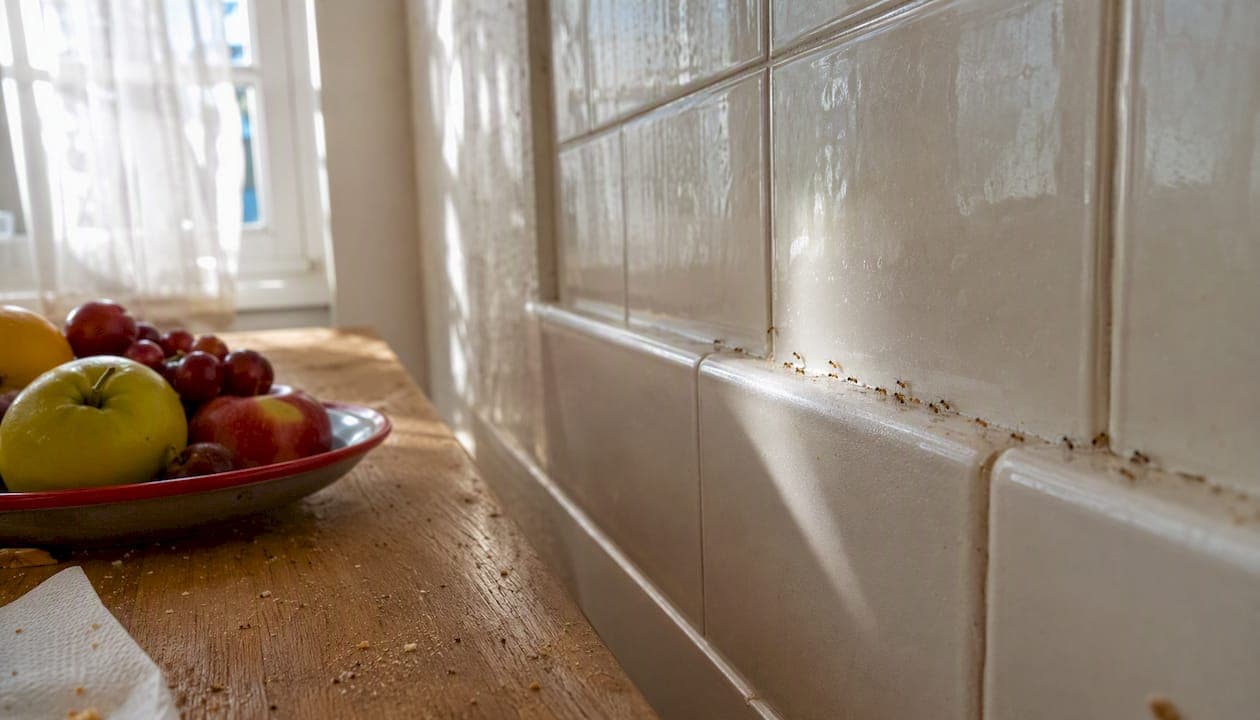
The quickest reliable way to control pharaoh ants is a bait-first integrated pest management (IPM) program using slow-acting, non-repellent baits and targeted monitoring. Sprays and bug bombs will make the problem worse. Here is what to do in the first 24–72 hours:
- Remove all exposed food and wipe down surfaces where trails are visible.
- Place blank (non-toxic) monitoring stations along active trails to map foraging routes.
- Set slow-acting bait stations along those same trails, near entry points, and under appliances.
- Stop all spray use immediately, including aerosol cans and total-release foggers.
- Check bait stations every 2–3 days and replenish consumed bait without disturbing the trail.
Expect visible worker reduction within days to a few weeks with modern gel baits. Full colony elimination typically takes several weeks to months, depending on infestation size, and always requires follow-up inspections to catch satellite colonies.
Key Takeaways
Bait-first IPM using slow-acting, non-repellent baits and IGRs is the only reliable method to eliminate pharaoh ant colonies without triggering the budding that makes infestations worse.
| Point | Details |
|---|---|
| Never spray pharaoh ants | Repellent sprays and bug bombs trigger colony budding, spreading the infestation into new voids. |
| Use slow-acting, non-repellent baits | Active ingredients like s-methoprene, hydramethylnon, fipronil, and low-concentration boric acid reach queens through worker transfer. |
| Expect weeks to months | Visible reduction can appear within days with modern gel baits; full colony elimination typically takes several weeks to months. |
| Sanitation supports baiting | Sealed food, dry surfaces, and caulked entry points reduce competing food sources and reinfestation risk. |
| Call Bespoke-enviro for persistent cases | Building-wide or void-nesting infestations need professional survey, targeted bait placement, and scheduled follow-ups. |
Table of Contents
- How to identify pharaoh ants and tell them apart from similar species
- Why sprays and aerosols often make pharaoh ant problems worse
- Bait-based control: which active ingredients work and how they reach queens
- Step-by-step bait placement and how to read the results
- When DIY baiting isn't enough: signs you need a professional
- Common DIY mistakes and essential safety notes
- Sanitation, exclusion, and habits that prevent reinfestation
- Why we recommend bait-first IPM for every pharaoh ant case
- Bespoke-enviro's residential pharaoh ant service
- Sources
How to identify pharaoh ants and tell them apart from similar species
Pharaoh ants (Monomorium pharaonis) are among the smallest household ants you will encounter: workers measure roughly 2 mm long, with a pale yellow to light brown body and a noticeably darker, almost black abdomen. That two-tone coloring is the fastest visual cue. Up close, they have a 12-segmented antenna with a three-segmented club.
Behavior is equally diagnostic. Pharaoh ants move in well-defined trails along edges, baseboards, and pipe runs. They are attracted to both sweet foods and greasy or protein-rich foods, which is why you will find them raiding a honey jar and a butter dish in the same kitchen. Ghost ants, a common look-alike in tropical climates, share the pale body but have a distinctly darker head and thorax. Fire ants are larger and red-brown throughout. If the ants you see are tiny, pale, and trailing along a wall edge toward both sweet and oily food sources, pharaoh ants are the most likely culprit.
Indoors, colonies nest in warm, humid voids: behind kitchen cabinets, inside wall cavities near plumbing, around water heaters, and inside electrical conduits. Bathrooms and hospital-style environments with consistent heat and moisture are particularly attractive nesting sites.
Pro Tip: Pull out your stove or refrigerator and check the gap between the appliance and the wall. Shine a flashlight into electrical outlets near the kitchen or bathroom. Pharaoh ant trails often run inside these voids, invisible until you look directly into them.
Why sprays and aerosols often make pharaoh ant problems worse
Pharaoh ant colonies are not organized around a single queen. A mature colony can contain dozens of queens distributed across multiple satellite nests hidden inside walls, ceilings, and floor voids. That structure is what makes them so resilient and so different from most other household ants.
The critical behavior to understand is budding. When workers detect a chemical threat, such as a repellent insecticide or a total-release aerosol, queens and a portion of the workforce split off and relocate to form new satellite nests deeper in the building. A single spray event can turn one localized kitchen infestation into four or five separate colonies spread across multiple rooms or floors. Repellent sprays, aerosols, and bug bombs are widely discouraged precisely because they trigger this dispersal response.
Consider a typical scenario: a resident spots a trail along the kitchen counter and reaches for an aerosol. The visible trail disappears within hours. Two weeks later, trails appear in the bathroom, the bedroom, and a neighboring unit. The spray did not eliminate the colony. It fragmented it.
- Repellent contact sprays cause queens to relocate, not die.
- Total-release foggers (bug bombs) disperse ants into wall voids where baits cannot reach them.
- Repellent dusts applied indoors carry the same budding risk as liquid sprays.
- Even strong-smelling cleaning products used directly on trails can disrupt pheromone signals and scatter foragers.
Never use repellent sprays, aerosols, or bug bombs indoors for pharaoh ant control unless a licensed pest professional specifically instructs you to do so. The standard professional recommendation is non-repellent bait only. Pharaoh ants nest in inaccessible voids and a fragmented colony is far harder to eliminate than a contained one.
Bait-based control: which active ingredients work and how they reach queens
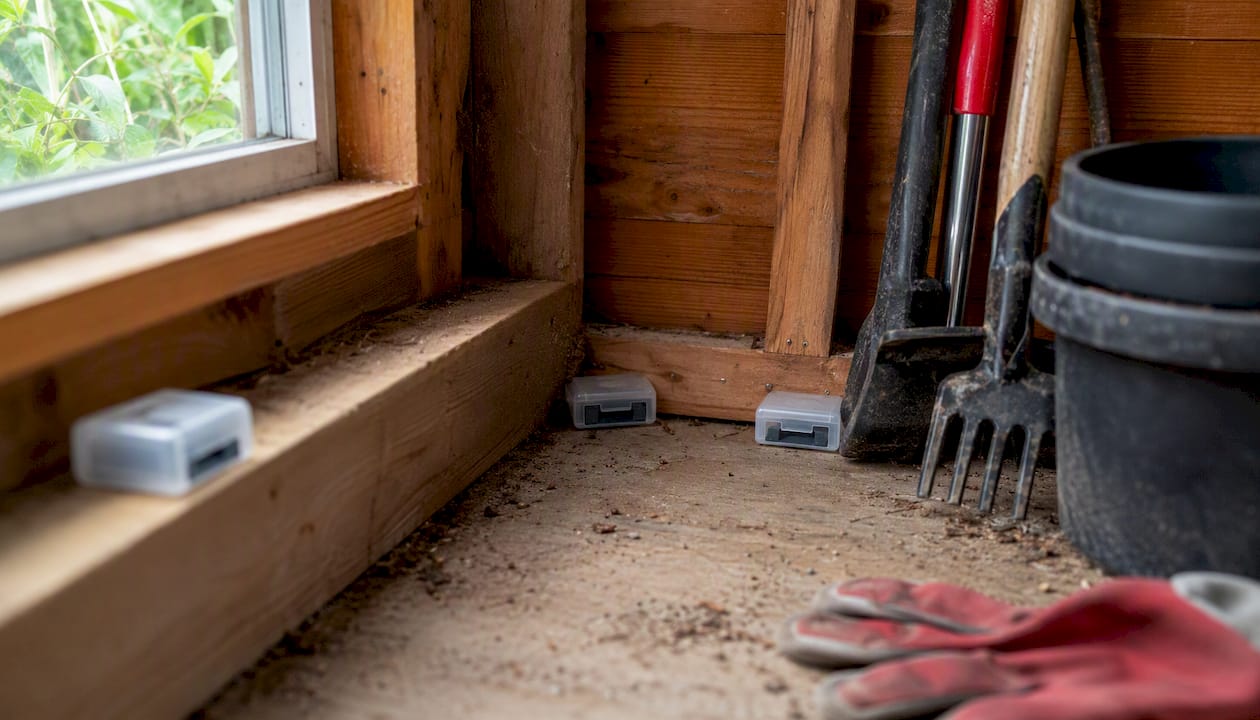
Slow-acting, non-repellent baits are the foundation of every effective pharaoh ant extermination method. The mechanism is straightforward: workers consume bait at the station, carry it back to the nest, and share it with queens and brood through normal feeding behavior. The toxicant or insect growth regulator (IGR) must act slowly enough that workers remain alive long enough to complete that transfer.
Active ingredients that work
Combination fat/protein and sweet baits outperform sweet-only formulations because pharaoh ant colonies shift food preferences over time. The most effective active ingredients used in bait matrices include:
- S-methoprene (IGR): Sterilizes queens and prevents larvae from developing into workers. Results are gradual but colony-level. Field trials showed significant worker reductions after 4–5 weeks, with colony declines continuing over several months.
- Hydramethylnon: A slow-acting metabolic inhibitor. Workers remain active long enough to transfer bait to the nest before dying.
- Sulfuramid: Similar slow-acting profile to hydramethylnon; effective in gel and granular bait matrices.
- Boric acid (below 1% concentration): At low concentrations, it is slow-acting and transferable. Higher concentrations repel workers and reduce uptake.
- Fipronil: Non-repellent at bait concentrations; disrupts the central nervous system of insects. Effective in gel formulations.
Timeline and safety
| Active Ingredient | Mechanism | Visible Reduction | Full Control Estimate |
|---|---|---|---|
| S-methoprene (IGR) | Sterilizes queens, halts larval development | 4–5 weeks | Several months |
| Hydramethylnon | Metabolic inhibitor, slow kill | 1–2 weeks | 4–8 weeks |
| Sulfuramid | Metabolic inhibitor | 1–2 weeks | 4–8 weeks |
| Boric acid (<1%) | Stomach poison, slow kill | 2–3 weeks | 6–12 weeks |
| Fipronil | Nerve agent, non-repellent at bait dose | Days to 1 week | 3–6 weeks |
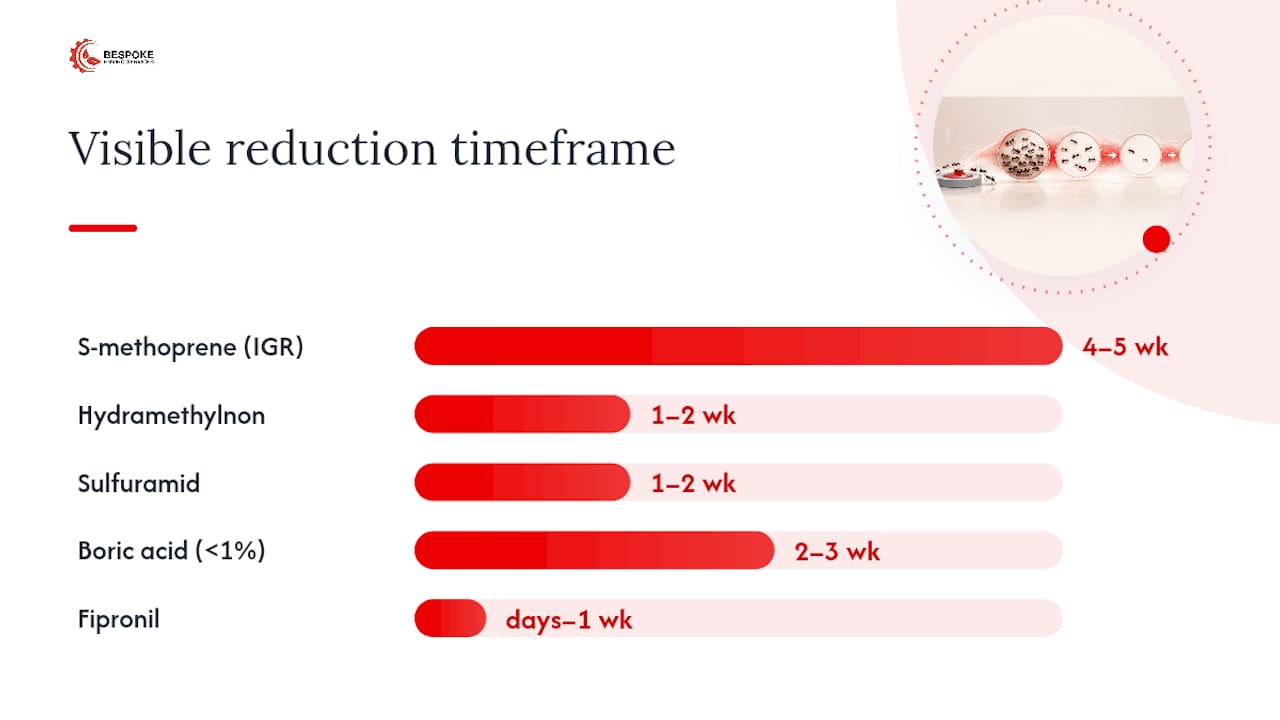
Modern gel baits using faster-acting compounds can produce visible reductions within days, but follow-up inspections remain necessary to detect satellite colonies that may not have been exposed to the initial bait placement.
For households with children and pets, use enclosed bait stations that prevent direct contact with the bait matrix. Place stations out of reach where possible, follow label instructions precisely, and never mix bait products or dilute them with other substances.
Pro Tip: If bait uptake drops after a week or two, switch the bait flavor. Rotate from a sweet gel to a protein/fat formulation. Pharaoh ant colonies cycle through food preferences, and a colony that ignores sweet bait today may take protein bait readily tomorrow.
Step-by-step bait placement and how to read the results
Pre-bait survey
Before placing any active bait, spend 24–48 hours mapping the infestation with blank (non-toxic) monitoring stations. Pre-treatment mapping often reveals a far wider infestation footprint than a single visible trail suggests. Place blank stations at 1-meter intervals along suspected trail routes and check them every 12 hours. Mark which stations show ant activity.
Placement checklist
- Along the edges of kitchen cabinets, inside corners, and on pantry shelves near food storage.
- Under the sink, near the drain pipe and any visible moisture.
- Behind the refrigerator and stove, along the wall edge.
- Near plumbing access panels and around water heater bases.
- Inside electrical outlet covers (use stations specifically designed for this purpose).
- Along baseboards in bathrooms, particularly near the toilet base and under vanity units.
- At external entry points: door frames, window sills, and any gap where pipes enter the wall.
In heavy infestations, place stations densely (every 30–50 cm along active trails) and expand outward from the hottest activity zones. For multi-unit buildings, an extensive baiting program covering all affected units simultaneously produces better results than treating one apartment at a time.
Monitoring what you see
| Observation | What It Means | Action |
|---|---|---|
| Heavy bait consumption within 48 hours | Active foraging; bait is being accepted | Replenish bait; do not disturb trail |
| No bait consumption after 5 days | Trail has shifted or bait flavor is wrong | Relocate station; try alternate bait type |
| Fewer workers visible at stations | Bait is working; colony is declining | Continue monitoring; do not reduce bait |
| New trails appearing in a different area | Satellite colony or budding from disturbance | Expand bait placement to new area |
| No activity after 3 weeks of baiting | Infestation may be resolved or deeply hidden | Conduct full re-survey; consider professional inspection |
Check and replenish bait every 3–5 days during active infestation. Once activity drops significantly, extend checks to weekly. Do not remove all bait stations until you have seen zero activity for at least two consecutive weeks.
Pro Tip: Start baiting from the outermost known trail and work inward toward the suspected nest area. This "outside-in" approach intercepts foragers before they return to the nest and maximizes the number of workers that carry bait back.
When DIY baiting isn't enough: signs you need a professional
Most homeowners can manage a contained pharaoh ant problem with consistent baiting. But some situations call for professional intervention.
Hire a pest professional when:
- Bait consumption remains high after 6–8 weeks with no visible reduction in worker numbers.
- Trails appear in multiple rooms or units simultaneously, suggesting a building-wide infestation.
- You can see ants emerging from wall voids, ceiling joints, or electrical panels, indicating nesting in inaccessible structural cavities.
- Occupants include infants, elderly residents, pregnant individuals, or people with respiratory sensitivities who require extra caution around any pest control product.
- The property contains sensitive electronics, medical equipment, or food-handling areas where bait placement is restricted.
A professional IPM service for pharaoh ants typically follows a structured process. The technician begins with a full survey using blank monitoring stations to map every active sub-colony, not just the visible trails. Building-wide baiting follows, with non-repellent formulations placed in voids, wall cavities, and utility runs that are inaccessible to residents. IGRs are often incorporated alongside faster-acting compounds to address both immediate worker populations and long-term colony reproduction. Scheduled follow-up visits, usually at 2–4 week intervals, confirm bait uptake, detect satellite colonies, and adjust placement as the infestation contracts.
When evaluating a pest control provider, ask these questions directly: What active ingredients will you use, and are they safe for children and pets in my home? Will you treat the entire building or only my unit? How many follow-up visits are included, and what happens if activity continues after the program ends? A provider who cannot answer these questions clearly is not running a structured IPM program.
A building-wide infestation in a multi-unit property almost always requires coordinated treatment across all affected units. Pharaoh ants nesting in structural voids will simply relocate to untreated units if only one apartment is addressed.
Common DIY mistakes and essential safety notes
Getting pharaoh ant control wrong does not just delay results. It actively worsens the infestation. These are the errors we see most often.
Mistakes that make infestations worse:
- Spraying visible trails with any repellent product, including household cleaners with strong scents. This triggers budding.
- Placing bait stations inconsistently, skipping areas where trails are less obvious. Satellite colonies in untreated zones survive and rebuild.
- Removing bait stations too early because visible activity has dropped. Remaining queens and brood will repopulate within weeks.
- Using repellent dusts (such as diatomaceous earth applied directly to trails) indoors, which scatter foragers and disrupt bait uptake.
- Treating only one unit in a multi-unit building, which pushes the colony into neighboring spaces.
- Mixing bait products or diluting them with water or other substances, which reduces palatability and active-ingredient concentration.
Safety notes for households with children and pets:
- Use only enclosed, tamper-resistant bait stations. Open bait placements are not appropriate where children or pets can access them.
- Store unused bait products in their original, sealed containers, out of reach and out of sight.
- Read and follow the product label completely before placing any bait. Labels are legal documents, and the instructions exist for safety reasons.
- Never attempt to mix or formulate your own insecticide solutions from commercial concentrates.
- If a child or pet contacts bait material, contact your local poison control center immediately and bring the product label.
The single most damaging mistake in pharaoh ant control is reaching for a spray. Insecticide sprays typically make infestations worse by dispersing colonies into new areas. Commit to bait-only treatment and give it time to work.
Sanitation, exclusion, and habits that prevent reinfestation
Baiting eliminates the colony. Sanitation and exclusion prevent the next one from establishing. These two approaches work together: clean conditions reduce competing food sources and make your bait stations the most attractive option for any foraging ant.
Sanitation checklist:
- Store all food, including pet food, in sealed containers. Pharaoh ants can enter cardboard packaging and loosely closed bags.
- Wipe down kitchen surfaces, stovetops, and counters after every meal. Even small grease residues sustain a colony.
- Empty kitchen and bathroom trash cans daily during an active infestation.
- Fix dripping taps and eliminate standing water. Moisture is as attractive as food for pharaoh ants in humid climates.
- Manage compost bins and recycling containers with tight-fitting lids.
Exclusion measures:
- Caulk gaps around pipes, conduits, and cables where they enter walls or floors.
- Seal cracks in baseboards and around window frames with silicone or latex caulk.
- Repair damaged door sweeps and install brush seals on exterior doors.
- Screen ventilation openings with fine mesh.
Pro Tip: In tropical and subtropical climates, pharaoh ant activity tends to increase during hot, humid periods when outdoor food sources are scarce. Run a brief monthly check of your bait stations year-round, not just when you see ants. Catching a new trail early, before a colony establishes in a void, is far easier than eliminating an entrenched infestation.
Why we recommend bait-first IPM for every pharaoh ant case
After more than 30 years of residential and commercial pest management, we have seen every variation of pharaoh ant infestation. The cases that resolve cleanly share one thing: the resident or building manager committed to bait-first IPM from the start and did not reach for a spray when progress felt slow.
The bait-first approach is not just a preference. It is the only method that addresses the colony's biology rather than its visible surface. Sprays eliminate workers you can see. Slow-acting baits and IGRs reach the queens and brood you cannot see, which is where the infestation actually lives.
Two things we emphasize in every treatment we conduct:
- Over 30 years of IPM experience in Singapore's residential and commercial environments, including multi-unit buildings where building-wide coordination is the difference between resolution and recurrence.
- Eco-friendly, non-toxic formulations as the default. We use the lowest effective concentration of the safest available active ingredient for every situation, with safety for children, pets, and the environment as a non-negotiable baseline.
Bespoke-enviro's residential pharaoh ant service
Persistent pharaoh ant activity after several weeks of careful DIY baiting is a clear signal that the colony has established in structural voids beyond what bait stations placed at surface level can reach.

Bespoke-enviro's residential pharaoh ant service begins with a structured site survey using blank monitoring stations to map every active trail and sub-colony before a single active bait is placed. We then deploy non-repellent, slow-acting bait formulations and IGRs in targeted locations, including wall voids, utility runs, and electrical cavities, using application methods suited to each access point. Every treatment includes scheduled follow-up visits to confirm bait uptake, detect satellite colonies, and adjust placement as the infestation responds. All products we use are selected for safety around children and pets, and we will walk you through exactly what was applied and where.
If your infestation spans multiple units, we coordinate building-wide treatment to prevent colony relocation between apartments. Contact Bespoke-enviro to schedule a site survey and get a clear picture of what your infestation involves before committing to a treatment plan.
Sources
The recommendations in this guide draw from peer-reviewed research and university extension resources. The following sources are worth consulting directly for treatment mechanics, active ingredient details, and professional guidance.
- Pharaoh Ant, Monomorium pharaonis (Linnaeus) (Insecta: Hymenoptera: Formicidae)
- Pharaoh Ants: What They Are, Health Risks, Getting Rid of Them, and More
- Managing pharaoh ants with baits
- PestWatch: Pharaoh ants
- ELIMINATION OF PHARAOH’S ANT, MONOMORIUM PHARAONIS COLONIES WITH S-METHOPRENE BAITS (HYMENOPTERA: FORMICIDAE)