
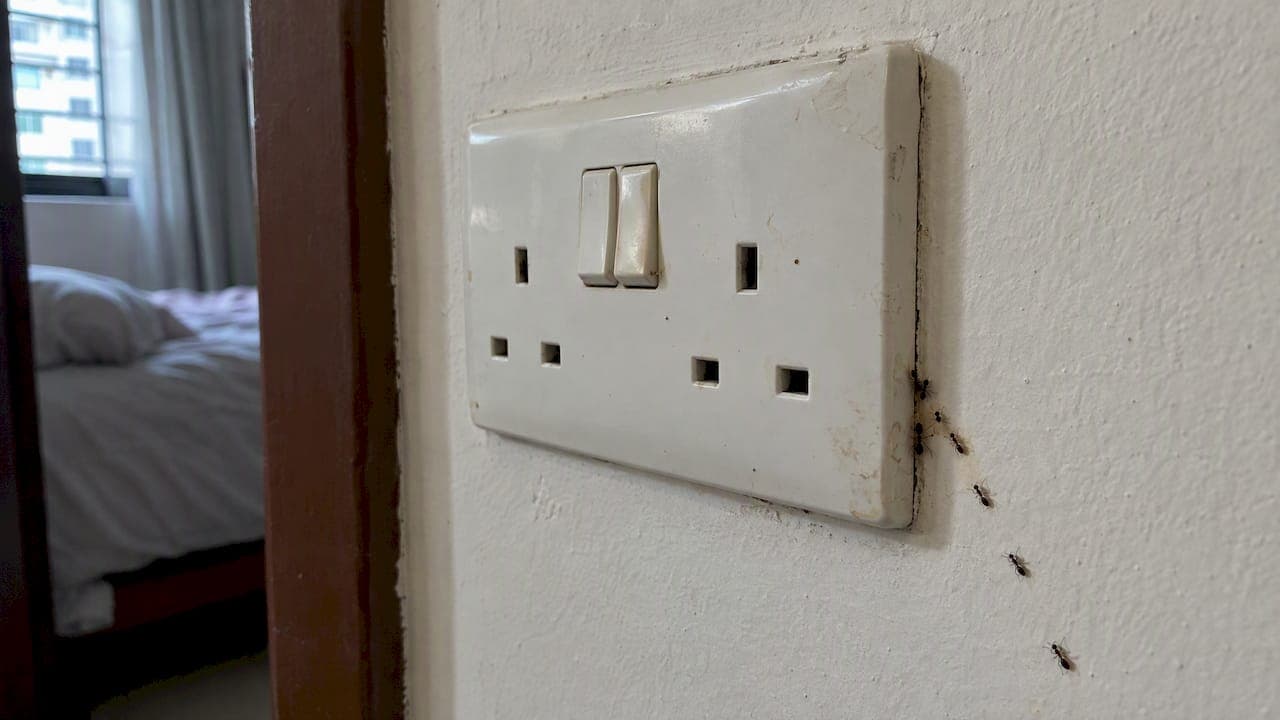
Yes, ants in electrical outlets can cause short circuits and fire risk, so this is not a problem to leave alone. If you suspect an infestation, switch off the affected circuit breaker if you can safely reach it, avoid touching or probing the outlet, and arrange both an electrician inspection and a pest-control visit. Most cases need both trades working together to resolve the cause and repair any damage.
TL;DR:
- Repeated breaker trips, flickering lights, or buzzing can signal a fault; sparking or a burning smell means stop using the circuit and call an electrician immediately.
- Switch off the correct breaker if safe, unplug connected appliances, and keep children and pets away; never spray liquids or probe the outlet.
- A licensed electrician should isolate power, inspect and replace damaged parts, and test protection devices before pest technicians bait and remove the colony.
- Bait treatments can take about a week to control a nest; seal cable gaps, reduce nearby food residue, and address colonies near foundations.
Table of Contents
- Why ants enter outlet cavities and how they create electrical faults
- Signs you have ants in sockets or behind outlets
- Immediate safety do's and don'ts for homeowners
- How professionals safely inspect, clear, and fix ants in electrical fittings
- Prevention: practical steps to stop ants returning to outlets
- A technician's view: common scenarios and realistic outcomes
- How we can help with ants in your electrical outlets
- FAQ
- Sources
Why ants enter outlet cavities and how they create electrical faults
Outlets and switch boxes offer ants exactly what they look for: warm, dark, undisturbed voids with little foot traffic. In humid climates, these cavities also stay drier than the surrounding structure, which makes them attractive nesting sites for several ant species. Research on fire ants and electrical equipment shows this pattern repeats across two distinct problems: colonies physically moving nesting material and soil into housings, and worker ants showing a particular affinity for electrical fields and switching mechanisms.
Ants are drawn to the oscillating magnetic fields that switching mechanisms generate, and this pulls them directly into contact with live components. When a worker ant bridges a live, neutral, or earth terminal, it can be electrocuted on contact. That single event rarely ends the problem:
- Electrocuted ants release pheromones that signal distress to the colony, drawing more workers toward the same switch.
- Successive ants die in the same spot, building up carbonized deposits that conduct electricity on their own.
- Soil and nesting material carried into the housing becomes conductive when it absorbs moisture, raising the chance of a short.
This feedback loop can pack a switch mechanism with dead ants and debris within days, turning an isolated nuisance into a recurring electrical fault.
Signs you have ants in sockets or behind outlets
Some symptoms point straight to the breaker box, others are visible at the wall plate. Catching them early limits damage and narrows down the urgency of the response.
- The same MCB or RCD trips repeatedly without an obvious appliance cause.
- Lights connected to the affected circuit flicker or dim intermittently.
- You hear a faint buzzing sound coming from the outlet or switch plate.
- A burnt plastic smell lingers near a specific socket.
- Ants are visible trailing toward, around, or into the faceplate.
- A professional who removes the faceplate finds dead ants, black carbon streaks, or nesting debris inside.
A burning smell, visible sparking, or a breaker that will not reset safely is an emergency. Stop using the circuit immediately and call a licensed electrician before doing anything else.
Immediate safety do's and don'ts for homeowners
The first few minutes matter. Acting correctly protects you from shock and prevents a minor fault from spreading to the wiring or nearby devices.
- Do identify the correct breaker for the affected outlet and switch it off if you can reach the panel safely.
- Do unplug any appliances connected to that circuit before further work begins.
- Do keep children and pets away from the outlet until it has been inspected.
- Don't spray insecticide, water, or any liquid into a live or recently live outlet.
- Don't remove the faceplate or insert anything into the socket to check for ants yourself.
- Don't keep resetting a tripping RCD; repeated resets without investigation risk arcing and further damage.
Pro Tip: If you're not confident which breaker controls the affected outlet, switch off the main supply rather than guessing, then call a Licensed Electrical Worker before any inspection or cleaning begins.
How professionals safely inspect, clear, and fix ants in electrical fittings
Resolving ants in a socket safely means combining two separate skill sets, sequenced correctly. In Singapore, Licensed Electrical Workers are legally required for the design, repair, inspection, and testing of fixed electrical installations, and damaged power points should be replaced by a LEW rather than patched up informally.
The electrician's role comes first:
- Isolate power at the correct switchboard or MCB before any physical work starts.
- Inspect the housing for heat damage, melted terminals, or degraded insulation.
- Remove conductive carbon debris and test RCD and MCB function.
- Replace any socket or section of wiring that shows damage.
Once the circuit is confirmed safe, pest-control technicians address the root cause through integrated pest management: locating the external colony, applying bait-formulated products that control the nest rather than just the ants visible in the housing, and removing nesting material after power has been isolated. Specialized treatment programs for electrical and utility equipment recommend this exact order, turning off service first, then treating with bait products that typically bring control within about a week.
Sequencing matters because treating a colony without first isolating power risks electrocution, and repairing an outlet without removing the colony invites a repeat infestation within weeks.
Prevention: practical steps to stop ants returning to outlets
Once an outlet has been cleared and repaired, keeping ants out is mostly about closing the gaps they use to get in and removing what draws them toward the building in the first place.
- Seal small gaps around outlet boxes and cable entries with expanding foam, rubber gaskets, or copper wool.
- Wipe down counters and clear food residue near sockets, especially in kitchens where ants forage most.
- Treat or bait ant mounds near the foundation rather than relying on sprays alone.
- Keep mulch and dense landscaping pulled back from exterior walls, since both hold moisture and shelter colonies.
- Have older sockets checked periodically, particularly in homes with a history of pest activity.
- Ask a technician to inspect and seal trunking and service risers, which can let ants travel between units in multi-story buildings.
A bait-first approach tends to outperform contact sprays for colonies hidden behind walls or risers, since it lets workers carry the active ingredient back to the nest instead of just killing what is visible.
A technician's view: common scenarios and realistic outcomes

In the field, three scenarios repeat often: kitchen outlets near food prep areas, riser trunking in multi-unit buildings where ants travel between floors, and colonies that carry soil directly into switch housings. The repeated-trip complaint is usually the first sign something is wrong, not the last.
Coordinated intervention tends to produce the same reliable pattern: the electrician resolves the trips and replaces any damaged socket, the pest technician removes the colony and seals the entry point, and the homeowner stops seeing either ants or faults at that location. The appliance troubleshooting some homeowners try first, like checking permanent lighting fixtures for faults, rarely uncovers an ant-related cause, which is why a joint inspection saves time once pest activity is suspected.
— Bespoke-Enviro Services
How we can help with ants in your electrical outlets
We coordinate integrated pest management with licensed electricians, so the colony and the damaged outlet get addressed in the right order rather than one without the other. Our approach favors non-toxic, bait-based treatments where they fit the situation, aiming to keep the process safer for the people and pets in the home.

A typical visit starts with an inspection to confirm whether ants are the cause, followed by a treatment timeline that works around your electrician's safety checks, then remediation of the colony itself and a scheduled follow-up to confirm it has not returned.
- Inspection to identify the colony, entry points, and affected outlets.
- Treatment scheduled around the electrician's isolation and repair work.
- Follow-up visit to confirm the colony has not re-established.
If you are seeing repeated trips, flickering lights, or ants around a socket, book a general pest control inspection and we will take it from there.
FAQ
Can ants go through electrical outlets?
Yes, ants can enter through the small gaps around outlet boxes, cable entries, and faceplates, which is exactly what draws them into the warm, dark space behind a socket. Once inside, they can travel through wall cavities and trunking to reach other outlets or units.
What time of year are carpenter ants most active?
Carpenter ant activity typically rises during warmer months when colonies forage more widely for food and nesting sites, though indoor infestations can persist year-round in climate-controlled buildings. If you notice activity regardless of season, treat it as a sign of an established indoor colony rather than a seasonal visitor.
What kills ants immediately around an outlet?
Nothing should be sprayed or poured directly into a live outlet, since liquid insecticides create a shock and fire hazard near electrical components. The safe approach is to isolate the circuit first, then let a pest-control technician apply a bait-formulated product that controls the colony without introducing liquids near live parts.
Why are ants attracted to electrical outlets specifically?
Ants are drawn to the oscillating magnetic fields that switching mechanisms generate, along with the warmth and shelter these cavities provide. Once one ant is electrocuted, the pheromones it releases can draw more workers to the same spot, which is why small infestations can escalate quickly.
Do ants in sockets always mean a fire risk?
Not every ant sighting means immediate danger, but repeated breaker trips, carbonized marks, or melted terminals point to a fault that needs both electrical and pest-control attention. Treat any burning smell or persistent sparking as an emergency regardless of how minor the ant activity looks.
Sources
- Fire Ants and Electrical Equipment (Texas A&M entomology fact sheet)
- Electrical and utility treatment | Fire Ants (University of Tennessee)
- Electrical safety (Energy Market Authority, Singapore)
- Your power trip might be caused by ants in the socket — common issue! (AOTRINITYSG blog)