
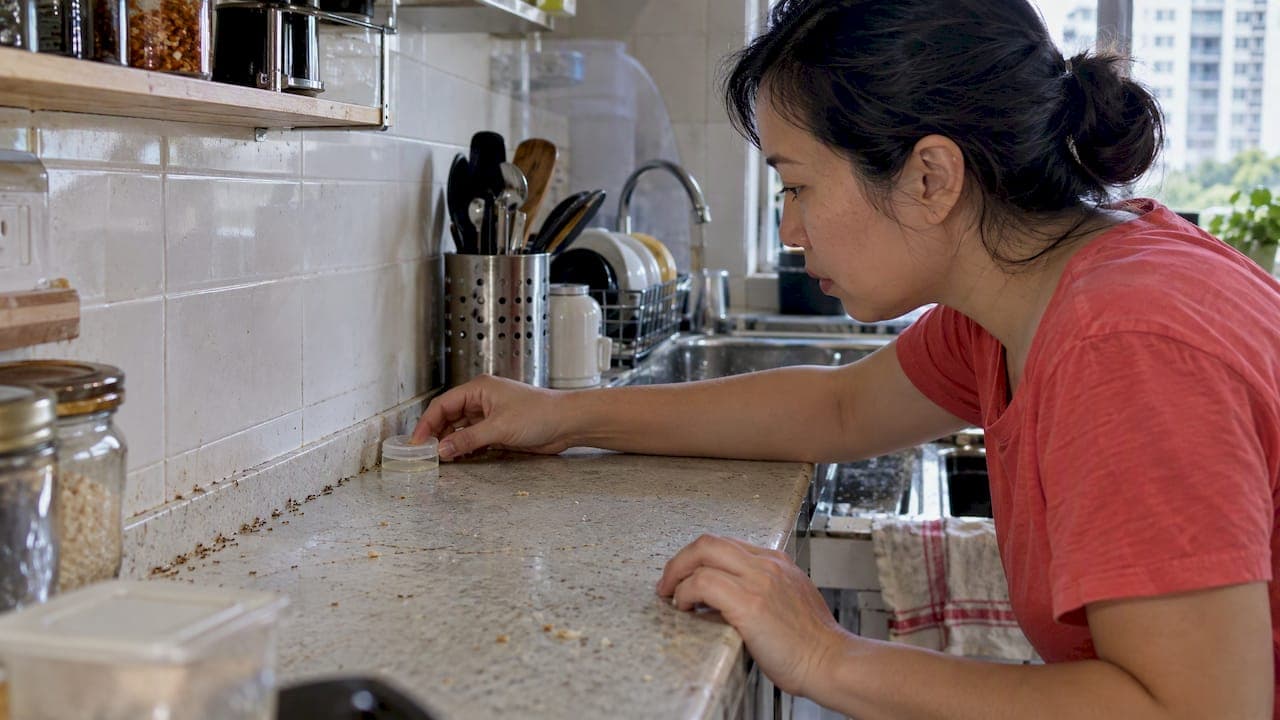
A practical homeowner-first route to ghost ant control is a bait-first approach: sugar-based liquid baits with boric acid, paired with inspection and sanitation. Check that any product is registered with the NEA before you use it. If nests are hidden or the problem keeps returning, we at Bespoke Enviro Services recommend an IPM inspection.
TL;DR:
- Confirm ghost ants by their dark front, translucent rear and legs, tiny size, and sweet food trails; uniformly colored ants may be another species.
- Use a commercial bait labeled for general use, verify its NEA registration, follow the label, and keep it away from food surfaces, children, and pets.
- Laboratory trials found that liquid bait with 1% boric acid outperformed solid formulations, with almost complete colony control developing over several weeks.
- DIY baiting suits ants in one area with a visible trail; seek professional IPM if they emerge from wall voids, spread across rooms, or return.
Table of Contents
- How can you tell if the ants in your home are ghost ants?
- What does a practical ant inspection checklist look like?
- How should you bait ghost ants safely?
- What sanitation and sealing steps stop ghost ants from coming back?
- Why do liquid baits work, and what does the research say?
- When is DIY enough, and when does professional IPM make sense?
- Book a ghost ant inspection with our team
- FAQ
- Sources
How can you tell if the ants in your home are ghost ants?
Ghost ants are tiny, and the color contrast is the giveaway. Workers have a dark head and thorax and a pale, almost translucent abdomen and legs. In a hurry they can look like they are missing their back half. Use these checks to confirm the species before you pick a treatment:
- Size: smaller than most kitchen ants, about the length of a grain of salt.
- Color: dark front, pale rear and legs, clearly visible under a flashlight or phone camera.
- Diet: a strong pull toward sweets such as spilled juice, honey, syrup and sugary residue.
- Where you see them: counters, baseboards, around sinks and near electrical outlets.
- Movement: quick, erratic trails rather than the steady marching line of larger ants.
If the ants are uniformly dark or uniformly pale, you are probably looking at a different species. Photograph a few against a white sheet of paper. A clear shot makes a species check far easier if you later ask us for help.
What does a practical ant inspection checklist look like?
Ghost ants spread across several small nests, so finding where they travel matters more than hunting one big colony. The general approach of following ant trails to entry points and nests is standard in house-invading ant control. Work through it in order:
- Note where you see ants first, such as a kitchen counter, and trace the trail back toward the wall.
- Follow it along baseboards, behind appliances and toward electrical boxes or wall voids.
- Check indoor hiding spots: under sinks, behind cabinets, potted plants, carpet edges and between stacked books.
- Walk the outside: foundation edges, mulch beds, potted plants and tree branches that touch the walls.
- Record the time, room and trail direction, and take photos for a technician if you escalate.
Pro Tip: Set a bottle cap of honey or sugary soda along a trail. Ants may gather around it, helping you spot an active route.
How should you bait ghost ants safely?
Baits work because workers carry the liquid back and share it with the rest of the colony, including queens. That slow transfer is the whole point: baiting gives workers time to carry the bait back to the nest. Avoid relying on spray-only approaches. Ant baiting works only when foragers find the bait and carry it home, so placement, sanitation and patience decide the result.
For homeowners, use a commercial sugar-based bait labeled "For General Use" and confirm its registration with the NEA, since "For Restricted Use" products are reserved for licensed technicians. Follow the label rather than mixing your own formulation.
- Clean the area so no competing food remains.
- Place bait directly on active trails and in protected spots such as under sinks or behind appliances.
- Leave it undisturbed for several days and replace it if it dries out.
- Never spray insecticide over or near the bait.
- Keep baits off food prep surfaces and away from children and pets.
One lab result matters here: liquid bait with 1% boric acid produced high worker and queen mortality and near-complete colony control over weeks.
Pro Tip: If ants seem to ignore the bait, wipe away competing sweets first. A cleaner kitchen makes your bait the most attractive food around.
Expect a gradual decline. Heavy feeding may indicate that ants are taking the bait. If trails persist, inspect again.
What sanitation and sealing steps stop ghost ants from coming back?
Baiting can help control the colony, while housekeeping can make the area less attractive to ants. Focus on removing food, water and entry routes:
- Store sugary foods, pet food and pantry items in airtight containers.
- Wipe up spills and sticky residue right away, and clean drains and sink edges.
- Fix leaks and reduce damp spots, and check air conditioner lines and bathroom seals.
- Keep mulch and woodpiles away from the foundation, and trim plants touching the house.
- Clear leaf litter near the building so ants lose outdoor shelter.
- Caulk gaps around pipes and windows, fit door sweeps, and seal pipe penetrations.
Many of these repairs are simple weekend jobs. For a deeper routine, our kitchen pest checklist shows how food-handling discipline translates into fewer pest problems at home.
Why do liquid baits work, and what does the research say?

Ghost ants are polygynous, meaning a single colony holds multiple queens, and they split into many mobile nests. That makes spray-only approaches frustrating. Texas A&M's urban entomology program names baits as the best management tactic and notes that boric acid in sugar or honey water has been reported to work well.
In laboratory trials, liquid boric acid bait outperformed solid formulations, and 1% boric acid in sugar water drove near-complete control over several weeks.
Baits work only when foraging workers carry the active ingredient back and share it within the colony.
Because nests are scattered, treating the whole building and monitoring afterward usually matters more than any single bait station.
When is DIY enough, and when does professional IPM make sense?
DIY baiting and sanitation suit small problems where ants are foraging in one area and you can see where they come from. Call a professional when ants emerge from wall voids, appear across multiple rooms or units, or return after your own efforts. At that point, we put an integrated pest management plan in place: inspection, targeted baiting, exclusion work and follow-up monitoring.
— Bespoke-Enviro Services
Book a ghost ant inspection with our team
If you would rather not guess where the nests are, we can find them. Our general pest control services include an inspection, IPM-based baiting and follow-up monitoring. Our approach is built around the safety of your family and pets. Request an inspection on our general pest control page, or call us for an assessment, and we will map the problem and treat it at the source.

FAQ
What smells do ghost ants hate?
Strong scents such as vinegar or peppermint may disrupt trails temporarily, but they should not be relied on to control the nest. Treat smells as a short-term nuisance for ants, not as control, and rely on baits and sanitation to solve the problem.
How do you prevent ants from coming back?
Remove food, moisture and entry points. Store food airtight, fix leaks, keep mulch away from walls and seal gaps, a combination of sanitation, exclusion and habitat changes that works better than any single tactic.
What are some common household ants?
Ghost ants, pharaoh ants and other small ants may be found in homes. Our post on pharaoh ant control shows how a bait-first approach carries across species.
How often should you schedule professional follow-ups?
Frequency depends on the size of the problem and the property. Our guide to IPM pest control schedules explains how inspection intervals are usually set.
Sources
- Registration of Control of Public Health Pesticides and Repellents against Vectors
- Strategies for controlling the ghost ant, Tapinoma melanocephalum (Hymenoptera: Formicidae) with liquid bait
- A Guide to House-Invading Ants and Their Control | NC State Extension Publications