
An effective warehouse pest control checklist runs on Integrated Pest Management: weekly visual checks of the perimeter, docks, racking, drains, monitoring stations, and waste areas, plus monthly device audits and quarterly proofing. Every finding gets a device ID, a photo, and a corrective-action ticket, so nothing gets fixed twice or missed entirely.
TL;DR:
- Gaps larger than 1/4 inch at loading dock doors and utility penetrations require immediate sealing to prevent rodent entry.
- Regular inspection of drains, sumps, and under-rack spaces is crucial, as most infestations start in hidden interior zones not visible during daily walk-throughs.
- Monitoring devices must be mapped, numbered, and checked weekly, with activity logs maintained for patterns that indicate escalating pest issues.
- Consistent sanitation practices, including daily trash removal and spill cleanup, are essential for reducing pest attractants and maintaining effective control.
- External vegetation should be cut back at least three feet from the building, and dumpster placement kept at least 10 to 15 feet away from entry doors to minimize pest access.
Table of Contents
- The Printable Warehouse Pest Inspection Checklist
- How Do You Inspect a Warehouse Exterior for Pests?
- What Should You Check at Loading Docks and Doors?
- Where Do Pests Hide Inside a Warehouse?
- How Should You Map and Log Monitoring Devices?
- Sanitation Habits That Remove Pest Attractants
- When Should You Escalate a Pest Finding?
- What Do 30 Years of Warehouse IPM Work Teach You?
- Turning the Checklist Into a Weekly Routine
- Bespoke-Enviro Services: Site Surveys and Audit-Ready Contracts
- Sources
- FAQ
The Printable Warehouse Pest Inspection Checklist
Print this before your next walk-through. It's organized by zone, so whoever is doing the inspection can move through the building in one continuous loop instead of backtracking.
Exterior perimeter
- Vegetation cut back at least 3 feet from the building wall
- No standing water, debris piles, or pallets stacked against the wall
- Foundation, vents, and utility penetrations free of gaps or cracks
Loading docks and doors
- Door gaps measured; none exceed 1/4 inch when closed
- Brush sweeps intact, dock levelers sealed
- Incoming pallets inspected before unloading
Interior storage and low-traffic zones
- Under-rack areas checked for droppings, gnaw marks, or shed insect wings
- Drains and sumps covered and free of standing organic matter
- Behind conveyors and disused rooms included in the rotation, not skipped
Monitoring devices
- Every station numbered, mapped, and matched to the site diagram
- Activity status, photo, and technician initials logged at each check
- Any station showing repeat activity flagged for placement review
Sanitation and waste handling
- Dumpsters sealed and positioned away from doors
- Break room and packing area trash removed daily
- Spill cleanup completed same shift, not next-day
To log a finding correctly, record four things every time: the device or location ID, a timestamped photo, the observed condition, and the action taken. A corrective-action entry isn't complete without a target closure date and the name of whoever signs off once it's fixed. Skip any one of those four and the record is useless in an audit.
How Do You Inspect a Warehouse Exterior for Pests?
Exterior inspections start with the 3-foot vegetation-free zone the NEA recommends around the building perimeter. Overgrown grass and shrubs against a wall give rodents cover and insects a bridge straight to your foundation.
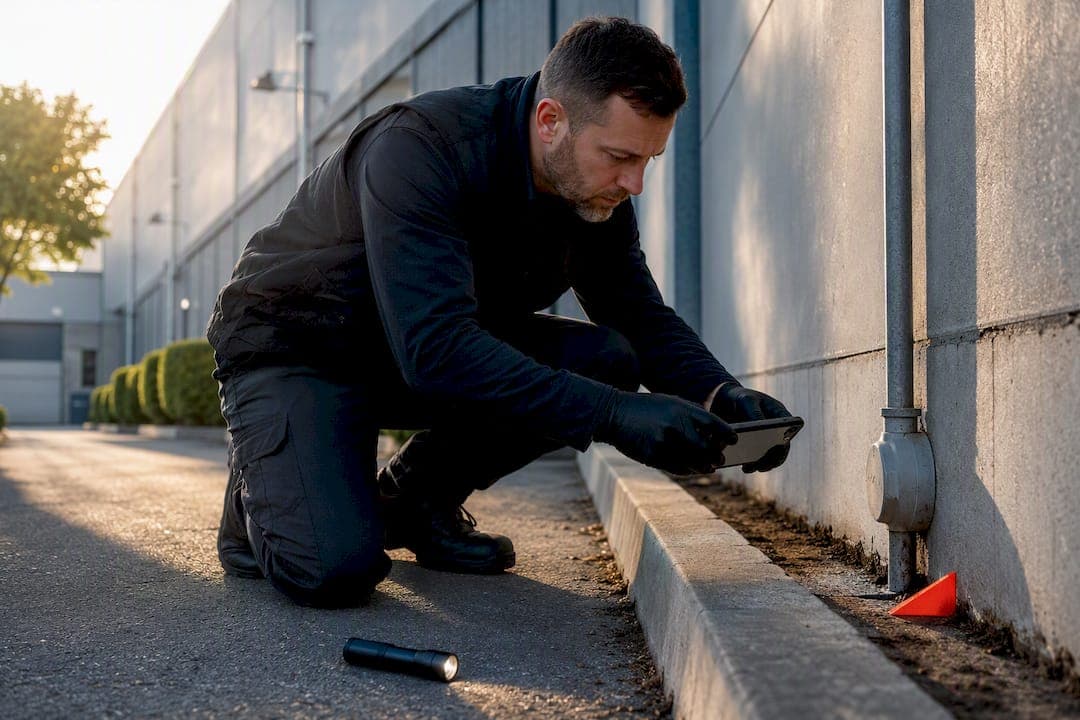
Walk the full perimeter and photograph every crack, gap, or vent you find, noting its exact location and how severe it looks. A hairline crack near a utility penetration might wait two weeks; a fist-sized gap under a wall panel needs a same-day fix.
Check dumpster placement next. Pads should sit at least 10 to 15 feet from any entry door, on a hard surface that can be pressure-washed, with a cleaning schedule posted and followed, not just written down. Finally, look up. Roof lines, ridge vents, and HVAC penetrations are common bird and insect entry points that ground-level inspections miss entirely.
Pro Tip: Keep a dated photo log of every exterior crack you flag. When the same spot shows up in three consecutive inspections, that's your signal the fix wasn't done right the first time.
What Should You Check at Loading Docks and Doors?
Loading docks are the single largest pest entry risk in most warehouses, and the threshold is smaller than most managers expect. A gap under a dock door of roughly 1/4 inch is enough for a mouse to squeeze through, so measuring gaps isn't optional, it's the first line item on every dock check.
- Measure every door gap with a flashlight test or a feeler gauge; log anything over 1/4 inch for immediate repair
- Inspect brush sweeps and weather seals for tears, gaps, or missing sections; replace on a fixed schedule rather than waiting for visible damage
- Check dock leveler seals monthly since these compress and degrade faster than door seals
- Inspect incoming pallets and trailers for visible pest evidence before unloading, and quarantine anything suspect rather than moving it into storage
Air curtains earn their cost on high-throughput bays where doors stay open for long stretches during peak shifts. Schedule a functional check of every air curtain at shift change, not just once a month, since a broken fan motor during a busy receiving window undoes the whole point of having one.
Where Do Pests Hide Inside a Warehouse?
Interior inspections catch what exterior sweeps miss, and the spots that matter most are the ones crews walk past every day. Under-rack cavities, wall voids, and the gap behind pallet racking hold droppings, gnaw marks, and shed insect wings long before an infestation becomes visible on the main floor.
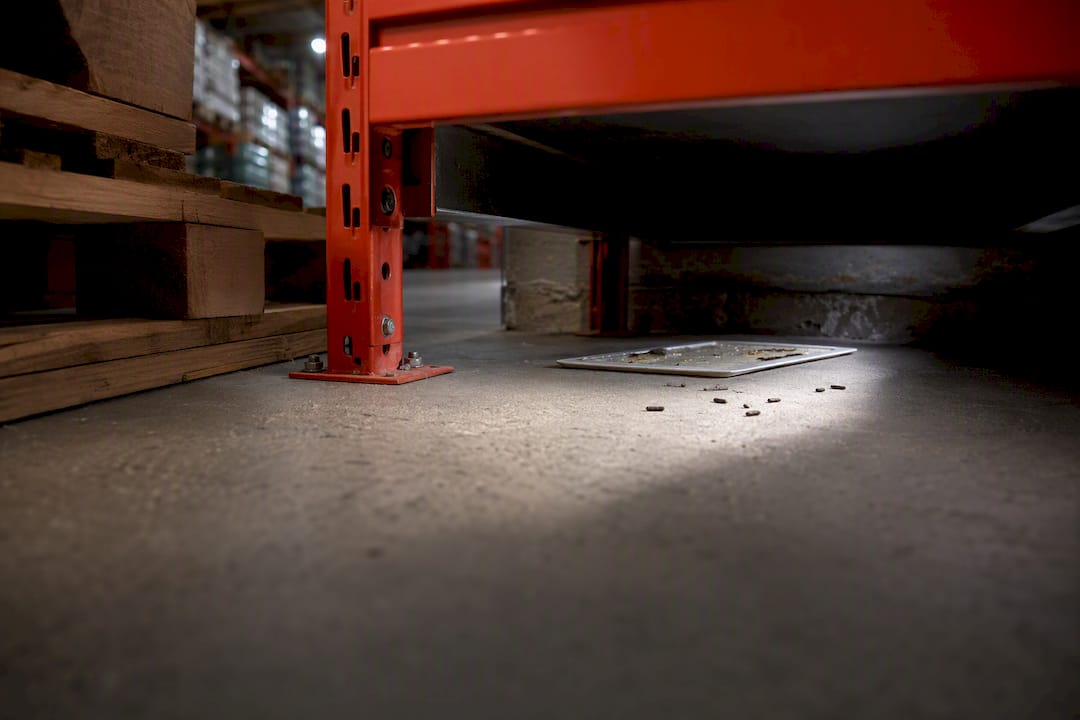
Drains and sumps deserve their own line item. Covers should sit flush and get cleaned on a set cadence, and glue boards belong near drain access points where rodents travel along pipe runs. Temperature matters too: cold storage slows insect activity but doesn't stop rodents, while ambient dry-goods storage is where stored-product pests thrive fastest.
For mezzanines, high shelving, and roof trusses, a pair of binoculars or a drone beats a ladder for a quick visual pass. Log every finding with the same rigor as ground-level checks, since low-traffic zones behind racking and under conveyors are where most infestations actually start, not the open aisles everyone walks through daily.
Pro Tip: Add behind-racking and under-conveyor spots to your weekly rotation instead of saving them for the quarterly walkthrough. By the time a quarterly check catches activity there, it's had three months to spread.
How Should You Map and Log Monitoring Devices?
Every monitoring station needs a number and a spot on the master site map, updated the same day a device gets moved. That single practice, numbering and mapping every device, is described as one of the most audit-proofing habits a warehouse can adopt, because it turns scattered trap checks into a searchable record.
Spacing follows a simple rule: rodent stations go every 30 to 50 feet along interior walls, with extra units near break rooms, loading docks, and other high-risk zones. Skimping on density in a big warehouse is the fastest way to miss early activity in a far corner nobody walks past often.
At each check, record five things:
- The device's unique ID number
- A timestamped photo of its current condition
- Activity status (clean, minor activity, active infestation)
- Any corrective action taken on the spot
- The initials of the technician who checked it
Quarterly, pull the logs together and look for patterns. A mapped, dated record across several months tells you whether to add stations near a specific dock, thin out a zone that's stayed clean for a year, or escalate exclusion work somewhere that keeps showing repeat activity.
Sanitation Habits That Remove Pest Attractants
Pests need food, water, and shelter. Take those away consistently and half the battle is already won before a technician ever sets a trap.
- Wipe down break room surfaces and empty trash daily, not at end of week
- Sweep packing and receiving areas for spilled product every shift
- Keep dumpsters sealed, positioned away from doors, and on a fixed cleaning cadence
- Inspect supplier delivery vehicles for pest evidence before goods come off the truck and reject any load with visible signs
- Clear condensation buildup around HVAC units and keep drain lines flowing freely
None of these tasks are complicated on their own. What breaks down is consistency, one skipped cleaning cycle during a busy week is often the exact window a pest population needs to establish itself.
When Should You Escalate a Pest Finding?
Not every sighting needs the same response. Thresholds keep your team from either overreacting to a single moth or underreacting to a growing rodent trail.
- One or two insects in a trap: log it, no action beyond continued monitoring
- Fresh rodent droppings or gnaw marks: trigger an immediate inspection of the surrounding 20 feet and tighten monitoring in that zone
- Suspected infested pallet: tag it, photograph the evidence, move it to a quarantine area away from clean stock, and hold it until cleared
- Repeat activity at the same station across two checks: escalate to your pest control provider for a targeted treatment plan
Every escalation needs a corrective-action ticket: what was found, what was done, who verified the fix, and when it closed. Provider service reports should get filed and summarized the same way, since audit-ready records depend on a complete paper trail, not just the memory of whoever handled it.
What Do 30 Years of Warehouse IPM Work Teach You?
The checklist itself isn't the hard part. What separates a warehouse that stays clean from one that keeps calling for emergency treatments is whether sanitation, maintenance, and monitoring actually talk to each other. IPM only works as a partnership between your team and a provider who shows up consistently, not as a one-time proofing job.
Brush sweeps and utility-penetration seals are the two items we see skipped most often, not because teams don't care, but because these components degrade quietly. A seal that looked fine in January can have a gap by July, and nobody notices until a service report flags it.
Staff reporting closes the loop. Simple laminated ID cards and a single-point reporting workflow turn every employee on the floor into an early-detection system, which catches activity long before a monthly device check would.
Pro Tip: Keep your approved materials list, safety data sheets, and corrective-action templates in one shared folder your whole team can access, not buried in one manager's inbox.
— Bespoke-Enviro Services
Turning the Checklist Into a Weekly Routine
A checklist only works if someone owns each piece of it. Assign weekly visual checks to operations staff, monthly device audits to maintenance, and quarterly proofing reviews to QA, then put the schedule in writing so it survives staff turnover.
Feed what you find into your supplier scorecards. A vendor whose trailers keep failing pre-unload inspection is a bigger long-term risk than one bad monitoring station. Schedule your quarterly proofing walkthrough two weeks before any external audit, never the week of, so you have time to close out corrective actions instead of just documenting them. For a deeper look at how the pieces fit together, this practical IPM guide walks through the full framework behind the checklist.
Bespoke-Enviro Services: Site Surveys and Audit-Ready Contracts
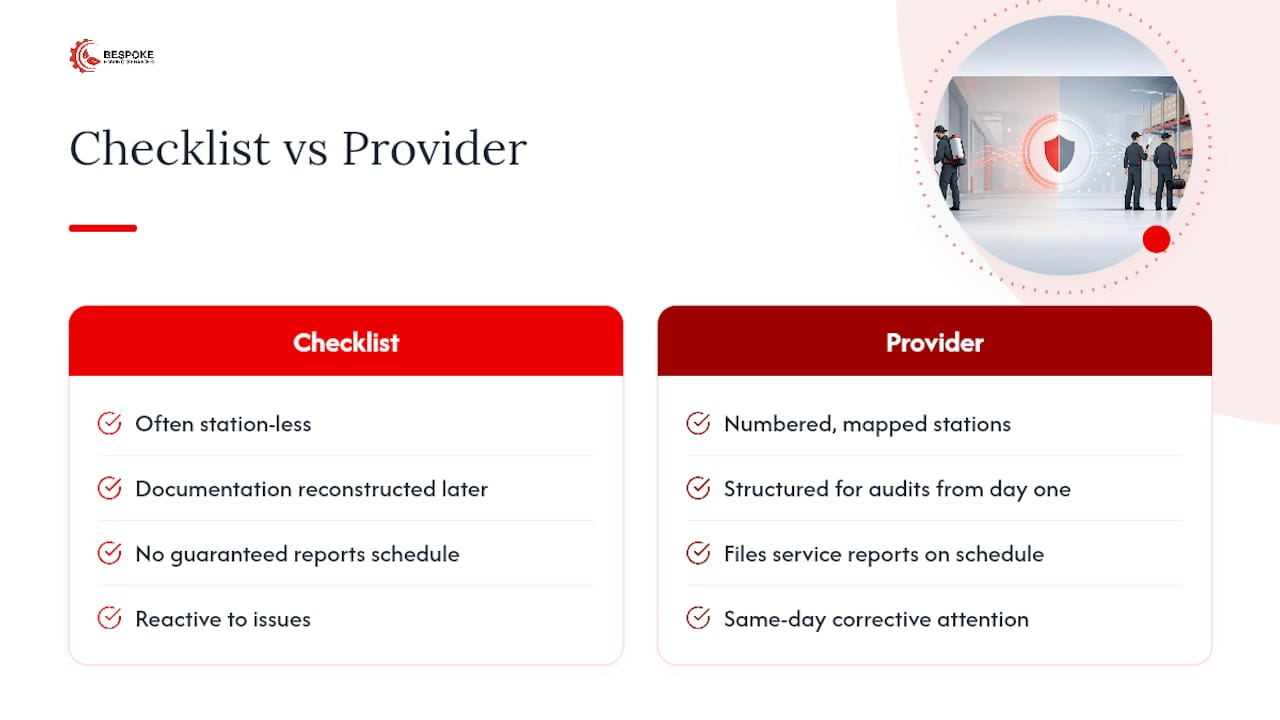
Running this checklist internally gets you most of the way there. What it can't replace is a provider who maps your stations, files service reports on schedule, and shows up before a small gap becomes a recurring infestation. The company promotes NEA-licensed technicians who use non-toxic, eco-friendly IPM methods, with availability for same-day attention when a corrective-action ticket arises.

We build monitoring programs around numbered, mapped stations, and our documentation is structured for audits from day one, not reconstructed after the fact. If your checklist keeps flagging the same dock door or the same corner of the warehouse, that's usually a sign the exclusion work needs a professional pass, not just another sanitation cycle.
Our general pest control services cover the full IPM program a warehouse needs: perimeter checks, device monitoring, and sanitation audits under one contract. If your checklist has already turned up rodent activity along the walls or near the docks, our rodent and rat control services address it directly, with the same documentation standards built into every visit. Ready to see where your current program has gaps? Schedule a site survey and we'll walk your facility with you, station by station.
Sources
The recommendations in this checklist draw on established public health guidance and warehouse-specific pest management practices.
FAQ
What Are the Key Components of a Pest Control Checklist?
A complete checklist covers exterior perimeter and vegetation control, loading dock and door seals, interior racking and drain checks, numbered monitoring devices, sanitation and waste handling, and a documentation process for logging findings. Each component needs a defined cadence, weekly, monthly, or quarterly, so nothing gets skipped between audits.
What Is a Warehouse Safety Checklist?
A warehouse safety checklist covers structural and operational hazards like fire exits, racking stability, and equipment maintenance, alongside pest control items such as exclusion points and sanitation standards. Pest control fits inside a broader safety and compliance framework because unsealed gaps and poor sanitation create both pest risk and general facility hazards.
How Do You Control Rats in a Warehouse?
Rat control starts with sealing gaps over 1/4 inch at doors and utility penetrations, since that gap size is enough for rodents to enter, then layering in numbered monitoring stations spaced every 30 to 50 feet along interior walls. Sanitation, sealed waste storage, and prompt spill cleanup remove the food sources that draw rodents in the first place. Bespoke-enviro's rodent and rat control services combine all three elements under one monitored program.
What Are the Recommended Audit Checklists for a Warehouse?
Audit-ready warehouses maintain a master site map of every monitoring device, an approved materials list, service reports, pesticide usage logs, and a corrective-action log showing how each finding was closed. These documentation categories are what most third-party auditors expect to review, so keeping them current between visits, not assembled the week before, is what actually saves time during an inspection.