
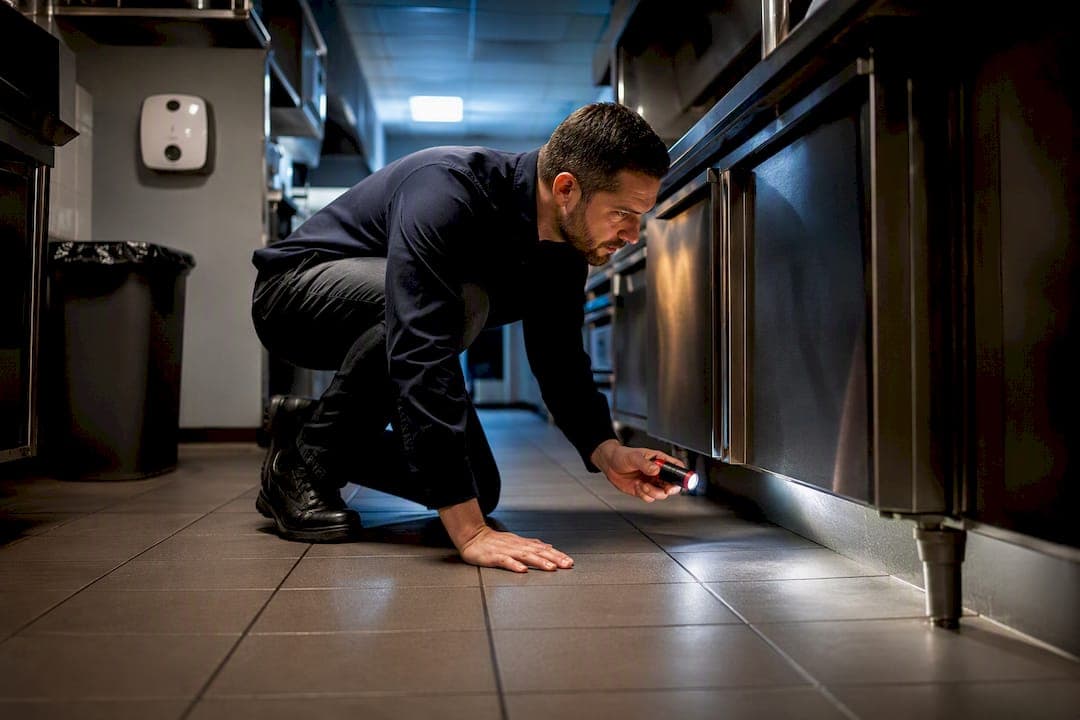
The single most reliable way to keep rodents out of a foodservice operation is a documented Integrated Pest Management (IPM) program built on daily sanitation, scheduled inspections, and physical exclusion. If you spot droppings, gnaw marks, or a live rodent, log it immediately and escalate to a licensed pest control professional the same week. A licensed pest control professional builds this exact framework, and CDC cleanup guidance should govern any contaminated-area response.
TL;DR:
- Daily inspections should focus on sealing gaps smaller than a quarter inch, cleaning spills immediately, and storing food securely to prevent rodent entry.
- Weekly and monthly tasks include checking storage areas, cleaning behind equipment, and inspecting exterior enclosures for structural damage or openings.
- Monitoring devices such as bait stations and sticky traps should be placed along walls near access points, with all checks thoroughly logged to satisfy inspection standards.
- Sealing entry points requires pairing metal barriers with durable filler, and taking photos before and after helps document compliance and fast-tracks violation responses.
- Never sweep or vacuum rodent droppings; instead, wet the area with a bleach solution, wear protective gear, and properly dispose of contaminated waste.
Table of Contents
- Restaurant Rodent Control Checklist: Daily Tasks
- Weekly and Monthly Checklist: Scheduled Maintenance
- Where Should You Place Monitoring Devices?
- Exclusion and Structural Fixes: Sealing Entry Points
- How Do You Safely Clean Up Rodent Droppings?
- When Should You Call a Pest Control Professional?
- IPM in Practice: What a Documented Program Looks Like
- Embedding Inspection Readiness Into Daily Culture
- Get Professional Rodent Control for Your Restaurant
- Sources
- FAQ
Restaurant Rodent Control Checklist: Daily Tasks
Rodent prevention lives or dies on what happens between shifts, not what happens during a monthly inspection. Mice need only about 6 millimeters, roughly a quarter inch, of gap to get inside, so daily discipline around food, water, and door seals matters more than any single trap.
Assign these tasks to a closing or opening manager, and record completion in a logbook or digital field app:
- Keep exterior doors closed except for active deliveries, and confirm door sweeps are intact.
- Wipe up spills the moment they happen. Grease and crumbs left overnight are what sustain a rodent population even when bait stations are in place.
- Store all food in sealed, labeled containers and rotate stock on a first-in, first-out basis.
- Empty interior trash cans nightly and wash them out weekly.
- Confirm dumpster lids are latched and the pad around the enclosure is free of spilled waste.
- Walk the perimeter and dining floor for droppings, grease smears along baseboards, or gnaw marks on packaging.
- Check floor-drain covers for gaps and confirm they sit flush.
A shift manager signs off on the log each night. Any live sighting, fresh droppings, or gnaw damage triggers same-day notification to whoever owns your pest program, not a note for next week's meeting.
Weekly and Monthly Checklist: Scheduled Maintenance
Daily tasks catch fresh activity. Weekly and monthly tasks catch the harborage and structural weaknesses that daily walk-throughs miss, and they're the ones inspectors specifically look for.
Weekly:
- Inspect dry-storage shelving, and keep all stock at least six inches off the floor so you can see beneath it.
- Check pallets and incoming deliveries for droppings or gnawed packaging before product reaches the shelf.
- Steam-clean range hoods and adjacent walls to strip grease buildup that attracts and shelters pests.
Monthly:
- Deep-clean under and behind fixed equipment: fryers, reach-ins, prep tables.
- Pull back drop ceiling tiles, and check booth cavities and employee lockers, since these hidden spaces accumulate food debris and make ideal nesting sites.
- Inspect exterior dumpster enclosures for holes, gaps at the base, or overgrown landscaping that offers cover.
- Schedule and record your professional pest service visit, including any corrective actions taken.
Checklist templates built for hotels and restaurants consistently break tasks into exactly this cadence, pairing daily sanitation with weekly and monthly structural checks and dumpster enclosure inspections.
Where Should You Place Monitoring Devices?
A monitoring program only works if devices sit where rodents actually travel, and every check gets written down. Municipal IPM checklists treat written monitoring records as core evidence of a functioning prevention program, not an optional add-on.
Placement principles that hold up in practice:
- Set sticky boards and tamper-resistant bait stations along walls, since rodents travel by touch and tend to run edges, not open floor space.
- Position devices near likely ingress points: utility penetrations, dumpster corridors, and back-of-house doors.
- Log snap-trap catches the same way you log bait station checks, not as a separate afterthought.
Each visit, record the date, device location, sign type observed (droppings, gnawing, a catch), the count, the action taken, and a signature. A practical cadence is a daily visual scan during opening or closing, a weekly device check, and a monthly professional visit. That documented trail is exactly what a health inspector wants to see when they ask how you're controlling pests.
Exclusion and Structural Fixes: Sealing Entry Points
Rodents get in through gaps at door thresholds, utility penetrations, roofline vents, and floor-wall joints where slabs have settled. Walk each of these points with a flashlight during your monthly inspection, because gaps that look cosmetic at eye level often run deeper than they appear.
Foam sealant alone fails because rodents chew straight through polyurethane foam. Pair a metal barrier, hardware cloth or steel wool, with a durable filler or cement, then finish cosmetically over the top. Metal flashing works well on larger gaps at rooflines or utility chases. Anything under half an inch to a centimeter should be sealed on sight; larger structural gaps need prompt sealing to prevent disease transmission and probably belong on a maintenance ticket, not a DIY fix.
Pro Tip: Photograph every gap before and after sealing. If a health inspector asks about a prior violation, a dated photo record closes the conversation faster than an explanation.
How Do You Safely Clean Up Rodent Droppings?
Never sweep or vacuum rodent droppings. Both actions aerosolize particles that can carry hantavirus and other pathogens, and airborne contamination is the primary way people are exposed. The CDC recommends wetting the area with a bleach solution mixed at one part bleach to nine parts water, letting it soak for 10 minutes, then wiping it up with disposable towels.
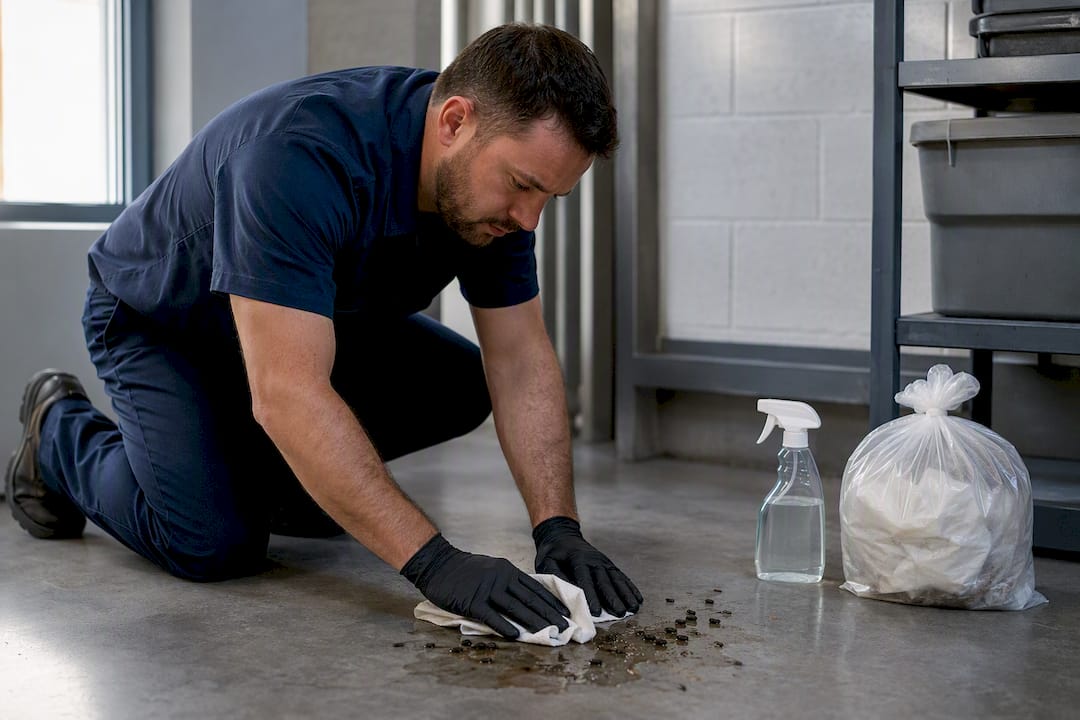
Wear gloves and a mask, ventilate enclosed spaces for 30 minutes before you start cleaning, and double-bag contaminated waste for disposal per your local rules. Log the cleanup in your pest record with date, location, and who performed it. If the contamination points to an active nest rather than a one-off event, notify management immediately and treat it as an escalation trigger, not routine cleanup.
When Should You Call a Pest Control Professional?
Escalate immediately for live sightings in prep or storage areas, droppings that reappear despite cleaning, gnaw damage on structural material, burrows near the foundation, or any carcass found on-site. Waiting for the monthly service visit to report an active problem is how a manageable issue becomes a closure notice.
When you bring in a vendor, ask specific questions:
- What does their IPM approach look like: sanitation and exclusion first, targeted treatment second?
- Where will tamper-resistant bait stations go, and how are they documented?
- What report do you receive after each visit, and how often will they return?
Expect snap traps inside protected stations indoors, tamper-resistant bait stations outdoors, and targeted baiting rather than broadcast application. Regular professional service, monthly for most restaurants, more often for high-volume kitchens, is what separates operators who pass inspections consistently from those who scramble before every visit.
IPM in Practice: What a Documented Program Looks Like
A working IPM sequence runs sanitation, then exclusion, then monitoring, then targeted treatment, with every step logged. That order matters: prevention through sanitation and sealing comes first, and traps or bait are the backup, not the plan.
A service report typically includes the visit date, device-by-device check results, photo notes on any activity, and a corrective-action ticket for anything that needs repair. Managers who fold that report straight into their own food-safety binder pass inspections faster. For a deeper walkthrough of the framework, see our practical IPM guide, and for fast field identification, our dropping identification guide helps staff photograph and log signs correctly before you even pick up the phone.
Embedding Inspection Readiness Into Daily Culture
Treat your pest log the same way you treat a temperature log: non-optional, reviewed at shift handover, acted on immediately. A quarter-inch gap ignored for a month costs far less to seal than the closure notice it eventually causes.
— Bespoke-Enviro Services
Get Professional Rodent Control for Your Restaurant
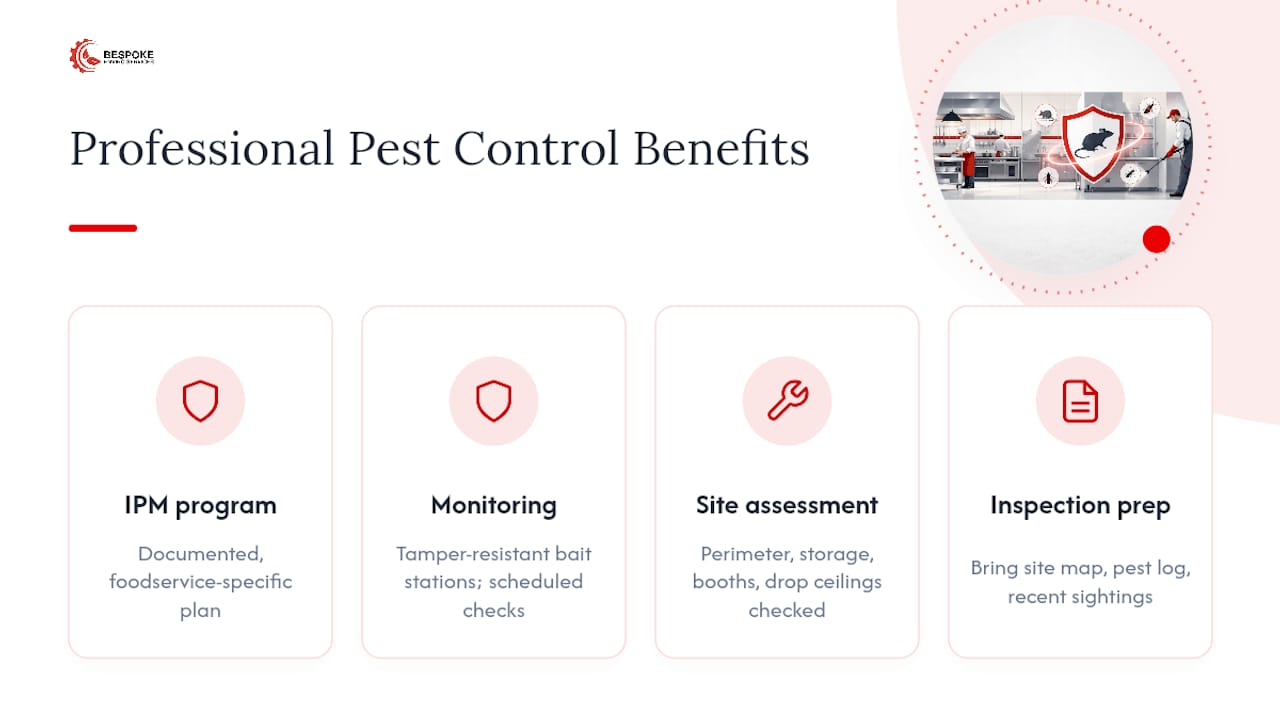
Most operators patch this together themselves until a health inspector or a customer complaint forces the issue. A professional pest control company offers a documented IPM program built specifically for foodservice sites, with tamper-resistant bait stations, scheduled inspections, and written service reports you can drop straight into your compliance file.

Technicians assess your exterior perimeter, storage areas, and hidden cavities like booth seating and drop ceilings, then set a monitoring cadence matched to your delivery schedule and past pest history. For operators managing recurring service scheduling alongside pest control, Served's restaurant tools can help keep inspection-ready records organized between visits. When an infestation is already active, our fumigation services handle remediation at the source.
Before you request an inspection, pull together a rough site map, your current pest log if you have one, and notes on any recent sightings. Then get in touch through our general pest control page to schedule your first inspection.
Sources
Keep these on hand for staff training and inspection prep: CDC rodent cleanup guidance and NYC's food establishment IPM checklist.
- CDC — Rodent Control: Cleaning Up After Rodents
- NYC Department of Health — Keep Pests Out of Food Establishments (IPM checklist)
- Province of British Columbia — Managing rat and mouse pests
- GoAudits — Pest Control - Hotels & Restaurants checklist
- Florida Pest Control — Food-Service Rodent Checklist (PDF)
FAQ
How Often Should a Restaurant Be Inspected for Rodents?
Daily visual checks during shifts, weekly device checks, and at least monthly professional visits, with high-volume kitchens often needing more frequent professional service.
What Are the Earliest Signs of a Rodent Problem?
Fresh droppings near food storage, grease smears along baseboards, gnaw marks on packaging, and unusual pet or staff alertness near dark corners are typically the first signs.
Can I Use Foam to Seal Gaps Around Pipes?
No. Rodents chew through polyurethane foam easily, so pair a metal barrier like hardware cloth or steel wool with a durable filler for any gap around a quarter inch or larger.
Is It Safe to Vacuum Rodent Droppings?
No. Vacuuming or sweeping aerosolizes particles that can spread pathogens; the CDC recommends wetting the area with a bleach solution first, then wiping it up.
Does Bespoke-Enviro Provide Documented Service Reports?
Yes. Bespoke Enviro Services delivers written reports covering device checks, activity notes, and corrective-action tickets that operators can add directly to their food-safety compliance files.