
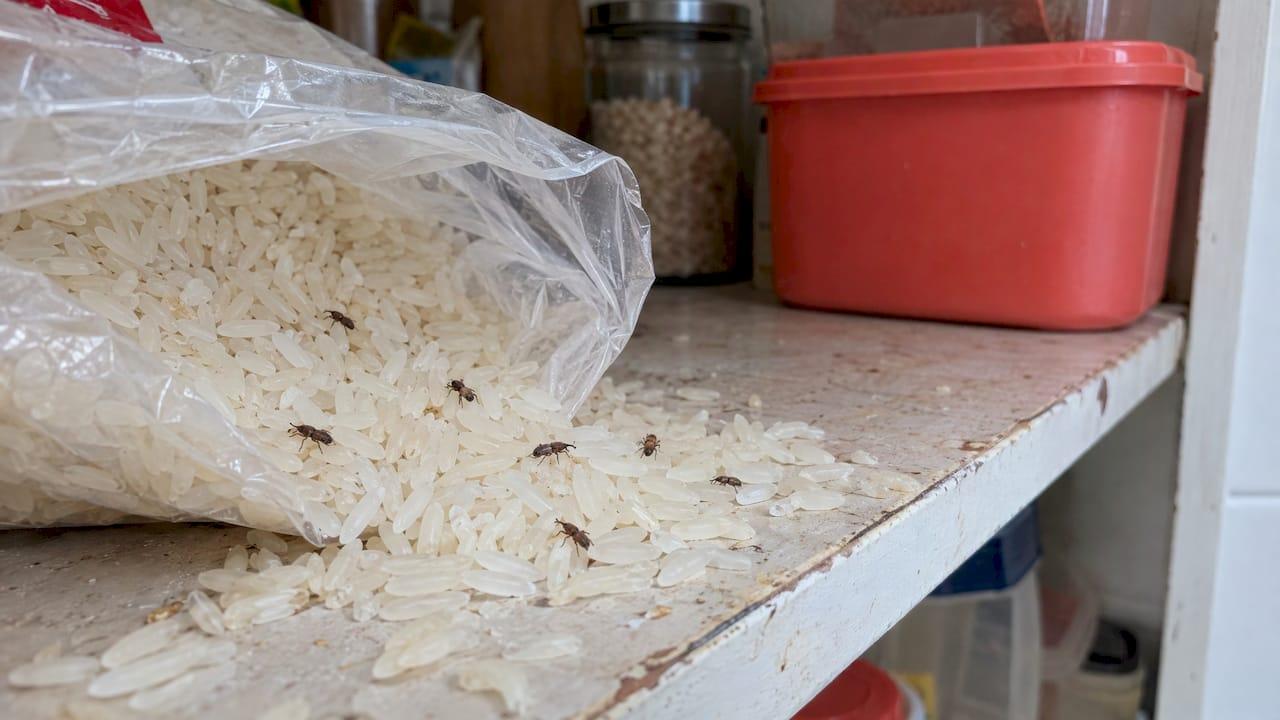
Rice weevils are small dark beetles that arrive inside the rice you buy, then breed in Singapore's warm, humid kitchens. The Singapore Food Agency (SFA) says they are not harmful to people, so a find in one bag is a hygiene problem, not a health emergency. To clear them, wash the rice, empty and dry the container, and store new rice sealed. If they keep coming back, or they turn up in a restaurant, shop, warehouse or block of units, the cause is usually the storage area, and we treat that cause.
TL;DR
- Rice weevils are 2 to 3 mm beetles with a long snout. Round holes in grains and damp-feeling rice are the signs.
- The SFA says weevils, larvae and adults, are not harmful to people, and washed rice can still be eaten.
- Clear them by washing the rice, then emptying, washing and fully drying the container before refilling.
- Store rice sealed, cool and dry, buy smaller packs, and check stock regularly.
- Repeat infestations, several infested foods or commercial storage call for a professional inspection of the storage area.
Table of Contents
- What rice weevils are
- How to identify rice weevils
- Why they appear in Singapore homes
- Is rice with weevils safe to eat?
- How to get rid of rice weevils at home
- How to prevent rice weevils from coming back
- Rice weevils in shops, restaurants, warehouses and managed buildings
- When to call a pest control professional
- Get the storage area inspected
- Our view on weevils
- FAQ
- Sources
What rice weevils are
The rice weevil (Sitophilus oryzae) is a beetle. The SFA describes it as about 2 to 3 mm long, found mainly in the tropics and most often in rice. It also infests corn, millet, wheat, sorghum, oats and barley.
The Food and Agriculture Organization (FAO) notes that weevils are set apart from other storage pests by a long beak, called a rostrum. Adults are dark brown, sometimes with four lighter spots on the wing cases. The FAO also ranks them among the most important primary pests of cereals in the humid tropics.
A local supermarket's guide puts the size at 2.5 to 3.5 mm and says they do not bite or spread disease. That matches the SFA's position.
How to identify rice weevils
Most people first notice small dark insects crawling on a rice bag, the container lid or the nearby shelf. Check for these signs:
- Tiny dark beetles with a snout. Look closely at the front of the insect. The snout is the feature that separates a weevil from other small beetles.
- Round holes in the kernels. The SFA lists round holes in rice kernels as a sign of presence. The female lays eggs inside the grain, and the larva develops there before leaving through a round exit hole, as the FAO describes.
- Rice that feels damp. The SFA also says increased moisture may make grains feel damp.
- Pale, legless larvae. The University of Maryland Extension describes the larvae as legless and creamy-white with a brownish-black head. They live inside the grain, so you rarely see them unless a kernel is broken.
Rice weevil or another pantry pest?
The same extension page says rice weevil adults have four faint reddish to yellowish marks on the wing covers, can fly and are attracted to light. The related granary weevil lacks the pale spots, cannot fly and is not drawn to light. In a Singapore flat, a weevil flying to a lamp near the kitchen is therefore likely a rice weevil.
Different insects need different handling. Tiny flat beetles in flour are not weevils, and moths with webbing in grains are a separate problem. A pest control technician can identify the insect from a sample and an inspection of the area.
Why they appear in Singapore homes
Your kitchen is rarely where the problem starts. The SFA explains that rice weevils can already be in the crop before harvest and be carried into food-processing facilities. They can become visible in the product later, and generally enter homes when consumers buy it.
The Austrian Agency for Health and Food Safety (AGES) describes how they travel with rice and cereals. In the tropics they infest grains in the field, fly back and forth from the store to the paddy, and return to the store after harvest.
Once the bag is at home, climate does the rest. The University of Maine Cooperative Extension says the rice weevil breeds continuously in warm countries. Adults live roughly four to five months, a female can lay 300 to 400 eggs, and in hot weather a generation can complete its life cycle in as few as 26 days.

A rice supplier in Singapore adds that warm, humid conditions let dormant eggs or larvae develop once rice is stored at home. It also says moisture and long storage encourage activity once a bag is opened to the air. So a bag that sat unopened for months can start showing weevils within weeks of opening.
That is why a clean kitchen can still get weevils. They came in with the rice.
Is rice with weevils safe to eat?
Yes, according to the national food authority. The SFA states that rice weevils, whether larvae or adults, are not harmful to people, and consumers can wash the rice and continue to eat it. Food authorities generally treat weevils as natural, unavoidable substances with no known illness from eating them.
A media report citing the SFA adds practical advice. Pluck weevils out as you wash the grains. If you miss a couple, there is no harm as long as the food is cooked. For flour or other food you cannot wash, pick out as many as you can and cook it thoroughly.
If you are a food business, a different standard applies. A customer who finds insects in a dish does not care that they are harmless. For restaurants, shops and storerooms, the aim is no insects in stock at all, which we cover below.
How to get rid of rice weevils at home
Work through the kitchen in one session, so survivors have nowhere to go.
Step 1: Deal with the rice
Follow the SFA's advice: wash the rice and remove the weevils as you do. The washing step does the removing, so rinse in several changes of water and skim off what floats.
A local supermarket suggests an alternative for the whole bag. Bake the rice at 60°C (140°F) for 20 minutes on a baking pan to kill the weevils. Then remove the dead ones by hand or with a sieve, and transfer the rice to a new airtight container.
If the rice is heavily infested, with many holes, a damp feel or a musty smell, it is reasonable to throw it away and start with a fresh bag.
Step 2: Empty and clean every container and shelf
Weevils do not stay in one bag. Take out everything on the shelf and the cupboard around it. Check other grains, pasta, flour, cereal, pet food and dried beans. Vacuum corners, shelf edges and the gaps where lids sit, then wipe with a damp cloth.

The SFA specifically advises that you wash and dry the container before refilling it. Moisture is what weevils thrive on, so a container put back damp restarts the problem.
Step 3: Sort what else is affected
Rice weevils also infest corn, millet, wheat, sorghum, oats and barley, so check those. Anything with holes, live insects or a damp feel gets the same treatment as the rice, or goes in the bin. Seal the bin bag before taking it out so the beetles do not return through the door.
Step 4: Refill sealed and watch for two weeks
Put fresh rice in a clean, dry airtight container. Look at the shelf and container every few days for two weeks. If new beetles appear, something in the cupboard is still infested, or the source is elsewhere in the home.
Remedies you may have heard about
Some sites suggest putting infested food in the sun for a few hours, or adding bay leaves, garlic or turmeric. The same media report lists sunlight, bay leaves, a whole garlic or turmeric as tips. The supermarket guide adds Sichuan pepper and neem leaves wrapped in a paper towel. These are household habits, not a treatment for a recurring infestation. The cleaning in Step 2 and sealed storage matter more.
How to prevent rice weevils from coming back
The SFA's storage advice is simple and covers most homes:
- Store rice in a tightly sealed container in a cool, dry place.
- Buy smaller quantities when your household eats less rice.
- Open a pack only when you need it.
- Wash and dry the container before refilling.
- Check your stock regularly.
Two more habits come from local rice and grocery sources. A Singapore rice supplier advises transferring rice to an airtight container right after opening, keeping it away from heat sources, and opening one pack at a time. If you have fridge space, storing rice there also works. The supermarket guide suggests an oxygen absorber packet in an airtight container, since weevils cannot survive without oxygen, or keeping an opened pack in the freezer.
If you buy rice in bulk, rotate it. Use the oldest pack first and avoid stockpiling bags that will sit for months in a humid cupboard.
Rice weevils in shops, restaurants, warehouses and managed buildings
For a business, one infested bag is a signal about the storage area. The SFA tells importers to store rice under proper conditions with low moisture and proper aeration, and to check it regularly for insects.
The SFA's Good Warehousing Practices document sets out what a sound storage facility looks like:
- Ventilation that prevents condensation.
- Meshed openings to the exterior to keep pests out.
- Products stored off the floor and away from walls.
- Stock rotated by a first-in-first-out or first-expired-first-out system.
- Pest management practices in place to prevent harborage and breeding.
Property managers can use that list as an audit of a provision store, a canteen kitchen or a shared storeroom. Gaps against any line are where weevils settle. A recurring problem in tenant units can also come from one shared supply point, so look at the building's food storage as a whole.
One rice supplier in Singapore says it uses a chilled warehouse with low-temperature storage to prevent weevil growth without fumigation. It shows that temperature and moisture control are the basis of weevil prevention at scale.
When to call a pest control professional
A single infested bag does not need a technician. Call one when any of these applies:
- Weevils return after you have cleaned, discarded the rice and stored fresh stock sealed.
- Several foods are infested across more than one cupboard or room.
- You cannot tell whether the insect is a weevil or another pest.
- You run a food business, or manage a building with shared kitchens or storerooms, and need to show that pest control is in place.
- You are managing a construction site canteen or store, where food storage is temporary and poorly sealed.
What the visit should achieve is finding where the insects live, not only killing the ones you see. Our approach is integrated pest management (IPM): inspect, find the source, remove the conditions that support the pest, and treat only where needed. If you want to know more, see our integrated pest management guide. It also suits households with children, pets or an eco-conscious outlook, because our methods are non-toxic. If you are unsure about pets, read whether pest control is safe for pets.
If you have found other pests in the same kitchen, our guide to preventing cockroaches in HDB flats covers the cleaning and entry-point habits that help with those too.
Get the storage area inspected
Our general pest control service in Singapore covers homes, businesses, industrial sites and construction sites. Our technicians are NEA-licensed, and we use non-toxic, environmentally safe methods that put the safety of people and pets first. We also use technology such as thermal imaging for inspections, and we are available 24/7.

For larger storage areas, our fumigation services are also available. Contact us through the service pages with a description of where you saw the insects and what is stored there.
Our view on weevils
Rice weevils are a good example of how pest problems really work. The insects people see are the end of the story. The beginning is the grain, the storage conditions and the building.
The official advice is right: weevils in a bag of rice are not a health hazard, and washing is the first step. But a home or business that sees them repeatedly has a storage or moisture issue, and wiping the shelf will not fix that.
That is why we work by integrated pest management. We inspect first, find where the pests are living and what is feeding them, and fix those conditions. Our treatments are non-toxic and eco-friendly, because food storage areas sit next to the places where people and pets eat and sleep.
For property managers and business owners, we think the best result is a storage area that stays clean and keeps passing inspection. Our technicians are NEA-licensed, and we are available around the clock when a problem cannot wait.
Bespoke-Enviro Services
FAQ
Can I eat rice that has weevils in it?
The SFA says rice weevils are not harmful to people, and consumers can wash the rice and continue to eat it. Remove the weevils as you wash, and cook the rice thoroughly. If the rice smells musty or looks heavily damaged, discarding it is a sensible choice.
Where do rice weevils come from if my kitchen is clean?
Usually from the rice itself. The SFA explains that weevils can be in crops before harvest and enter homes when consumers buy the product. Singapore's warm, humid conditions then let eggs and larvae in the grain develop, so cleanliness alone does not prevent them.
How long does it take for rice weevils to multiply?
The University of Maine Cooperative Extension says that in hot weather weevils can pass through all life stages in as few as 26 days. A female can lay 300 to 400 eggs. A small number found early can become a large infestation within weeks if the rice stays in a warm cupboard.
How do I stop rice weevils coming back?
Store rice sealed in a cool, dry place, buy smaller packs, and wash and dry the container before refilling. Check stock regularly and open one pack at a time. If weevils return despite this, have the storage area inspected for the source.
Do I need pest control for rice weevils?
Not for a single bag. You should consider it when infestations repeat, spread to several foods or occur in a business, shared kitchen or storeroom. We inspect the area, find the source and treat it using non-toxic methods.
Sources
- SFA: Rice Weevils
- FAO: Storage pests in the prevention of post-harvest food losses
- University of Maryland Extension: Rice and Granary Weevils
- AGES: Rice weevil
- University of Maine Cooperative Extension: Rice Weevil
- Sheng Siong: how to prevent rice weevils in an opened pack of rice
- Tong Seng Produce: Rice weevils in your rice
- Tong Seng Produce: Our Company
- SAYS: Rice weevils can bore holes in the grains and lay eggs
- SFA: Good Warehousing Practices