
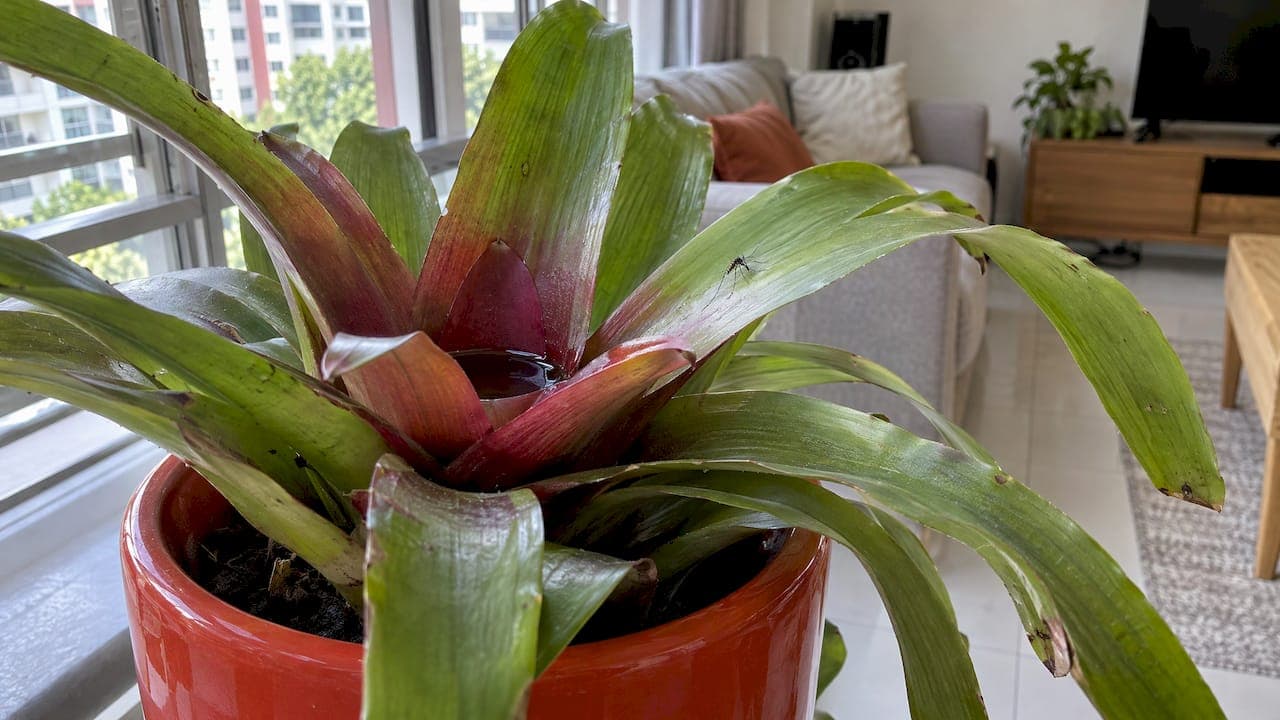
Indoor plants do not attract mosquitoes by themselves. The problem is standing water: a full saucer, a vase that is never changed, or water held in a plant's leaf bases can all become a breeding site. The small flies hovering over potting soil are often not mosquitoes at all but fungus gnats, which need a different fix. This guide helps you tell them apart, find the real source and clear it, with advice written for Singapore homes.
TL;DR
- Plants do not breed mosquitoes. Water left in plant saucers, vases and leaf axils does.
- Tiny flies rising from the soil are usually fungus gnats. They do not bite, and drier soil controls them.
- NEA advises against plant pot plates where possible. If you keep them, remove the water and scrub them every other day.
- Plants are not an effective mosquito repellent, according to NEA, so do not rely on them.
- If mosquitoes keep returning after you remove standing water, call a licensed pest control operator.
Table of Contents
- Do mosquitoes breed in indoor plants?
- Mosquitoes or fungus gnats: how to tell
- Where mosquitoes hide around your plants
- A weekly routine for plant owners
- Dealing with fungus gnats
- Do any plants repel mosquitoes?
- When to call a professional
- Our perspective
- Mosquito control with Bespoke Enviro
- FAQ
- Sources
Do mosquitoes breed in indoor plants?
They can breed in the water that indoor plants collect, but not in the plant or its soil. A mosquito needs water to complete its early life stages. A saucer under a pot, a glass of cuttings rooting in water, a decorative vase or a plant that holds water in its leaf bases all give it that.
In Singapore the mosquito to worry about is Aedes, the one that spreads dengue. NEA runs a national dengue prevention campaign every year, and it has noted that higher Aedes aegypti populations can accelerate dengue transmission once cases are present. A few forgotten saucers in one flat might seem minor, but in a dense housing estate they add to a bigger problem.
So the plant is rarely the culprit. How you water it, and what you leave underneath it, usually is.

Mosquitoes or fungus gnats: how to tell
Many people searching for this topic are actually looking at fungus gnats. The two look alike at a glance, yet they behave differently.
| Clue | Mosquito | Fungus gnat |
|---|---|---|
| Bites | Females land on skin to feed on blood | Does not bite |
| Behavior after landing | Settles to feed | Walks around on the surface |
| Where you see it | Around people, dark corners, under furniture | Around soil, windows and lights near plants |
| Wings | Long, narrow, held flat over the body | Light gray to clear, with a Y-shaped vein in common Bradysia species |
The behavior difference is the easiest test. Fungus gnats do not bite and tend to walk around after landing, while a hungry female mosquito may land on your skin to take blood. If you have never been bitten and the insects cluster near the pots, you are most likely dealing with gnats. The Y-shaped wing vein is another marker: the University of California IPM program describes common Bradysia fungus gnats as having light gray to clear wings with that vein.
A quick check: hold a clear cup over a resting insect, then look closely. If you find bites on your ankles in the evening or early morning, treat it as a mosquito problem regardless of what you see near the plants.
Where mosquitoes hide around your plants
Walk through your home with a torch and check these spots. They match the places NEA and NParks tell residents to inspect.
Saucers and plant pot plates
This is the most common source. NEA says to remove water from plant pot plates and scrub them every other day to remove mosquito eggs, and advises avoiding plant pot plates if possible. Eggs stick to the surface, so pouring water out is not enough. Scrubbing is what removes them.
Vases and water-rooting jars
Pothos, monstera and other cuttings rooting in water look good on a shelf, and they are also an ideal egg-laying site. Change the water often, scrub the container walls and keep the jar covered where you can. NEA also advises adding the prescribed amount of sand granular insecticide to vases, gully traps and roof gutters monthly, even if they are dry.

Plants that hold water
Some plants collect water by design. NParks advises checking bromeliads, taro and pitcher plants, and flushing standing water weekly or applying BTI. These are common on balconies and in living rooms, so include them in your weekly round.
Plant axils and hardened soil
NEA's home inspection checklist advises you to flip flowerpot plates, clear plant axils and loosen hardened soil. Soil that has become compacted can pool water on the surface after watering. Loosening it lets the water drain.
A weekly routine for plant owners
This takes about ten minutes once you have done it a few times.
- Empty every saucer and tray. Tip the water out, and do not leave pots sitting in it after watering.
- Scrub the saucers. Do it every other day if you keep them, as NEA advises. Better still, remove them if your plants allow.
- Change the water in vases and jars. Wipe the inside walls, not just the water line.
- Flush water-holding plants. Check bromeliads, taro and pitcher plants, and flush any standing water weekly.
- Check leaf axils. Look where leaves meet the stem for trapped water.
- Loosen compacted soil. Make sure watering drains through rather than pooling.
- Treat the dry spots on schedule. Vases, gully traps and roof gutters get granular insecticide monthly per NEA, even when dry.
If you want the whole home covered, not only the plants, our 30-minute mosquito source reduction checklist goes room by room, and our guide to 10 weekly actions to prevent dengue shows how to build the habit.
Dealing with fungus gnats
If your identification points to fungus gnats, the approach is different, and the good news is that it is simple.
- Let the top of the soil dry. Gnat larvae need damp conditions to survive, so allowing the top few centimeters of potting mix to dry out between waterings cuts their numbers. This is the main control measure.
- Check your potting mix. UC IPM advises avoiding incompletely composted organic matter in potting media unless it has been pasteurized, because it is often infested with fungus gnats.
- Use yellow sticky traps. Placed just above the soil, they catch adults and show you whether numbers are falling.
- Do not overwater. Overwatering is the common thread between gnats and mosquitoes. Wet soil feeds one, and standing water feeds the other.
Offices and shared spaces often keep many plants at once, and a problem in one pot spreads fast. For a facilities team, an IPM plan for office plant pests explains how to handle gnats without mistaking them for mosquitoes.
Do any plants repel mosquitoes?
No, not in a way you can rely on. NEA states that studies have shown plants are not effective at repelling mosquitoes, and that plant-based candles and diffusers have limited data on efficacy. Geranium, lemon balm, rosemary, citronella, lavender, lemongrass and peppermint all appear in repellent products, but the repellent compounds are only released when the leaves are crushed or burnt. A pot of lemongrass on your windowsill will not keep Aedes away.
That does not mean you should avoid these plants. Grow them because you like them, and keep their saucers dry. Just do not treat them as protection.
Humidity is another point worth knowing if you are choosing plants for a room. Damp air does not breed mosquitoes, but it helps to understand how indoor plants and humidity levels relate, so that you adjust watering sensibly and avoid soggy soil.
When to call a professional
Some sources cannot be removed. A large planter built into a balcony, a water feature, a shared roof gutter or a drain can hold water you cannot empty each week. For breeding sites that cannot be permanently removed, NEA suggests engaging a professional pest control operator to apply appropriate insecticide treatments.
Call someone in if:
- you keep getting bitten indoors even after clearing every saucer and vase;
- you find mosquito larvae (small wriggling shapes) in water you cannot drain;
- you manage a building, office or construction site where many possible breeding sites exist; or
- someone in the household or neighborhood has had dengue and you want the premises checked.
For homes and offices that need a structured approach, see how we handle property-wide mosquito and dengue control. Construction teams can use our NEA audit-ready checklist for mosquito control. Residents who want to understand the legal side can read about NEA penalties for mosquito breeding.
Our perspective
Most mosquito calls we hear about plants have the same cause. The plant is fine, and the water under it is the problem. A saucer that is emptied on Sunday and forgotten for the rest of the week is enough to keep a breeding cycle going.
We approach this the way integrated pest management (IPM) works: find the source, remove it, and use treatment only where removal is not possible. That means we look at how your plants are watered, where water collects and what lies beyond the pots, such as drains, gutters and balcony corners. Our technicians are NEA-licensed, and we use non-toxic, environmentally safe methods designed with the safety of people and pets in mind.
We also tell customers early when the insects are not mosquitoes. Fungus gnats need different handling, and getting the identification right saves time and avoids unnecessary treatment. For recurring problems in homes, offices and managed properties, a regular inspection and maintenance contract keeps the sources under watch, and our team is available 24/7 if you need us.
Bespoke-Enviro Services
Mosquito control with Bespoke Enviro
If you have cleared your plants and still see mosquitoes, or you look after a property with many potential breeding sites, we can inspect and treat it. Our general pest control services in Singapore cover mosquito prevention and other common household pests, for homes, businesses, property managers and construction sites. We use integrated pest management and non-toxic, eco-friendly treatments, with technology such as thermal imaging for inspections.

For one-time treatments or an ongoing maintenance contract, start on our main site and tell us about your property.
FAQ
Can mosquitoes lay eggs in potting soil?
Mosquitoes need standing water, not soil, to breed. Soil itself is not a breeding site, but hardened soil can pool water on the surface after watering. NEA advises loosening hardened soil and clearing leaf axils so that water does not stay put.
Should I stop using saucers under my plants?
NEA advises against plant pot plates where possible, because they are potential mosquito breeding sites. If you need one to protect your floor, empty it after watering and scrub it every other day to remove any eggs.
What are the tiny flies around my houseplants?
They are most often fungus gnats. They do not bite, and they walk around on surfaces after landing. Let the top of the soil dry between waterings and use yellow sticky traps just above the soil to catch adults.
Are there indoor plants that repel mosquitoes?
NEA says studies have shown plants are not effective at repelling mosquitoes. Repellent compounds from plants such as lavender or lemongrass are only released when the leaves are crushed or burnt. Removing standing water is the dependable way to cut mosquito numbers.
When should I call a pest control company about mosquitoes?
Call when you have removed every source you can reach and mosquitoes still appear, or when water cannot be drained, such as in built-in planters or shared gutters. NEA suggests a professional pest control operator for breeding sites that cannot be permanently removed.
Sources
- NEA launches national dengue prevention campaign
- Fungus gnats: mosquito look-alikes
- UC IPM: Fungus gnats
- NEA: Other preventive measures
- NParks: Keeping gardens mosquito free
- NEA: Protect and check checklist
- NEA: Types of spatial repellents
- NEA: Scope of works for mosquito control
- IPM plan for office plant pests
- Indoor plants and humidity levels