
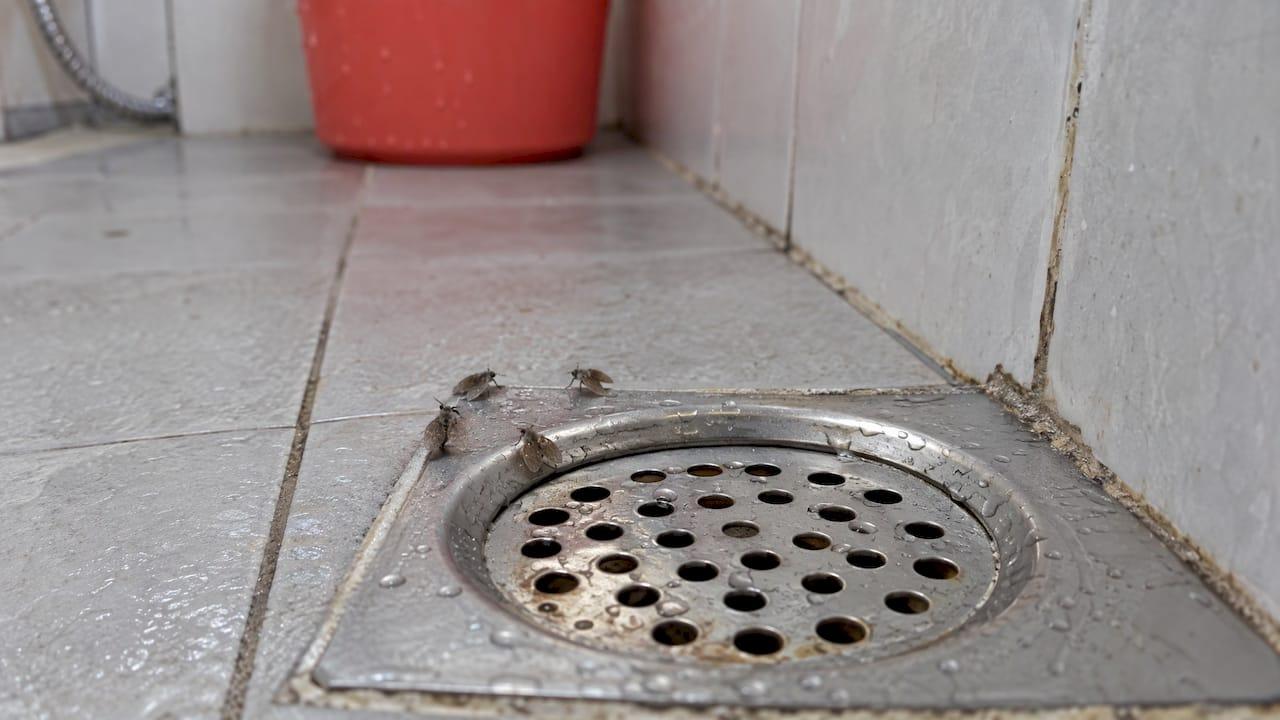
Drain flies are controlled at the drain, not in the air. The adults you see on the bathroom wall are the last stage of a life cycle that happens in the slime film inside a drain, floor trap or pipe. Removing that film, and finding every drain that holds it, is what ends an infestation. When flies keep returning after you have cleaned, the breeding site is usually out of reach, and an inspection by a licensed pest control team is the fastest way to find it. We handle that work for homes, businesses and property managers across Singapore through our general pest control service.
TL;DR
- Drain flies (also called moth flies) are small, fuzzy, moth-like flies that rest on walls near sinks and floor drains. Their larvae live in the slime film inside drains.
- Spraying or swatting adults does not solve the problem. The film must be physically removed, and every drain in the unit has to be checked.
- Drain flies do not bite and are not known to spread disease, but heavy numbers are a hygiene and nuisance problem, and in food premises they are a compliance concern.
- If flies return within a couple of weeks of thorough cleaning, the source is probably hidden: a cracked pipe, a condensate line, a shared stack or a neighbouring unit.
- A licensed team can inspect, locate and treat the source using non-toxic methods that are safe around people and pets.
Table of Contents
- How to tell drain flies from other small flies
- Why drain flies appear and where they breed
- Are drain flies harmful?
- What actually works: remove the film
- Step by step: dealing with a drain fly problem
- When to call a licensed pest control team
- How we handle drain fly infestations
- Preventing drain flies from coming back
- FAQ
- Sources
How to tell drain flies from other small flies
The fix depends on the fly, so identify it first. Drain flies are small, delicate and fuzzy, about 1/16 to 1/4 inch long (roughly 2 to 6 mm), and pale brownish-gray to black. At rest the wings are held over the body like a roof, so the insect looks like a tiny moth.
Three features separate them from the other small flies people find at home:
- Behavior. Drain flies are weak fliers. They hop or flutter short distances and cling to the wall above a sink, shower or floor drain.
- Location. Fruit flies hover around ripening fruit, bins and sugary spills. Fungus gnats stay near potted plants. Drain flies stay near drains, overflow holes and damp, dirty fixtures.
- Appearance. Fruit flies are smoother and often tan with red eyes. Drain flies are hairy and grey, with broad wings.
A cloud lifting off a fruit bowl is fruit flies, and a drain treatment will not touch it. We explain the differences in more detail in our guide to fruit flies versus drain flies. If the fly you see runs quickly across surfaces and has a humped back, it may be a different species, such as a phorid fly. That is a sign of decaying matter or a leaking waste line somewhere nearby, and it also calls for an inspection rather than a trap.
Why drain flies appear and where they breed
Adult drain flies are not the problem. The larvae are. Females lay masses of eggs in polluted shallow water or moist organic material, including the gelatinous film on the sides of drains, air-conditioner condensate pipes, septic and sewage tanks and wet compost. The larvae feed on the algae, bacteria and fungi in that slime.
The speed of the cycle explains why the flies seem to appear overnight:
- Eggs hatch in under 48 hours.
- Larvae mature in roughly 9 to 15 days, and pupae turn into adults in a day or two, according to NC State Extension.
- Egg to adult takes anywhere from 7 to 28 days, depending on conditions, and adults live up to about two weeks.
Once a drain is producing flies, new adults emerge every day. Killing the ones you can see only removes a fraction of the population.
Common breeding spots in Singapore homes and buildings
Because Singapore is warm and humid all year, there is no cold season to slow the cycle. These are the places we would check first:
- Kitchen sink drains and the pipe just below the strainer
- Bathroom and yard floor traps, especially ones with a lifted cover or a dry water seal
- Rarely used bathrooms, where the water seal evaporates and slime builds up undisturbed
- Basin and bathtub overflow holes
- Air-conditioner and refrigerator condensate pans and drain lines
- The bottom of bins, and wet cracks under broken or cracked floor tiles
Slow drains and drains that smell are a strong clue. Extension guidance also notes that when no source is found indoors, flies may be carried in on the wind from a nearby sewage treatment plant or faulty septic system. In a dense estate or a shared building, that translates into a simple rule: the source may not be in your unit.
Are drain flies harmful?
Drain flies do not bite or sting, and moth flies are not known to transmit disease. That is the good news. The other side is hygiene. They develop in filthy material, and university extension guidance notes they can carry microbes from breeding sites onto surfaces where they land, which matters in a kitchen if cleanliness is poor. Large numbers can also trigger allergic reactions in sensitive people.
For businesses the context is stricter. Singapore's National Environment Agency lists flies among the country's five main disease vectors, and inspections at residential and commercial premises look for vector breeding habitats, with fines when lapses are found. Drain flies are a different insect from the filth flies NEA is concerned with, but a visible fly problem in a food outlet still signals a sanitation gap. If you run an F&B outlet, our note on pest contracts and monthly reports for Singapore food businesses explains the documentation side.
What actually works: remove the film
The most useful finding from the extension research is also the most counterintuitive. Larvae live inside a protective slime layer on the pipe wall, and adults have water-repellent hairs. As a result, drain flies are very resilient to liquid treatments. Pouring baking soda, vinegar, bleach or boiling water down the drain rarely reaches the larvae, and strong chemicals can damage pipes. Physical removal of the film is what controls them.
That is the principle behind integrated pest management (IPM): fix the conditions that let the pest breed, then use the least hazardous treatment that works. You can read how we apply it in our integrated pest management guide.
Step by step: dealing with a drain fly problem
If you want to start the job before a team arrives, this is the sequence that matches how the flies breed. Each step also shows where it tends to go wrong.

Step 1: find which drains are active
Tape a clear plastic bag or a sticky note loosely over each suspect drain overnight. Flies or larvae on the inside in the morning point to the active drain. Check every drain in the unit, not only the one you see flies near, because the adults wander. This is where most home attempts stall: a single missed floor trap or overflow hole keeps the cycle going.
A thermal imaging camera helps with the next level of the problem. Our technicians use thermal imaging in inspections, which can help in tracing moisture-related issues in places you cannot open up. It does not replace a physical check of every drain, but it supports it.
Step 2: scrub, do not just flush
Lift the floor-trap cover, remove the basket and scrub the basket and the visible pipe wall with a stiff brush. For kitchen and basin drains, use a long, narrow brush to reach the pipe below the strainer. The goal is to break and lift the film, then rinse it away with hot water.

Where it goes wrong: pouring water or cleaner over an intact film. The liquid runs past it, and the larvae survive underneath.
Step 3: use a biological cleaner for stubborn buildup
Extension guidance recommends non-toxic biological drain cleaners to break down the organic layer after scrubbing. These are enzyme or bacteria-based products designed to digest organic buildup. They need contact time, so use them at night when the drain is idle, and follow the label.
Commercial caustic drain cleaners are a poor choice: they can clear a minor blockage but can damage older or more delicate pipes, and they do not remove the film evenly.
Step 4: restore the water seal
A floor trap works because it holds a plug of water. Top up any trap in an unused bathroom or yard, and run water through rarely used drains at least once a week. A dry trap lets flies in from the pipe network and lets slime dry on the walls.
Step 5: repeat and watch
Because eggs, larvae and pupae are all present at once, one cleaning is rarely enough. Repeat the scrub over several days and keep checking with the bag or sticky note test. Adults live up to about two weeks, so it can take that long for the last ones to disappear even after the source is gone. If new flies keep appearing after two to three weeks, assume there is a source you have not found.
When to call a licensed pest control team
Call for help in these situations:
- Flies return after thorough cleaning of every visible drain.
- You cannot find which drain is active.
- The smell or slow drainage points to a problem beyond the fixture, such as a cracked pipe, a blocked cavity, or a leaking waste line.
- The flies seem to come from a shared stack, a neighbouring unit, or a commercial kitchen's grease trap area.
- You manage a building, restaurant, hotel or construction site and need documented, repeatable control rather than one-off cleaning.
Plumbing faults are a plumber's job to repair, and a pest control operator's job is to locate the breeding site and treat it. The two often work in sequence. If an inspection shows a damaged pipe, we will tell you what needs to be fixed before treatment can hold.
How we handle drain fly infestations
We are a Singapore pest control and fumigation company with more than 30 years of experience. Our technicians are NEA-licensed, we use non-toxic, environmentally safe methods built on integrated pest management, and we are available 24/7. Fly control is part of what we do for residential, commercial and industrial sites, alongside cockroach, rodent, mosquito and other pest services.
For a drain fly problem, the starting point is an inspection to find where the flies are actually breeding, so that treatment goes to the source rather than to the adults on the wall. Because our methods are designed with the safety of people and pets in mind, they suit homes with children, pets and food preparation areas; you can read more in our guide on whether pest control is safe for pets.
If you would like a technician to inspect your drains, arrange it through our general pest control service page. Pricing is not published, so it is quoted after you describe the site.

Preventing drain flies from coming back
Prevention is a routine, not a product. These habits keep the film from rebuilding:
- Weekly: run hot water through every drain, including the ones nobody uses. Check floor-trap water seals.
- Monthly: lift and scrub floor-trap covers and baskets. Busy kitchens and bathrooms may need it every two to three weeks.
- Always: keep grease out of the sink, fit mesh drain covers, and keep bins dry and clean.
- Fix leaks: dripping taps and leaks under the sink create the constant moisture that larvae need.
- Clean condensate pans and lines: air-conditioner and refrigerator condensate pans and drain lines are listed breeding sites in extension guidance.
Property managers should add drains to the routine inspection checklist for common areas, bin centres, toilets and pantries, and record the findings. A pattern of flies in one block or floor is a clue to a shared source that individual tenants cannot fix. An ongoing maintenance contract keeps those checks regular and documented.
Our view on drain fly control
In our experience as a pest control company, drain fly calls start with the flies but end with the drain. People spend money and effort on sprays and traps that deal with adults, while the larvae keep developing in the film below. The sound approach is the one integrated pest management teaches: find the source, remove the conditions that support the pest, and use the gentlest method that works.
That is why we begin with inspection. A thorough look at every drain, trap and moisture point tells us where the problem is, and it avoids treating areas that are not the cause. We use non-toxic, environmentally safe methods, because drains sit next to kitchens, bathrooms and the places where families and pets live and where food is prepared. Our NEA-licensed technicians work with that in mind.
For homeowners, the aim is a fix that holds. For property managers and business owners, it is a documented process and a site that stays clean between visits. Both start with finding the real breeding site.
Bespoke-Enviro Services
FAQ
What is the fastest way to get rid of drain flies in Singapore?
Find the active drain, then physically scrub the pipe walls and trap to remove the slime film, and follow with a biological cleaner. Repeat over several days. Adults can take up to two weeks to disappear even after the source is gone, so give it time before judging the result.
Can pouring boiling water or vinegar down the drain kill drain flies?
Extension guidance says these liquids are largely ineffective because the larvae sit in a protective slime layer, and some liquids can damage pipes. Scrubbing the film away is what works.
Why do drain flies keep coming back after I clean?
Usually because a breeding site was missed or sits out of reach. Common culprits are a second floor trap, an overflow hole, a condensate line, a cracked pipe or a shared drain. A fresh generation emerges daily, so any remaining source restarts the problem. An inspection finds it.
Are drain flies dangerous to my family or pets?
They do not bite and are not known to spread disease. They can carry microbes from dirty breeding sites onto surfaces, so keep food areas clean, and people with allergies may react to large numbers.
How do I know if it is a drain fly or a fruit fly?
Look at where it gathers. Drain flies are fuzzy, moth-like and rest on the wall near drains. Fruit flies are smoother, often tan with red eyes, and hover around ripe fruit and bins.
Sources
- Drain Flies, NC State Extension Publications
- Drain Flies, University of Maryland Extension
- Indoor Flies and Their Control, Texas A&M AgriLife Extension
- Drain Flies in the Home: Identification and Management, Alabama Cooperative Extension System
- Moth flies or Drain flies, Michigan State University
- Moth flies (drain flies), Washington State University Pestsense
- Pest control overview, National Environment Agency Singapore