
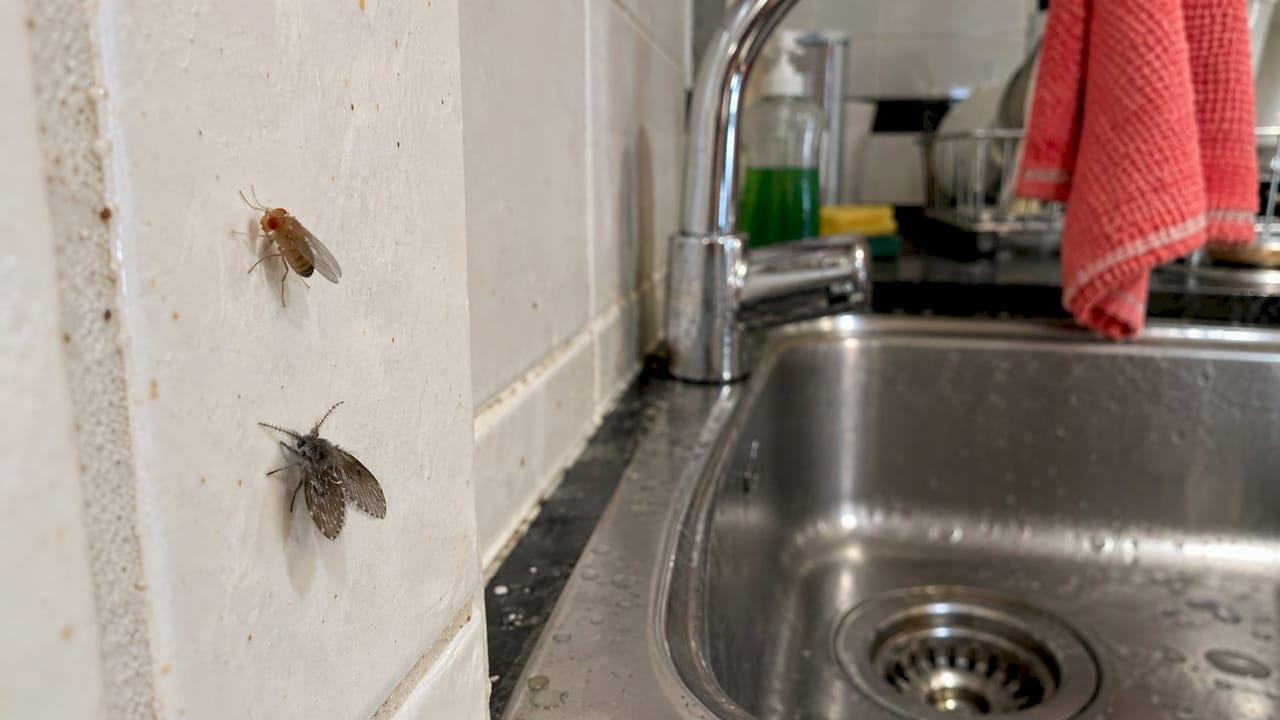
Fruit flies are tan, red-eyed and hover around ripe produce and bins. Drain flies are dark, fuzzy and moth-like, and they rest on walls near drains. That one difference in where they breed tells you what to fix: fruit flies come from fermenting food, drain flies come from the slime inside pipes. Below, we show how to identify each one, confirm it with a simple test, and remove the source so they do not return.
TL;DR
- Fruit flies are about 4 mm or smaller, with red eyes and tan or yellowish bodies. They gather around overripe fruit, vegetables and waste containers.
- Drain flies are small, dark and covered in fine hair, with moth-like wings held roof-like over the body. They rest on bathroom and kitchen surfaces near drains.
- Both species multiply at their breeding site, so killing adults alone does not end the problem. Remove the fermenting food or the drain film.
- Bleach does not help. Scrub the pipe, then use a bacterial drain treatment.
- If flies return after a thorough clean, the source may be hidden, such as a leaking pipe or an overflow. That is the time to call a pest professional.
Table of Contents
- Fruit flies vs drain flies at a glance
- How to identify a fruit fly
- How to identify a drain fly
- The clear tape test for drain flies
- Why you are suddenly getting them
- Do they bite or make you ill?
- How to get rid of fruit flies
- How to get rid of drain flies
- Can you pour bleach down the drain?
- Why killing the flies you see is not enough
- Our perspective: identify first, then treat the source
- When to call a professional
- Fly control from Bespoke Enviro
- FAQ
- Sources
Fruit flies vs drain flies at a glance
Use this table first. Most households can name the fly in under a minute.
| Feature | Fruit fly | Drain fly |
|---|---|---|
| Size | About 4 mm or less | About 3 mm (1/8 inch) |
| Colour | Tan, amber or yellowish body, red eyes | Dark, often grey or brown |
| Wings | Clear, streamlined body | Fuzzy, moth-like, held roof-like |
| Flight | Active, hovers around food | Weak, short hops when disturbed |
| Where you see them | Fruit bowl, kitchen bin, recycling | Bathroom and kitchen walls near drains |
| Breeds in | Fermenting fruit and vegetables, sometimes drain film | Slime inside drains, sewage, wet organic matter |
| What it points to | Food left out, overripe produce, dirty bins | Dirty or slow drains, a possible leak |
The sizes and body descriptions come from university extension sources: fruit flies measure 4 mm or less and have red eyes with amber, tan or yellowish bodies, while drain flies are about 1/8 inch long, often dark, with fine-haired, moth-like wings held roof-like over their backs.
How to identify a fruit fly
Look at the colour first. A fruit fly looks pale next to a drain fly. The body is tan to yellowish, and the eyes are red, though you may need to look closely or use your phone camera zoom to see them.
Then look at the movement. Fruit flies fly freely and hover around the thing they want. If you wave a hand over a bowl of mangoes or bananas and a small cloud lifts and settles again, you are looking at fruit flies.
Check the places they favor:
- Fruit bowls, especially fruit that is soft or bruised
- Kitchen bins and food waste containers
- Recycling with sugary residue, such as drink cans and bottles
- Sink areas with food residue
Fruit fly larvae feed in fermenting fruits and vegetables. So the flies are telling you that something in the kitchen is rotting, fermenting or sitting too long.
How to identify a drain fly
A drain fly does not look like a fly at all at first glance. The wings are covered in fine hair, so it looks like a tiny moth. Many people call them moth flies or sewer gnats for that reason.
Their behavior also gives them away. Drain flies are weak flyers. They sit on a wall or the side of a basin near the drain, then make short hopping flights when disturbed. If you see a small dark insect that barely flies and keeps landing on the tiles beside the shower, it is almost certainly a drain fly. The extension guidance notes that they rest on surfaces near their larval habitats and make short hopping flights.
The usual places to find them:
- Bathroom walls and ceilings near the floor trap or shower drain
- Kitchen sink areas and floor drains
- Utility rooms and service yards with floor traps
- Any room with a rarely used drain
The larvae live in moist organic matter, often the slime coating drains, and also in wet manure, sewage or compost. That is why drain flies point to the plumbing, not the fruit bowl.
The clear tape test for drain flies
If you are still unsure, test the drain. Signs of drain fly activity include adult flies on surfaces near drains and slow or bubbling drains. Alabama Extension suggests you can confirm the source by placing clear tape over drain openings to capture emerging adults.
- Dry the area around the drain.
- Place a strip of clear tape over the opening, sticky side down, leaving a small gap at the edges for air.
- Leave it overnight.
- Check the tape in the morning. Small fuzzy flies stuck to it confirm that drain is a breeding site.
- Repeat on each drain in the unit. The infested one is rarely the only suspect.
For a plumbing-side view of the same checks, this guide on bathroom drain fly checks covers what to inspect before calling a plumber.
Why you are suddenly getting them
People often say the flies appeared overnight. They did not. Both species develop out of sight and then emerge in a wave.
Drain flies. The University of Maryland Extension notes that they may breed in sewer leaks or back-ups, dirty garbage cans and drains, and that development from egg to adult can take 7 to 28 days. So the larvae have been growing for weeks before you see adults. A drain you rarely use, such as one in a spare bathroom, is a common source.
If you have cleaned every visible drain and flies keep returning, look further. Alabama Extension entomologists explain that infestations can stem from hidden sources like overflow pipes or leaking pipes behind walls, which means all potentially moist organic sites need inspection.
Fruit flies. A single forgotten piece of fruit, a bin that was not emptied, or a sugary spill under the fridge is enough. Fruit flies find fermenting material quickly, and the next generation emerges from it.

Do they bite or make you ill?
Neither species bites or stings. Drain flies, for example, do not bite or sting humans or other animals is not what NEA says, so we point to what NEA does say: flies in general are listed there as vectors of cholera, typhoid, paratyphoid, salmonellosis and dysentery. In Singapore, the National Environment Agency lists flies among disease-carrying pests, which is a good reason to treat any fly problem in a kitchen seriously, especially where food is prepared.
If you run a food business, flies near food are also an inspection matter. Our guide to pest control requirements for restaurants explains what to document.
How to get rid of fruit flies
The strategy is to take away what they breed in. University guidance states that small-fly control targets larval sites, starting with discarding overripe produce. A practical routine:
- Clear the source. Throw out overripe or bruised fruit and vegetables. Check the back of the pantry, the bottom of the fruit bowl and anything in a compost container.
- Clean the bin. Wash food waste containers and the area around them. Empty them daily while you have flies.
- Rinse recycling. Wash drink cans, bottles and jars before storing them.
- Clean the drains and food-residue areas. The Maine Department of Agriculture's guidance says fruit flies can be managed by removing overripe produce and regularly cleaning drains, food-residue areas and waste containers.
- Store produce well. Keep ripe fruit in the fridge or in sealed containers until you eat it.
Note step 4. Some fruit flies, the dark-eyed kind, may also feed on biofilms in floor drains. So if you removed all the fruit and flies remain, check the drains as well.
How to get rid of drain flies
Drain flies need the drain itself to be cleaned, not just rinsed.
- Scrub the pipe. Physically remove the film. Extension guidance recommends brushes or augers to remove drainpipe biofilms. Use a stiff brush on the inside of the pipe and the underside of the drain cover, where the slime builds.
- Follow with a bacterial drain treatment. Iowa State University Extension notes that bacterial drain treatments can biodegrade organic matter. Apply it as the label directs, usually at night when the drain is not used.
- Run water through unused drains. Floor traps and spare-bathroom drains dry out and collect film. Flush them regularly.
- Clean the bins. Dirty garbage cans are a recognized breeding site.
- Repeat the tape test after a few days to see whether adults are still emerging.
If the film is deep inside the line, a camera can show what a brush cannot reach. This explanation of drain camera inspection shows why a recurring blockage or slow drain deserves a proper look.
Can you pour bleach down the drain?
It is a common reflex, and it does not work. Iowa State University Extension states that there is no benefit to treating drains with bleach or ammonia, and recommends cleaning the inside of drainpipes with a stiff brush. Bleach passes through quickly and leaves the film that feeds the larvae. It is also not safe to mix cleaning products in a drain, so keep to one method at a time.
Why killing the flies you see is not enough
Sprays and traps remove adults. They do not remove the thing producing the next batch. As the University of California puts it, larvae continue to develop and new adults emerge if the larval substrate is not removed, altered or treated.
The same source says UV fly lights can help provide specimens for identification and locate breeding sites, but should not be used as standalone control tools. Treat them as a clue, not the solution.

The Maine guidance adds that cultural, physical and mechanical options are the best strategies, and pesticides have limited value and are rarely required. This matches how we work: find the source first, then decide what treatment is needed, if any.
Our perspective: identify first, then treat the source
Most small-fly callouts begin with a wrong guess. A household assumes fruit flies, throws out the fruit, and the flies stay, because the real source is a floor trap or a pipe. Or they assume drain flies and pour chemicals down the sink while a forgotten bag of rotting produce sits in a cupboard.
That is why we start with identification. Our technicians are NEA-licensed, and we use thermal imaging in inspections to help locate moisture and hidden problem areas that are not visible to the eye. Where a leak or a hidden damp site is behind the flies, finding it matters more than any spray.
We build our work on integrated pest management. That means removing breeding sources, adjusting sanitation and structure, and using non-toxic, environmentally safe methods that prioritize the safety of people and pets. We are available 24/7, because a fly problem in a kitchen or food area should not wait.
If a thorough clean has not solved it, a professional inspection is the efficient next step. It identifies the fly, finds the source, and sets up a plan that fits your home or premises.
Bespoke-Enviro Services
When to call a professional
Try the home steps for a week or two. Call for help if:
- Flies return within days of cleaning every drain you can reach
- You find flies in several rooms, or near a wall, ceiling or floor where no drain exists
- A drain is slow or bubbling, which can point to a plumbing fault. A plumber should look at that first
- You run a restaurant, shop, office or property where flies near food, customers or tenants create a compliance or reputation risk
- You are not sure what the fly is. Small flies in homes can also include fungus gnats, which breed in damp potting soil, so a proper identification saves time
For flies in a business setting, our guides on fly control methods for homes and businesses and a one-hour restaurant fly checklist set out the steps in more detail.
Fly control from Bespoke Enviro
We handle fly problems in homes, commercial kitchens, industrial sites and construction environments across Singapore. Our approach combines inspection, source removal and non-toxic, eco-friendly treatment under an IPM plan, with ongoing maintenance available where the risk is recurring.
If you want the flies identified and the source found, see our general pest control services in Singapore and request an inspection.

We also treat the pests that often turn up alongside a moisture or sanitation problem. See our pages on rodent control and fumigation. Pricing depends on the premises and the scope of work, so we quote after an inspection.
FAQ
Are fruit flies and drain flies the same thing?
No. They are different families of insects. Fruit flies are tan with red eyes and breed in fermenting food. Drain flies are dark and fuzzy, look like tiny moths, and breed in the slime inside drains. The fix for one will not solve the other.
Why am I suddenly getting drain flies?
The larvae have usually been developing for some time. Egg to adult can take 7 to 28 days, so a wave of adults reflects weeks of growth in a drain, bin or leak. Check every drain, including unused ones, and consider a hidden leak if visible drains are clean.
What instantly kills drain flies?
Nothing removes the problem instantly. A trap or spray can reduce the adults you see, but larvae keep developing in the drain film, and new adults emerge. Scrub the pipe, follow with a bacterial drain treatment, and repeat until the tape test stays clear.
Can I pour bleach down my drains to get rid of fruit flies?
Bleach is not recommended. Extension guidance states there is no benefit in treating drains with bleach or ammonia. Use a stiff brush on the inside of the pipe instead, then a bacterial drain treatment.
Do I need a pest controller for a few small flies?
Usually not at first. Remove overripe food, clean bins and scrub drains. If the flies persist, or you cannot find the source, an inspection is faster than repeating treatments that miss the breeding site.
Sources
- The Big League Approach to Controlling Small Flies, UC ANR
- Pest Notes: Moth Flies, UC IPM
- Drain Flies in the Home: Identification and Management, Alabama Extension
- Drain Flies, University of Maryland Extension
- Pest Control Overview, National Environment Agency Singapore
- Structural and Public Health Pests: Flies, Maine Department of Agriculture
- Fruit, Vinegar, and Pomace Flies, Iowa State University Extension
- Bathroom Drain Flies: 4 Checks Before Calling a Plumber
- Drain Camera Inspection