
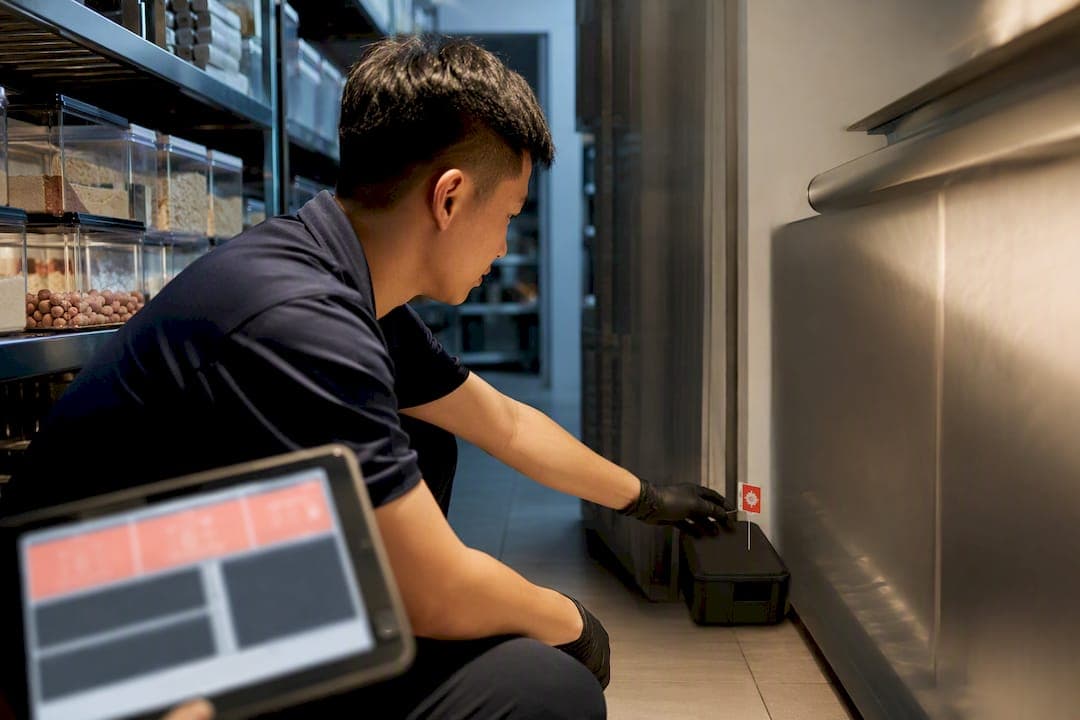
SFA expects licensed food premises to hold a signed pest-control contract covering rodents, cockroaches, and flies, typically for at least 12 months, with monthly inspections and on-site records. Before any inspector arrives, verify that contract, pull the most recent monthly report, and confirm your monitoring traps and sighting logs are current. These three checks cover most of what determines whether an audit goes smoothly or triggers follow-up action.
TL;DR:
- A pest control contract must cover rodents, cockroaches, and flies for at least 12 months with monthly inspections; weekly visits are advisable near infested or high-risk sites.
- Inspectors require documented proof, including signed contracts, recent reports, chemical MSDS, invoices, and staff-maintained sighting logs, not just verbal assurances.
- Preventive measures such as sealing gaps, covering refuse bins, and maintaining drains are prioritized; photographic evidence of monitoring traps strengthens compliance.
- Records should include thorough inspection reports, chemical documentation, and trend data showing pest activity over at least two contract cycles to demonstrate ongoing prevention.
- PCOs must provide detailed, traceable reports with baseline findings, targeted treatments, actual trap counts, and compliance with IPM principles to meet regulatory standards.
Table of Contents
- What SFA Pest Control Requirements Actually Cover
- Preventive Steps That Inspectors Actually Check
- How to Choose a Pest Control Operator and Verify Their Work
- Recordkeeping That Holds Up Under Audit
- Integrated Pest Management: Prevention Before Chemicals
- What Happens If SFA Finds a Pest Problem
- What Compliant PCO Reports Actually Look Like
- Where the Conventional Advice on This Falls Short
- Get Your SFA Audit-Readiness Pack
- Sources
- FAQ
What SFA Pest Control Requirements Actually Cover
SFA's self-checklist for food shop operators sets the baseline most inspectors work from. A signed pest-control contract must cover rodents, cockroaches, and flies for at least 12 months, with inspection or treatment frequency of at least once a month. If your premises has had a recent infestation, sits near a construction site, or handles high-risk food categories, weekly visits are worth negotiating even though monthly is the stated floor.
When an officer walks in, you need more than a verbal assurance that a pest control operator (PCO) visits regularly. Have these on hand:
- The signed contract itself, showing scope, duration, and pest species covered
- Inspection and treatment reports from the last several visits, not just the most recent one
- Material Safety Data Sheets (MSDS) for every chemical used on-site
- Invoices matching the contract's stated visit frequency
- A pest sighting log kept by your own staff, separate from the PCO's paperwork
SFA publishes the source documents directly, including its Guidelines for Licensed Food Retail Premises, which is worth bookmarking rather than relying on secondhand summaries.
Preventive Steps That Inspectors Actually Check
Pest control regulations from SFA treat prevention as the first line of defense, not an afterthought to chemical treatment. The guidelines point directly to covered refuse bins, disciplined waste removal schedules, and clean drains as the difference between a premises that stays pest-free and one that calls its PCO every other week.
Work through these in order of what inspectors tend to flag first:
- Cover every refuse bin and remove waste on a fixed schedule rather than "when it's full."
- Clear grease traps and drains weekly; grease buildup is one of the most common cockroach food sources.
- Seal structural gaps around pipes, baseboards, and wall penetrations where rodents squeeze through.
- Maintain clearance behind and under appliances, since refrigerators and stoves are among the most common harborage points for both cockroaches and rodents.
- Keep kitchen exhaust hoods and ducts clean, since grease residue in ventilation systems attracts pests and complicates fire safety too.
- Place monitoring devices like sticky traps and bait stations at wall lines and appliance corners, and log counts every time they're checked.
Pro Tip: Photograph your monitoring traps in place during every self-inspection. A dated photo showing zero activity is far more persuasive to an SFA officer than a verbal claim, and it costs you nothing but ten seconds.
How to Choose a Pest Control Operator and Verify Their Work
Not every PCO delivers what SFA expects, and a cheap contract that skips documentation will cost you more at audit time than it saves upfront. Before signing anything, confirm the operator's business registration, ask how their technicians are trained, and check that they carry proper insurance.
The contract itself should spell out:
- A term of at least 12 months, not a rolling month-to-month arrangement
- Explicit coverage of rodents, cockroaches, and flies (and any other pests relevant to your premises)
- Monthly inspection frequency at minimum, with a clear escalation clause for active infestations
- An emergency response provision for urgent callouts outside the regular schedule
A compliant service report goes beyond "treatment completed." It should show a baseline inspection finding, the specific locations treated, the chemicals used with matching MSDS references, and monitoring trap counts over time. If a PCO hands you a one-line invoice with no monitoring data, or relies exclusively on blanket spraying instead of targeted treatment, that's a red flag worth acting on before your next audit, not after.
Recordkeeping That Holds Up Under Audit
SFA pest management standards lean heavily on paper trails. Auditors want to see that your monitoring system produces consistent data over time, not just a folder of paid invoices.
Your pest sighting log should capture five fields every time: date and time, location, a photo if possible, the action taken, and who reported it. Anyone on staff, not just the manager, should know how to fill it in.
- Store inspection and treatment reports chronologically in a single physical or digital folder, not scattered across email threads.
- Keep MSDS sheets filed by chemical name, cross-referenced to the treatment reports that used them.
- Retain records for at least the length of your pest-control contract, plus one prior cycle, so an auditor can see a trend rather than a snapshot.
- Run a pre-inspection self-audit using the same categories an outside audit checklist would use: PCO credentials, documentation completeness, structural condition, and staff training records.
A fumigation certificate from any deep-clean or emergency treatment belongs in the same file, since inspectors increasingly ask for proof that follow-up remediation actually happened.
Integrated Pest Management: Prevention Before Chemicals
Integrated pest management (IPM) is the framework SFA's own guidance builds around, and it works in a fixed sequence: identify the pest, monitor its activity, prevent the conditions that support it, treat with the least-toxic option available, then verify the treatment worked.
- Dry standing water and fix leaks before reaching for a spray.
- Favor gel baits and targeted trapping over foggers, which SFA's own guidance discourages in most food-premises situations, since least-toxic, targeted treatments outperform blanket spraying for both effectiveness and safety around food.
- Use your monitoring trap counts to decide when to increase treatment frequency, rather than guessing.
Prevention-first IPM costs less over a year than repeated emergency callouts, and it's exactly the documentation trail SFA wants to see.
What Happens If SFA Finds a Pest Problem
Enforcement outcomes range from a written advisory to fines or licence suspension, depending on severity and history. Singapore has seen real consequences play out publicly: a bakery was fined after SFA found dead mice in its central kitchen, a reminder that findings don't stay quiet.
If SFA flags an issue, act immediately:
- Isolate and discard any potentially contaminated food.
- Call your PCO for an emergency visit the same day.
- Deep-clean the affected area and document every step with photos and timestamps.
- Reply to SFA with your corrective-action plan and updated monitoring data attached, not a verbal promise.
What Compliant PCO Reports Actually Look Like
Over more than 30 years managing pest issues across Singapore's food and beverage sector, we've seen the gap between a PCO that ticks boxes and one that builds a real IPM program. A compliant deliverable isn't a signature on a clipboard. It's a baseline inspection report, monthly written summaries with actual trap counts, a full MSDS list for every chemical used, and a corrective-action plan when numbers trend upward instead of down.
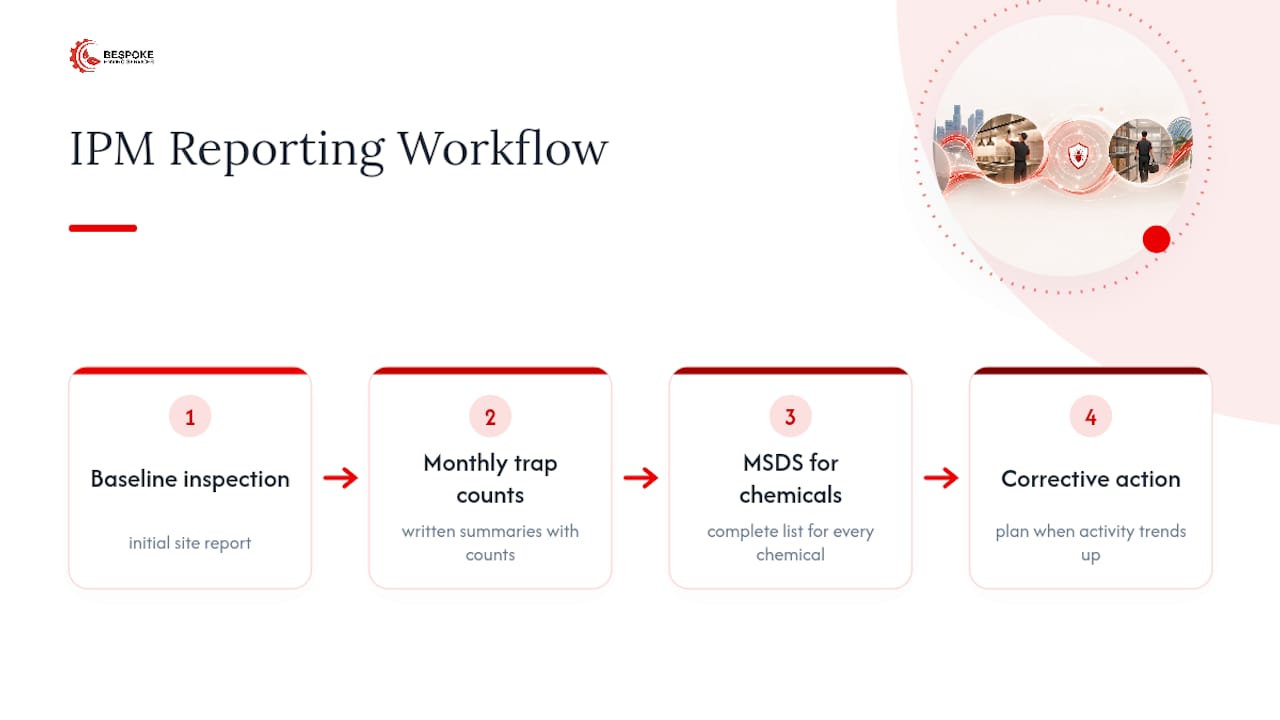
That's the standard we hold our own general pest control work to, and it's the same standard we'd tell any operator to demand from whoever they hire. Ask to see a sample monthly report before signing anything. If a provider can't produce one, that tells you what their actual process looks like.
Where the Conventional Advice on This Falls Short
Most guidance treats SFA compliance as a paperwork exercise: get a contract, file the invoices, done. That misses the point. The self-checklist's monthly minimum is a floor, not a target, and treating it as sufficient is how operators end up scrambling when an inspector asks for trend data they never collected.
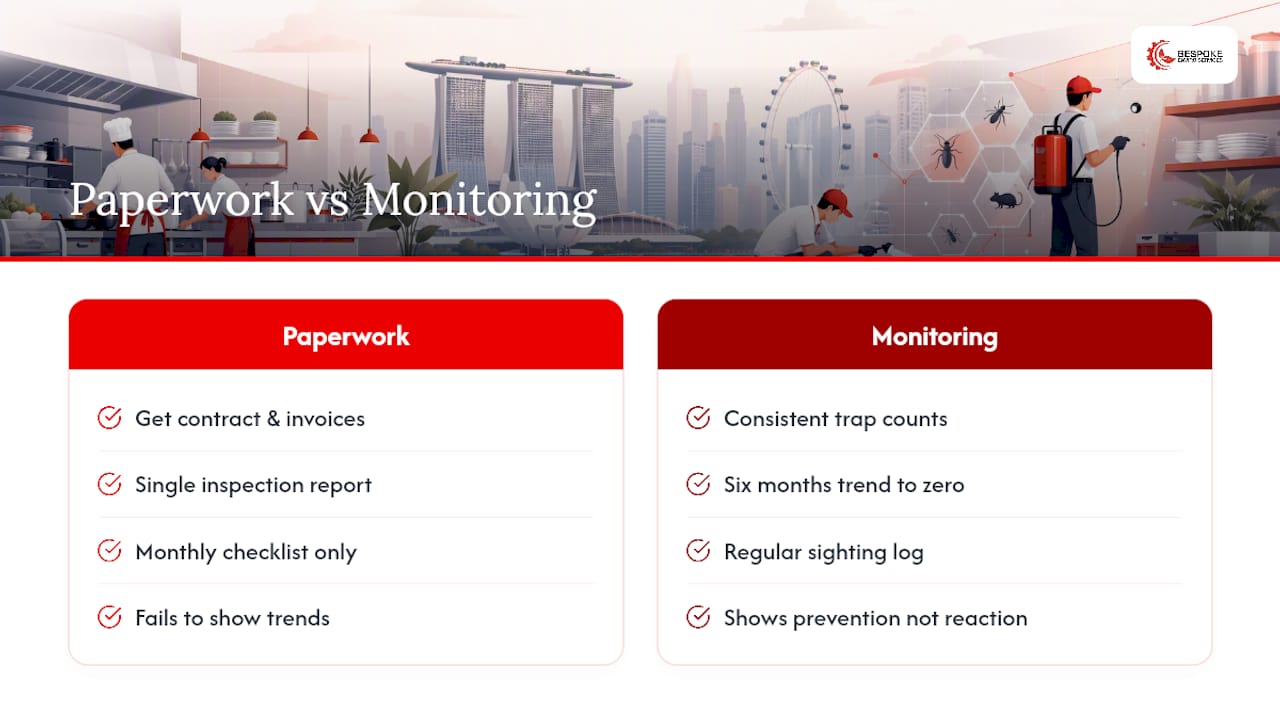
What actually protects a premises is monitoring data collected consistently enough to show a pattern. A single clean inspection report means nothing next to six months of trap counts trending toward zero. That's the difference between a business that reacts to pest problems and one that can prove, on paper, that it prevents them.
Operators should prioritize the sighting log over almost everything else. It's the cheapest record to keep, and it's the first thing that reveals whether your prevention measures are working or your PCO is just showing up and leaving. Contracts and MSDS sheets prove you hired someone. Consistent logs prove the hire is actually working.
— Bespoke-Enviro Services
Get Your SFA Audit-Readiness Pack
Some pest control services offer F&B operators a documentation trail built for SFA audits from day one, not assembled after an inspector asks for it. Our general pest control plans run on 12-month terms covering rodents, cockroaches, and flies, with monthly written reports, full MSDS records, and monitoring data you can hand an inspector without digging through email.
If your kitchen needs a deeper reset after an infestation or a lapsed contract, our fumigation service handles the emergency response and documents it properly for your file. Facilities teams managing grease traps and drains alongside pest prevention can also coordinate with services like Budget Rodz's commercial drainage program, since drain condition drives a large share of cockroach activity in commercial kitchens. Contact a pest control provider today to request an SFA audit-readiness pack tailored to your premises.
Sources
FAQ
What are the three rules for pest control?
SFA's approach centers on prevention, monitoring, and least-toxic treatment: eliminate conditions that support pests first, track activity with monitoring devices, then treat with targeted methods like gel baits before resorting to broader intervention.
How much does pest control cost in Singapore?
Costs vary widely by premises size, pest pressure, and contract scope, and no single figure applies across the industry. Request quotes tied to a 12-month contract with monthly inspections so you're comparing equivalent service levels.
What are the different types of SFA licenses available?
SFA issues licenses based on food business type, such as food shops, food stalls, and food manufacturing establishments, each with its own conditions. Pest control requirements apply broadly across licensed food retail premises regardless of the specific license category.
Is HACCP mandatory in Singapore?
HACCP certification is not universally mandatory for all food businesses in Singapore, though it is required for certain categories and strongly encouraged as a food safety framework. Pest control recordkeeping supports HACCP principles even where certification itself isn't required.
What should I do if I find pests despite a signed pest control contract?
Log the sighting immediately with date, location, and photo, then contact your PCO for an emergency visit rather than waiting for the next scheduled inspection. Document every corrective step taken, since that record protects you if SFA follows up.