

If your cargo shipped from a target-risk country during the regulated season and falls under a listed high-risk commodity group, it needs a regulator-approved treatment and a matching certificate before it ever reaches port. Skip that step and you're looking at an inspection hold, a costly onshore re-treatment, or in the worst case, re-export or destruction. BMSB compliance hinges on three things: origin, timing, and treatment documentation, and all three need to line up before the vessel sails.
TL;DR:
- The shipped-on date must match the vessel's load date on the bill of lading, as discrepancies are the most common cause of inspection delays.
- Offboard treatment before departure, especially using approved fumigants or heat, is preferred to avoid costly onshore re-treatment or delays.
- Regulatory lists of high-risk commodities and origin countries are updated annually, requiring ongoing verification before shipping.
- Container type and stowage location influence inspection risk and treatment requirements, with loose or open-stowed cargo facing higher exposure.
- Proper documentation, including treatment certificates referencing the correct vessel and bill of lading, is crucial for smooth clearance and avoiding re-export or destruction.
Table of Contents
- Which Goods and Origins Fall Under BMSB Seasonal Measures
- When Do BMSB Rules Actually Apply? The Season Window Explained
- Approved BMSB Treatments and When to Use Offshore vs. Onshore
- How Container Type Changes Your BMSB Compliance Requirements
- Preparing Your Shipment: A Step-by-Step Compliance Checklist
- What Happens at Arrival: Inspections, Holds, and Delays
- A Practitioner's Pre-Shipment Checklist for BMSB Risk
- How Professional Pest Control Supports Trade Compliance
- How Bespoke-Enviro Supports Your BMSB Compliance Needs
- Where to Verify Current BMSB Rules Before You Ship
- Sources
Which Goods and Origins Fall Under BMSB Seasonal Measures
The Brown Marmorated Stink Bug (BMSB) doesn't discriminate by industry. It hitchhikes in whatever offers a dark, tight space to overwinter, which is why seasonal measures target specific commodity groups rather than entire trade lanes. Regulators publish detailed lists, and getting familiar with them before you book cargo saves weeks of downstream headaches.
Commodities flagged most consistently across biosecurity notices include:
- Vehicles, machinery, and parts, especially those with cavities or crates
- Timber and wooden packaging material
- Outdoor furniture and other goods stored in the open
- Plant material, nursery stock, and certain horticultural produce
- Tiles, steel, and other goods that transit through high-risk regions in open storage
A DAWE factsheet on goods subject to BMSB measures breaks these categories down by tariff line, and it's worth cross-checking your HS codes against that list every season rather than assuming last year's classification still applies. Target-risk countries shift too. Agencies review pest reports and seasonal data annually, then republish which origin countries trigger the measures. A country that was clear last season can get added mid-cycle if detections spike. Before you commit to a shipping schedule, check the current regulator notice for your commodity and origin pairing. It's a five-minute task that prevents a five-week delay.
When Do BMSB Rules Actually Apply? The Season Window Explained
Timing is where most disputes happen, and it usually comes down to one document field: the shipped-on date. Regulators define this as the date recorded on the ocean bill of lading when goods are actually loaded onto the vessel. Gate-in dates, booking dates, or container stuffing dates don't count, no matter how close they sit to the cutoff.
Seasonal windows follow a published format. Australia's seasonal measures for BMSB run from September 1 through April 30, reflecting the Northern Hemisphere autumn and winter when BMSB seek shelter in cold-adjacent goods. That exact window can shift slightly year to year, so treat any date range you find in an older guide as a starting point, not gospel.
A few timing complications deserve extra attention:
- Transhipment through an intermediate port can complicate which "shipped on" date actually governs the consignment.
- Vessel berth and load dates sometimes diverge from the paperwork carriers issue, creating mismatches inspectors flag immediately.
- Treatment certificates must reference dates and vessel details that reconcile with the bill of lading, not just the treatment provider's internal schedule.
Getting the shipped-on date wrong, or letting your treatment certificate cite a different vessel reference than your BL, is the single most common paperwork failure at arrival.
Approved BMSB Treatments and When to Use Offshore vs. Onshore
Regulators accept a limited menu of treatments, and which one applies depends heavily on the commodity, its sensitivity to heat or chemical residue, and whether you're treating before departure or after arrival.
- Methyl bromide fumigation. Widely accepted offshore and onshore, effective against BMSB at all life stages, but restricted for certain commodities due to residue and ozone-related regulatory limits.
- Sulfuryl fluoride. A common alternative fumigant, often used where methyl bromide isn't suitable, though it requires longer exposure times to achieve equivalent efficacy.
- Heat treatment. Effective and residue-free, but not viable for heat-sensitive goods like certain electronics, plastics, or perishable timber products.
- Ethyl formate. Used in specific commodity contexts, generally faster-acting but with narrower approval scope depending on the destination regulator.
Offshore treatment, done at origin before loading, is usually the preferred route because it avoids arrival delays entirely. Onshore treatment happens after arrival, typically triggered by a failed inspection or missing documentation, and it almost always costs more once you factor storage and demurrage.
Commodity limits matter more than shippers often expect. A methyl bromide fumigation that works cleanly on machinery parts might cause phytotoxic damage on certain plant material, which is why the biology and management research on BMSB consistently stresses commodity-matched treatment selection rather than a one-size-fits-all fumigant.
Treatment providers themselves need regulator approval. New Zealand's MPI, for example, requires offshore treatments to be performed by approved facilities, and the resulting certificate needs to reference the specific consignment, not just a generic treatment batch. Inspectors expect to see the treatment method, the provider's approval number, the exact date and time of treatment, and the bill of lading or vessel reference tied to that shipment.
Pro Tip: Where the commodity allows it, ask your treatment provider about heat treatment or ethyl formate instead of defaulting to methyl bromide. Both leave less chemical residue, which matters increasingly to import markets tightening their own environmental standards, and documentation for non-chemical treatments tends to draw fewer follow-up questions at inspection.
How Container Type Changes Your BMSB Compliance Requirements
Whether your cargo moves as a full container, a shared load, loose break-bulk, or by air changes how treatment and inspection risk actually plays out.
- FCL (Full Container Load) and FCX shipments are treated as a single unit, meaning one certificate covering the whole container generally satisfies the requirement, assuming the goods inside are uniformly compliant.
- LCL (Less than Container Load) and FAK consignments mix cargo from multiple shippers, so a single non-compliant item can put the entire container at risk of inspection or hold, even when your specific goods are properly treated.
- Break-bulk cargo stowed loose on deck or in open holds carries higher inspection risk simply because BMSB can access more surface area and gaps during transit, and stowage location becomes part of the risk assessment.
- Airfreight typically moves faster than ocean cargo, which sometimes means tighter windows for arranging treatment beforehand, but the same seasonal and documentation rules generally still apply.
Container hygiene matters regardless of mode. Empty containers used for previous shipments through target-risk regions can carry hitchhiking BMSB in structural voids, door tracks, and corner castings, since the insects hide well and can be inactive during visual checks, as UC IPM's research on BMSB hitchhiking behavior documents. A pre-load sweep and interior inspection, even a basic one, catches problems a certificate alone won't.
Preparing Your Shipment: A Step-by-Step Compliance Checklist
Getting from "cargo ready" to "cleared for departure" without a last-minute scramble comes down to sequencing.
- Classify your goods against the current HS/tariff lines the regulator lists as high-risk.
- Check the active seasonal window for your destination country and confirm your shipped-on date falls inside or outside it.
- Contract an approved treatment provider, confirming their approval status directly with the regulator's published list rather than taking a provider's word for it.
- Schedule treatment to align with your sailing date, building in buffer time in case a re-treatment becomes necessary.
- Obtain the certificate and verify every field, matching provider approval number, treatment date and time, commodity description, and bill of lading or vessel reference against your shipping documents.
Certificates that inspectors accept without follow-up questions share a pattern: they name the treatment method plainly, cite a provider approval number that's checkable against a public list, and reference the exact vessel and BL your carrier is using. Coordinate with your forwarder early. Carrier advisories, like Hapag-Lloyd's seasonal BMSB measures notice, often echo the regulator's rules in booking-specific terms, which helps catch mismatches before the container is even loaded.
Pro Tip: Photograph your treatment certificate, the container number, and the seal at the point of treatment, then store all three centrally with your shipping file. If a certificate's details get questioned at arrival, that photographic chain of custody, tied to MPI's certificate-matching requirements, resolves disputes far faster than a phone call to the treatment provider.
What Happens at Arrival: Inspections, Holds, and Delays
Arrival outcomes fall into a fairly predictable range, and knowing which triggers which helps you budget for the worst case without panicking over the routine one.
Most consignments start with a document check, a review of your treatment certificate against manifest data. Clean paperwork usually clears in hours. Documents that don't reconcile, a certificate referencing the wrong vessel, or a treatment date that falls outside a plausible window, trigger a physical inspection, which can take one to several days depending on port workload.
From there, outcomes generally split four ways:
- Release, when documentation and physical checks both pass.
- Targeted inspection, when risk profiling flags the origin, commodity, or carrier for extra scrutiny even with clean paperwork.
- Onshore fumigation, when live BMSB or documentation gaps are found but the goods can still be treated locally.
- Re-export or destruction, reserved for repeated non-compliance or goods that can't be safely treated onshore.
Cost drivers stack quickly once a hold happens: demurrage on the container, the treatment fee itself, storage charges at the port or a bonded facility, and potential administrative fines for non-compliant documentation. The Australian government's seasonal measures guidance treats the shipped-on date mismatch as one of the most frequent causes of arrival disputes, which tracks with how often certificate details simply don't match the carrier's own records.
The mitigation playbook is straightforward: pursue pre-clearance where your regulator offers it, keep treatment certificates inside the carrier's own documentation set rather than a separate email chain, and if your commodity or origin runs high risk this season, book an onshore treatment slot as a contingency before you need it, not after.
A Practitioner's Pre-Shipment Checklist for BMSB Risk
Beyond the regulatory paperwork, a few practical habits cut hitchhiker risk before goods ever reach the port:
- Choose packaging materials that limit voids and crevices where BMSB can shelter.
- Inspect containers and machinery cavities visually before loading, even when treatment is already scheduled.
- Apply simple exclusion measures at the origin site, like sealing storage areas during peak BMSB activity.
- Favor heat treatment or ethyl formate over broad-spectrum fumigants where the commodity allows it, since overreliance on broad-spectrum pesticides is increasingly viewed as unsustainable for long-term pest management.
Pro Tip: Weekly monitoring with pheromone-baited traps at origin facilities catches BMSB activity long before visible damage appears, since UMass Extension's monitoring guidance notes that damage symptoms lag actual feeding by a wide margin. Our integrated pest management approach applies the same early-detection logic to pre-shipment site checks.
How Professional Pest Control Supports Trade Compliance
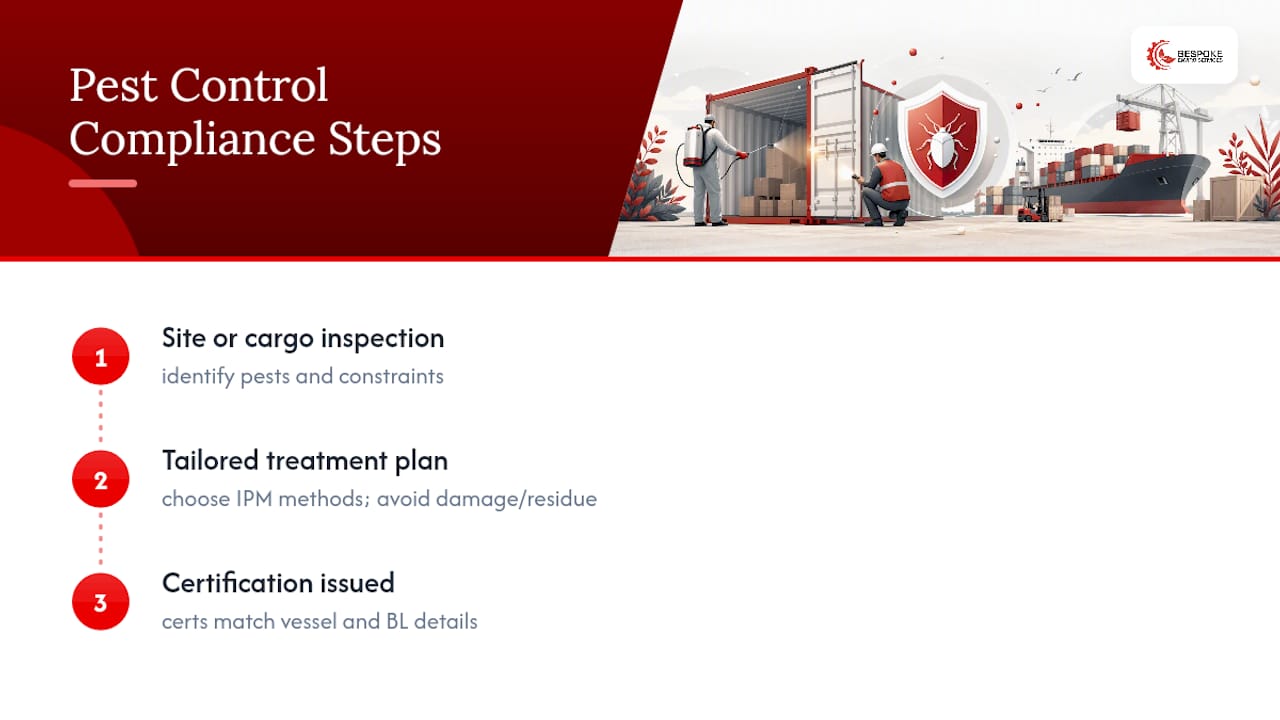
We treat BMSB compliance as an execution problem, not just a paperwork one, and effective business management tools like Pest controller invoicing software play a key role in streamlining treatment and documentation workflows. That means running the treatment itself, issuing certificates that match your vessel and BL details exactly, and advising on which method fits your commodity without causing residue or heat-damage issues down the line. Our IPM-first approach, refined over three decades in the field, favors targeted, sustainable treatments over blanket chemical application wherever the commodity allows it. Exporters typically start with a site or cargo inspection, move into a tailored treatment plan, then receive certification built to survive scrutiny at arrival.
How Bespoke-Enviro Supports Your BMSB Compliance Needs
Getting a treatment certificate that actually holds up at inspection means working with a provider who understands both the fumigation science and the paperwork inspectors are trained to scrutinize. That's the gap Bespoke-enviro closes for exporters and logistics teams handling BMSB-affected cargo out of Singapore.
Our services span certified fumigation using eco-friendly, non-toxic treatment options where commodity conditions allow, alongside broader general pest control for site-level inspections and IPM consulting. Engagement follows a simple sequence: inspection of your cargo or facility, building a treatment plan matched to the specific commodity and its sensitivities, then issuing certification with the vessel and bill-of-lading references inspectors typically check first. If you're coordinating machinery, timber packaging, or containerized goods within this season's BMSB window, consider requesting a treatment quote and scheduling a treatment slot before your sailing date.
— Bespoke-Enviro Services
Where to Verify Current BMSB Rules Before You Ship
Season dates and approved provider lists change, so confirm details directly on regulator pages: the Australian government's BMSB seasonal measures, MPI's import requirements, and your carrier's own seasonal advisory. Check again right before booking treatment and once more before the vessel sails.
Sources
- The biology, ecology, and management of BMSB (PMC)
- BMSB requirements for importing vehicles, machinery and parts — MPI
- BMSB monitoring and management — UMass Extension
- Brown marmorated stink bug in North Carolina — NC State Extension