
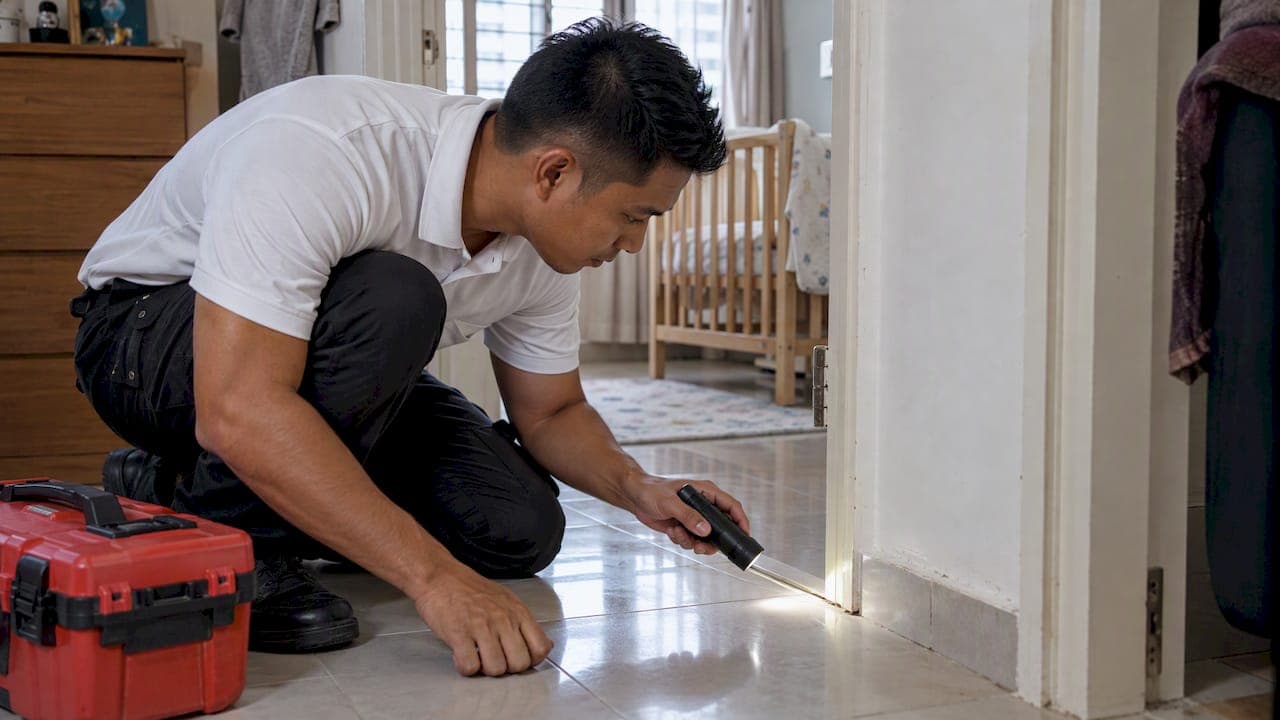
Pest control with a newborn at home can be done safely, but not casually. The method, the product and the timing matter more than the label "non-toxic". Ask for an inspection-led, integrated pest management (IPM) approach, use a licensed operator, keep the baby out of the home during any spraying or misting, and bring the baby back only after the surfaces are dry and the rooms are aired. This guide explains how, step by step.
TL;DR
- No pesticide treatment is automatically safe for a newborn. Infants are more susceptible than adults, so the aim is the least exposure that still solves the problem.
- In Singapore, only NEA-registered Vector Control Operators may carry out vector-control work, so hire a licensed company, not an unlicensed individual.
- Ordinary treatments usually do not require you to leave. Gassing, misting and fumigation do, and fumigation re-entry needs written clearance.
- Before treatment, store food and bottles and move the baby's things. Afterwards, wash toys and appliances, ventilate and keep baits out of reach.
- IPM puts inspection, prevention and targeted treatment ahead of blanket spraying, which suits a home with a baby.
Table of Contents
- Why newborns need a different approach
- Is pest control safe for newborns?
- How long after pest control is it safe for the baby?
- Before treatment: how to prepare the home
- After treatment: bringing the baby back
- What is integrated pest management, and why does it suit a home with a baby?
- Prevent pests without relying on pesticides
- Pest-by-pest notes for parents
- Our perspective
- Questions to ask a pest control provider
- Safe pest control for your family
- FAQ
- Sources
Why newborns need a different approach
A newborn is not a small adult when it comes to pesticides. Health Canada explains that infants and children can receive a greater exposure than adults because they breathe more per minute, have more skin relative to body weight, spend time close to treated floors and surfaces, and put their hands and objects in their mouths. The same page states that all pesticides can pose some risk and that children may be more susceptible.
That does not mean you must live with cockroaches, rats or bed bugs. Pests carry their own risks, and a newborn sleeps, feeds and crawls in the same rooms the pests use. It means the goal changes: choose the method that removes the pest with the least contact between product and baby.
In Singapore, SPMA's buyer guidance makes a useful distinction. Common vectors such as rats, cockroaches, mosquitoes, flies and fleas should be dealt with quickly and safely. Non-vector pests can be left alone if their presence is tolerable. So the first question is whether you actually have a pest that needs chemical treatment at all.
Is pest control safe for newborns?
It can be, when three things line up: a licensed operator, a suitable method and sensible timing.
A licensed operator. NEA states that only companies registered as Vector Control Operators may undertake vector-control works in Singapore, and their staff must be licensed Vector Control Technicians or certified Vector Control Workers. NEA also advises the public to buy vector-control services, including cockroach treatment, from licensed operators. For a family with a newborn, this is the baseline, not a bonus.
Registered products. NEA requires public-health pesticides and repellents against mosquitoes, flies, cockroaches, rats and rat fleas to be registered before they are sold, supplied or advertised. NEA also separates "For General Use" products, which households may use directly, from "For Restricted Use" products, which only licensed technicians or certified workers may handle because of higher toxicity or concentration. That is a good reason not to improvise with products bought online while a baby is in the flat.
The right method. Gel baits placed in cracks, tamper-resistant bait stations and physical proofing put far less product in the air and on surfaces than a blanket spray. Misting and fogging sit at the other end. They are sometimes necessary, and then the baby should be elsewhere.

How long after pest control is it safe for the baby?
There is no single number, because it depends on the treatment. Use this as a working guide.
| Treatment type | Do you leave with the baby? | When to return |
|---|---|---|
| Targeted gel baiting or bait stations | Usually not required | Keep the baby out of the room while the technician works, and keep baits out of reach |
| Residual spray on skirting, cracks or outdoor areas | Safer to leave the room or home during application | After surfaces are fully dry and the area is ventilated |
| Misting or insecticidal gassing | Yes | After a few hours, once the operator confirms re-entry |
| Fumigation | Yes, for the period set by the fumigator | Only after written clearance from the licensed fumigator |
The general rule comes from two sources. NPIC at Oregon State University advises following the product label, and if the label gives no wait time, waiting until the pesticide is completely dry or longer, ventilating the home and avoiding contact with treated surfaces. SPMA says occupants generally do not need to leave during ordinary pest-control treatment, but should leave when insecticidal gassing or misting is used, and may re-enter after a few hours depending on the circumstances.
If you are cautious, choose the longer end. A newborn cannot tell you about a smell, and a few extra hours at a grandparent's home cost little. Ask the operator for the product name and its label re-entry instructions so you are not relying on a verbal estimate.
What changes with fumigation
Fumigation is a different category. SPMA defines it as the use of poisonous gas such as methyl bromide or phosphine, carried out by an NEA-licensed fumigator. Spraying, misting and thermal fogging are not fumigation. NEA's fumigation code of practice says the fumigation area and risk area must stay closed to everyone except fumigation personnel until a licensed fumigator declares them safe in writing. It requires gas monitoring before that declaration, with re-entry thresholds below 10% of the applicable long-term permissible-exposure level, and removal of residues and treatment of absorbent items before clearance.
For a home with a newborn, fumigation is rarely the first choice. If an operator proposes it, ask why a targeted method will not do, and do not return until you hold the written clearance.
Before treatment: how to prepare the home
Good preparation shortens the job and reduces what the baby can touch. A practical sequence:
- Confirm the method in advance. Ask what will be applied, where, and whether the baby needs to be out. Do this a few days ahead, not at the door.
- Arrange somewhere for the baby. A relative's home or a few hours out with a caregiver is easier than managing a sleeping newborn in a treated flat.
- Store food and feeding items. SPMA recommends storing food and kitchen utensils properly before treatment. Seal bottles, sterilizer parts, breast pump components and formula tins in closed cabinets or containers.
- Move baby items out of treatment zones. Cot, mattress, bouncer, playmat, toys and laundry go into another closed room or are covered, unless the technician says the area is not being treated.
- Tell the technician about the baby. Point out where the baby sleeps, feeds and is placed on the floor, so those spots are handled with care or left for non-chemical methods.
- Clear access. Move furniture away from walls where cockroaches or rodents travel, so the work is precise rather than broad.
After treatment: bringing the baby back
- Wait for dry surfaces. Health Canada advises keeping children out during application and until treated areas are dry, following the label for re-entry, and ventilating indoor areas before going back.
- Ventilate. Open windows and run fans for the period the operator recommends.
- Wash what the baby touches. SPMA recommends washing toys and kitchen appliances before using them after treatment. Add playmats, cot sheets and anything that sat on a treated floor.
- Avoid treated surfaces. Do not let the baby crawl on or mouth skirting boards, floors or ledges that were treated until the label or operator says it is fine.
- Keep baits locked or out of reach. Health Canada also advises baits in locked stations or out of reach. Check that bait stations are fixed and that none have been moved.
- Watch the baby. If you see unusual symptoms after a treatment, such as breathing difficulty, vomiting or a rash, contact your paediatrician or go to an emergency department, and take the product name with you.
What is integrated pest management, and why does it suit a home with a baby?
IPM is a way of controlling pests that treats chemicals as one tool among several. NEA's background page on Singapore Standard SS 721:2025, the country's first national framework for professional pest-management services, describes IPM principles as prevention, physical, biological and chemical controls as appropriate, risk-based assessment, reduced chemical dependency and monitoring. The standard applies these ideas to household pests including rats, cockroaches, mosquitoes, fleas, flies, bed bugs and termites.
The US National Pesticide Information Center recommends IPM to minimize infant and child exposure, because it combines methods to prevent and eliminate pests in the most effective and least hazardous manner.
In practice, an IPM visit in a home with a baby looks like this:
- Inspect first. Find where the pest lives, enters and feeds before anything is applied.
- Fix the cause. Seal gaps around pipes, trim door gaps, repair leaks and remove food sources.
- Choose the narrowest treatment. Baits and monitoring devices before sprays, with sprays only where needed.
- Monitor and adjust. Return to check results and change the plan, rather than repeating the same application.
For a deeper explanation, read our practical IPM guide. If you are weighing how often visits make sense, our article on pest control schedules in Singapore sets out how IPM visits are planned.
Prevent pests without relying on pesticides
The cheapest treatment for a newborn's home is the one you never need. NEA's November 2024 environmental sanitation guidelines recommend good refuse management and housekeeping, periodic surveys, prompt escalation when an infestation is found, pest-proofing of openings, and maintenance of sanitary systems and grease traps. Those are written for premises generally, but the logic applies to a flat or landed home:
- Take rubbish out daily and keep bins lidded, especially with nappies and feeding waste.
- Wipe up milk and formula spills at once, and do not leave bottles in the sink overnight.
- Store dry food, pet food and formula in sealed containers.
- Keep floor traps and drains covered or fitted with proper screens, and keep kitchen grease traps clean.
- Seal gaps around pipes and under sinks, and fit door sweeps.
- Keep cot sheets, baby clothes and soft toys washed regularly, which also makes bed bugs easier to spot.
The same NEA guidelines say premises with infestations should hire a registered vector-control operator for surveillance and treatment. Prevention reduces the problem. It does not replace a professional when you see droppings, gnaw marks, live bed bugs or a steady stream of cockroaches.
There is one cleanup hazard worth a separate note. Droppings are not only a pest signal but a contamination risk, and large deposits in a ceiling or roof void should not be swept up casually with a baby in the house. This guide on when to DIY bat guano cleanup shows how professionals judge the size of a deposit and when a job is too large to handle yourself.
Pest-by-pest notes for parents
Cockroaches
The most common call in a Singapore home. Ask for gel baits in hinges, cracks and behind appliances rather than a floor-wide spray. Keep the baby out of the kitchen during the visit, and wash feeding equipment afterwards. Our general pest control service starts with an inspection to decide the lightest effective method.
Rats and mice
Rodents carry disease risk and chew wiring, so waiting is not a good plan. Proofing entry points and using bait stations that are locked and tamper-resistant keeps product away from children. Place stations where the baby cannot reach, and check them each visit. See our rodent control service.
Bed bugs
Bed bugs are a particular worry for a baby's cot and parents' bed. Treatment often involves heat or targeted application, plus laundering and encasing mattresses. Do not use foggers or store-bought sprays on a mattress. If you are unsure whether bites come from bed bugs or fleas, our comparison of fleas versus bed bugs helps, and our bed bug control service covers inspection and treatment. For budgeting, read about bed bug treatment costs in Singapore.
Mosquitoes
In Singapore, mosquito control is mostly about removing standing water and screening windows. Nets over the cot and screens on windows protect the baby without any spray. If fogging is carried out near your home, NEA's licensing conditions say it should be done only when necessary, with personal protective equipment, manufacturer-specified mixing and advance electronic notification to NEA. Keep windows closed and the baby indoors during the activity.
Termites
Termites are a structural problem, not a direct health one, so there is usually time to plan. Ask for baiting or treatment methods that do not put product where the baby plays, and schedule the work before the due date if you know about an infestation. See our termite control service.
Our perspective
We have worked in Singapore pest control for over 30 years, and the families with newborns who call us usually ask the same thing: "Can you do this without risk?" We answer honestly. No treatment is risk-free, but exposure is something you can design down.
That is why we start with an inspection, including thermal imaging where it helps us find activity behind walls and ceilings without opening them up. We prefer non-toxic, eco-friendly treatments and IPM strategies that remove the cause of the infestation, so we apply less and return less. Our technicians are NEA-licensed, and we tell you the method, the placement and the re-entry advice before we begin, so you can plan around the baby.
When a household has a newborn, we also suggest scheduling the work for a time when the baby can be with family, and we keep bait placements out of reach of small hands. If a pest problem is not urgent, we will tell you so. If it is, we are available 24/7.
— Bespoke-Enviro Services
Questions to ask a pest control provider
Use these before you sign anything.
- Are you a registered Vector Control Operator, and are the technicians licensed?
- What exactly will you apply, where, and can I see the product name and label?
- Is a non-chemical or bait-based option available for the areas where my baby sleeps and plays?
- Will we need to leave, and for how long? Will you confirm re-entry in writing for any gassing, misting or fumigation?
- How will baits be secured, and who checks them?
- What will you do to fix the cause, such as proofing and sanitation advice, rather than only treating the symptoms?
- When will you return to check results?
A provider who answers these clearly, without hurry, is one you can trust with a nursery.
Safe pest control for your family
If you have a newborn and a pest problem, we can inspect your home, explain every step and choose the least intrusive effective method. Start with our general pest control services, or contact us to book an inspection. If you manage a condominium, our guide to MCST pest control responsibilities explains how common-area programs are planned.
FAQ
Is pest control safe for newborns?
It can be when the work is done by an NEA-licensed operator with a method suited to the home. Health Canada notes that all pesticides can pose some risk and that infants may be more susceptible, so keep the baby away during application and until surfaces are dry. Targeted baiting and proofing carry far less exposure than spraying or misting.
How long after pest control can I bring my baby home?
Follow the product label and the operator's instructions. Where there is no stated wait time, NPIC advises waiting until the pesticide is completely dry or longer and ventilating the home. After misting or gassing, plan on at least a few hours away, and after fumigation wait for written clearance.
Do we have to leave the house during pest control?
Not for ordinary treatments, according to SPMA, but you should leave during insecticidal gassing or misting. If you have a newborn, it is sensible to take the baby out for any spray application as well. Ask the technician in advance so you can plan.
Can I use a store-bought spray myself instead?
It is not a good idea around a newborn. NEA limits higher-toxicity products to licensed technicians, and household sprays are easy to over-apply on cots, floors and toys. A licensed provider can use baits and proofing that put less product into the room.
Is a non-toxic treatment completely safe?
Non-toxic describes a lower hazard, not zero risk. You should still keep the baby out during application, keep baits out of reach and follow the re-entry advice. Ask for the product details so you know what is being used.
Sources
- Keep your family safe when using pesticides, Health Canada
- What about using pesticides if I am pregnant or have a baby? NPIC
- Pesticides and Children, NPIC
- Buyers of Pest Control Services, SPMA
- Vector Control Operator, NEA
- Registration of public health pesticides and repellents, NEA
- Conditions of Licensing, NEA
- Code of Practice for Fumigation Personnel, NEA
- Singapore Standard SS 721:2025 background, NEA
- Environmental sanitation guidelines, NEA, November 2024
- When to DIY bat guano cleanup